The quietest hours of the morning deserve a brewing ritual that doesn’t rely on a wall outlet, a circuit breaker, or the hum of a heating element. A manual brew method — whether pour-over, French press, or stovetop moka — puts total control of water temperature, steep time, and grind contact back in your hands, stripping away the plastic interiors and electronic failure points that plague so many countertop machines.
I’m Mohammad Maruf — the founder and writer behind AirfryerBite. My research into non-electric brewing hardware focuses on material safety (BPA-free, PFOA-free, and 316 surgical-grade steel), filter efficiency, and thermal retention across the most popular manual formats.
Whether you are camping off-grid, conserving counter space, or simply chasing a cleaner cup, you need to know which manual brewer delivers real heat retention, durable construction, and proper filtration. This guide breaks down the best options to help you find the ideal non electric coffee maker for your kitchen routine or outdoor setup.
How To Choose The Best Non Electric Coffee Maker
The manual coffee world splits into three main architectures — French press, pour-over, and moka pot — and each changes the flavor profile, sediment level, and effort required. Before you buy, match the brewing style to your daily drinking habits and the physical space you cook in.
Brewing Method: Press, Drip, or Pressure
A French press uses steeping and a mesh plunger, producing a full-bodied cup with natural oils and fine sediment. Pour-over brewers rely on a paper or metal cone filter, delivering a clean, bright cup with zero grit. Moka pots use stovetop steam pressure to force water through grounds, creating a concentrated shot similar to espresso. Pick your method before comparing any other spec.
Material Safety and Heat Retention
Borosilicate glass resists thermal shock and won’t absorb odors, but it breaks on impact. 316 surgical-grade stainless steel is rust-proof, shatter-proof, and double-wall options hold coffee hot for hours without a burner. Aluminum moka pots are classic but can react with acidic coffee over time. Avoid plastic interior components entirely when shopping for a non-electric brewer meant for long-term daily use.
Filter Efficiency and Crew Size
Multi-layer mesh filters (three to four layers) trap fines better than single-screen designs, reducing sludge especially in French presses. Pour-over brewers that accept standard paper filters offer the cleanest mouthfeel. Capacity is measured in cups — but note that a “cup” in French press and pour-over language is often 5 ounces, not the full 8-ounce mug. Count the actual fluid ounces you need per brew session.
Quick Comparison
On smaller screens, swipe sideways to see the full table.
| Model | Category | Best For | Key Spec | Amazon |
|---|---|---|---|---|
| Ziruma French Press | French Press | Health-focused daily brewing | 316 surgical-grade steel, 4-layer filter | Amazon |
| OXO Brew French Press | French Press | Easy cleanup and composters | GroundsLifter design, 32 oz | Amazon |
| Chemex Pour-Over | Pour Over | Clean, sediment-free flavor | Borosilicate glass, 8-cup capacity | Amazon |
| Bialetti Moka Express | Moka Pot | Authentic stovetop espresso | Aluminum, 6-cup / 250 ml | Amazon |
| YETI Rambler French Press | French Press | Large groups and outdoor use | Double-wall vacuum, 64 oz | Amazon |
| Yopinmall Pour Over | Pour Over | Budget entry to pour-over | Borosilicate glass, 27 oz / 8-cup | Amazon |
| LAOION Moka Pot | Moka Pot | Visual brew monitoring | Glass-top, induction base, 6-cup | Amazon |
In‑Depth Reviews
1. Ziruma Non-Toxic French Press
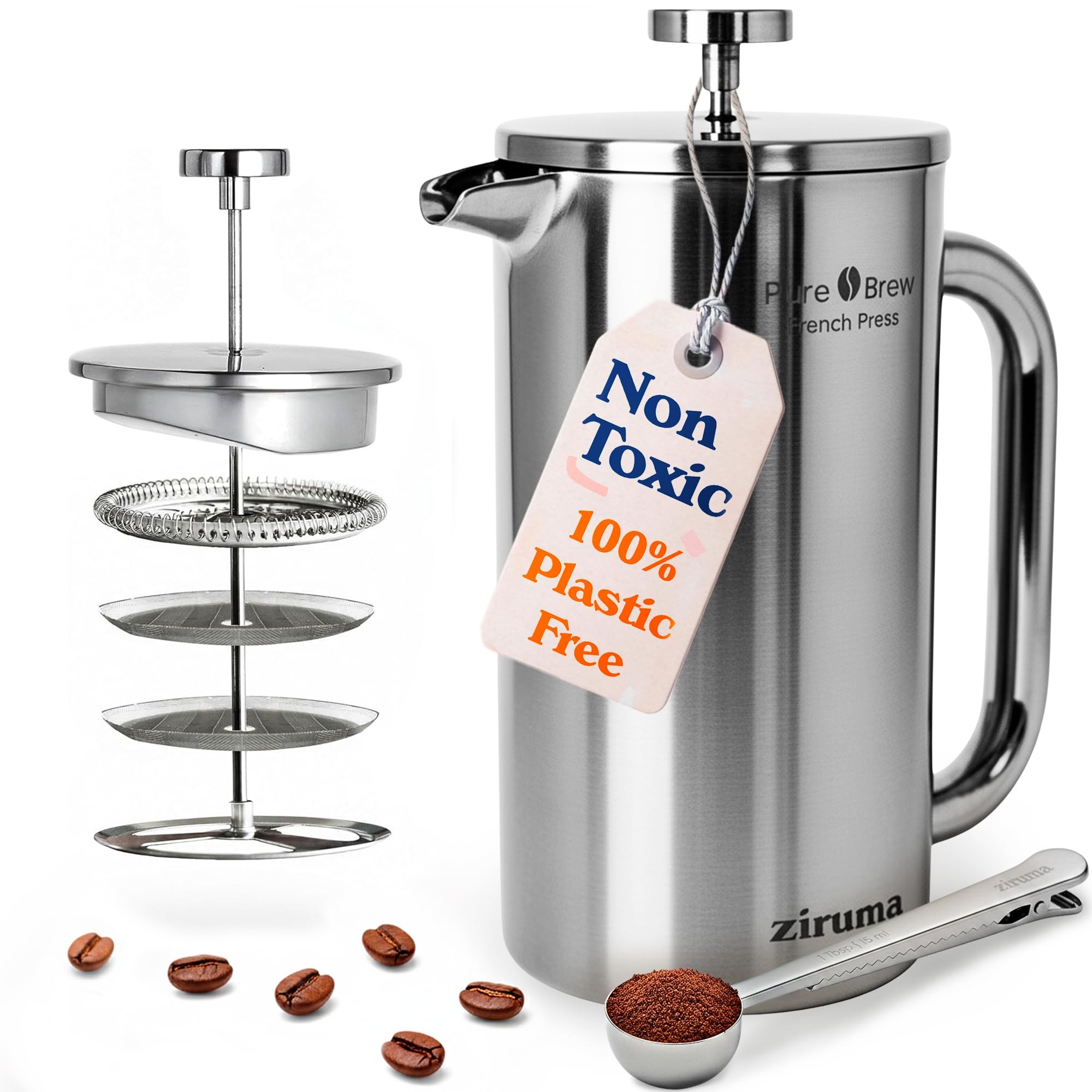
The Ziruma French Press uses 316 surgical-grade stainless steel throughout its construction — a jump above the more common 18/8 or 304 alloys — meaning zero plastic contact and improved corrosion resistance against acidic coffee oils. The double-wall vacuum insulation locks brew temperature for roughly three to four hours, and the 34-ounce (1,000 ml) capacity serves about four standard mugs per batch.
Its defining mechanical feature is the precision 4-layer mesh filter assembly, which traps ultra-fine grounds far more effectively than the typical single-screen French press. Users consistently report a smooth, sludge-free cup despite the full-immersion brewing method. The carafe includes internal measurement markings and ships with a stainless steel measuring spoon, removing guesswork from the coffee-to-water ratio.
Cleaning is straightforward since every component is dishwasher safe and the filter stack disassembles without tools. The exterior remains cool to the touch during brewing thanks to the vacuum layer, and the lightweight build makes it genuinely portable for camping, road trips, or office desks without an outlet.
Why it’s great
- Fully plastic-free, 316 surgical steel body
- 4-layer filter eliminates sediment and sludge
- Double-wall insulation keeps coffee hot for hours
Good to know
- Initial filter resistance may produce a metallic noise that fades after several uses
- Capacity is 34 oz, which may be more than needed for single-cup drinkers
2. OXO Brew Stainless Steel French Press

The OXO Brew French Press solves the single messiest part of French press cleanup with its proprietary GroundsLifter — a plastic scoop that lifts out 95 percent of spent grounds in one motion, ideal for anyone who composts. The body pairs a borosilicate glass carafe (removable for thorough washing) with a brushed stainless steel exterior sleeve that adds durability without the weight of all-metal construction.
Its fine mesh filter does a solid job of keeping grounds out of the cup, though a handful of users note some sediment passes through with very fine grinds — a coarse grind setting mitigates this. The 32-ounce capacity translates to roughly four 8-ounce cups, and the plunger mechanism moves smoothly with a comfortable non-slip knob. The glass carafe slides out of the sleeve easily, making it simpler to scrub than a sealed one-piece unit.
One trade-off is the GroundsLifter itself — it is plastic, which contradicts the all-metal preference of health-focused buyers. The glass is borosilicate but not a reinforced Pyrex formulation, so care is needed during handling and cleaning. Despite these small compromises, the thoughtful engineering of the grounds removal system makes daily upkeep noticeably faster than a standard French press.
Why it’s great
- GroundsLifter scoops out 95% of spent grounds for mess-free composting
- Borosilicate glass carafe with sturdy stainless steel sleeve
- Smooth plunger action with comfortable ergonomic knob
Good to know
- GroundsLifter is plastic, not stainless steel
- Some sediment may pass through with very fine grinds
3. Chemex Pour-Over Glass Coffeemaker

The Chemex is arguably the most recognizable pour-over brewer in the world, and its design has remained functionally unchanged since the 1940s for good reason. The hourglass-shaped carafe is made from non-porous borosilicate glass that will not absorb coffee oils or chemical residues, and the thick glass construction resists thermal shock when pouring near-boiling water directly onto the brewer. The 8-cup model holds 40 fluid ounces (using the 5-ounce Chemex “cup” measurement), making it suitable for multiple servings in one brew cycle.
Cleanliness of the cup is the defining advantage here — the pour-over method combined with Chemex’s proprietary bonded paper filters (sold separately) produces a sediment-free, bright, and smooth coffee that lacks the grit and heavy body of French press brews. The wooden collar and leather tie add a tactile, premium feel and also serve as a heat barrier when gripping the carafe. The angled pour spout provides precise control with no drips.
The glass carafe does not retain heat the way double-wall stainless does, so the coffee cools faster after brewing unless transferred to a thermal carafe or preheated mug. The brewer also requires a separate gooseneck kettle for the best pouring control, adding another piece to your routine. For those who prioritize flavor clarity and zero sludge over heat retention, the Chemex remains the reference standard in manual pour-over.
Why it’s great
- Non-porous borosilicate glass — no odor or chemical absorption
- Paper filter delivers the cleanest, sediment-free cup available
- Timeless design with wooden collar and leather tie
Good to know
- Requires Chemex-brand paper filters (not included)
- Glass carafe does not retain heat; coffee cools quickly
4. Bialetti Moka Express

The Bialetti Moka Express has been the definitive stovetop espresso maker since its invention in 1933, and its octagonal aluminum body is instantly recognizable in kitchens across Italy and beyond. The 6-cup version produces roughly 250 ml of concentrated coffee — about 1.5 ounces per cup in the traditional espresso-sized serving. It operates on gas and electric stovetops (an induction adapter plate is required for induction cooktops).
The brewing physics are straightforward: water in the lower chamber is heated until steam pressure forces it up through a funnel of finely ground coffee and into the upper chamber. The result is a rich, bold, nearly syrupy brew with a thick mouthfeel and natural crema. Because there are no paper filters, the coffee retains its full oil profile, though some fine sediment may sneak through the metal filter plate. The patented safety valve on the lower chamber prevents dangerous pressure buildup.
Cleaning is intentionally simple — rinse with water only and never use soap or a dishwasher, as detergent degrades the aluminum’s seasoning and can impart a metallic taste. The metal handle on the classic model gets very hot during brewing, so a potholder or towel is required during handling. For drinkers who want the strongest, most concentrated brew from a non-electric stove device, the Bialetti Moka Express is the benchmark.
Why it’s great
- Original 1933 design — proven, durable, and iconic
- Produces concentrated, bold espresso-like coffee with natural oils
- Simple mechanical operation with safety valve
Good to know
- Not compatible with induction cooktops without a separate adapter plate
- Hand washing only — never use soap or a dishwasher
5. YETI Rambler 64 oz French Press

The YETI Rambler French Press is built for volume — its 64-ounce capacity makes it the largest non-electric brewer in this roundup, capable of serving eight to twelve cups in a single press. The body is constructed from kitchen-grade 18/8 stainless steel with double-wall vacuum insulation, which keeps the coffee hot for hours without any external heat source. The GroundsControl filter uses a fine mesh screen and a tight seal to separate grounds from the brew during pressing.
The plunger action feels smooth and well-damped, and the spout is designed to pour cleanly without dripping down the side. The carafe is dishwasher safe, and the filter assembly disassembles for thorough cleaning. YETI’s proprietary MagSlider lids are available separately if you want to convert the press into a sealed travel pitcher — though the company explicitly warns against using the Twist-to-Lock lid with contents above 185°F.
The biggest downside is the exposed pouring hole at the top, which allows significant heat loss even with the double-wall insulation — some users report the coffee cools faster than expected. The unit is also heavy at nearly 4 pounds empty, and the base is wide enough that it may not fit under a standard countertop cabinet. For large households, group camping, or anyone who needs a massive single batch without replugging, the YETI delivers unmatched capacity and build toughness.
Why it’s great
- 64 oz capacity — largest batch size in the category
- Double-wall vacuum insulation keeps coffee hot for hours
- Dishwasher safe with fully removable filter assembly
Good to know
- Exposed pouring hole causes heat loss despite insulation
- Heavy (3.66 lbs empty) and bulky footprint
6. Yopinmall Pour Over Coffee Maker
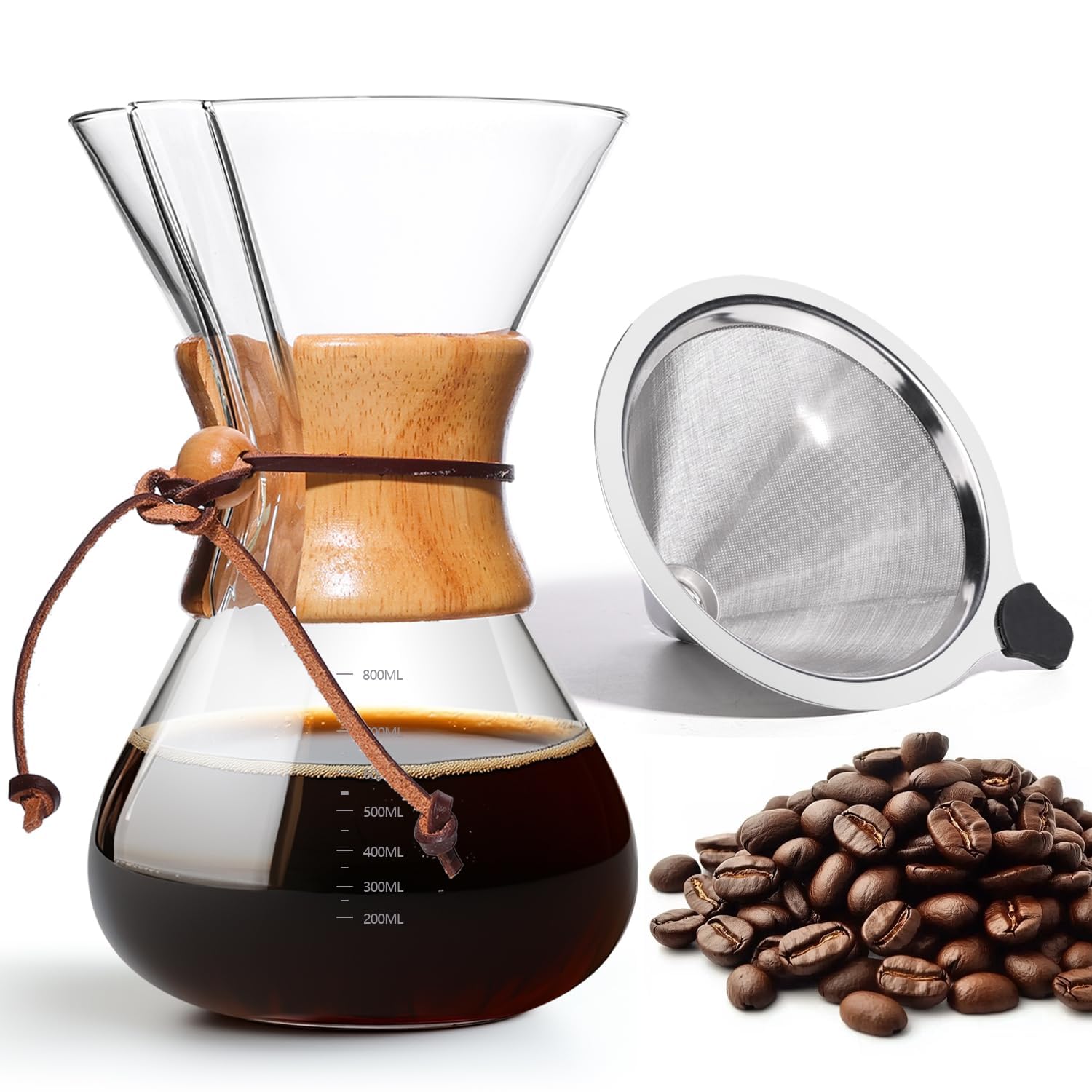
The Yopinmall Pour Over is a budget-friendly entry into manual drip brewing, centered around a 27-ounce (800 ml) borosilicate glass decanter paired with a reusable stainless steel mesh filter. The cork sleeve and natural wood tie add a warm aesthetic while also providing a small degree of grip insulation from the hot glass. The decanter is rated for low-flame stovetop heating and safe for refrigerator storage, which adds some versatility outside of pure pour-over use.
The permanent stainless steel filter eliminates the ongoing cost of paper filters and allows more of the coffee’s natural oils to pass through, resulting in a fuller mouthfeel than a paper-filter pour-over. Users consistently report that the brewer produces a clean, flavorful cup with minimal sediment, especially when paired with a coarse grind. The anti-drip spout pours cleanly, and the easy-grip handle makes handling less precarious than many all-glass carafes.
The cork sleeve and wooden tie are not dishwasher safe — they require a quick wipe-down by hand — though the glass decanter and metal filter are dishwasher safe. The silicone grip on the basket handle has been noted to loosen after several cycles, which is a minor durability concern. For a first pour-over setup or a secondary brewer for travel, the Yopinmall delivers solid glass construction and a reusable filter at a low entry cost.
Why it’s great
- Borosilicate glass decanter resists thermal shock
- Reusable stainless steel filter saves money on paper filters
- Aesthetic cork sleeve and wood tie design
Good to know
- Cork sleeve and wood tie not dishwasher safe
- Silicone grip on basket handle may loosen over time
7. LAOION Stovetop Espresso Maker

The LAOION Moka Pot breaks from the classic Bialetti formula by replacing the upper metal chamber with a borosilicate glass top, letting you watch the espresso rise in real time — a genuinely useful feature for beginners who tend to overheat or remove the pot too early. The lower chamber is made from stainless steel with an induction-compatible base, making it the only moka-style brewer in this lineup that works directly on induction cooktops without an adapter plate.
The stainless steel construction eliminates the reactive-aluminum issue, so there is no metallic taste and no need to avoid acidic beans. The safety valve on the lower chamber works identically to the classic moka design, and the manufacturer provides clear instructions to prevent leaks — fill water below the valve, do not tamp the grounds, and finger-tighten the chambers only.
A small percentage of users report minor leaking from the lower chamber seam after brewing, which appears to be related to over-tightening or debris on the threading. The unit is compact and lightweight, making it genuinely portable for travel or camping. For anyone who wants the concentrated output of a moka pot with the visual feedback of a glass top and induction compatibility, the LAOION is the most versatile option in the stovetop category.
Why it’s great
- Glass top allows visual monitoring of the rising brew
- Stainless steel induction base works on all stovetops
- No aluminum reactivity — safe for acidic coffee beans
Good to know
- Some units may seep slightly from the lower chamber seam
- 240 ml capacity is smaller than a typical serving for two large mugs
FAQ
Which non-electric coffee maker produces the strongest brew?
Can I use a non-electric coffee maker on an induction stovetop?
Is a French press or pour-over easier to clean daily?
Final Thoughts: The Verdict
For most users, the non electric coffee maker winner is the Ziruma Non-Toxic French Press because it combines 316 surgical-grade stainless steel with a 4-layer filter and double-wall insulation — delivering a plastic-free, sediment-free brew that stays hot for hours without any electrical components. If you want the cleanest, brightest cup with zero sludge, grab the Chemex Pour-Over Coffeemaker. And for bold, concentrated stovetop espresso that works on induction, nothing beats the LAOION Moka Pot with its glass-top brew visibility.