A dull knife is a dangerous knife — it slips, it tears instead of slices, and it turns every prep session into a struggle. But the market is flooded with pull-through sharpeners that strip away too much metal and honing rods that only align an already dull edge. Finding a genuine precision knife sharpener that delivers consistent, repeatable results without requiring the patience of a master bladesmith is the real challenge.
I’m Mohammad Maruf — the founder and writer behind AirfryerBite. I have spent hundreds of hours analyzing the engineering, clamping mechanisms, and abrasive quality of guided-angle systems to identify which models actually remove the guesswork from the sharpening process.
This guide cuts through the marketing to bring you a curated selection of what I believe is the absolute best precision knife sharpener on the market right now for everyone from the weekend home cook to gear-obsessed outdoorsmen.
How To Choose The Best Precision Knife Sharpener
Selecting a guided sharpening system is less about finding a “good” product and more about matching specific hardware traits to your knife steel and desired finish. The most common mistake is to buy a system with too few grit options, leaving you with a sharp edge that lacks a polished final refinement. Here are the three non-negotiable factors to evaluate.
Angle Adjustment Range and Increments
The sharpening angle dictates the edge geometry. A 15° edge is ideal for Japanese-style kitchen knives that need low-resistance slicing, while 20-25° is better for hard-use hunting and pocket knives that require edge durability. The best systems offer continuous adjustment from at least 15° to 30° in 1° increments. Systems that lock into only three or four presets limit your ability to match the manufacturer’s original bevel, which is a common frustration among buyers who switch between kitchen and outdoor blades.
Abrasive Type and Grit Progression
Not all abrasives are created equal. Diamond plates cut harder steels — including high-vanadium powder metallurgy blades like S90V or ZDP-189 — that would wear out traditional aluminum oxide stones. A good system provides at least three grit stages: a coarse (200-300 grit) for edge repair and profiling, a medium (600-800 grit) for refining the edge, and a fine (1000-1500 grit) for polishing. The addition of a leather strop or ceramic rod for final deburring is a mark of a complete system. Cheap systems that skip the coarse stone often fail to remove chips or re-profile a damaged edge.
Clamp Design and Stability
If the knife moves even half a degree during a stroke, every previous pass is wasted. A good clamp must hold the blade rigidly without damaging the finish, and the rotation mechanism must return to exactly the same angle after flipping the blade. Systems that use two-piece clamp plates with rubber padding or magnetic alignment are superior. Pay attention to the clamp’s maximum jaw opening — hunting knives with thick spines (3-4 mm) require a generous clamp gap that budget systems often lack.
Quick Comparison
On smaller screens, swipe sideways to see the full table.
| Model | Category | Best For | Key Spec | Amazon |
|---|---|---|---|---|
| Work Sharp Pro Precision Adjust | Premium | All-in-One Pro Kit | 7 Abrasives + Digital Angle Indicator | Amazon |
| KME Precision Knife Sharpener System | Premium | Hard Steels & Repeatability | 4 Gold Diamond Hones (140-1500 grit) | Amazon |
| Warthog V-Sharp A4 | Premium | Fast Dual-Side Sharpening | 325 Grit Diamond Hone + Spring-Loaded Rods | Amazon |
| GEN3 Guided Knife Sharpening System | Mid-Range | Budget-Friendly Kit | 3 Alu Diamond Plates (320/800/2000) | Amazon |
| VIDOME Professional Electric Sharpener | Mid-Range | Quick Electric Sharpening | 100% Diamond Abrasives + 15° Guide | Amazon |
| VN3 Professional Knife Sharpener | Mid-Range | Countertop Aesthetic Style | Tungsten Carbide + 304 SS Build | Amazon |
| Lansky Deluxe 5-Stone System | Budget | Entry-Level Guided System | 5 Stones + Controlled-Angle Guide | Amazon |
In‑Depth Reviews
1. Work Sharp Professional Precision Adjust Knife Sharpener Kit

The Work Sharp Professional Precision Adjust is the most complete guided kit I’ve evaluated in this tier. It ships with seven abrasives — five diamond plates (220 to 800 grit), one fine ceramic rod, and a leather strop — which gives you the full progression from aggressive edge repair to a shaving-sharp, almost mirrored finish. The included digital angle indicator removes all guesswork: you set the angle from 15° to 30°, lock it, and the rotating arm maintains that exact bevel across both sides of the blade.
The all-metal construction is notably rigid. The clamp rotates without needing to disassemble the knife, and the long arm accommodates blades up to chef’s knife length without any angle drift. Users have reported taking a dull kitchen knife from torn-edge to hair-whittling sharp in under 20 minutes on their first attempt. The only practical limitation is that the clamp’s design slightly interferes when sharpening very small pen knives at the lowest 15° setting.
Compared to the KME system, the Work Sharp offers more stones out of the box and a more intuitive setup for beginners, though it lacks the spherical bearing rod guide that KME users prize for ultra-smooth motion. The 3-year warranty and Oregon-based support team add real confidence for buyers treating this as a long-term investment.
Why it’s great
- Full 7-abrasive set covers repair through stropping
- Digital angle indicator provides foolproof repeatability
- Solid metal build with rotating clamp saves time
Good to know
- Clamp obstructs sharpening very small blades at 15°
- No dedicated carrying case included
2. KME Precision Knife Sharpener System with 4 Gold Series Diamond Hones

The KME system is something of a cult classic among knife enthusiasts, and for good reason. Its spherical bearing rod guide creates near-zero friction during the sharpening stroke, which translates to exceptionally smooth passes and consistent edge geometry even on high-vanadium powder steels like S90V and ZDP-189 that quickly wear down cheaper stones. The four included Gold Series diamond hones — 140 extra-coarse, 300 coarse, 600 fine, and 1500 extra-fine — cover the essential progression for rebuilding a dull edge and then refining it to a working sharpness.
The angle adjustment is continuous from 17° to 30°, marked in clear 1° increments on the base. The rotating fixture eliminates the need to unclamp and re-clamp the blade when switching sides, which is a major time saver. Users have noted that the system is especially repeatable: once you dial in an angle and mark the clamp position, you can return to that exact setting weeks later. The included hard carry case makes the whole system very portable for those who sharpen at hunting camps or in the field.
The main trade-off is the price. At nearly double the cost of the Work Sharp kit, you get fewer abrasives, so most serious users end up buying additional stones (like a Chosera 5000 or a leather strop) to achieve a true mirror polish. Some reviewers also report that the small set screws can loosen during use and require periodic tightening.
Why it’s great
- Spherical bearing guide delivers zero-angle deviation
- Rotating fixture keeps blade clamped through both sides
- Excellent repeatability for hard-to-sharpen super steels
Good to know
- Only four grits included; extra stones add cost
- Small set screws can vibrate loose during extended use
3. Warthog V-Sharp A4 Knife Sharpener

The Warthog A4 takes a fundamentally different approach from the clamp-and-guide systems above. Instead of a single-sided rod, it uses spring-loaded diamond hones that sharpen both sides of the blade simultaneously. This patented V-Sharp mechanism dramatically cuts sharpening time — users report going through 25 kitchen knives in about an hour, with each blade taking only a few minutes. The metal frame and powder-coat finish give it a heavy, bench-stable feel that doesn’t slide around during use.
The four preset angle settings — 15°, 20°, 25°, and 30° — are selected by turning a dial on the top of the unit. While this limits fine-tuning compared to a continuous adjustment system, the trade-off is that you never have to measure, align, or guess. The included 325-grit natural diamond hone handles the initial edge repair, and the hardened steel hone finishes the edge. For kitchen knives and EDC blades, this combination produces a consistent, aggressive working edge that holds up well under daily use.
However, the Warthog system has less flexibility than the KME or Work Sharp. You cannot easily swap to higher-grit stones for a mirror polish without buying separate optional hones that cost almost as much as the base unit. Also, the dual-sided design means you cannot independently adjust the angle for asymmetrical grinds common on high-end Japanese knives.
Why it’s great
- Sharpens both sides at once — incredibly fast
- Simple dial-based angle selection, no setup guesswork
- Sturdy metal frame with solid rubber base for stability
Good to know
- Limited to four angle presets (not continuous adjustment)
- No included fine-grit stones for a polished mirror edge
4. GEN3 Guided Knife Sharpening System (XARILK)
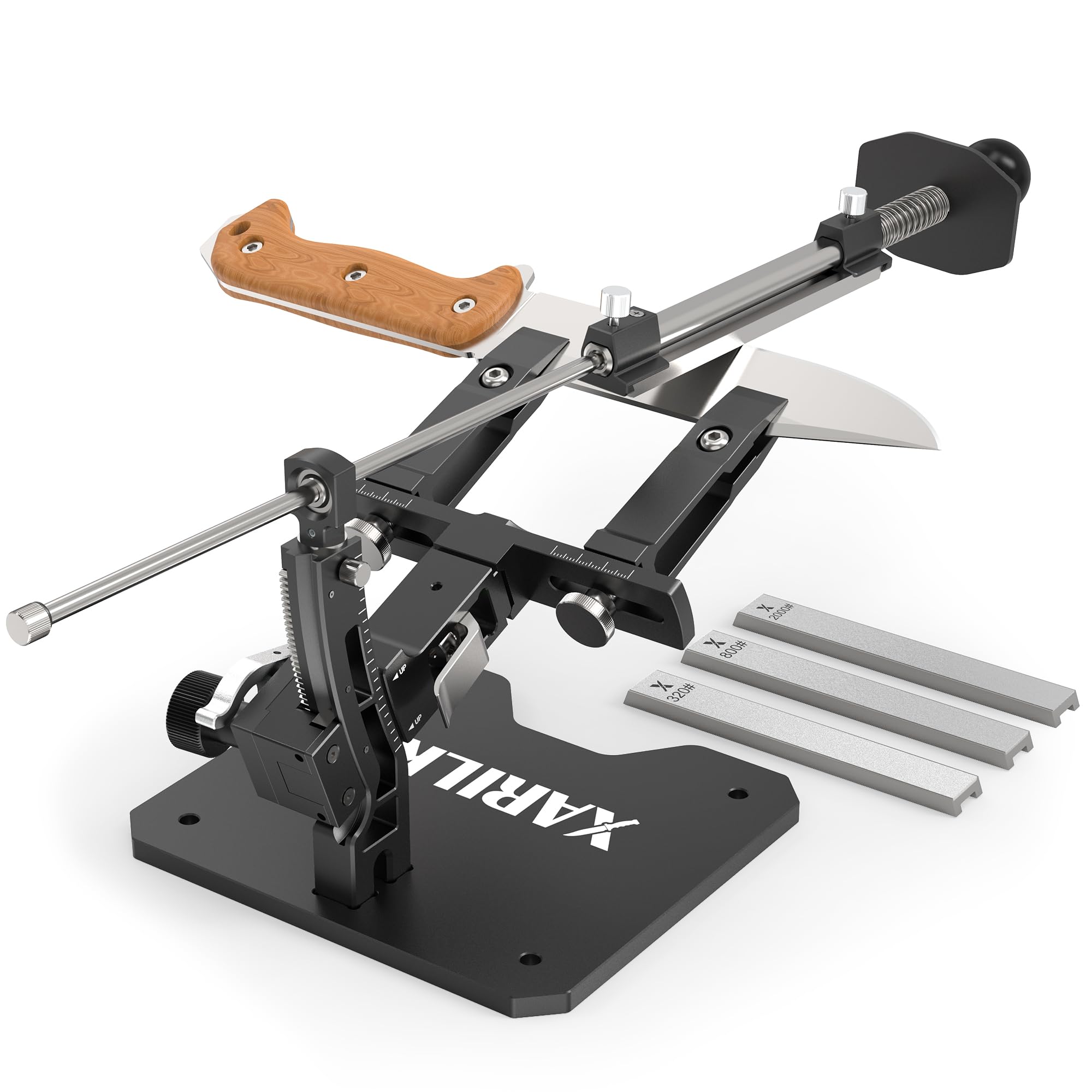
The XARILK GEN3 occupies a sweet spot in the mid-range: it offers a fully guided, clamp-based system with three aluminum-backed diamond plates (320, 800, and 2000 grit) at a price that undercuts the premium systems by a wide margin. The all-metal construction — high-strength aluminum alloy frame and clamp — provides the rigidity that budget plastic systems lack. The angle is continuously adjustable via a pivot mechanism, giving you granular control from roughly 14° to 30.5°.
Reviewers consistently note that the system is easy to assemble and intuitive to use, even for someone who has never sharpened with a guided jig. The diamond plates cut aggressively on kitchen knives and standard pocket knife steels, and with careful technique the 2000-grit stone can produce a reflective, hair-shaving edge. The system also accepts non-proprietary plates, which is a nice bonus for users who already own loose diamond stones from other setups.
There are a few trade-offs at this price point. The clamp uses hex set screws that can mar softer blade finishes if over-tightened, and the clamp itself introduces about 10° of elevation that requires a digital angle finder to compensate for — the included markings are not precise enough for repeatable work at specific angles. Several users recommend starting with a separate 180-240 grit stone for badly damaged edges before moving to the included 320 plate.
Why it’s great
- Full metal build at a budget-friendly price
- Three diamond plates cover repair through fine polishing
- Accepts non-proprietary stones for future upgrades
Good to know
- Clamp introduces 10° elevation — need a digital angle finder
- Set screws can scratch blades without caution
5. VIDOME Professional Electric Knife Sharpener

The VIDOME is the only electric sharpener on this list, and it earns its place by solving a different problem: speed. If you maintain a rotation of standard German-style steel kitchen knives and do not want to spend 20 minutes per blade on a guided system, the VIDOME can take a dull knife to a serviceable edge in about 10 to 30 seconds. Stages 1 and 2 use 100% diamond abrasives for sharpening and honing, while Stage 3 uses stropping disks to polish the final edge and remove burrs.
The 15° angle guide is fixed — the elastic constant-force spring mechanism presses the blade evenly against the diamond wheels — so there is no angle adjustment. This is fine for most Western-style chef’s knives, but it will not work well for blades with factory grinds of 20° or more unless you are willing to gradually reprofile them over multiple sessions. The magnetic chip collection tray is a thoughtful touch that keeps metal dust off the counter.
The primary limitation is that the system struggles with wide blades on the left side of Stage 3 and the right side of Stage 1, creating clearance issues with larger chef’s knives. The motor runs at 60-80 dB, which is moderate but noticeable. The 15° fixed angle also means that users with Japanese knives ground to 10-12° or serrated blades with varying tooth geometry will see inconsistent results.
Why it’s great
- Super fast — sharpens most kitchen knives in under 30 seconds
- 100% diamond abrasives handle both metal and ceramic blades
- Magnetic chip tray keeps metal filings contained
Good to know
- Fixed 15° angle — cannot adjust for different blade geometries
- Stage 3 slot has poor clearance for large blades on one side
6. VN3 Professional Knife Sharpener (Grihot)
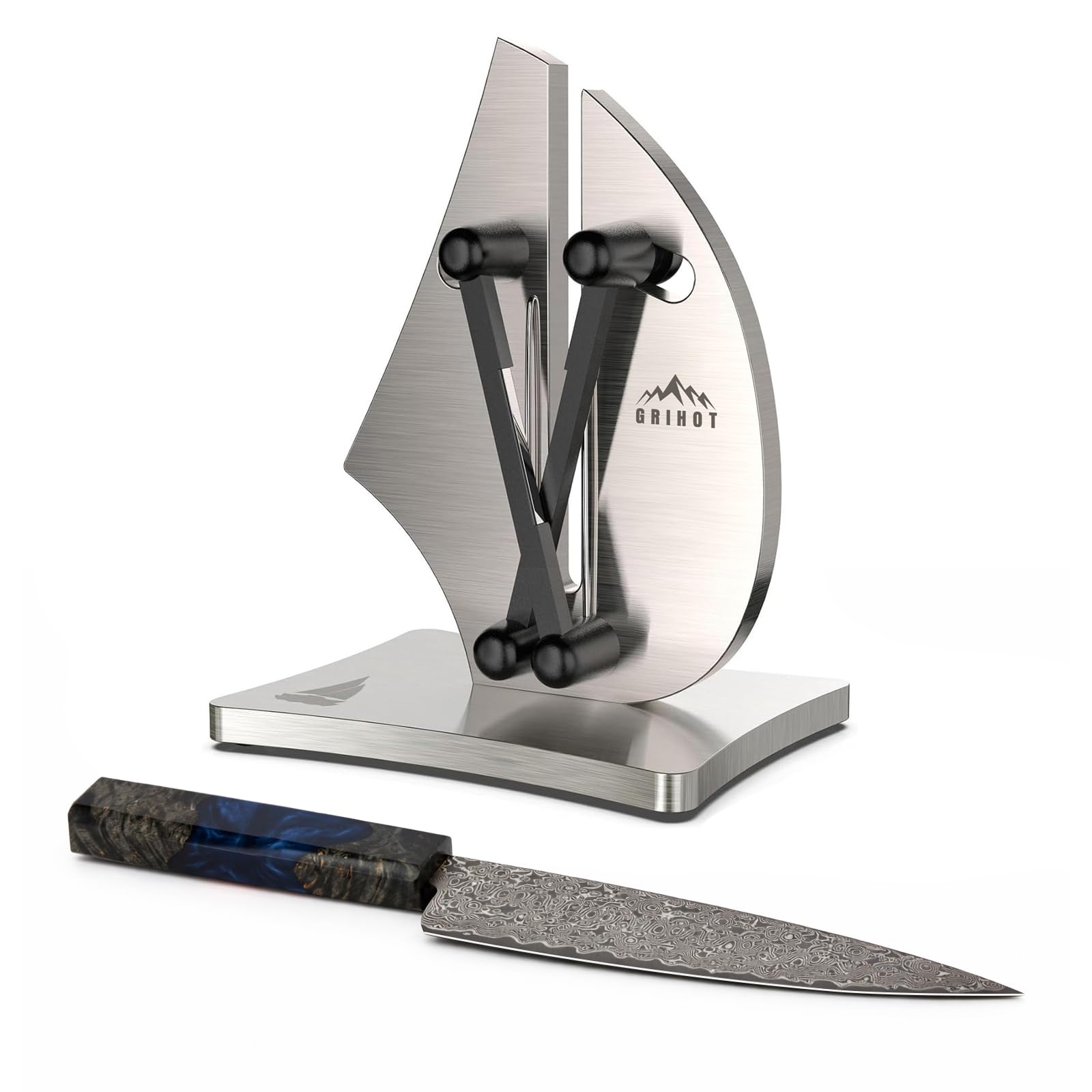
The VN3 from Grihot is a manual pull-through sharpener, but unlike cheap plastic models, it is built entirely from 304 stainless steel and uses spring-mounted tungsten carbide blades that automatically adjust to the knife’s existing bevel. The unique sailboat design doubles as a countertop showpiece — heavy enough at 1.9 pounds to stay planted during use. The three-action system allows you to repair, restore, and sharpen by selecting the appropriate slot on the base.
Because the tungsten carbide arms are spring-loaded, they self-adjust within a range of angles, so you do not need to manually set an angle the way you do with clamp systems. This makes it exceptionally easy to use: just pull the blade through each slot 3-5 times and test sharpness. Many users report that it can restore a very dull knife to a functional edge in about 30 seconds per knife, and the unit handles serrated blades competently thanks to the independent spring arms.
However, the VN3 removes more metal per pass than a guided diamond system, so it is better suited as a quick maintenance tool than a precision edge profiling system. You cannot control the exact apex angle, and the carbides will leave a coarser edge than diamond stones. It is best paired with a ceramic rod or strop for final smoothing. The 5-year warranty is generous, but the long-term sharpening behavior depends heavily on consistent pulling technique rather than mechanical precision.
Why it’s great
- Beautiful all-stainless build that lives on the countertop
- Auto-adjusting tungsten carbide arms require no angle setup
- Handles serrated blades as well as straight edges
Good to know
- Removes more metal per pass than controlled-angle systems
- No precise angle control — depends on user technique
7. Lansky Deluxe 5-Stone Controlled-Angle Sharpening System

The Lansky system has been a gateway for many home cooks and outdoorsmen into controlled-angle sharpening for decades. The deluxe kit includes five medium-grit ceramic stones — extra coarse, coarse, medium, fine, and extra fine — along with honing oil and a multi-angle guide that locks into four positions: 17°, 20°, 25°, and 30°. The clamp is a simple screw-adjust design that holds the blade securely while the stone guide rod rides across the top of the stone and the thumb screw sets the angle.
The system is easy to learn. Users who have never sharpened before routinely report restoring a dull pocket knife to a “ridiculously sharp” edge after a few passes through each stone. The ceramic stones are splash-and-go with the included oil, and they load less quickly than diamond plates when working with softer steel. The compact plastic storage case keeps everything organized — a nice feature for campers who pack their sharpener in their gear.
The main limitation is the angle system: the four presets are adequate for most Western knives, but the guide rod fits loosely in the guide holes on some units, introducing a few degrees of wobble that inhibits true precision. The clamp does not rotate — you must unclamp the knife completely to switch sides, which makes it slower than the KME or Work Sharp. The 17° minimum angle also excludes users who want to sharpen Japanese knives at 15° or below without modifying the system.
Why it’s great
- Excellent introduction to controlled-angle sharpening
- Five ceramic stones provide a solid grit progression
- Compact case makes it portable for field use
Good to know
- Preset angles only (17/20/25/30°), not continuously adjustable
- Clamp does not rotate — must unclamp to switch sides
FAQ
Can a precision knife sharpener fix a chipped blade?
How often should I sharpen my kitchen knives with a guided system?
What is the best angle for my kitchen knives vs hunting knives?
Do electric sharpeners like the VIDOME qualify as precision sharpeners?
Final Thoughts: The Verdict
For most users, the best precision knife sharpener winner is the Work Sharp Professional Precision Adjust because it delivers a complete seven-abrasive kit, a digital angle indicator for repeatability, and a rotating all-metal clamp at a price that bridges enthusiast and pro value. If you want the smoothest stroke and the most repeatable angle locking for super-hard steels, grab the KME Precision System. And for low-effort dual-side speed on standard kitchen knives, nothing beats the Warthog V-Sharp A4.