Tap water traveling through aging municipal pipes accumulates a cocktail of invisible threats — chlorine byproducts, heavy metals, and increasingly, microplastic particles measured at microscopic diameters. The right unit balances flow rate against filtration depth, filtering capacity against refrigerator shelf fit, and certification scope against long-term filter replacement cost.
I’m Mohammad Maruf — the founder and writer behind AirfryerBite. I have spent hundreds of hours analyzing third-party lab test reports, NSF certification listings, customer filtration performance data, and real-world flow rate comparisons across the leading water filter pitcher brands to identify which models actually deliver measurable microplastic reduction without sacrificing convenience.
The following analysis breaks down the seven most compelling options on the market right now, with detailed spec comparisons and real user feedback so you can confidently select the water filter pitcher for microplastics that matches your household’s specific water quality concerns and daily usage patterns.
How To Choose The Best Water Filter Pitcher For Microplastics
Not every pitcher that claims to “filter water” can stop a microplastic particle. These fragments — shed from synthetic clothing fibers, tire wear, and degraded plastic packaging — range from 5 millimeters down to 1 micrometer. Standard activated carbon filters designed mainly for chlorine taste reduction have pore structures too large to trap the smallest particles. You need to evaluate three specific areas: the certification scope of the filter, the physical filtration media used, and the flow rate versus contaminant hold trade-off that directly impacts how often you swap cartridges.
Certification scope matters more than brand reputation
Look for pitchers tested and certified against NSF/ANSI Standard 53 for cyst and particulate reduction, or NSF/ANSI 42 for chlorine reduction alongside independent microplastics testing. Products from Clearly Filtered and PUR list specific contaminant reduction percentages for microplastics and PFAS in their literature, while less expensive models from Brita focus primarily on chlorine, copper, cadmium, and mercury. If microplastic removal is your primary goal, skip anything that only advertises “improved taste” without a published micron rating or a third-party test report naming microplastics specifically.
Filter media determines what gets trapped
Activated carbon block filters physically trap particles as water passes through tight channels — the denser the block, the lower the micron rating and the higher the microplastic capture rate. Ion exchange resins target dissolved metals and hardness, not solid particulates, so they add little to microplastic removal. Bioceramic filters (like the Alkanatur) use a different approach, altering water chemistry to bind contaminants, but their physical particle capture depends on the ceramic pore size. For microplastic reduction specifically, you want a dense carbon block filter with a published micron rating at or below 1 micron.
Flow rate and filter lifespan are inversely related to filtration depth
A filter engineered to trap 0.5-micron particles naturally restricts water flow more than a coarse 10-micron carbon filter. Premium pitchers like the Clearly Filtered and Waterdrop glass model deliberately trade slower filtration speed for deeper contaminant removal — expect fill times of 6–10 minutes per full pitcher versus 2–3 minutes for a standard Brita. If your household consumes 2–3 pitchers daily, the slower flow becomes a real inconvenience. Calculate your daily filtered water volume and match it to the filter’s rated gallon lifespan so you are not replacing cartridges every three weeks.
Quick Comparison
On smaller screens, swipe sideways to see the full table.
| Model | Category | Best For | Key Spec | Amazon |
|---|---|---|---|---|
| Clearly Filtered Pitcher | Premium | Broadest contaminant coverage | NSF certified for 365+ contaminants | Amazon |
| Alkanatur Drops Pitcher | Premium | Alkaline pH + fluoride removal | Bioceramic filter, pH 8.5–9.5 | Amazon |
| Waterdrop PT-09BL Glass | Premium | Glass build + fast flow | 8.5 oz/min flow rate, 5-stage filter | Amazon |
| Waterdrop PT-04B | Mid-Range | Long filter life + included 4 filters | 200-gallon filter lifespan | Amazon |
| PUR 7-Cup PPT710BA | Mid-Range | NSF certified for microplastics | 3-in-1 filtration, NSF certified | Amazon |
| Brita Wave 10 Cup | Budget | Trusted brand, low cost | 40-gallon filter lifespan | Amazon |
| Brita UltraMax 27 Cup | Budget | Large capacity for family use | 27-cup dispenser, spigot pour | Amazon |
In‑Depth Reviews
1. Clearly Filtered Filtered Water Pitcher
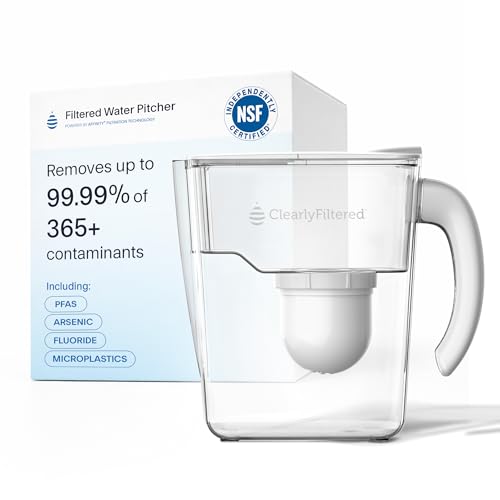
This pitcher targets 365+ contaminants including microplastics, PFAS, lead, fluoride, arsenic, and chlorine — a breadth unmatched by any other unit in this roundup. The proprietary Affinity Filtration Technology uses ionic binding to capture particles while preserving beneficial minerals, and the filter is NSF certified to NSF/ANSI Standards 42 and 372 for chlorine reduction and lead-free materials. At 80 fluid ounces, the capacity covers a full day of drinking for two people without constant refills, and the medical-grade Tritan plastic body is BPA-free and BPS-free, eliminating the risk of plastic leachates from the pitcher itself.
The filter lasts 100 gallons or roughly four months of daily use, which is competitive for this filtration depth, and the redesigned reservoir includes a spill-resistant water dam and an ergonomic handle that makes pouring a full pitcher manageable. Setup is straightforward — the included priming bag helps saturate the filter quickly — and the easy hinge fill lid reduces the chance of the top popping off mid-pour, a common complaint with other brands. Customer feedback consistently highlights the dramatically improved taste, particularly for users with municipal water that carries a strong chlorine or chemical aftertaste.
The downsides are the slower flow rate compared to standard carbon filters — expect 5–8 minutes for a full pitcher — and the filter replacement cost, which runs higher than Brita or PUR equivalents. Some users have reported black growth in the pitcher after several months, though this appears to correlate with infrequent cleaning rather than a systemic defect. For anyone whose primary concern is microplastic and PFAS reduction with verifiable NSF certification, this is the most defensible choice on the market right now.
Why it’s great
- NSF certified for 365+ contaminants including microplastics and PFAS
- Medical-grade Tritan plastic, BPA/BPS-free construction
- 100-gallon filter lifespan reduces replacement frequency
Good to know
- Slower flow rate than standard pitchers — expect 5–8 min per fill
- Filter replacement cost is higher than budget alternatives
- Some users report mold growth if pitcher is not cleaned thoroughly
2. Alkanatur Drops Pitcher
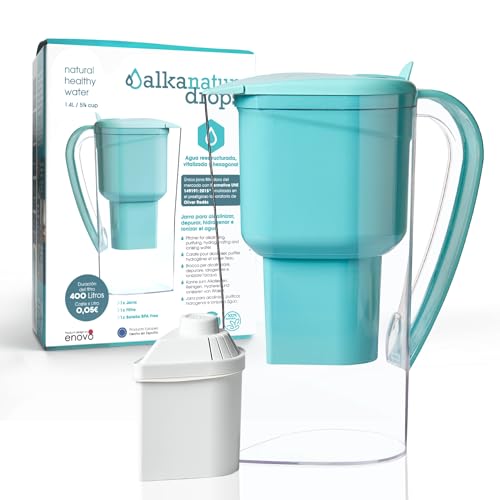
The Alkanatur stands apart from every other pitcher in this comparison because it uses an active bioceramic filter rather than traditional activated carbon or ion exchange resin. The filter transforms tap water into alkaline, ionized water with a pH between 8.5 and 9.5 while adding magnesium and removing chlorine, heavy metals, fluorides, and microplastics. The pitcher is certified by the Ceramic Institute of Galicia (University of Santiago de Compostela) and carries CE, RoHS, and SGS approvals, giving it a robust third-party validation backbone that few competitors can match.
One of the unique advantages of the Alkanatur design is that it does not use ion exchange resin, which means it adds no sodium to the water — a meaningful consideration for anyone monitoring sodium intake. The bioceramic media also produces a negative ORP (oxidation-reduction potential) of up to -350 mV, which acts as an antioxidant. The filter life is rated at 400 liters — roughly three months with average household use — and the pitcher includes a BPA-free water bottle in the package, adding practical value for taking filtered water on the go.
The downsides include a higher upfront cost compared to standard pitchers and reports from some users that the filter can shed fine carbon particles into the first few batches of water, requiring several flushes before the water runs clear. The plastic body, while BPA-free, does not match the premium feel of glass or medical-grade Tritan. For buyers who want alkaline water with documented microplastic and fluoride reduction and are comfortable with a slightly more involved filtration system, this pitcher delivers a genuinely different approach to water treatment.
Why it’s great
- Bioceramic filter produces alkaline pH 8.5–9.5 without adding sodium
- Adds magnesium and delivers antioxidant ORP values
- Certified by multiple European institutions for contaminant reduction
Good to know
- Higher upfront cost than carbon-based pitchers
- Some carbon shedding reported during initial use
- Plastic body feels less premium than glass or Tritan alternatives
3. Waterdrop PT-09BL 10-Cup Glass Water Filter Pitcher

This pitcher solves the plastic leachate paradox — a plastic pitcher used to filter microplastics from water can itself shed microplastics over time. Waterdrop addresses this with a high-quality glass body that does not release harmful substances into the water, while the internal liner remains plastic for structural durability. The 5-stage filtration system uses advanced carbon fiber, ion exchange resin, and an activated carbon block to reduce chlorine, mercury, copper, cadmium, PFOA/PFOS, sand, sediment, and large particles, and the filter is NSF/ANSI 42, 53, and 372 certified for chlorine, taste/odor, mercury, and lead-free materials.
The standout spec here is the flow rate — 8.5 ounces per minute, which fills an 8-ounce cup in less than 60 seconds. That is roughly ten times faster than many densely packed carbon block filters, making this a practical choice for households that go through multiple pitchers daily. The filter lifespan is rated at 100 gallons or about two months, and the pitcher includes a convenient replacement indicator dial on the lid. The 10-cup capacity (80 fluid ounces) matches the Clearly Filtered unit in volume, and the glass body is easy to clean with a soft sponge — though Waterdrop explicitly warns against dishwasher use for the glass component.
The weight is the primary practical trade-off — the glass body plus water makes a full pitcher noticeably heavy, and users with reduced hand strength may struggle with single-handed pouring. The lid can also be tricky to align properly after cleaning. For buyers who prioritize avoiding plastic contact with their water and want a fast-flowing filter that still reduces a broad range of contaminants including PFAS, this is the strongest glass option currently available.
Why it’s great
- Glass body eliminates plastic leachate risk from the pitcher itself
- Fast 8.5 oz/min flow rate — fills a cup in under one minute
- NSF/ANSI 42, 53, and 372 certified for multiple contaminants
Good to know
- Heavy when full — may be difficult for some users to pour
- Not dishwasher safe; hand wash only
- Filter lifespan shorter than some competitors at 100 gallons
4. Waterdrop PT-04B 10-Cup Pitcher with 4 Filters

What makes the PT-04B unusual in this category is the filter lifespan — each cartridge lasts up to 200 gallons, which is five times longer than the standard Brita filter and double the lifespan of most premium competitors. For a household of two, that translates to roughly 10–12 months before a filter swap is needed, dramatically reducing long-term operating cost. The pitcher comes with four filters in the box, effectively covering nearly four years of filtration out of the gate, which makes the per-gallon cost exceptionally low for a pitcher that reduces chlorine by 97.4% and also targets PFOA/PFOS, odor, iron, and metal ions.
The design incorporates a natural wood handle that provides a comfortable, ergonomic grip, and the hands-free spout lid eliminates the need to remove the top for refilling — you simply pour water directly through the opening, which also keeps dust out of the reservoir. The filter uses activated carbon and ACF (activated carbon fiber) media, and the pitcher body is made from lead-free, food-grade materials with BPA-free construction. The 10-cup capacity fits most refrigerator side doors, and the overall dimensions (10.4 x 5 x 10.1 inches) are compact enough for countertop use in smaller kitchens.
Customer feedback highlights a common lid issue — the top pops off easily when pouring if not pressed down firmly, which can lead to spills. The flow rate is adequate but slower than the glass Waterdrop model, and some users report that the wooden handle, while attractive, can feel slightly awkward in hand due to its shape. For budget-conscious buyers who want the lowest long-term filter cost and are willing to tolerate minor design quirks, this pitcher delivers exceptional value per filtered gallon.
Why it’s great
- 200-gallon filter lifespan — lowest long-term cost per gallon in this review
- Includes 4 filters in the box, covering years of use
- Innovative spout lid allows hands-free refilling
Good to know
- Lid can pop off during pouring if not secured properly
- Wooden handle shape may feel uncomfortable for some users
- Slower flow rate compared to the Waterdrop glass model
5. PUR 7-Cup PPT710BA

PUR is one of the few major brands that explicitly markets and NSF certifies its filters for microplastic reduction, making the PPT710BA a standout option for buyers who want a straightforward, well-documented solution from a household name. The 3-in-1 filtration system combines activated carbon with ion exchange technology to reduce microplastics, chlorine, and over 20 other chemical and physical substances that affect taste and odor. The filter is rated for 40 gallons or about two months of use, and the included filter indicator light takes the guesswork out of replacement timing.
The 7-cup capacity is smaller than most pitchers in this comparison, but the slim design (9.6 x 4.5 x 10.1 inches) fits easily on narrow refrigerator shelves and in compact RV spaces — several customer reviews specifically mention using it in their RV refrigerators. The stay-tight lid allows filtering and pouring simultaneously without the lid detaching, and the BPA-free, dishwasher-safe construction makes maintenance simple. The manual power source means no batteries or electricity required, keeping the system purely gravity-fed.
The main trade-off is the filter replacement frequency — at 40 gallons, you will be changing filters roughly every two months, and the filter cost per gallon is higher than the Waterdrop PT-04B or the Brita UltraMax. Some users also report that the filtration speed is slower than expected, taking several minutes to fill the reservoir. For buyers who want a brand with clear NSF certification for microplastic reduction and a compact, refrigerator-friendly form factor, the PUR PPT710BA delivers reliable, verified performance without overcomplicating the user experience.
Why it’s great
- NSF certified specifically for microplastic reduction
- Slim, space-saving design fits narrow refrigerator shelves
- Filter indicator light removes replacement guesswork
Good to know
- 7-cup capacity is smaller than most competitors
- 40-gallon filter means more frequent replacements
- Filtration speed is slower than budget carbon filters
6. Brita Wave 10 Cup Pitcher
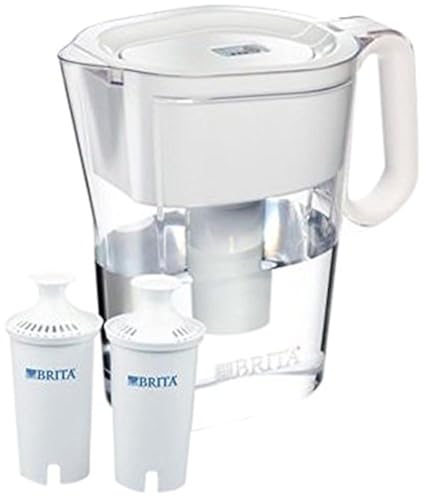
The Brita Wave is the most recognized name in water filtration, and for buyers entering the filtered water category, it offers the lowest barrier to entry. The 10-cup pitcher uses Brita’s standard filter, which is certified to reduce copper, cadmium, and mercury impurities while cutting the taste and odor of chlorine. Each filter lasts 40 gallons or roughly two months, and one filter replaces approximately 300 single-use plastic water bottles. The flip-top lid makes refilling straightforward, and the electronic filter indicator tracks usage so you know exactly when to swap the cartridge.
Where the Brita Wave falls short for microplastic-conscious buyers is in its filtration scope — the standard Brita filter does not carry NSF certification for microplastic or PFAS reduction. It is primarily designed for taste improvement and basic heavy metal reduction, not for capturing the sub-millimeter synthetic particles that increasingly concern health-aware consumers. The pitcher dimensions (12.1 x 9.8 x 6.5 inches) are bulkier than the slim PUR design, and some users report that the spout door can stick, causing water to spill inside the refrigerator door.
For the price, the Brita Wave delivers reliable chlorine and heavy metal reduction with a trusted brand and easy filter availability at any grocery store. But if microplastic removal is your primary reason for buying a filter pitcher, this model is best understood as a starting point — a solid foundation for improving tap water taste that may need to be paired with a more capable filter if microplastics are your main concern. The sturdy build and proven track record make it a reasonable entry-level choice, but not the final destination for targeted contaminant reduction.
Why it’s great
- Low upfront cost with widely available replacement filters
- Electronic filter indicator tracks filter life accurately
- Reduces chlorine taste, copper, cadmium, and mercury effectively
Good to know
- No NSF certification for microplastic or PFAS reduction
- Pitcher footprint is bulkier than slim alternatives
- Spout door can stick, causing spillage
7. Brita UltraMax Large 27-Cup Dispenser
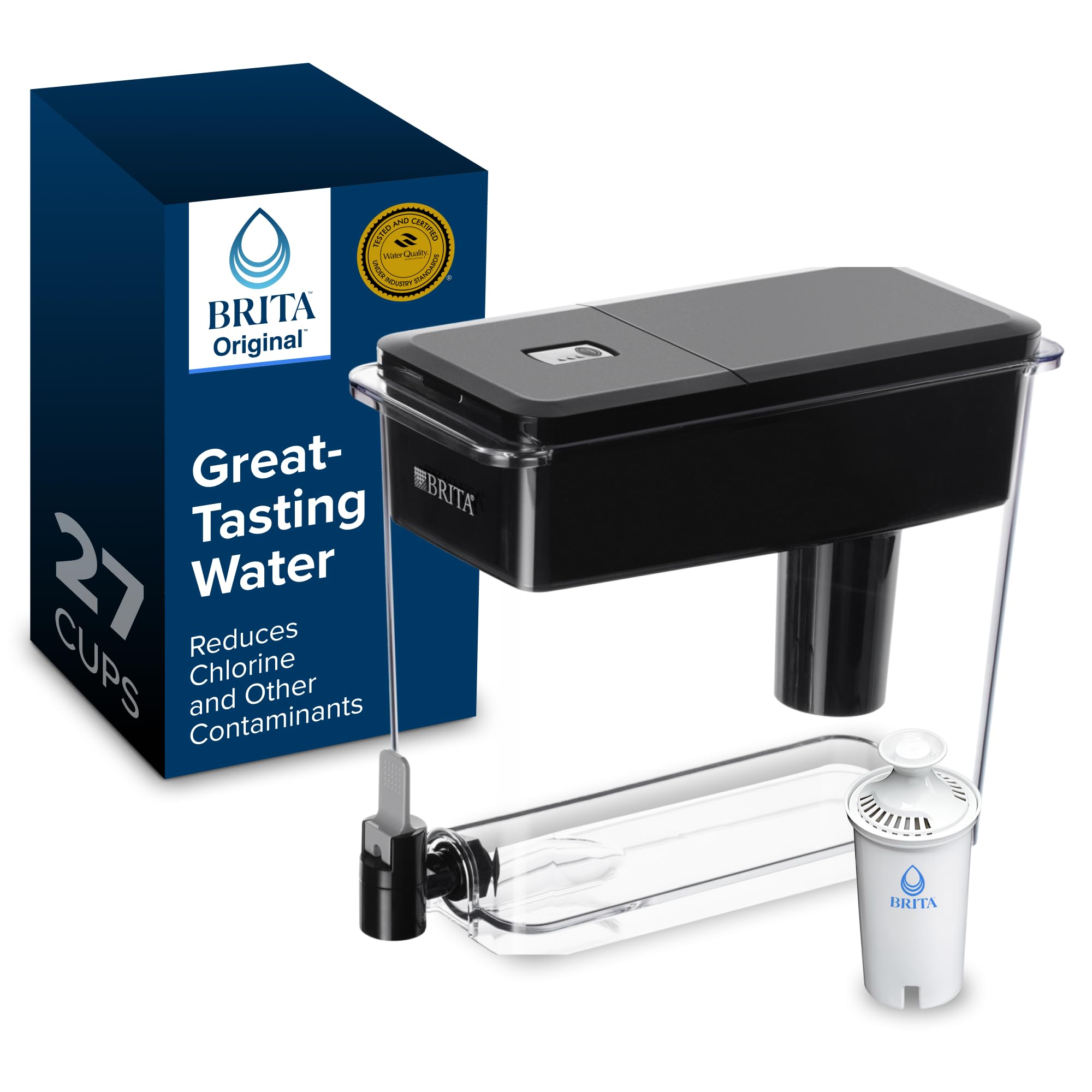
When daily filtered water consumption exceeds three or four pitchers, the Brita UltraMax eliminates the constant refill cycle with a 27-cup (13.5-pound) reservoir that dispenses through a precision-pour spigot rather than requiring you to lift and tilt the entire container. The space-efficient design fits on standard refrigerator shelves, and the easy-locking lid prevents spills during transport. The included Standard filter lasts 40 gallons or about two months, and the sticker-style filter indicator helps track replacement timing.
The UltraMax is compatible with both Standard filters (40-gallon, 2-month life) and Elite filters (120-gallon, 6-month life), giving you flexibility to extend replacement intervals if you upgrade to the Elite cartridge. The dispenser format allows multiple household members to pour water without waiting for a new batch to filter, and the spigot delivers a controlled stream that fills tall water bottles without splashing. Customers consistently praise the removal of chlorine taste and the convenience of the large capacity, especially in households with 3+ people who drink filtered water throughout the day.
The same microplastic limitation that applies to Brita’s standard pitchers applies here — the Standard and Elite filters are not certified for microplastic or PFAS reduction, and the filtration media is designed primarily for taste and odor improvement plus heavy metal reduction. The rigid lid design can be difficult to grip, especially when wet, and some users note that condensation on the top can drip onto the counter when opening the lid after refrigeration. For families who prioritize volume and convenience over deep contaminant removal, the UltraMax delivers unmatched capacity, but buyers targeting microplastic reduction specifically should pair this with a more capable filter or choose a different brand with published microplastic certification.
Why it’s great
- Huge 27-cup capacity with convenient spigot dispensing
- Compatible with Elite filters for 120-gallon lifespan
- Fits standard fridge shelves despite large reservoir
Good to know
- No microplastic or PFAS reduction certification
- Lid can be difficult to grip when wet
- Condensation on lid surface may drip during opening
FAQ
Do standard Brita or PUR filters remove microplastics from tap water?
What is the difference between activated carbon block and granulated activated carbon for microplastic capture?
How often should I replace the filter in a microplastic-reducing pitcher?
Final Thoughts: The Verdict
For most users, the water filter pitcher for microplastics winner is the Clearly Filtered Pitcher because it holds NSF certification for 365+ contaminants including microplastics and PFAS, uses medical-grade Tritan plastic that will not leach its own microplastics, and delivers a 100-gallon filter lifespan. If you want a glass body that completely avoids plastic contact with your water, grab the Waterdrop PT-09BL Glass Pitcher for its fast flow rate and 5-stage filtration. And for the lowest long-term operating cost with four filters included at purchase, nothing beats the Waterdrop PT-04B with its 200-gallon filter lifespan.