The rectangular shape of a tamagoyaki pan is not a gimmick—it is a functional tool designed to solve a specific rolling problem that round pans cannot address. Without the straight sides and precise dimensions, achieving the tight, layered roll of a traditional Japanese omelette requires far more skill and patience.
I’m Mohammad Maruf — the founder and writer behind AirfryerBite. My market research focuses on isolating the hardware specifications that separate a short-lived pan from one that performs reliably over hundreds of uses, specifically within the narrow category of Japanese egg cookware.
This guide cuts through the marketing noise to identify the best tamagoyaki pan based on real-world performance data, coating durability, and fit-for-purpose design rather than brand hype or price alone.
How To Choose The Best Tamagoyaki Pan
Choosing the right tamagoyaki pan means evaluating three specific factors that determine whether your omelettes roll cleanly or end up as scrambled mess. Most beginners focus on price, but the coating quality and pan dimensions will define your cooking experience far more.
Coating Durability and Layer Count
The non-stick coating is the single most critical component of any tamagoyaki pan. A single-layer coating will begin to degrade after a few months of regular use, causing eggs to stick and the coating to flake. Look for pans that specify a three-layer inner coating or a reinforced platinum coating. Ceramic coatings offer PFOA-free safety but may wear faster than PTFE-based options, while a thicker aluminum base (2.5mm or greater) helps distribute heat evenly and reduces hot spots that accelerate coating breakdown.
Dimensions and Sidewall Design
A standard tamagoyaki pan measures roughly 5 by 7 inches with a depth of about 1.2 inches. The sloped front edge is not decorative—it allows the spatula to slide under the egg roll cleanly. Straight sidewalls on the other three sides create the defined corners necessary for the rectangular shape. If the pan is too shallow, the egg layer spreads too thin; if too deep, rolling becomes awkward. Verify these dimensions before purchasing to ensure they match your stovetop burner size and portion needs.
Handle Construction and Stovetop Compatibility
The handle affects both safety and comfort during the rolling motion. A double-riveted stainless steel handle stays cooler on the stovetop and provides a solid grip for the tilting motion required to roll the omelette. Screw-on wood handles, while comfortable, can loosen over time and are not oven-safe. Check that the base is induction-compatible if you use an induction cooktop—many inexpensive pans claim compatibility but have a weak magnetic plate that causes uneven heating or fails to center properly.
Quick Comparison
On smaller screens, swipe sideways to see the full table.
| Model | Category | Best For | Key Spec | Amazon |
|---|---|---|---|---|
| TECHEF Onyx | Premium PTFE | Long-term durability | 3-layer reinforced platinum non-stick | Amazon |
| DXBVIEX 9Pcs Set | Full Kit | Complete starter package | Includes glass lid and silicone tools | Amazon |
| YumOmNom | Accessory Kit | Beginner-friendly extras | 3-layer inner non-stick coating | Amazon |
| GiPP Granite | Eco Ceramic | Budget-friendly build | 0.8 Liter capacity, granite coating | Amazon |
| LISOS Ceramic | Entry Ceramic | Simple daily use | 2.5mm aluminum body, 2 quart capacity | Amazon |
In‑Depth Reviews
1. TECHEF Onyx Tamagoyaki Pan
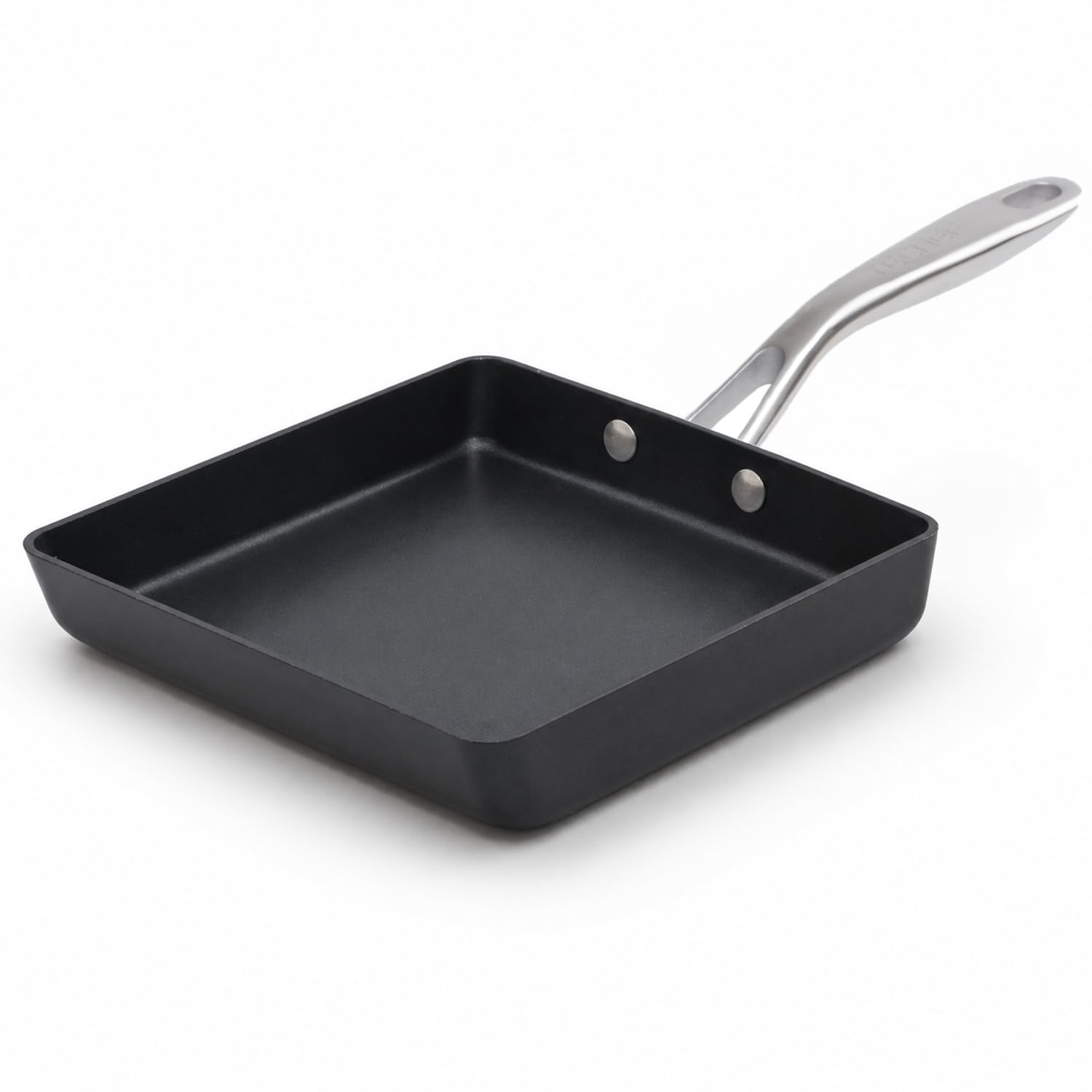
The TECHEF Onyx pan uses a forged heavy-gauge 3004 aluminum body combined with a three-layer reinforced platinum non-stick coating that resists scratching far better than standard PTFE layers. The coating is PFOA-free, cadmium-free, and lead-free, and it is bonded to a base that measures 2.5mm thick, providing even heat distribution across the 8.5-inch square cooking surface. The sloped front edge is engineered specifically for tamagoyaki rolling, allowing the spatula to slide cleanly under the egg without tearing.
The double-riveted stainless steel handle remains cool during stovetop use and provides a solid grip for the tilting motion required to form tight rolls. The pan is oven-safe up to 450°F and dishwasher-safe, though hand washing will extend the coating lifetime. Several long-term users report the pan performs flawlessly after months of weekly use, with no sticking or flaking, which is rare in this category.
One limitation is the absence of a lid and pour spout, which some cooks prefer for steaming the top layer of the omelette. The induction-ready base works on all stovetops, but users of induction cooktops note that the magnetic plate requires careful centering on smaller burners. The shallow rim also means standard pot lids do not fit, so if you want a lid for low-temp steaming, you will need to purchase a separate glass lid that fits the dimensions.
Why it’s great
- Forged 3004 aluminum body resists warping and distributes heat evenly
- Three-layer reinforced platinum coating is highly scratch-resistant and PFOA-free
- Double-riveted stainless steel handle stays cool and feels substantial during rolling
- Oven-safe up to 450°F, adding versatility for finishing dishes
Good to know
- No lid included; standard lids do not fit the shallow rim
- Induction base requires careful centering on smaller burner zones
- Higher price point compared to entry-level ceramic options
2. DXBVIEX 9Pcs Tamagoyaki Pan Set

The DXBVIEX set bundles a 7×5-inch non-stick pan with a glass lid, silicone spatula and brush, bamboo chopsticks, a fork, a spoon, a ceramic plate, and a storage bag. The pan itself has a non-stick coating that performs well at low to medium temperatures, which is exactly where tamagoyaki needs to cook to avoid browning the egg layers. The glass lid is a practical inclusion: it traps steam to help the top layer of the omelette congeal evenly without flipping, which reduces the chance of tearing during the roll.
The pan is made of aluminum with a stainless steel and wood handle. Users who cook on induction stoves report even heating at 160-175°F, though the pan is not as thick as the premium forged options. The included silicone spatula is shaped to fit the pan corners, making it easier to tuck the egg edges before rolling. The entire set is dishwasher-safe, and the lid is oven-safe, adding flexibility for recipes that require a brief oven finish.
The trade-off is that the pan body is not as heavy as the TECHEF or forged aluminum pans, and some users note that the handle is a combination of materials rather than a single solid piece. Over time, the screw-in handle may require tightening. Additionally, using four eggs makes the pan feel cramped; three eggs produce the best roll thickness. For a beginner who wants everything included in one box, this set removes the guesswork of buying accessories separately.
Why it’s great
- Includes glass lid for steaming the top egg layer without flipping
- Complete 9-piece set eliminates need to purchase accessories separately
- Non-stick coating performs well at low tamagoyaki temperatures
- Lightweight design is easy to handle and store
Good to know
- Handle may require occasional tightening over time
- Pan body is not as thick as forged aluminum options, reducing heat retention
- Four eggs fill the pan completely; three eggs are ideal for rolling
3. YumOmNom Tamagoyaki Pan

The YumOmNom pan features a three-layer PFOA-free non-stick coating bonded to an aluminum body, with a composite wood handle that is comfortable to grip. The 5×7-inch cooking surface is the standard size for two to three egg omelettes, and the sloped front edge is present to aid the rolling motion. The pan comes with a generous accessory set: silicone oil brush, silicone spatula, frying chopsticks, a Japanese serving plate, and a downloadable recipe guide.
Users consistently report that the non-stick performance is excellent out of the box, with eggs sliding freely and cleanup requiring only a paper towel wipe. The pan is suitable for gas, electric, and induction cooktops, though the thin aluminum body means it responds quickly to temperature changes—you will need to watch heat levels to avoid overheating and damaging the coating. The included silicone spatula is particularly useful: its thin edge slides under the egg roll easily, compensating for the pan’s modest weight.
The main concern is that the handle is attached with screws rather than rivets, which means it may loosen over time with frequent use. While the pan is dishwasher-safe, hand washing is recommended to protect the coating. A few users note that the pan has a slight manufacturing residue on first use, so a thorough wash with mild soap before the first cook is essential. For the price, the accessory bundle provides a complete start-to-finish cooking experience that makes this a strong entry point for beginners.
Why it’s great
- Three-layer non-stick coating provides excellent release from day one
- Includes silicone brush, spatula, chopsticks, plate, and recipe guide
- Standard 5×7-inch size works well for two to three egg portions
- Easy to clean with a simple wipe or rinse
Good to know
- Screw-on handle may loosen over time and require tightening
- Thin aluminum body can overheat quickly if heat is not carefully managed
- Light manufacturing residue was reported on some units; wash before first use
4. GiPP Tamagoyaki Egg Pan
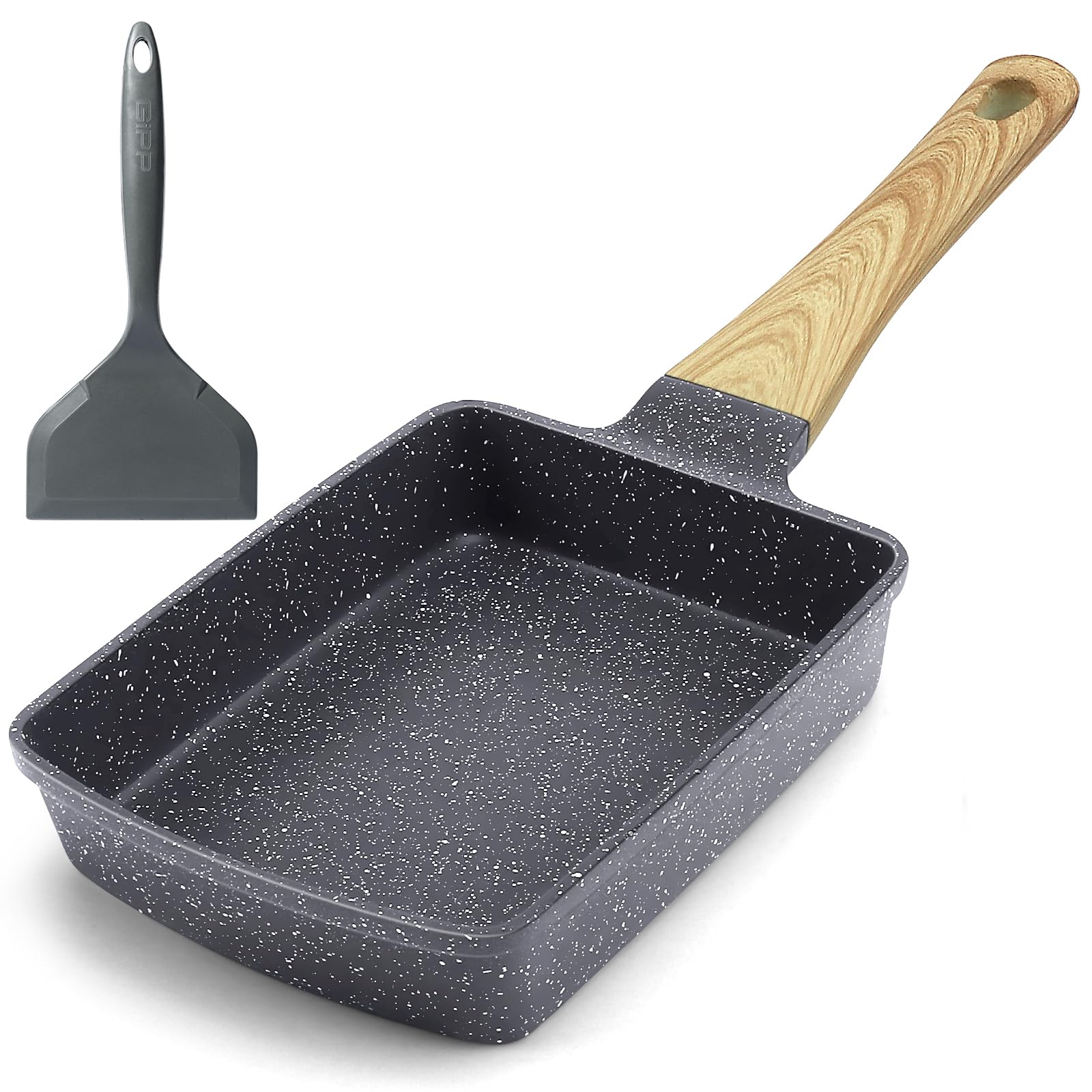
The GiPP pan uses a grey granite non-stick coating that is free of PFOS and PFOA, and the aluminum body is cast for even heat distribution. The 5×7-inch size is compact, fitting two to three eggs comfortably, and the magnetized base is compatible with all stovetops including induction. The wooden handle is attached with a screw and included screwdriver, and the pan comes with a small shovel accessory for flipping.
Cooking performance is strong for the price point: users report even heating with minimal spatter, and the ceramic granite surface releases eggs easily during the first several months of use. The pan is lightweight enough for easy handling during the rolling motion, and the compact footprint is ideal for small kitchens or RV cooking. Cleanup is straightforward with a quick rinse or a wipe with a paper towel, and the pan is dishwasher-safe.
The durability of the granite coating is the main variable here. Several users report that after roughly a year of regular use, the non-stick surface begins to degrade, with eggs starting to stick and the coating eventually chipping. This is consistent with ceramic-based coatings that typically have a shorter lifespan than multi-layer PTFE options. If you cook tamagoyaki a few times per week and want a budget-friendly entry point, this pan works well, but plan for replacement within twelve to eighteen months of frequent use.
Why it’s great
- Granite coating is PFOS and PFOA free for healthier cooking
- Compact size is perfect for small kitchens, RVs, or single servings
- Magnetized base works on all stovetops including induction
- Lightweight design is easy to handle during the rolling process
Good to know
- Ceramic granite coating may degrade after 12-18 months of frequent use
- Screw-on handle requires assembly and may loosen over time
- Coating chipping reported by some long-term users
5. LISOS Ceramic Tamagoyaki Pan
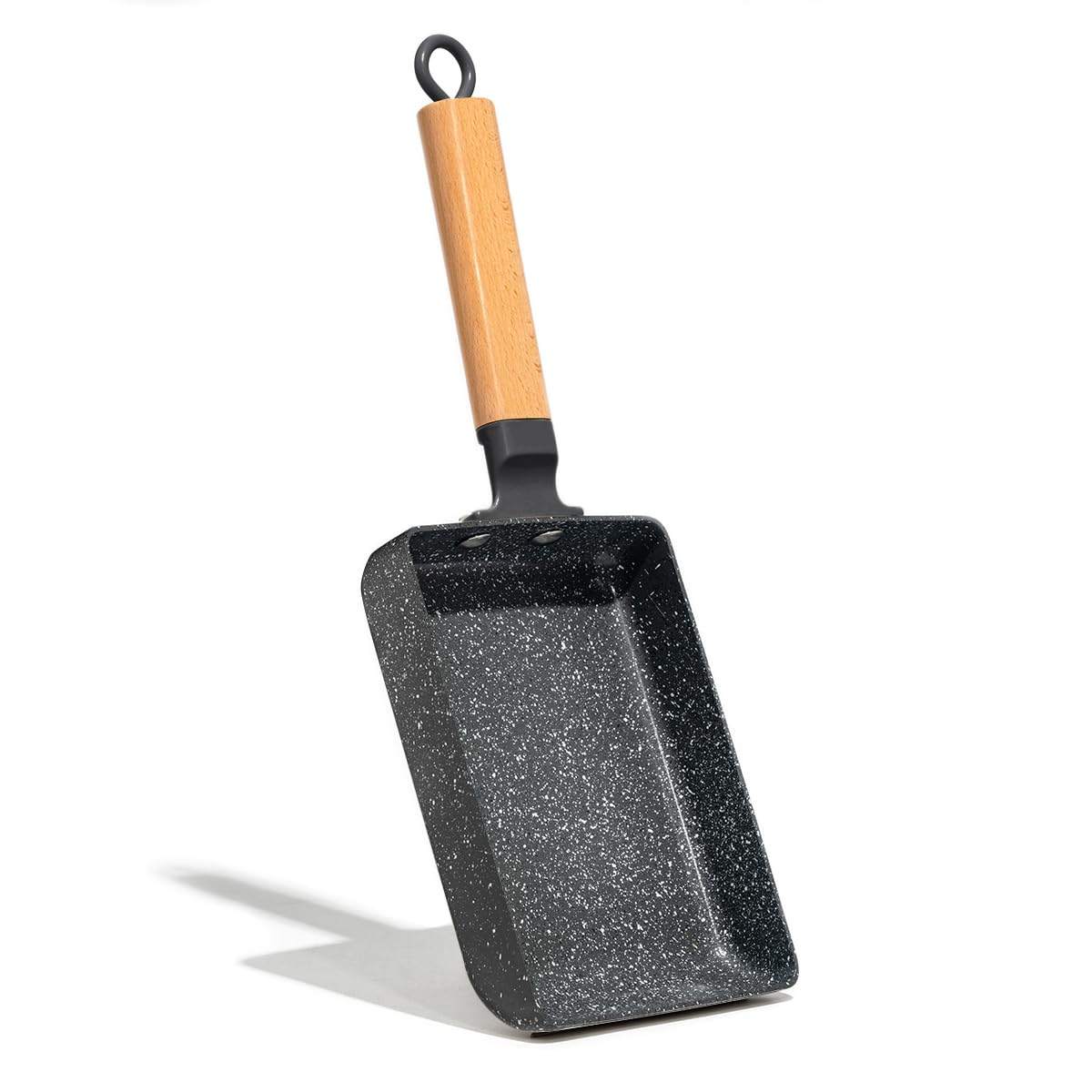
The LISOS pan features a ceramic internal coating that is PFOA, lead, and cadmium free, applied over a 2.5mm high-strength aluminum alloy body. The pan measures the standard 5×7-inch shape, and the wood handle is a separate piece that installs without tools—simply push it into the bracket. The stainless steel base is compatible with electric, induction, and gas stovetops, and the pan is dishwasher-safe for easy cleanup.
Cooking performance is reliable for basic tamagoyaki needs. Users report that the non-stick surface works well for rolled omelettes, fried eggs, and even pancakes, with even heat distribution across the cooking surface. The 2.5mm body is noticeably thicker than some ultra-budget options, which helps reduce hot spots and provides more consistent cooking. The included silicone brush and wooden spatula are useful additions for rolling and oiling the pan.
The handle construction is the weak point here. The wood handle is a push-fit design without a locking mechanism, meaning it can detach if the pan is lifted with a sharp tilt. Some users also note that the outer coating on the bottom of the pan can rub off on gas stove grates over time, though the inner cooking surface remains intact. For occasional tamagoyaki cooking or as a backup pan, this is a functional choice, but frequent users may want to upgrade to a pan with a more secure handle attachment.
Why it’s great
- 2.5mm aluminum body is thicker than many budget pans, reducing hot spots
- Ceramic coating is PFOA, lead, and cadmium free
- Tool-free handle installation is convenient for setup
- Works on all stovetops including induction
Good to know
- Push-fit wood handle can detach during sharp tilting motions
- Outer bottom coating may rub off on gas stove grates over time
- Not as durable as riveted stainless steel handle options
FAQ
Can I use metal utensils on a tamagoyaki pan?
What size tamagoyaki pan is best for two people?
Why does my tamagoyaki stick even with a non-stick pan?
Are ceramic tamagoyaki pans better than PTFE pans?
Final Thoughts: The Verdict
For most users, the best tamagoyaki pan winner is the TECHEF Onyx because its forged 3004 aluminum body and three-layer reinforced platinum coating provide the durability and even heat distribution that keeps eggs sliding cleanly for years. If you want a complete starter kit with a lid and all accessories, grab the DXBVIEX 9Pcs Set. And for a budget-friendly entry point with solid non-stick performance, nothing beats the GiPP Granite Pan.