The difference between a good French press and a great one often comes down to the quality of the coffee grounds. Too many fines turn your brew bitter and muddy, while uneven chunks lead to weak extraction. A manual grinder gives you full control over the particle size, letting you dial in that ideal coarse, consistent grind that French press demands.
I’m Mohammad Maruf — the founder and writer behind AirfryerBite. I’ve spent years analyzing the internal mechanics of manual coffee grinders, comparing burr geometries, click adjustments per rotation, and build materials across dozens of models to understand what actually delivers a cleaner, more consistent cup.
To get the right balance of speed and texture, you need a grinder with a stable steel burr and enough adjustment range to hit the coarse end of the spectrum cleanly. That’s exactly what this guide to finding the best manual coffee grinder for french press covers in detail — from capacity and burr type to practical cleaning tips that keep your grinder performing.
How To Choose The Best Manual Coffee Grinder For French Press
French press brewing relies on immersion — the grounds sit in hot water for four minutes. This means any fine dust (called fines) keeps extracting past the steep time, turning your cup bitter and cloudy. A manual grinder built for French press must deliver a uniform coarse grind with minimal fines. The three factors below determine whether a grinder can do that job cleanly.
Burr Geometry and Material
Conical steel burrs dominate this category because they produce a more even particle distribution with fewer shattered fines than ceramic or blade grinders. The specific alloy (like SUS420 or 420 stainless steel) affects sharpness retention over time. A dual bearing design on the drive shaft eliminates wobble, which is particularly important at coarse settings where burr alignment matters most.
Adjustment Step Size and Range
For French press, you need the burr gap to open wide enough — roughly 800 to 1200 microns. Look for click increments of 0.03mm or smaller per step, which gives you enough resolution to find the sweet spot between coarse enough (no clogging the press screen) and fine enough (good extraction). A range of 30 to 60 clicks total is typical; the more clicks, the finer you can dial in your preferred coarseness.
Catch Capacity and Static Control
A standard French press carafe uses about 30 to 50 grams of coffee. Choose a grinder that holds at least 30g in one batch to avoid grinding twice. Static electricity causes grounds to stick to the catch cup and lid — grinders with a metal or glass catch cup (rather than plastic) reduce this issue. Spraying the beans with a mist of water before grinding also helps, but the grinder itself should not be damaged by minimal moisture exposure.
Quick Comparison
On smaller screens, swipe sideways to see the full table.
| Model | Category | Best For | Key Spec | Amazon |
|---|---|---|---|---|
| 1Zpresso J Manual | High-End Manual | Long-term durability | 48mm steel burrs, 30-click per rotation | Amazon |
| KINGrinder K6 | Premium Manual | Espresso & French press versatility | Full metal build, 16µm per click | Amazon |
| HEIHOX H1 | Mid-Range Manual | Travel and camping | 38mm dual-bearing steel, 24+ click settings | Amazon |
| Vivaant Manual 32g | Mid-Range Manual | Quiet operation | 32g capacity, 6 easy external settings | Amazon |
| ALPACA VENTURES AV 1 | Entry-Level Manual | First-time manual grinder buyers | 420 stainless conical burr, dual bearing | Amazon |
| KINGrinder P2 | Ultra-Portable | Travel and Moka pot | 330g weight, 0.033mm per click | Amazon |
| CEVING MEGA PRO 60g | Large Capacity | Big batches & family use | 60g capacity, 40 external settings | Amazon |
In‑Depth Reviews
1. 1Zpresso J Manual Coffee Grinder

The 1Zpresso J stands out for its 48mm stainless steel conical burrs, which are larger than most grinders in this category. Larger burrs mean faster grinding — a full French press dose takes about 30 to 40 seconds — and the extra diameter reduces the chance of fines slipping through at coarse settings. The internal adjustment ring uses 30 clicks per full rotation, giving you enough resolution to lock in a French press grind that stays clean through the entire steep.
The body is built from aluminum with a foldable handle that tucks into the top, making it stable on the counter and easy to store. Disassembly is tool-free, which simplifies cleaning after every few uses — important for French press because oily coarse grounds can build up around the burr exit. The included cleaning brush reaches the burr teeth without needing water, protecting the unsealed bearings from rust.
Longevity ratings from the manufacturer estimate 100 to 200 kg of grinding life before burr replacement is needed, supported by a one-year limited warranty. The only real trade-off is the catch capacity — it holds about 25 to 30 grams, so if you brew a full 1-liter press, you may need to grind twice. For most home users who brew one 500ml press daily, this is a non-issue.
Why it’s great
- Large 48mm burrs for fast, consistent coarse grinding
- Foldable handle saves counter space and prevents tipping
- Tool-free disassembly makes deep cleaning straightforward
Good to know
- Catch cup holds only about 25–30g per batch
- Number dial alignment can be tricky for new users
2. KINGrinder K6 Manual Coffee Grinder

The KINGrinder K6 is a full-metal manual grinder with an internal adjustment system that delivers 16 micrometers per click — the finest step resolution in this lineup. That granularity is particularly valuable for French press because you can micro-adjust your grind just below the point where the press screen clogs, maximizing extraction without introducing sludge. The aluminum body and stainless steel burrs give it a hefty feel that resists wobbling during grinding.
It grinds roughly 18 to 20 grams in about 45 seconds at a medium setting, which drops to about 35 seconds at a coarse French press setting due to reduced resistance. The dual-bearing design keeps the burr stable even when you apply downward pressure, producing fewer shattered particles at wider gaps. The catch cup screws on with threads — some users note the threads can bind if overtightened, but a gentle hand avoids this.
Disassembly requires no tools, and the included brush handles routine cleaning. The only downsides for French press users are the 25 to 35 gram hopper capacity — again, large brew sessions require a second grind — and the fact that the adjustment dial is internal, meaning you have to open the top to change settings between brew methods. For a dedicated French press user, this is rarely an issue.
Why it’s great
- 16µm per click gives ultra-precise coarse grind control
- Full metal build feels solid and reduces vibration
- Dual bearing design ensures stable burr alignment at wide gaps
Good to know
- Internal adjustment requires opening the top to change settings
- Threaded catch cup can jam if overtightened
3. HEIHOX Manual Coffee Grinder H1

The HEIHOX H1 brings a 38mm dual-bearing stainless steel conical burr into the mid-range price bracket without cutting corners on burr stability. The adjustment ring produces over 24 audible click stops, which is enough coverage to move from French press coarse to brew-drip fine without guesswork. At a coarse setting around click 30, the grind output is noticeably even with minimal fines, making it a solid choice for French press daily use.
Grinding time for a 25-gram French press dose is about 55 seconds at a coarse setting, which is competitive with grinders costing significantly more. The aluminum alloy surface resists ground coffee sticking, and a simple twist separates the burr from the body for cleaning. The magnetic handle attachment is convenient but some users report the rubber grip can shift during heavy use — a small dab of superglue fixes it permanently.
Weight comes in at 580 grams, making it one of the heavier manual grinders here, which actually helps with stability during grinding. It includes a drawstring bag for travel. The only real limitation is that the bearings are not sealed, so you should not rinse the burr assembly with water — dry brush cleaning only.
Why it’s great
- Dual-bearing 38mm burr produces consistent coarse grinds
- Audible click stops let you dial in repeatable settings
- Heavy build stays planted on the counter during use
Good to know
- Unsealed bearings require dry cleaning only
- Rubber grip may shift on the metal body over time
4. Vivaant Manual Coffee Grinder 32g

The Vivaant grinder sets itself apart with a glass catch cup that holds exactly 32 grams of ground coffee, marked in increments for measuring your dose. Glass is naturally anti-static, so you won’t get grounds clinging to the inside walls — a common annoyance with plastic cups. The stainless steel conical burr (called a “dragon tooth” design) grinds roughly twice as fast as ceramic burrs at the same coarseness, which translates to about 50 seconds for a full 32g French press dose.
Adjustment is handled by an external numbered dial with six positions. The numbered marks make it easy to return to your preferred setting after cleaning. Disassembly is simple — the glass jar unscrews, and the burr lifts out for brushing.
The trade-off is the glass jar’s fragility — several users have reported breakage from drops, though the manufacturer offers replacement jars through customer support. The lifetime warranty adds peace of mind. This grinder is best for someone who brews one 500ml French press at a time and values quick, quiet grinding without static mess.
Why it’s great
- Glass catch cup eliminates static cling
- External numbered dial makes setting changes fast
- Lifetime warranty with responsive customer support
Good to know
- Glass jar can break if dropped
- Only six grind settings — less granularity than competitors
5. ALPACA VENTURES Premium Manual Coffee Grinder

The ALPACA VENTURES grinder uses a 420 stainless steel conical burr with a dual-bearing design that keeps the grind consistent from the first click to the last. It offers 12 distinct grind settings, which is a useful middle ground between limited-entry dials and ultra-fine adjustment systems. For French press, setting 10 or 11 produces a clean coarse grind, and the built-in bearing makes turning effortless even with lighter-roast beans that are harder to crush.
The body is aluminum with a sandblasted finish that resists fingerprints and wipes clean easily. The handle is longer than average, providing extra leverage to reduce wrist strain during grinding. A full 25-gram French press dose takes roughly 60 turns at the coarse setting, which takes about one minute. The included brush helps clear grounds from the burr teeth, though complete disassembly for deep cleaning requires a bit more mechanical patience than some competitors.
One missing element is a rubber base ring — the smooth aluminum bottom can slide on polished countertops during grinding. Placing it on a silicone mat solves this. Overall, this grinder offers reliable construction for users who want an all-metal build without stepping up to premium price brackets.
Why it’s great
- All-metal construction with a premium sandblasted feel
- Dual bearing design reduces effort at coarse settings
- 12 settings cover French press through Turkish with clear separation
Good to know
- No rubber base ring — slides on smooth surfaces
- Full disassembly for cleaning requires some mechanical skill
6. KINGrinder P2 Lightweight Manual Coffee Grinder

The KINGrinder P2 is built for portability without sacrificing grind quality. It weighs only 330 grams — about the same as a can of soda — yet delivers a SUS420 conical burr with 30 clicks per rotation, each representing a 0.033mm adjustment. That’s enough resolution to find a clean French press grind, though the small 20-gram capacity means you’ll need two batches for a standard 500ml press.
The body is ABS plastic rather than metal, which keeps the weight down but still feels sturdy in the hand. The adjustment dial is external and simple to turn without disassembly. Grinding at a coarse French press setting takes about 40 seconds for a 20-gram batch. The included cleaning brush and tool-free disassembly make maintenance simple, though the manufacturer advises against wetting the beans before grinding (the recommended anti-static trick) to avoid water damage to the plastic components.
Its compact size makes it an excellent travel companion for camping, hiking, or office use where counter space is tight. The main trade-off is that the plastic construction absorbs more vibration than metal, which can slightly increase the number of fines at very coarse settings. For most travel French press brewing, this difference is negligible.
Why it’s great
- Ultra-light 330g design is ideal for travel and camping
- 0.033mm per click gives precise control for coarse grind
- Tool-free disassembly and included brush for quick cleaning
Good to know
- 20g capacity requires two grinds for a 500ml press
- Static reduction spray (RDT) not recommended by manufacturer
7. CEVING MEGA PRO 60g Manual Coffee Grinder
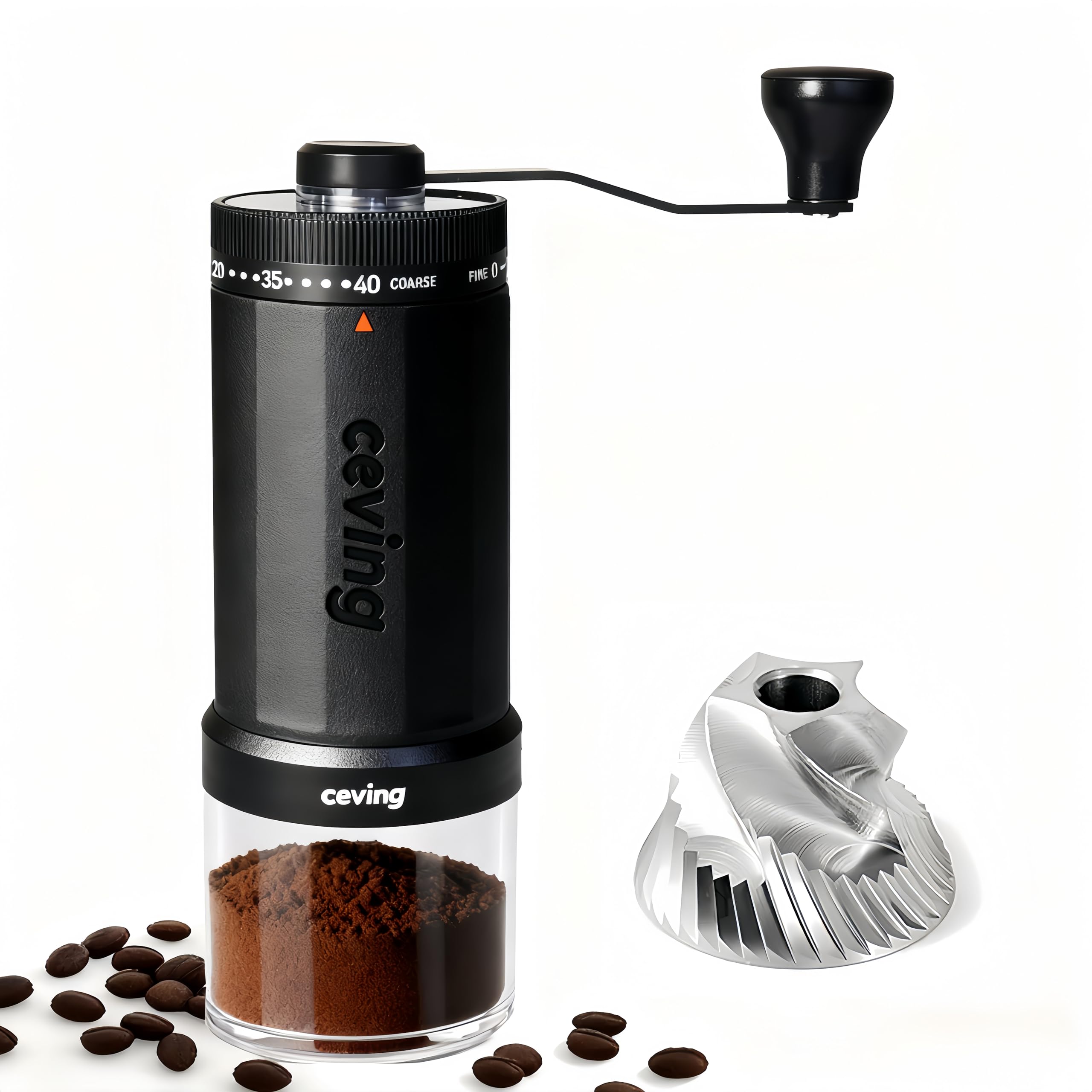
The CEVING MEGA PRO addresses the single biggest pain point of manual French press grinding: capacity. Its 60-gram hopper holds enough beans for a full 1-liter French press carafe in a single session, eliminating the need to grind twice when brewing for multiple people. The CNC-machined stainless steel burrs are driven by an external click ring with 40 adjustment settings, each step representing a 0.05mm change — fine enough to avoid overshooting the coarse zone.
Grinding speed is notably fast for a manual unit; a full 60-gram coarse batch takes roughly two minutes, which is reasonable for the doubled output. The steel burrs are designed for longevity and produce a uniform grind with fewer fines than many budget-oriented grinders. The external adjustment ring means you can switch between grind sizes without opening the grinder, which is convenient if you alternate between French press and pour-over.
At 416 grams, the MEGA PRO is still light enough to pack for camping, though its larger diameter makes it slightly bulkier than travel-focused grinders. The static-reduction tip from the manufacturer — spray beans with 2–3 mists of water before grinding — is a useful workaround for the plastic catch cup. The one-year warranty and responsive customer service round out the package.
Why it’s great
- 60g capacity handles a full 1-liter press in one grind
- 40 external click settings with 0.05mm resolution
- Fast CNC steel burrs reduce grinding time at coarse settings
Good to know
- Plastic catch cup may require bean misting to control static
- Larger body is less pocket-friendly than ultra-compact grinders
FAQ
What grind setting should I use for French press on a manual coffee grinder?
Can I use the same manual grinder for espresso and French press without losing consistency?
How often should I clean my manual coffee grinder for French press?
Is a ceramic or stainless steel burr better for French press grinding?
Final Thoughts: The Verdict
For most users, the best manual coffee grinder for french press winner is the 1Zpresso J Manual because its 48mm steel burrs, 30-click resolution, and tool-free cleaning give you the most consistent coarse grind at a competitive price without cutting corners on build quality. If you want a single-batch capacity for large French press carafes, grab the CEVING MEGA PRO 60g — its 60-gram hopper eliminates the need for double grinding when brewing for a crowd. And for travel or counter-space-limited kitchens, nothing beats the KINGrinder P2 with its ultra-light 330-gram body and precise 0.033mm click adjustment.