An electric meat slicer that struggles through a roast or shreds the edge of a tomato is worse than no slicer at all. The right unit makes short work of bulk cheese blocks, venison quarters, and home-baked bread, turning a Saturday meal-prep chore into a few quiet minutes of consistent output. The difference between frustration and seamless slicing comes down to motor torque, blade diameter, and whether the machine can hold its adjustment setting under load.
I’m Mohammad Maruf — the founder and writer behind AirfryerBite. Over the past several years I’ve compared the build materials, blade types, and cleaning protocols of dozens of meat slicers, separating the machines that deliver deli-quality results from those that wobble and walk across the counter.
This guide ranks the machines that earned their place through real-world utility, not marketing claims. If you are searching for the best rated electric meat slicers, these seven models represent the strongest balance of cutting precision, durability, and safety features for home and light commercial work.
How To Choose The Best Rated Electric Meat Slicers
Buying an electric meat slicer means matching the machine’s physical specs to the volume and type of food you cut most often. Four factors separate a slicer that earns its counter space from one that gathers dust: motor power, blade size and material, build stability, and ease of cleaning.
Motor Wattage and Torque Delivery
Wattage alone tells half the story. A 200W induction motor with a belt drive produces consistent torque that maintains speed when you push a dense block of cheese or a semi-frozen roast against the blade. Entry-level slicers often use direct-drive universal motors that lose RPM under load and create more noise. For weekly home use — slicing five to ten pounds of meat or cheese — a 200W to 250W motor is adequate. For processing whole game animals or running a small deli counter, look for 320W to 400W units with belt-driven mechanisms and heavier flywheels that resist stalling.
Blade Diameter and the Serrated vs. Smooth Decision
A 7.5-inch blade handles standard roasts, loaves of bread, and block cheese. Stepping up to a 10-inch or 12-inch blade lets you slice larger cuts — whole pork bellies, wide briskets, and baguettes — without repositioning the food mid-cut. Serrated blades grip crusty bread and soft tomatoes without crushing the structure. Smooth blades produce cleaner, more uniform slices on raw meat and firm cheeses. Several mid-range models include both blade types in the box, giving you the flexibility to swap based on the day’s task.
Chassis Weight and Countertop Stability
A slicer that vibrates or slides across the counter is dangerous and produces uneven slices. Look for a cast aluminum body with a minimum weight of eight to ten pounds for home units. Commercial-grade slicers often exceed 35 pounds, using their mass to dampen vibration. Rubber suction feet help hold the machine in place on smooth surfaces, but a heavy, wide footprint is more reliable over the long term, especially when you apply downward force through the food pusher.
Disassembly and Cleaning Convenience
Every slicer collects food residue between the blade housing and the carriage track. Models with a removable blade that releases without tools, a detachable food carriage, and a drip tray that slides out for washing save significant cleanup time. The best designs allow the blade, thickness plate, and guard to go into the sink or dishwasher. Avoid units where the blade is fixed or requires a screwdriver to remove — those traps will harbor bacteria and degrade performance over repeated use.
Quick Comparison
On smaller screens, swipe sideways to see the full table.
| Model | Category | Best For | Key Spec | Amazon |
|---|---|---|---|---|
| KWS MS-10NS | Premium | Bulk processing & semi-frozen meats | 320W belt-driven / 10″ stainless blade | Amazon |
| VEVOR 400W | Commercial | Restaurant & high-volume use | 400W motor / 12″ carbon steel blade | Amazon |
| ROVUN 8″ | Mid-Range Pro | Small commercial & serious home use | 210W motor / built-in sharpener | Amazon |
| OSTBA 8.7″ | Mid-Range | Weekly home use with varied foods | 200W DC motor / 2 blades included | Amazon |
| Borlebbi 7.5″ | Mid-Range | Quiet operation & dual-blade versatility | 200W DC quiet motor / 2 blades | Amazon |
| Kalorik 7.5″ | Entry-Level | First-time buyers & light duty | 200W motor / serrated blade | Amazon |
| Nutrichef 7.5″ | Budget | Occasional bread & deli meat slicing | 200W motor / 0-15mm dial | Amazon |
In‑Depth Reviews
1. KWS KitchenWare Station 10″ Commercial Meat Slicer (MS-10NS)

The KWS MS-10NS sits at the top of this list because it brings true commercial-grade engineering — a 320W belt-driven motor and a 10-inch NSF-certified stainless steel blade — into a footprint that still fits on a home counter. Belt drive absorbs shock loads much better than direct-drive designs, so the blade maintains speed when you push a semi-frozen pork shoulder or a dense block of aged cheddar against it. The adjustable thickness dial delivers consistent slices from paper-thin hot-pot cuts up to 14 mm for thick sandwich slabs.
Owners consistently report that this slicer handles high-volume processing — venison, bulk bacon, whole brisket — without stalling or overheating. The cast aluminum body weighs 37 pounds, which kills vibration and keeps the unit planted on the work surface. A built-in dual whetstone sharpener lets you touch up the blade edge between heavy uses without removing the blade. The food carriage, hand guard, and blade cover all come off for cleaning, though the unit is heavy enough that you will want to dedicate a permanent counter spot to it.
ETL listed for electrical safety and NSF certified for the food-contact blade, this machine matches the build quality of commercial deli units at roughly half the price. The optional bread-guide attachment expands its versatility into loaf work. If you process more than 20 pounds of meat or cheese per week and want a single machine that will last a decade, this is the pick.
Why it’s great
- Belt-driven 320W motor provides steady torque under constant load
- 10-inch stainless steel blade handles large roasts and whole pork bellies without pre-cutting
- NSF-certified blade and ETL listing for food-contact safety
- Built-in sharpener with dual whetstones for on-the-fly edge maintenance
- Heavy cast aluminum frame eliminates vibration and walking
Good to know
- Weighs 37 pounds — requires a permanent counter spot
- Cleaning is thorough but time-consuming due to the enclosed blade housing
- Partial freezing recommended for ultra-thin slicing to prevent tearing
2. VEVOR Commercial Meat Slicer 400W
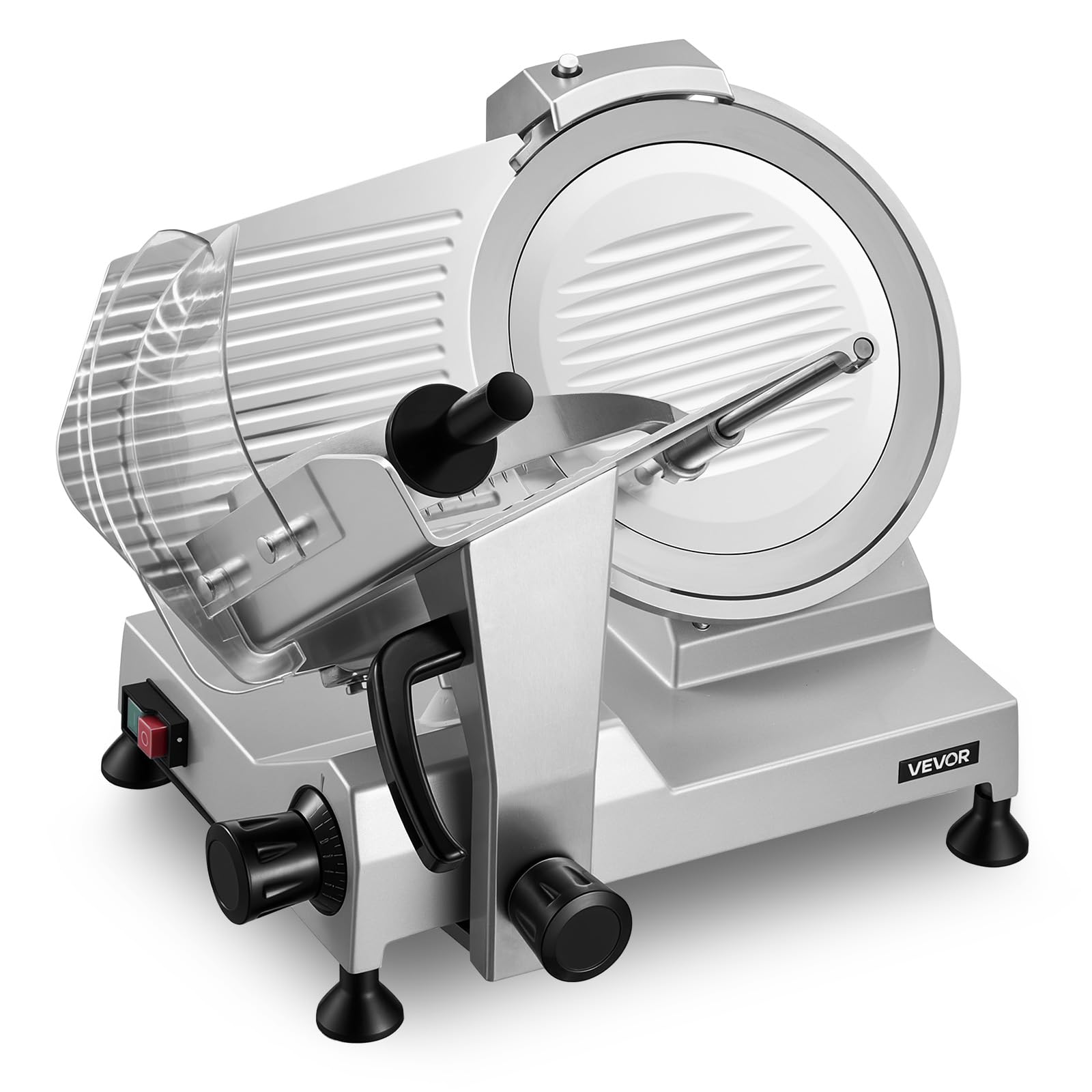
The VEVOR commercial slicer brings a 400-watt motor and a massive 12-inch carbon steel blade to the table, making it the most powerful unit in this lineup. The motor spins the blade at 300 to 450 RPM, which translates to fast throughput on whole hams, baguettes, and even semi-frozen steaks. The thickness adjustment knob covers 0 to 15 mm, so you can dial from wafer-thin carpaccio to thick-cut roast beef with a quarter-turn.
The build relies on a cast aluminum body that weighs over 45 pounds, giving it the stability needed to resist walking during high-speed slicing. A built-in blade sharpener and a safety guard that covers the exposed edge during operation address the two main concerns of anyone moving up to a commercial-size blade. The blade, food holder, and pusher all remove for cleaning, and the stainless steel tray wipes down without scrubbing.
ETL approved for North American electrical standards, this machine is aimed at small butcher shops, restaurant prep kitchens, and serious hunters who process whole animals at home. The 12-inch blade demands respect during assembly and cleaning — it is extremely sharp and requires careful handling. For the highest available motor power and blade diameter at a mid-commercial price point, this unit delivers unmatched cutting speed.
Why it’s great
- 400W motor with 300-450 RPM blade speed for rapid cutting
- 12-inch carbon steel blade handles oversize items without pre-cutting
- Heavy 45-pound cast aluminum frame for vibration-free operation
- Built-in sharpener for maintaining the carbon steel edge
- Detachable blade, food holder, and pusher simplify deep cleaning
Good to know
- Very large footprint — requires dedicated counter or cart space
- Carbon steel blade needs regular oiling to prevent surface rust
- 45-pound weight makes moving or storing the unit impractical
3. ROVUN 8″ Commercial Meat Slicer
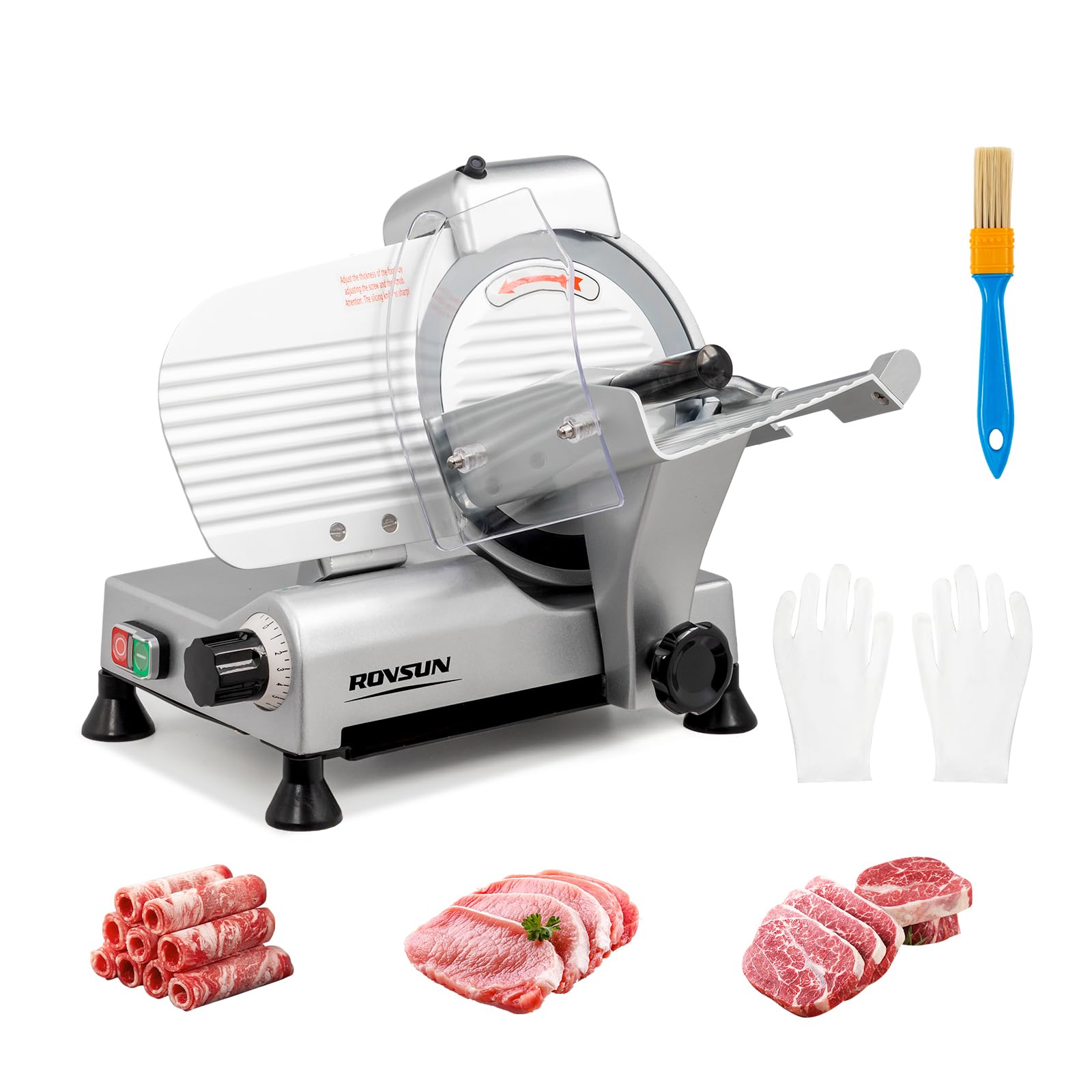
The ROVUN 8-inch slicer bridges the gap between home-duty machines and full commercial units. Its 210W all-copper motor drives the blade at a steady speed, and the company claims a throughput of 50 slices per minute, which holds up in practice when you are processing deli rolls or blocks of cheese. The thickness dial adjusts from 0 to 13 mm with a positive click that does not drift during use — a common problem on cheaper machines.
What sets this model apart is the hidden built-in sharpener. You activate it by turning a small knob, and dual grinding wheels refresh the chromium-plated steel blade edge without requiring disassembly. The cast aluminum body and non-slip rubber feet keep the unit stable, and the transparent blade shield lets you monitor the cut without exposing your fingers. The detachable blade and safety shield come off for cleaning, though the stainless steel tray must be wiped by hand.
Suitable for both home kitchens and light commercial settings such as cafes and butcher shops, the ROVUN delivers commercial-adjacent performance at a mid-range price. Owners report that it handles homemade bacon, brisket, and pork shoulder with equal ease. The chromium-plated blade resists corrosion better than raw carbon steel, though it will still require occasional sharpening — the built-in system makes that maintenance nearly effortless.
Why it’s great
- 210W copper motor with steady torque and 50 slices/minute throughput
- Built-in hidden sharpener for quick blade maintenance without disassembly
- Chromium-plated steel blade resists rust and food acid damage
- Compact 18.9 x 19.3 x 26.3-inch footprint for a commercial-capable unit
- Transparent safety shield allows visual monitoring during cutting
Good to know
- Thickness range tops out at 13 mm, not 15 mm like some competitors
- Cleaning the blade housing requires patience to reach all crevices
- Not designed for ultra-high-volume daily commercial use
4. OSTBA Electric Meat Slicer 8.7″
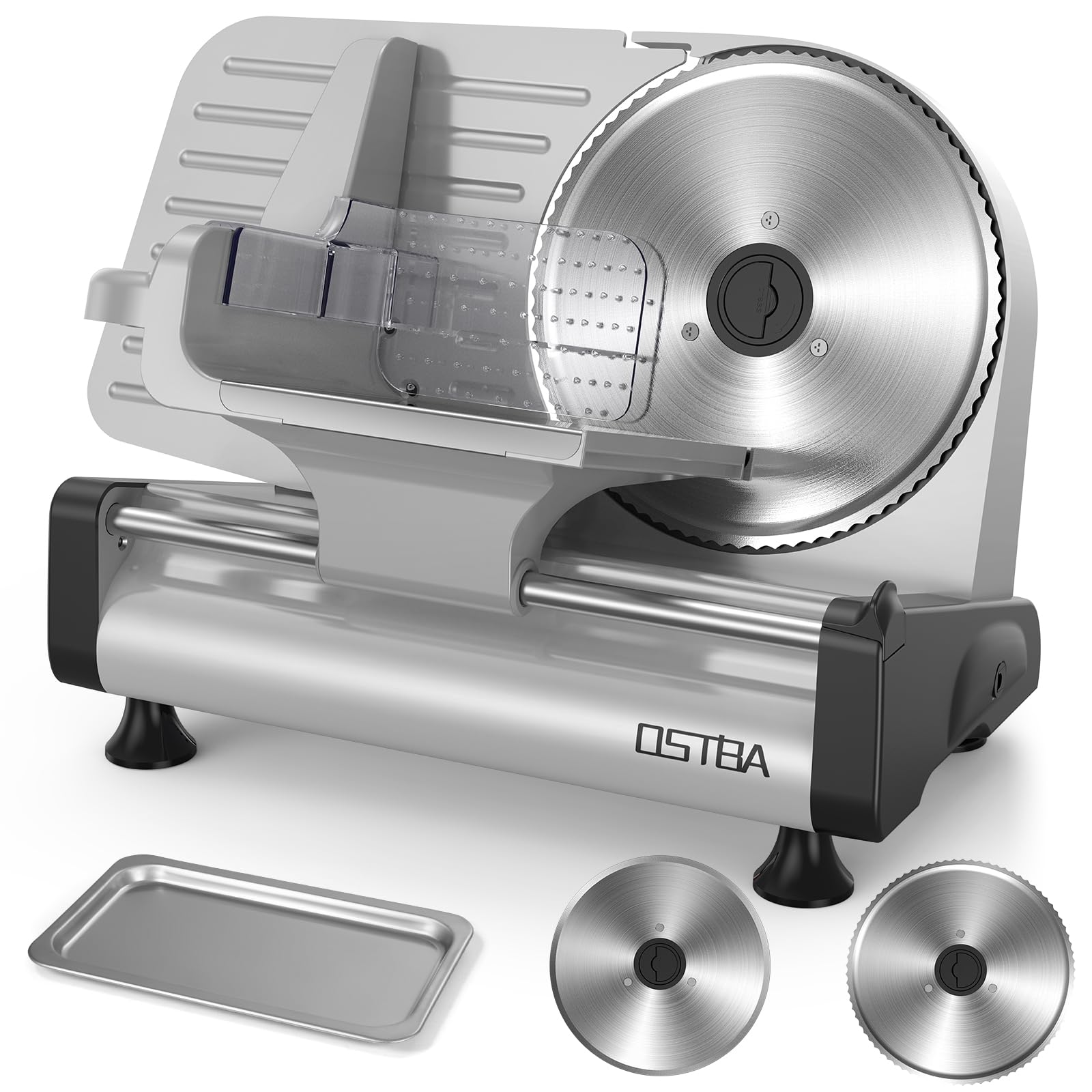
The OSTBA electric meat slicer stands out because it includes both a serrated and a smooth stainless steel blade, each 8.7 inches in diameter — larger than the typical 7.5-inch home blade. The serrated blade excels on crusty sourdough bread and soft tomatoes, while the smooth blade delivers clean, even cuts on raw meat and firm cheese. The 200W DC motor operates quietly and maintains speed through moderate loads, and the adjustable thickness dial provides precise control from paper-thin to 15 mm.
A key practical advantage is that all removable parts — blade, carriage, tray, and pusher — are dishwasher safe. That single feature dramatically reduces the cleanup friction that turns many buyers off meat slicers. The child lock switch, blade cover, and non-slip suction feet address safety and stability concerns. The assist hand grip on the food pusher gives you better leverage when slicing dense ingredients.
Owners report that the OSTBA handles 30 pounds of meat and 15 pounds of cheese in a single session without performance degradation. The thickness adjustment can creep slightly under heavy vibration, so periodic checks during long sessions are wise. The included user manual is sparse, but the design is intuitive enough for most users to set up in minutes. For families who want a versatile, easy-to-clean slicer that does not force them to choose between bread and meat performance, this is the strongest overall option.
Why it’s great
- Two 8.7-inch blades (serrated and smooth) for bread, meat, and cheese
- All removable parts are dishwasher safe for fast cleanup
- 200W DC motor delivers quiet, steady torque
- Child lock switch and non-slip suction feet for safe operation
Good to know
- Thickness dial can drift slightly under continuous heavy load
- Instruction manual lacks detail on maintenance and lubrication
- Not designed for frozen meat — partial thawing required
5. Borlebbi 200W DC Motor Meat Slicer 7.5″

The Borlebbi slicer is engineered around a 200W DC motor that produces significantly less noise than a universal motor, making it a strong choice for early-morning or late-evening prep. It ships with two 7.5-inch stainless steel blades — one serrated, one smooth — giving you the same dual-blade flexibility found on more expensive models. The thickness dial adjusts from 0 to 15 mm with detents that hold their position during use.
The design emphasizes safety and disassembly. A child safety lock prevents accidental startup, non-slip feet grip the counter, and a blade cover protects your hands when the unit is not running. The blade, food carriage, and tray all detach without tools for hand washing. Owners note that the suction cups hold well on smooth surfaces, though placing the slicer on a cookie sheet or cutting board improves grip on textured counters. The motor provides good torque even at low speeds, which is useful for slicing cheese without crumbling.
Several users report using this machine for shaved rib eye for Philly cheese steaks, thin-cut brisket for hot pot, and even canning peppers. The main caution involves meat debris migrating behind the blade into the gear compartment over time — periodic deep cleaning of that area is necessary. For home cooks who prioritize quiet operation and want the versatility of two blade types without jumping to the premium tier, the Borlebbi offers excellent performance per dollar.
Why it’s great
- 200W DC motor runs quieter than most universal-motor slicers
- Includes both serrated and non-serrated 7.5-inch blades
- Child safety lock and blade cover for secure operation
- Detachable design makes routine cleaning straightforward
Good to know
- Food debris can work its way behind the blade into the drive area
- Suction feet may need a smooth surface or mat to hold reliably
- Hand wash only — no dishwasher-safe parts
6. Kalorik Professional Electric Meat Slicer 7.5″

The Kalorik Professional slicer is a straightforward, no-frills machine built around a 200W motor and a 7.5-inch serrated stainless steel blade. The cutting width reaches 6.7 inches, and the adjustable thickness control covers the range most home users need — from thin deli slices to thicker cuts for sandwiches. The included safety pusher has a thumb guard that keeps fingers away from the blade during operation.
The blade and food carriage are removable for cleaning, which is the most important maintenance feature at this price level. Owners consistently mention that the unit is lightweight enough for an older or smaller user to lift and store, and that it cleans up quickly after slicing ham, turkey, or beef jerky. The rubber suction feet hold reasonably well on smooth counters, though some users add a damp towel underneath for extra grip during heavier cutting.
The trade-offs for the entry-level price are noticeable: the chassis is lighter and less rigid than mid-range options, so you may need to hold the unit steady with one hand while feeding with the other. The motor is adequate for weekly use — slicing five to ten pounds of meat or cheese — but will struggle if you try to process large quantities of semi-frozen product. For someone buying their first electric slicer for occasional home use, the Kalorik delivers reliable performance at a budget-friendly entry point.
Why it’s great
- 200W motor and 7.5-inch serrated blade cover standard home slicing needs
- Removable blade and food carriage simplify cleaning
- Safety pusher with thumb guard reduces injury risk
- Lightweight enough for easy storage and handling
Good to know
- Light chassis may require stabilization during heavy slicing
- Not designed for semi-frozen or high-volume commercial use
- Suction feet work best on very smooth surfaces
7. Nutrichef Electric Meat Slicer 7.5″

The Nutrichef electric slicer is the smallest and most affordable unit in this roundup, with a 7.5-inch stainless steel blade and a 200W motor in a frame that measures just 13.9 x 9.9 x 10.9 inches. The compact footprint fits easily into a crowded cabinet or on a narrow counter. The adjustable thickness dial covers 0 to 15 mm, and a removable blade and food carriage make post-use cleaning less tedious than many similarly priced competitors.
This machine is best suited for occasional use: slicing a loaf of homemade sourdough a couple of times a week, portioning cheese for a party platter, or cutting lunch meat from a bulk purchase. The safety guard and food pusher add a layer of protection, and the suction feet hold well enough on laminate or granite counters. Owners note that the blade is very sharp out of the box and that the machine produces consistent slices on bread, cheese, and cold cuts.
The limitations reflect its entry-level price. The motor is slow compared to higher-wattage models, and the build feels less substantial — the blade housing is made from ABS and aluminum rather than full stainless steel or cast iron. Some users report that the unit needs a stabilizing hand during operation, and inconsistency can appear when slicing larger or denser items. For anyone who needs a slicer for light, weekly use and wants to spend the minimum, the Nutrichef gets the job done without taking up much space.
Why it’s great
- Very compact size fits in small kitchens and stores easily
- Adjustable thickness dial covers 0 to 15 mm for versatile slicing
- Removable blade and carriage simplify cleaning
- Sharp blade out of the box handles bread, cheese, and deli meats
Good to know
- Motor is slow and may struggle with large or dense items
- ABS/aluminum build feels less durable than cast metal alternatives
- Requires a stabilizing hand during operation — not suitable for unattended use
FAQ
Can I slice frozen meat with an electric meat slicer?
How often should I sharpen the blade on my slicer?
Why does my slicer produce uneven slices and how do I fix it?
Is it safe to put slicer parts in the dishwasher?
Final Thoughts: The Verdict
For most users, the best rated electric meat slicers winner is the KWS KitchenWare Station MS-10NS because its 320W belt-driven motor, 10-inch NSF-certified blade, and heavy cast aluminum body deliver commercial-grade slicing consistency without requiring a commercial kitchen budget. If you want the flexibility of both serrated and smooth blades with dishwasher-safe cleanup, grab the OSTBA 8.7-inch. And for quiet, dual-blade versatility at a mid-range price point, nothing beats the Borlebbi 200W DC model.