Dull scissors don’t cut cleanly — they tear paper, fray fabric, and turn a quick snip into a frustrating tug-of-war. A purpose-built sharpener for scissors restores that factory-fresh bite without needing a bench grinder or a trip to the hardware store.
I’m Mohammad Maruf — the founder and writer behind AirfryerBite. I spend my time dissecting the hardware specifications of kitchen and utility tools, analyzing pull-through slot geometry, carbide versus ceramic abrasive grades, and the ergonomic factors that separate a one-and-done tool from a drawer-filler.
Whether you’re maintaining sewing shears, kitchen poultry shears, or general household clippers, this guide covers the five models that deliver real results. After reviewing build quality, abrasive materials, and user feedback, I’ve narrowed the field to the sharpener for scissors that consistently brings blades back to life without guesswork.
How To Choose The Best Sharpener For Scissors
Buying a scissor sharpener is not the same as buying a knife sharpener. Scissor blades meet at an angle and require a tool that respects both the bevel geometry and the pivot alignment. The wrong abrasive or slot design can ruin a pair of good shears in seconds.
Dedicated Scissor Slot vs. Multi-Tool Compromise
Many combo knife-and-scissor sharpeners treat the scissor slot as an afterthought — a narrow groove that forces you to drag the blade at an unnatural angle. The best sharpeners either include a purpose-designed scissor stage (like a carbide V-notch set at the correct 70-80 degree included angle) or use a side-flat method where the sharpener body itself guides the blade. Look for explicit scissor functionality in the product description, not a vague “also sharpens scissors” claim.
Abrasive Type: Carbide vs. Ceramic
Tungsten carbide blades are aggressive — they remove steel quickly to restore a dull or nicked edge in three to four strokes. Ceramic rods and wheels are finer and meant for honing, not material removal. A two-stage system that combines carbide for shaping and ceramic for deburring delivers the most consistent edge. For scissor-specific tools, ceramic grinding heads that adjust automatically to the blade’s bevel (like the Fiskars design) offer a gentler, lower-risk approach for regular maintenance.
Stability and Hand Fatigue
A sharpener that slides across the counter during a pass introduces inconsistent pressure and increases the risk of scratching the blade. Suction-base models (like the SHARPAL 191H) lock the tool in place so both hands are free to control the scissors — especially useful for left-handed users or anyone working with long fabric shears. Pocket-sized tools without suction rely on a non-slip rubber base and the user’s downward pressure, which works for quick touch-ups but can fatigue the wrist during a multi-blade session.
Quick Comparison
On smaller screens, swipe sideways to see the full table.
| Model | Category | Best For | Key Spec | Amazon |
|---|---|---|---|---|
| SHARPAL 191H | Pull-Through | All-in-one kitchen/shears | 3-stage: carbide + ceramic + scissor slot | Amazon |
| Klein Tools 48036 | Pull-Through | Trade/utility scissors | Tungsten carbide inserts, 1.6 oz | Amazon |
| Smith’s Pull-Thru | Pull-Through | Quick knife touch-ups | Coarse carbide + ceramic honing rods | Amazon |
| Edgemaker Pro 331 | Crossed-Steel | Long-term kitchen sharpening | Rotatable crossed steels, 0.26 lb | Amazon |
| Fiskars Universal | Cut-Through | Fiskars scissor owners | Ceramic grinding heads, ambidextrous | Amazon |
In‑Depth Reviews
1. SHARPAL 191H 3-Stage Sharpening Tool
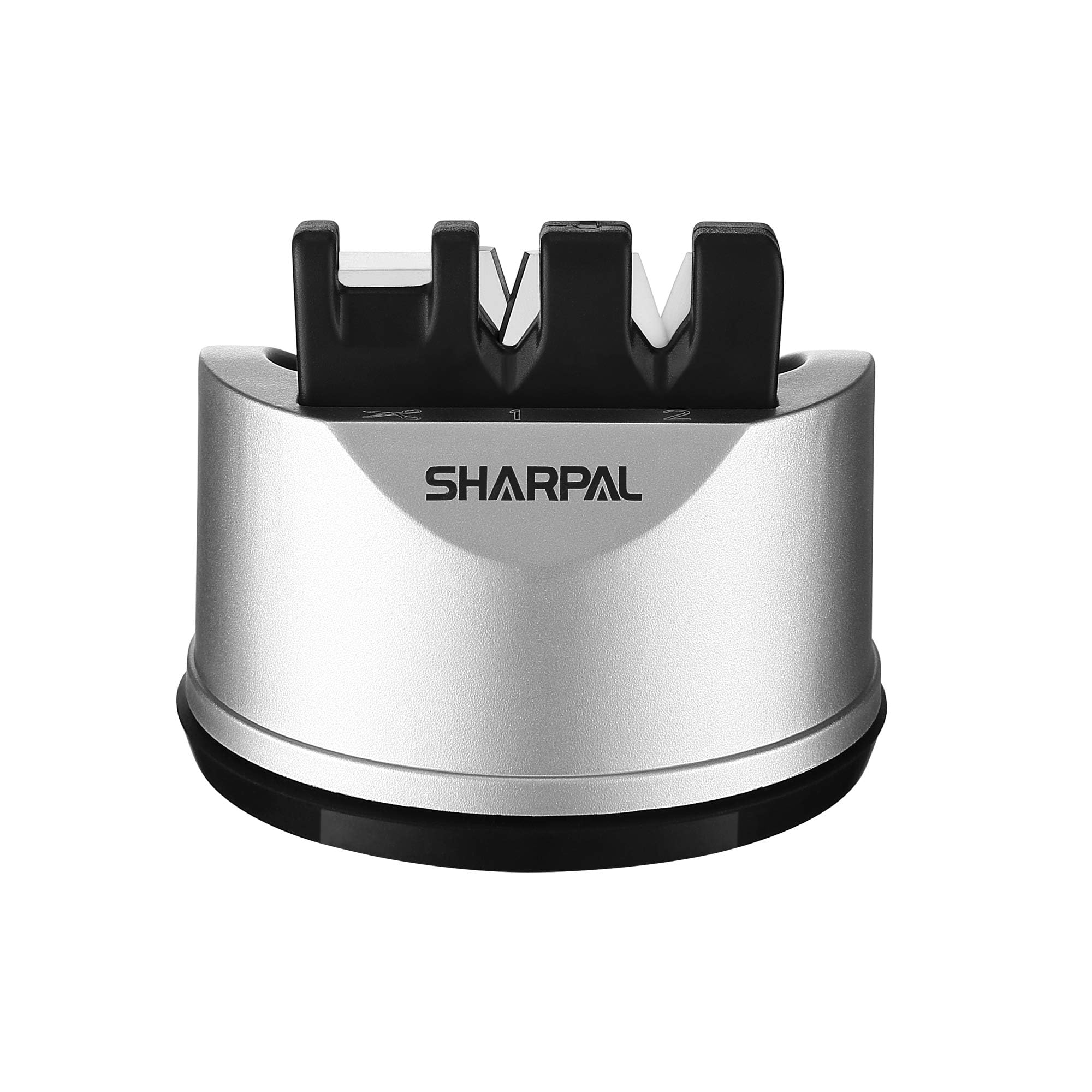
The SHARPAL 191H stands out because it dedicates an entire third stage exclusively to scissors — a tungsten carbide V-notch set at the correct angle — rather than forcing scissors through a knife slot. The first two stages handle knives (carbide for edge setting, ceramic for honing), but the scissor-specific slot is what earns this unit the top spot. The suction base generates twice the holding force of competing models, so the sharpener stays planted while you draw the blade through with consistent pressure.
At just over 3 ounces and a 2.76-inch cube footprint, it disappears into a drawer. The three-year warranty from a California-based company adds confidence that the carbide and ceramic elements will hold up through repeated use. User reports confirm it revived severely dull fabric shears and kitchen poultry scissors in under a minute each, with no prior sharpening experience required.
The trade-off is that the scissor slot works best on straight-edge scissors with blade widths that fit the fixed V-notch. Extremely thin embroidery scissors or oversized garden loppers may not seat properly. For the vast majority of household and workshop shears, however, this is the most foolproof design available at this price tier.
Why it’s great
- Dedicated scissor stage with correct carbide angle
- Powerful suction base prevents sliding during use
- Compact storage and lightweight for portability
Good to know
- Fixed V-notch may not accept extra-thin or extra-thick scissor blades
- Plastic housing feels functional but not premium
2. Klein Tools 48036 Combination Knife and Scissors Sharpener

Klein Tools built this sharpener for electricians and tradespeople who rely on their snips and scissors daily. The tungsten carbide inserts sharpen both sides of a blade simultaneously, and the scissor sharpening method is refreshingly direct: lay the sharpener flat on its side and draw the scissor blade through the dedicated slot. The built-in finger guard protects your hand from the blade edge — a practical safety touch that no other model in this roundup offers.
Weighing only 1.6 ounces with a 4-inch length, this unit slips into a tool pouch without adding bulk. The bright yellow body makes it easy to spot in a cluttered toolbox or drawer. User feedback is consistent: it restores Klein electrician scissors to like-new sharpness in a few strokes and handles standard household shears with equal ease. The lifetime warranty on material defects and workmanship is another sign that Klein expects this tool to last through years of job-site abuse.
The limitation is that it is not a precision sharpener. The carbide inserts remove material quickly but leave a working edge rather than a razor-polished finish. Users who need a hair-whittling edge on fine sewing shears will want to follow up with a diamond hone or whetstone. This tool is optimized for speed and utility, not artistry.
Why it’s great
- Finger guard adds safety during scissor sharpening
- Lightweight and compact for tool-bag carry
- Lifetime warranty from a trusted pro-tool brand
Good to know
- Leaves a working edge, not a polished razor finish
- Not suitable for serrated scissors or heavily nicked blades
3. Smith’s Pull-Thru Knife Sharpener
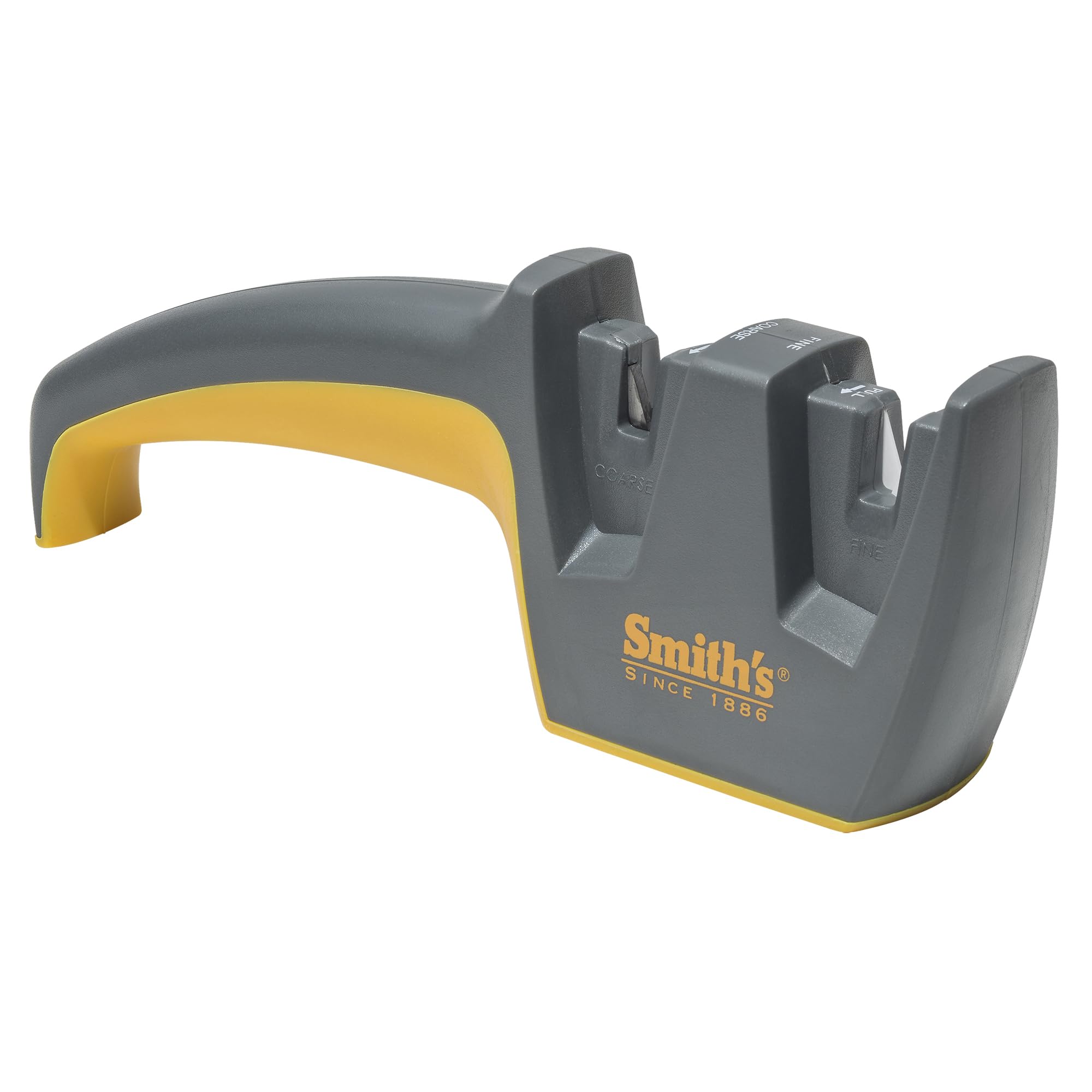
Smith’s Pull-Thru is primarily a knife sharpener, but the ceramic honing rods on the fine side can be used to lightly touch up straight-edge scissor blades. The carbide slot aggressively resets a dull edge, and the ceramic rods then deburr and hone the bevel. The non-slip rubber base and ergonomic soft-grip handle make the tool comfortable to hold during repetitive passes — a benefit when you are working through a full block of kitchen knives plus a pair of shears.
The pre-set sharpening angles (coarse carbide at a fixed angle, ceramic rods at a finer angle) eliminate the guesswork of angle setup. Users report that the fine side works well for maintaining serrated-edge scissors, a niche advantage since most scissor sharpeners explicitly exclude serrated blades. The replaceable carbide and ceramic components extend the tool’s lifespan well beyond disposable sharpeners.
This is not a scissor-dedicated tool. It lacks a purpose-built scissor slot, so you have to use the knife slots and adjust your technique. For someone who sharpens more knives than scissors and wants a single gadget that can handle both in a pinch, this is a solid mid-range choice. But if scissors are your primary concern, the dedicated scissor stage on the SHARPAL or the side-flat method on the Klein will deliver better results with less fuss.
Why it’s great
- Replaceable carbide and ceramic components for long life
- Non-slip base and ergonomic handle reduce fatigue
- Fine ceramic slot can touch up serrated scissors
Good to know
- No dedicated scissor slot — requires technique adaptation
- Coarse carbide can over-remove steel if too much pressure is applied
4. The Edgemaker Knife Sharpener Pro 331

The Edgemaker Pro 331 uses two crossed ceramic-steel rods that sharpen and hone simultaneously as you draw the blade through them. Unlike pull-through sharpeners that rely on fixed V-slots, the crossed rods automatically self-adjust to the blade’s thickness and bevel angle. This design works on straight, wavy, and serrated blades, making it versatile for multi-tool households. Users consistently report that the tactile feedback lets them feel the edge being set, reducing the risk of over-sharpening.
Durability is a standout feature. The high-impact plastic body is unbreakable in normal use, and the rods can be pulled out, rotated 180 degrees, and reinserted to present a fresh sharpening surface. With regular rotation, a single set of rods lasts for years. Users have reported getting a decade of daily use from one unit. For scissors specifically, the technique involves drawing each blade individually through the crossed steels, which takes a bit of practice but yields a clean, uniform edge.
The main drawback is that the Edgemaker is not designed for heavily damaged or nicked blades; a bench stone is still the best first step for those cases. Additionally, the learning curve for scissor sharpening is steeper than a dedicated scissor slot — you need to maintain a steady angle and consistent draw speed. For users willing to invest a few minutes of practice, the payoff is a tool that outlasts multiple replacements.
Why it’s great
- Self-adjusting crossed rods adapt to any blade bevel
- Rotatable rods extend sharpener lifespan indefinitely
- Tactile feedback prevents over-sharpening
Good to know
- Steeper learning curve for scissor sharpening
- Not for severely nicked or damaged blades
5. Fiskars Universal Scissor Sharpener
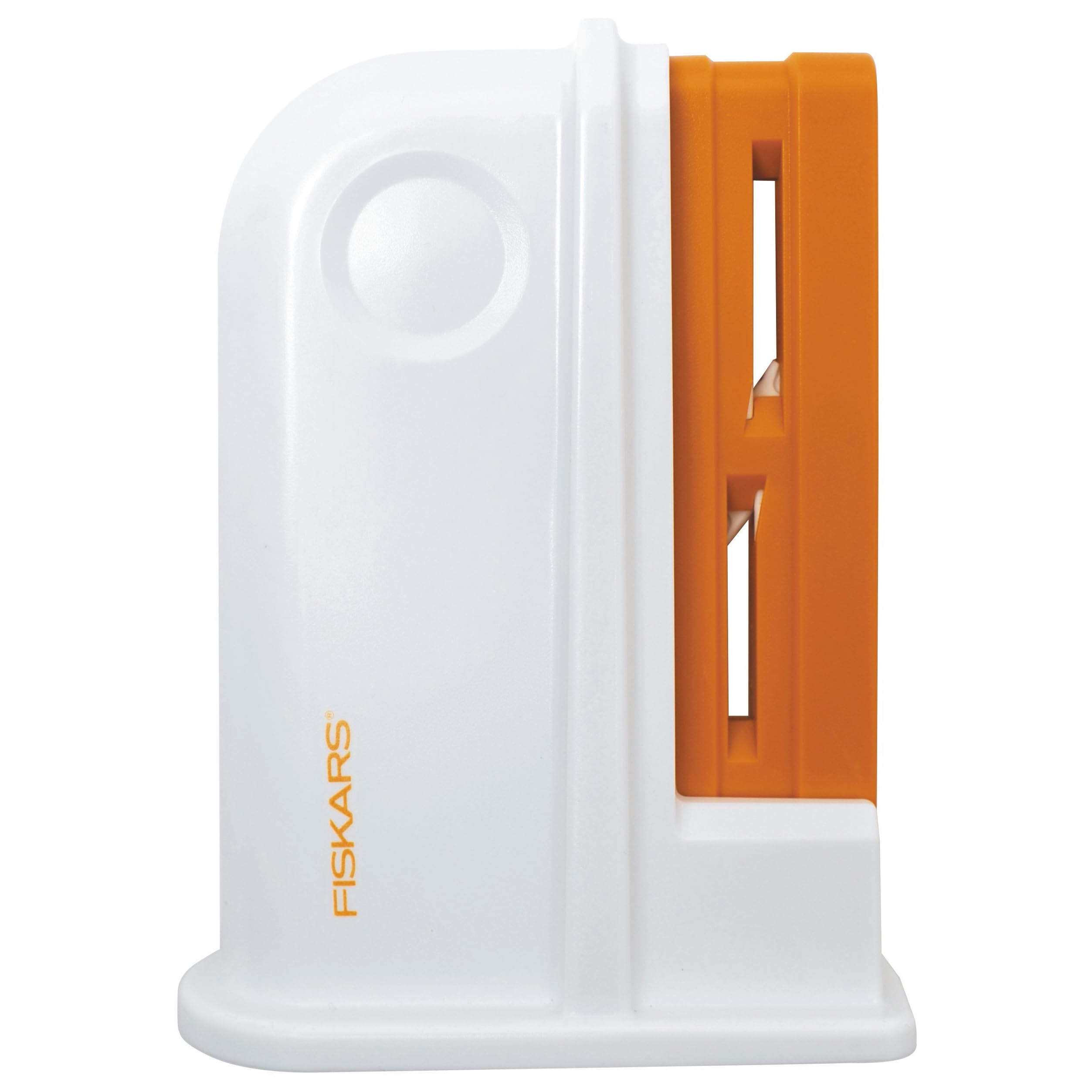
Fiskars designed this sharpener exclusively for scissors — no knife slots, no multi-tool compromise. Its ceramic grinding heads automatically adjust to the scissor blade’s bevel angle as you perform a natural cutting motion. You simply open the scissors wide, place the blade into the slot, and make several cutting strokes. The ceramic heads grind both sides of the blade simultaneously, mirroring the scissor’s own cutting geometry. This makes it the most intuitive scissor-specific tool in the lineup.
The ambidextrous design accommodates both right- and left-handed users without any adjustment. The compact body (13.8 cm long) with finger-grip notches feels secure in the hand. Fiskars specifically recommends this for conventional and RazorEdge blades, and user reports confirm it excels on Fiskars-brand scissors at all price points. The hygienic plastic body is easy to rinse under running water after use, and the steel/ceramic components resist rust.
The catch is compatibility. This sharpener is optimized for Fiskars scissors and scissors with similar blade geometry. Users who tried it on unbranded shears with different edge angles or curved tips reported poor results. It also cannot handle zigzag pinking shears, scissors with curved tips, or serrated-edge blades. For owners of Fiskars scissors, this is an effortless maintenance tool. For a mixed-brand household, the SHARPAL or Klein models offer broader compatibility.
Why it’s great
- Intuitive cut-through action matches scissor mechanics
- Ceramic heads self-adjust to blade bevel angle
- Works for left- and right-handed users out of the box
Good to know
- Works best with Fiskars and similar blade geometries
- Does not sharpen serrated, curved-tip, or zigzag scissors
FAQ
Can I sharpen serrated scissors with a pull-through sharpener?
Why does my sharpener have a knife slot but no scissor slot?
How often should I sharpen household scissors?
Final Thoughts: The Verdict
For most users, the sharpener for scissors winner is the SHARPAL 191H because it combines a dedicated scissor-specific carbide stage with a rock-steady suction base and a compact footprint — all at a price that undercuts multi-tools with weaker scissor performance. If you want a trade-ready tool that fits in a tool pouch and includes a finger guard, grab the Klein Tools 48036. And for owners of Fiskars scissors who want zero-guesswork maintenance, nothing beats the Fiskars Universal Scissor Sharpener.