Your knives are the single most expensive tool in your kitchen, and a dull edge makes them a liability. Whether you are slicing through a ripe tomato or breaking down a primal cut of beef, the difference between a dangerous drag and a clean, effortless cut comes down to one thing: the quality of your edge. A professional-grade sharpener is not a luxury; it is the essential complement to every high-end chef’s knife, hunting blade, or pocket knife you own.
I’m Mohammad Maruf — the founder and writer behind AirfryerBite. I have spent years combing through the metallurgy of blade steels, analyzing the grit progression of diamond abrasives, and comparing the torque ratings of motor-driven systems to determine what actually delivers a repeatable, factory-level edge in a home environment.
The market offers everything from budget-friendly pull-through tools to precision-guided clamping systems, but finding the right hardware requires understanding abrasive grit, angle control, and build tolerances. After extensive research and comparison, here is my curated analysis of the best professional knife sharpener options available.
How To Choose The Best Professional Knife Sharpener
Selecting a sharpener for regular professional or enthusiast use requires more than picking the highest price tag. You must match the system to your blade portfolio, your willingness to learn a technique, and the specific finish you demand from an edge. Look past the marketing and focus on three defining characteristics that separate a capable system from a mediocre one.
Sharpening Mechanism: Guided Systems vs. Freehand Designs
The fundamental divide in this category is between systems that lock the blade at a fixed angle versus those that rely on your hand-eye coordination. Precision-guided clamp systems, such as those using a spherical bearing rod guide or a rigid angle arm, eliminate human error and allow you to reproduce the exact same bevel on both sides of the blade. This is non-negotiable for high-hardness steels like S90V or ZDP-189 that require consistent pressure. Conversely, spring-loaded pull-through sharpeners are faster but typically lack the fine angle adjustment needed for a true professional edge on premium knives.
Abrasive Quality and Grit Progression
The abrasive medium determines how quickly you remove metal and how refined the final edge is. Monocrystalline diamond plates cut aggressively and last through dozens of sharpenings, making them ideal for reprofiling a chipped edge. Ceramic and whetstone plates (3000 to 6000 grit) refine the scratch pattern to a polished, near-mirror finish. A sharpener that offers a broad progression—from a coarse 140 or 220 grit up to a fine 1500 or 6000 grit—gives you the flexibility to handle both heavy restoration and delicate finishing on the same system. Beware of systems that only offer one or two grit options; they force you to compromise on either speed or polish.
Angle Adjustment Range and Locking Precision
A professional system must let you dial in the edge angle with real precision. Most kitchen knives benefit from a 15 to 20 degree bevel per side, while outdoor and pocket knives often require a more robust 20 to 30 degree edge. Look for a mechanism that is marked in one-degree increments and locks firmly without drift. Systems that rely on a simple screw clamp without detents can shift mid-stroke, ruining the bevel. The best systems incorporate a digital angle indicator or a distance-based setting that compensates for blade width variations, ensuring the angle you set is the angle you hold from the first stroke to the last.
Quick Comparison
On smaller screens, swipe sideways to see the full table.
| Model | Category | Best For | Key Spec | Amazon |
|---|---|---|---|---|
| SHARPAL 202H | Guided System | Angle precision across all blade widths | Angle range 10°–35°; 7 abrasives (diamond + whetstone + strop) | Amazon |
| KME Precision | Guided System | Repeatable edges on hard powder steels | Spherical bearing rod guide; continuous 17°–30° angle adjustment | Amazon |
| Work Sharp Precision Adjust | Guided System | Kitchen and pocket knives with digital angle assist | Digital angle indicator; 7 abrasives (220–800 diamond, ceramic, strop) | Amazon |
| Chef’sChoice 15XV | Electric | Quick 15-degree edges on straight and serrated knives | 100% diamond abrasives; 3-stage; 1 min initial sharpening | Amazon |
| Work Sharp Ken Onion | Belt System | Fast edge generation for varied blade types | Variable speed motor; flexible abrasive belts; angle range 15°–30° | Amazon |
| WEN BG4270T | Water-Cooled | Chisels, planer blades, and long kitchen knives | 10″ 220 grit stone; 8″ leather strop; 115 RPM; reversible rotation | Amazon |
| VN3 Grihot | Pull-Through | Quick maintenance on steel kitchen knives | 304 stainless steel body; tungsten carbide springs; 3-action stages | Amazon |
In‑Depth Reviews
1. SHARPAL 202H Precision Knife Sharpening System
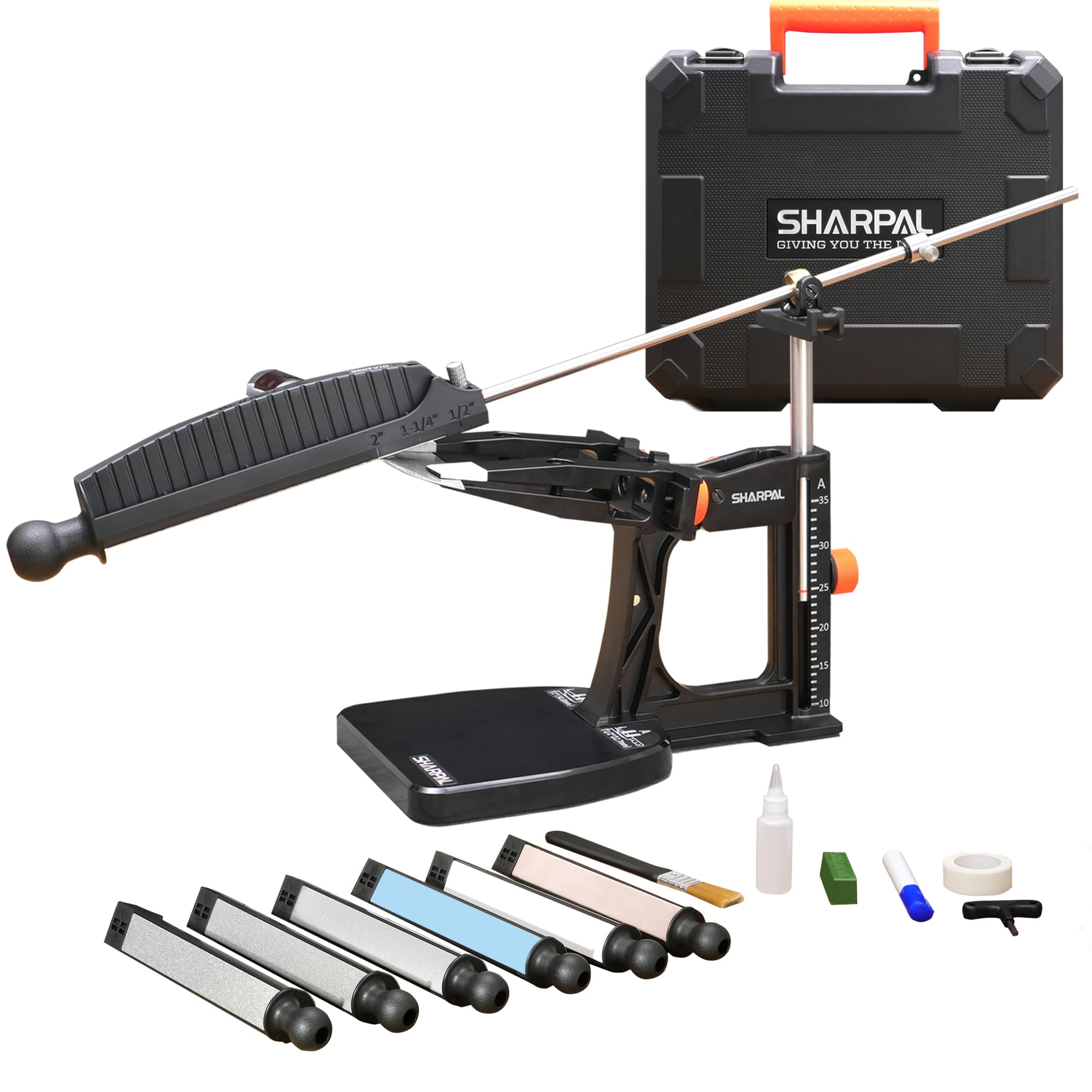
The SHARPAL 202H represents a serious leap in angle-guided sharpening for anyone who demands sub-degree precision across a wide range of blade geometries. Its distance-based angle setting mechanism fixes the edge-to-clamp distance, eliminating the width-related inaccuracies that plague traditional pivot-arm systems. You can smoothly dial in any angle from 10 to 35 degrees in one-degree increments, and the dual sliding clamps hold blades of any length securely without shifting during a stroke. The seven-piece abrasive library—monocrystalline diamond plates in 220, 325, 600, and 1000 grit, plus 3000 and 6000 grit whetstone plates and a leather strop—covers everything from grinding out a chip on a thick cleaver to polishing a 15-degree edge on a Japanese gyuto to a hair-whittling finish.
What separates this system from lower-tier competitors is the flip-clamp design. You do not need to remove the blade to switch sides; the clamp body rotates, keeping the angle identical on both bevels. This is a massive time-saver and eliminates the most common source of asymmetrical edges. The base is heavy-duty metal with an anti-slip pad, and the entire kit packs into a rigid zippered case that organizes every stone and strop securely. Users report achieving a razor-sharp, toothy edge in about three minutes using the 600-grit diamond plate and strop, and a fully polished mirror edge in seven to ten minutes through the full progression. The system handles blades from narrow pocket knives to extra-wide meat cleavers without issue.
The only real concession is that the included 3000 and 6000 whetstone plates require wetting for best performance, which adds a minor step compared to fully dry diamond-only systems. Additionally, the jaws are designed for blades up to roughly 0.375 inches thick, so very thick custom bushcraft knives may require a small modification. However, for the vast majority of kitchen, hunting, and pocket knives, the SHARPAL 202H delivers consistent, repeatable results that rival systems costing significantly more.
Why it’s great
- Distance-based angle setting eliminates width-related errors and improves consistency across different blade sizes
- Full seven-grit progression from coarse diamond to fine whetstone plus strop covers both restoration and mirror finishing
- Robust metal construction with anti-slip base and premium zippered carry case for storage and transport
Good to know
- Whetstone plates require wetting for optimal cutting action, adding a small extra step to the process
- Jaw opening may be too tight for blades thicker than 0.375 inches without minor adjustment
2. KME Precision Knife Sharpener System with 4 Gold Series Diamond Hones

The KME Precision system has earned a loyal following among blade enthusiasts who value zero angle deviation and rock-solid repeatability on hard powder metallurgy steels. The spherical bearing rod guide is the standout engineering decision here: it eliminates any side-to-side play in the sharpening motion, which means every stroke follows exactly the same plane. The angle adjustment is continuous from 17 to 30 degrees and is marked in one-degree increments on the base, and the rotating knife fixture means you never have to unmount the blade to switch sides. This is a critical design advantage that reduces the chance of introducing a secondary bevel. The kit ships with four Gold Series 1×4-inch diamond hones in 140, 300, 600, and 1500 grit, giving you a solid foundation for reprofiling and refining.
KME’s clamping system uses a firm padded jaw that grips without marring the blade finish, and the clamp pivots on a threaded rod that adjusts to different tang widths. Users report that the system excels at establishing a fresh edge on steels like AUS8, S30V, and even S90V after about twenty knives. The 1500-grit finish is adequate for most everyday carry blades, but many serious users add the optional 2000-grit ceramic stone or a separate strop to achieve a kitchen-ready polished edge. The system is built around a compact wooden base that is stable on a bench, and the entire kit stores in a hard carry case that is easy to take to a job site or on a hunting trip.
Where the KME shows its age is in fit and finish. The tiny set screws that secure the stone holder are easy to lose and require periodic tightening during a session. The build quality is functional rather than luxurious, and the case requires near-full disassembly for storage. Some users note that the angle indicator on the base is not perfectly calibrated from the factory, so a magnetic angle block is recommended for first-time setup. Despite these minor frustrations, the KME remains one of the most capable manual sharpeners for the price and is widely considered the easiest system to master for beginners who want immediate results.
Why it’s great
- Spherical bearing rod guide delivers zero side-to-side play for extremely consistent bevels on every stroke
- Rotating knife fixture allows side switching without unmounting the blade, preserving angle precision
- Diamond hones cut hard steels like S90V and ZDP-189 effectively even after extensive use
Good to know
- Tiny set screws can loosen during sharpening and are easy to drop or misplace
- Angle indicator may require calibration with a magnetic angle lock for perfect repeatability
3. Work Sharp Professional Precision Adjust Knife Sharpener Kit

The Work Sharp Professional Precision Adjust is a thoroughly modern guided system that incorporates a digital angle indicator directly into the base, removing any guesswork from the setup. You select your target angle between 15 and 30 degrees, and the digital readout confirms it before you make the first pass. The kit includes seven abrasive panels: 220, 320, 400, 600, and 800-grit diamond plates, plus a fine ceramic stone and a leather strop. This progression lets you move from heavy reprofiling of a dull utility knife all the way to a polished, shaving-sharp edge without switching systems. The construction is predominantly metal, giving the unit a reassuring heft that resists tipping during aggressive strokes, and the tilting base accommodates longer blades up to chef’s knife length without the handle hitting the table.
The rotating arm feature is well executed. You clamp the blade once, and the arm pivots to the opposite side to maintain the same angle on the second bevel. This eliminates the most common failure point in manual sharpening—inconsistent pressure between sides. The magnetic stone holder makes swapping abrasives fast, and the included digital angle finder can also be used to check the existing bevel on a knife before you start. Users consistently report achieving near-factory edges on their first attempt, and the system is particularly forgiving for novices who have struggled with freehand methods. The 3-year warranty and Oregon-based engineering give additional confidence in the build quality.
There are two notable limitations. The first is that the clamp design can obstruct sharpening at angles below 18 degrees for blades with especially thick spines or unusual handle geometry. The second is that the included case is not designed for permanent storage; you must remove the arm and clamp to fit everything back in, and some users prefer to buy a separate hard case for long-term organization. For most kitchen and pocket knives, however, this system delivers outstanding, repeatable results with minimal frustration.
Why it’s great
- Digital angle indicator provides precise, repeatable setup without relying on markings or guesswork
- Full seven-abrasive progression from 220 diamond to ceramic and strop for near-mirror finishes
- Metal construction and tilting base offer stability and clearance for long chef’s knives
Good to know
- Clamp may obstruct sharpening at 15-degree angles for blades with thick or oddly-shaped spines
- Case requires partial disassembly for storage, not ideal for permanent kit organization
4. Chef’sChoice 15XV Professional Electric Knife Sharpener

The Chef’sChoice 15XV is the electric sharpener that serious home cooks turn to when they want a consistent 15-degree Trizor XV edge in under a minute. The brushed metal housing and five-pound weight give it a commercial-grade presence that stays planted on the counter. The core technology is the three-stage EdgeSelect system: Stage 1 uses 100-percent diamond abrasives for initial edge shaping, Stage 2 uses finer diamond abrasives for honing, and Stage 3 deploys a patented flexible abrasive system that polishes the edge and supports serrated blades. The flexible spring guides automatically adjust to the blade geometry, so you do not need to manually set an angle—the sharpener handles it for you. A full initial sharpening takes approximately one minute, and subsequent resharpening is around ten seconds per knife.
The 15XV is particularly effective at converting standard 20-degree factory edges down to the sharper 15-degree profile that Japanese and high-end German knives benefit from. Users report that the sharpener easily removes small nicks and restores a passable factory edge even on heavily abused blades. The machine operates at a noise level between 65 and 75 dB, which is tolerable for a kitchen environment. The integrated storage for the power cord is a thoughtful touch, and the rubber feet prevent sliding during use. The sharpener handles both straight-edge and serrated knives, and the serrated setting (Stage 3 alone) preserves the scalloped geometry without flattening the teeth.
The trade-off is material removal speed. The electric diamond abrasives remove metal faster than a manual stone, which is great for speed but means you must avoid excessive passes or you will shorten the lifespan of your blade. Some users note that the outer case labeling can be inconsistent, and the control switch is simple on/off without a grit selector. This is a dedicated tool for quick, repeatable edges and is not designed for heavy reprofiling or mirror polishing beyond the 15-degree bevel. For a fast every-day option that gets your knives back to work in seconds, the Chef’sChoice is a proven performer.
Why it’s great
- Three-stage diamond abrasive system delivers a consistent 15-degree edge in about one minute
- Flexible spring guides automatically accommodate blade thickness without manual angle adjustment
- Durable brushed metal housing at five pounds stays stable during fast sharpening sessions
Good to know
- Electric diamond abrasives remove metal quickly, so overuse can shorten blade life on thin knives
- Simple on/off control without grit selection limits flexibility for custom edge refinement
5. Work Sharp Ken Onion Knife Sharpener Tool Mk.2

The Work Sharp Ken Onion Edition Mk.2 is a belt-driven sharpening system designed for edge enthusiasts who need to handle a wide variety of blade types—from kitchen knives and scissors to axes and serrated blades. The key differentiator here is the electronic speed control and the flexible abrasive belt system. The variable-speed motor lets you dial down the belt speed for delicate edges or crank it up for fast reprofiling of a dull hatchet. The belt conforms to the blade edge, which means you can maintain a consistent bevel even on curved blades like a sheepfoot or a trailing-point hunting knife. The Mk.2 includes precision sharpening guides that help lock in the angle from 15 to 30 degrees, and the ergonomic design by Ken Onion makes the tool comfortable to handle during extended sessions.
Users consistently praise the speed and versatility of the Ken Onion system. It can take a badly dulled chef’s knife from butter-knife status to paper-cutting sharp in under two minutes. The ability to swap belts in different grits—from coarse 80-grit for heavy stock removal up to 6000-grit for finishing—gives you a broad range of edge outcomes. The Mk.2 also includes a slot for sharpening scissors and a separate guide for serrated blades. The unit is compact enough to store in a small cabinet and weighs just two pounds, making it portable for taking to a hunting lodge or workshop.
The main learning curve is belt control. Because the belt moves at speed, you must develop a steady hand to avoid rounding the tip or over-grinding at the heel of the blade. The belts are consumable and wear out after several uses, so you will need to budget for replacement packs. The unit is also on the louder side compared to stone-based systems. For users who prioritize speed, versatility, and the ability to tackle tough outdoor tools in addition to kitchen knives, the Ken Onion is a formidable tool.
Why it’s great
- Variable-speed motor and flexible belts allow rapid material removal on knives, scissors, and axes
- Wide grit range from coarse 80-grit to fine 6000-grit belts covers both heavy restoration and finishing
- Compact two-pound design with storage-friendly dimensions is easy to transport
Good to know
- Requires practice to avoid rounding blade tips and heels due to belt speed and hand motion
- Belts are consumables and will require periodic replacement to maintain cutting performance
6. WEN BG4270T 10-Inch Two-Direction Water Cooled Wet/Dry Sharpening System

The WEN BG4270T is a water-cooled sharpening system that prioritizes precision and heat-free grinding at an approachable price point. The setup features a 10-inch, 220-grit sharpening stone that rotates at a slow 115 RPM, which is significantly slower than most bench grinders. This low speed, combined with the adjustable water reservoir, prevents the blade from overheating and losing its temper—a critical advantage for Japanese high-carbon steels and thin kitchen blades. The unit also includes an 8-inch leather stropping wheel that you dress with the included honing compound for final edge polishing. A simple switch reverses the rotational direction, allowing left- and right-handed users to sharpen comfortably, and the universal jig support accepts a range of aftermarket accessories, including Tormek-compatible adapters.
The 35.5-pound weight and 16.5-inch height make this a stationary tool that you will keep on a dedicated bench or table. In return, you get a system that excels at sharpening chisels, planer blades, and long slicing knives that are awkward to clamp in a guided system. The included angle guide and jig for chisels and planer blades make it a strong choice for woodworkers who also need sharp kitchen knives. Users report that the water reservoir keeps the stone cool even during extended sessions, and the 220-grit stone is aggressive enough to remove nicks while slow enough to give you fine control over the bevel.
The main compromise is that the system is limited to a single 220-grit stone and a leather strop. While the stropping wheel can produce a polished edge, the user is responsible for managing the progression manually. Those seeking a multi-grit range will need to purchase additional stone sets or rely on the universal jig support. The jig grommets can be tight, and some users find the included accessories feel less refined compared to higher-priced competitors. For the craftsman who needs a water-cooled, low-speed stone for both woodworking tools and kitchen knives, the WEN offers excellent value.
Why it’s great
- Slow 115 RPM rotating stone with water cooling prevents blade overheating and preserves heat treatment
- Universal jig support accepts Tormek-compatible accessories for expanded versatility
- Reversible rotation accommodates both left- and right-handed use comfortably
Good to know
- Single 220-grit stone limits grit progression without purchasing additional abrasive sets
- Jig grommets can be tight and may require swapping with aftermarket parts for smoother operation
7. VN3 Grihot Professional Knife Sharpener
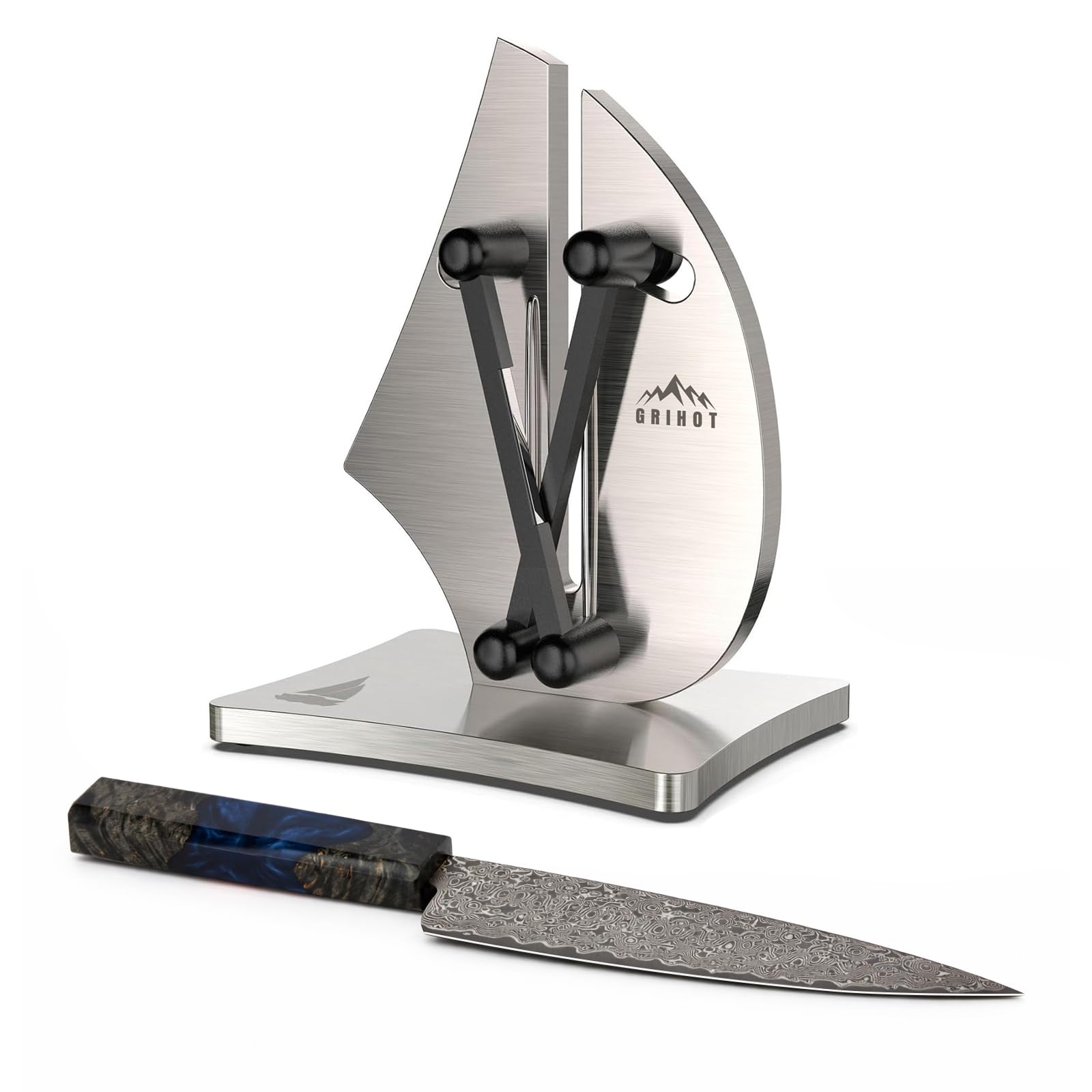
The VN3 Grihot is a manually operated pull-through sharpener built around two independent spring arms made from tungsten carbide. The sailboat-inspired design is made of solid 304 stainless steel that has undergone 196 hours of polishing, resulting in a heavy, stylish countertop tool that weighs 1.93 pounds. The system uses a three-action base: one set of slots for edge repair (aggressive coarse), one for restoration (medium), and one for fine sharpening. The spring-loaded arms automatically adjust to the existing blade angle, accommodating angles between 11 and 21 degrees. This makes the VN3 suitable for both Western-style German knives and thinner Japanese blades without any manual setup.
Users who invest time in learning the technique find that the VN3 produces sharp edges quickly, typically in under 30 seconds per knife. The heavy stainless steel body does not slide around on the counter, and the sailing look is genuinely attractive compared to most utilitarian pull-through sharpeners. The device includes spare tungsten carbide replacement cartridges, and the five-year warranty covers the stainless steel structure. Reviewers note that after about 20 minutes of practice, they were able to sharpen 20 knives, including serrated bread knives, with noticeable improvement in cutting performance. The cost of the sharpener pays for itself after a single session compared to professional sharpening services.
The limitation is that the spring-loaded mechanism removes metal aggressively, and the angle is not user-defined—it follows the existing blade bevel. This means you cannot use it to reprofile a knife to a different angle or remove a deep chip in a single stroke. The pull-through design also does not support stropping or polishing beyond the built-in fine stage, so you will not achieve a true mirror finish. For quick maintenance of standard steel kitchen knives, the VN3 is an effective, well-built tool, but it lacks the angle control and grit progression that serious blade enthusiasts demand.
Why it’s great
- Heavy 304 stainless steel body and five-year warranty provide a durable, long-term countertop tool
- Tungsten carbide springs self-adjust to blade bevels from 11 to 21 degrees for quick sharpening
- Spare tungsten carbide cartridges included, extending the life of the sharpening elements
Good to know
- Pull-through design does not allow user-defined angle selection or blade reprofiling
- Limited to a single fine stage for finishing; no stropping or mirror polish capability
FAQ
What is the best angle for sharpening kitchen knives?
Are electric sharpeners safe for high-end Japanese knives?
Can a professional sharpener fix a chipped blade?
Final Thoughts: The Verdict
For most users, the best professional knife sharpener winner is the SHARPAL 202H because it combines a distance-based angle system, a full seven-abrasive progression from coarse diamond to polishing whetstone, and robust metal construction into a package that suits both high-end kitchen knives and pocket blades. If you want a fast, electric option for daily use with no setup, grab the Chef’sChoice 15XV. And for a portable system with digital angle assist and excellent consistency on wide chef knives, nothing beats the Work Sharp Precision Adjust.