The biggest complaint about bread machines is simple: they devour counter space. Standard models stretch over 15 inches deep and weigh enough to warrant a permanent spot, leaving tiny kitchens, apartments, and RVs with an impossible choice — fresh bread or an uncluttered workspace. A machine built for tighter quarters solves that standoff by shrinking every dimension without sacrificing the loaf volume you actually need.
I’m Mohammad Maruf — the founder and writer behind AirfryerBite. I’ve spent years analyzing the internal specs of compact kitchen appliances, cross-referencing heating element placement, pan geometry, and program logic to identify which small-format machines actually bake evenly rather than just looking small.
After evaluating dozens of models across price tiers, I’ve narrowed the field to the compact performers worth your counter space. This guide covers the most capable options for the best small bread machine based on footprint, loaf quality, and real-world durability.
How To Choose The Best Small Bread Machine
Trim the feature noise and focus on the three specs that determine whether a compact bread machine actually works well or just takes up less space while baking poorly. Footprint, loaf capacity, and pan coating are the only filters that matter for small kitchens.
Footprint vs. Loaf Capacity
A machine that measures 13 inches deep or less is the usual cutoff for a tight counter. But a small base often means a vertical loaf pan, which produces tall, narrow slices that don’t fit standard toaster slots. Look for horizontal pans inside compact bodies — they make sandwich-ready slices without requiring a deep machine. Most decent small units offer 1lb or 1.5lb loaves, which feed two people easily without waste. A 2lb capacity in a small frame is rare and usually means the pan is vertical, so measure your toaster before buying.
Pan Coating and Material
Ceramic non-stick pans have become standard in this category because they release loaves cleanly and avoid the chemical concerns some buyers have with PTFE. The trade-off is fragility — ceramic can chip if you use metal utensils or abrasive scrubbers. PTFE-coated pans are more forgiving of rough handling but degrade faster at high temperatures. For a small machine that may live on a crowded counter and get bumped, a robust ceramic pan with visible thickness in the reviews is the smart middle ground.
Heating Element Configuration
Single heating elements (almost always at the bottom) create uneven browning in compact chambers because the loaf top stays cooler. Dual heaters — one at the top and one at the bottom — surround the pan and bake the crust evenly on all sides. This matters more in small machines because the reduced air volume amplifies temperature gradients. If the spec sheet says “single heating element,” expect a pale top crust unless you flip the loaf mid-cycle.
Quick Comparison
On smaller screens, swipe sideways to see the full table.
| Model | Category | Best For | Key Spec | Amazon |
|---|---|---|---|---|
| KITCHENARM 19-in-1 Handy | Mid-Range | Beginner bakers who want custom control | 19 presets + Home Made cycle | Amazon |
| Hamilton Beach 29987 | Mid-Range | Budget-conscious buyers wanting express loaves | 14 settings with 1lb express cycles | Amazon |
| Briskind BM8206 | Mid-Range | Health-focused users who want ceramic coating | Ceramic non-stick horizontal pan | Amazon |
| Neretva PE8866GR-MLK | Mid-Range | Dual-heater even baking seekers | Top & bottom 550W dual heaters | Amazon |
| Starfrit 024707 | Premium | Users wanting an automatic nut dispenser | Auto nut dispenser + viewing window | Amazon |
| Neretva PE9806U | Premium | Large families from a compact base | 3.3lb capacity in a 15.4″ deep body | Amazon |
| Panasonic SD-R2550 | Premium | Precision baking with temperature sensors | Dual temp sensor + raisin dispenser | Amazon |
In‑Depth Reviews
1. KITCHENARM 19-in-1 Handy Bread Machine
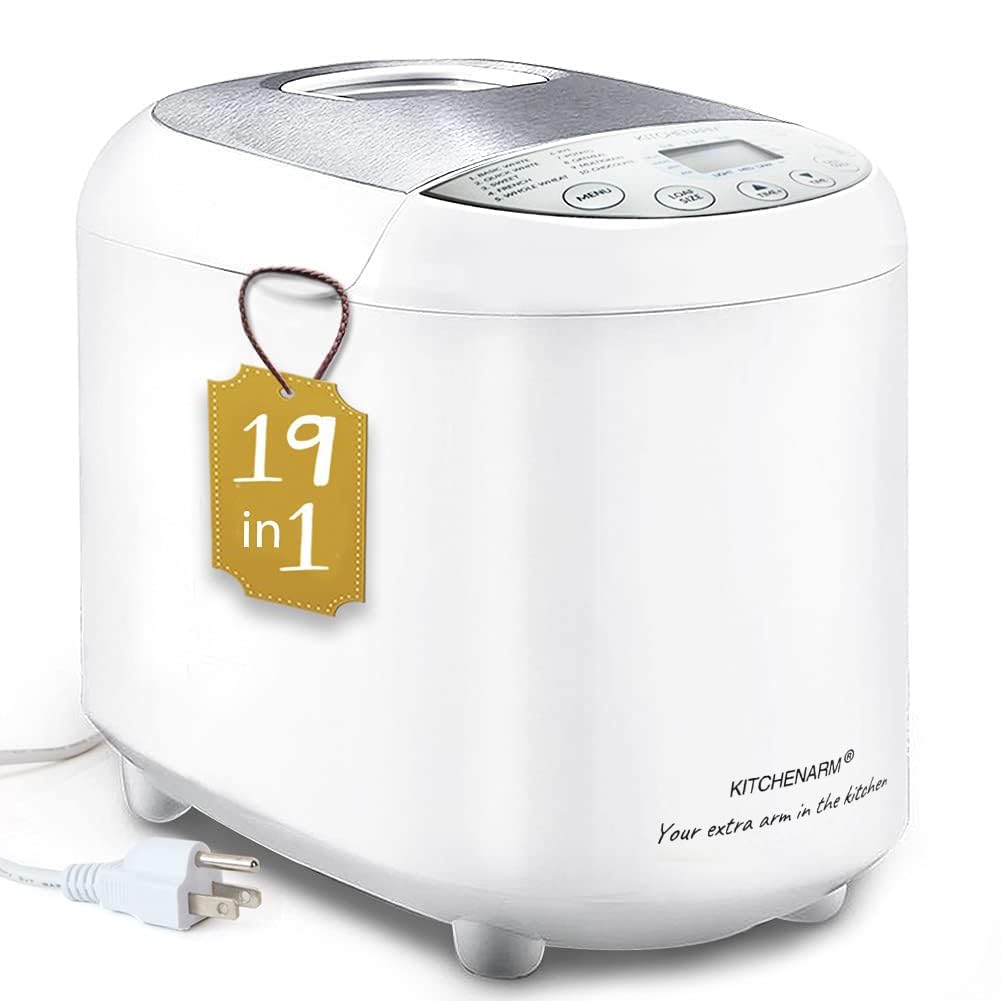
The KITCHENARM squeezes 19 programs into a 13.9-inch-deep chassis that actually fits under standard upper cabinets — rare for a machine that handles 1lb, 1.5lb, and 2lb loaves. The Home Made cycle (Menu 19) lets you program knead, rest, rise, and bake times independently, which is the closest thing to a pro-grade control board in a compact package. Multiple verified buyers confirm the unit runs quieter than the Hamilton Beach equivalent and that the manual includes specific recipes for all-purpose flour rather than demanding expensive high-gluten bread flour.
The stainless steel lid and PP body feel solid for the price, and the ETL certification with a three-prong grounded plug addresses the electrical safety concern that budget machines often overlook. The delay timer saves your settings between uses, turning operation into a one-press start once you dial in a recipe. Gluten-free loaves produce a flatter rise but reportedly taste better than any store-bought alternative, according to a verified owner who tried the multigrain and sourdough presets.
One downside: the included measuring system uses spoons for yeast, oil, and honey instead of gram weights, so switching between recipes requires minor math. The non-stick Teflon-coated pan cleans easily but will eventually wear faster than a ceramic alternative. For the footprint-to-feature ratio, this is the most versatile small bread machine at its price tier.
Why it’s great
- Fully programmable Home Made cycle gives you total control over each baking phase.
- Compact 13.9″ depth fits under standard cabinets.
- Quieter operation than many similarly-sized competitors.
Good to know
- Measures ingredients in spoons rather than grams.
- PTFE non-stick pan is less durable than ceramic.
2. Hamilton Beach Digital Electric Bread Maker (29987)

The Hamilton Beach 29987 is the lightest machine in this roundup at 9.3 pounds, which makes it easy to move between counter and storage — but that same lightness causes the unit to creep across the counter during the kneading cycle unless you place it on a non-slip mat. The 1lb Express cycle delivers a finished loaf in under an hour, which is genuinely useful for last-minute dinner bread, and the 14 settings include an Artisan Dough program that handles wetter, higher-hydration doughs better than the basic preset.
Verified owners consistently praise the compact footprint (13.98 by 9.13 inches) and the removable non-stick pan, which makes cleanup faster than machines with fixed pans. The delay timer works as advertised, and the jam setting adds versatility beyond bread. However, the kneading paddle’s coating on some units began flaking after about two months of daily use, and the control panel lacks a backlight — difficult to read in dim kitchen lighting.
The 2lb loaves occasionally hit the lid during the final rise, which compresses the top crust and produces a slightly domed shape that doesn’t slice evenly. For bakers who primarily make 1lb loaves for one or two people, this is a reliable, budget-friendly entry. The loud kneading noise contrasts with quieter models like the KITCHENARM, so consider placement away from living areas.
Why it’s great
- 1lb Express cycle bakes a loaf in under one hour.
- Lightweight at 9.3 lbs for easy relocation.
- Removable non-stick pan for quick cleaning.
Good to know
- Light enough to walk during kneading; needs a mat.
- Paddle coating durability issues reported after extended use.
3. Briskind Bread Maker Machine (BM8206)

The Briskind BM8206 stands apart from the crowd with its ceramic non-stick pan — a 100% chemical-free coating that releases loaves cleanly without the PTFE degradation concerns of standard pans. The horizontal pan design produces a traditional loaf shape that fits standard toaster slots, a meaningful advantage over vertical pans that yield tall, narrow slices. The slightly angled glass touch panel with white backlit LCD is readable in any lighting, which solves the visibility problem that the Hamilton Beach 29987 and several other competitors share.
Dual heating elements are absent — this is a single-heater machine — but the built-in smart sensor monitors internal temperature during fermentation and adjusts heating to compensate for the lack of top heat. The results are consistent if not dramatically browned on top; verified owners describe the white bread as soft and fine-textured without the large holes that plague some single-heater machines. The 2-pound capacity serves two to three people comfortably, and the 15-hour delay timer with a 1-hour keep-warm function works reliably.
The mute alert beep is a thoughtful touch for anyone who starts the machine overnight and doesn’t want a loud chime at 3 a.m. The pan locks into place with a clockwise twist that some users found unintuitive at first, and the absence of an automatic add-in dispenser means fruit and nuts must be added manually when the machine beeps. For bakers prioritizing health-conscious materials and horizontal loaf geometry, this is the strongest mid-range option available.
Why it’s great
- Ceramic non-stick pan is PFOA-free and releases loaves easily.
- Horizontal loaf pan produces standard sandwich-sized slices.
- Backlit glass touch panel is legible in any lighting.
Good to know
- Lacks a dual heating element; top browning is moderate.
- Pan locking mechanism requires a learning curve.
4. Neretva Bread Maker 20-in-1 (PE8866GR-MLK)

The Neretva PE8866GR-MLK is the most affordable dual-heater bread machine in this roundup, and that single spec — top and bottom 550W heating elements — makes a visible difference in crust browning compared to single-heater units at similar prices. The 360-degree surrounding bake means no more pale loaf tops, and the ceramic pan resists sticking without chemical coatings. The mint green finish is a rare aesthetic choice in a category dominated by white and stainless steel, which may appeal to bakers who keep their machine on the counter.
With 20 program menus including specific settings for potato, corn, and dried meat floss, the program count is higher than any other machine in this group. Realistically, most users will rotate between basic, whole wheat, gluten-free, and dough, but the extras provide room to experiment. The 15-hour delay timer and 1-hour keep-warm are standard, but the 15-minute power interruption recovery is a genuine safety net for anyone with unreliable household power.
The control buttons lock automatically after starting, requiring a 3-second press to unlock — a safety feature that also adds friction when you want to pause mid-cycle. The machine measures 11 inches deep by 7.91 inches wide, one of the narrower footprints here, but the vertical pan produces a small, almost square loaf that measures roughly 5 by 7 inches. If loaf shape matters less to you than even browning, this is the best value for dual heaters.
Why it’s great
- Dual top and bottom heaters deliver even browning across the entire crust.
- Ceramic pan coating is chemical-free and releases loaves reliably.
- One of the narrowest footprints at 7.91 inches wide.
Good to know
- Vertical pan produces a small, nearly square loaf shape.
- Button lock feature can be annoying during active baking sessions.
5. Starfrit Electric Bread Maker (024707-001)
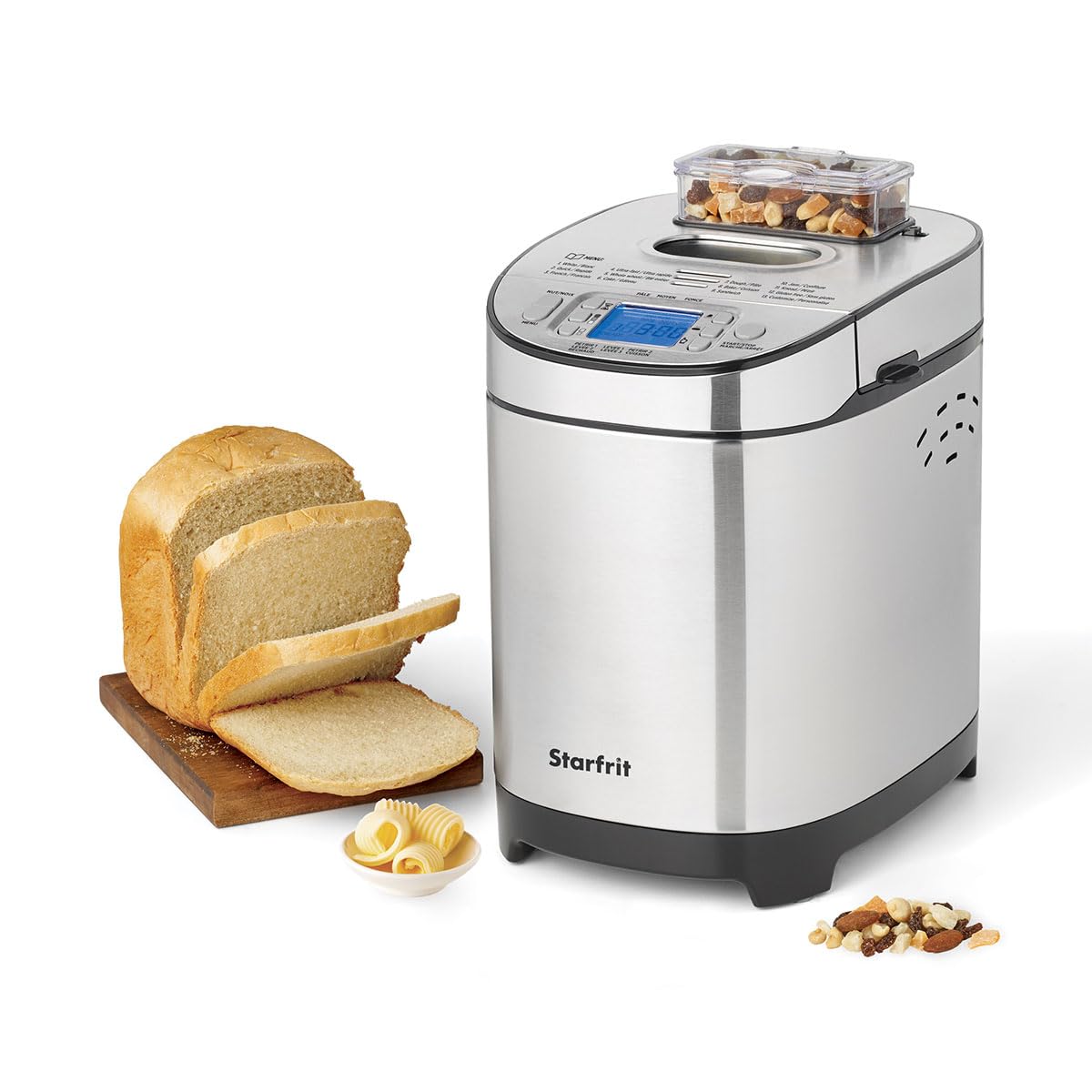
The Starfrit 024707 brings a feature that compact bread machines rarely include: an automatic nut dispenser that drops raisins, seeds, or nuts at the optimal moment during the kneading cycle. For bakers who regularly make cinnamon raisin, multigrain, or seeded loaves, this eliminates the risk of forgetting the add-ins or having them crushed by over-kneading. The large viewing window lets you monitor the dough without opening the lid and releasing heat, a practical advantage over blind machines.
The 2-pound capacity is served by 13 pre-programmed options including a gluten-free setting, and the 13-hour delay timer with 60-minute keep-warm covers overnight scheduling. The removable non-stick pan and single kneading blade simplify cleanup, though the vertical pan orientation means the loaf bakes tall rather than wide. Verified owners consistently report that the bread rises well and that the machine feels sturdier than its 8.68-pound weight suggests.
The footprint is 13.07 inches wide by 9.06 inches deep, which is compact enough for most counters but wider than the Neretva or KITCHENARM. The crust control offers light, medium, and dark options, and the results skew toward even browning thanks to the dual-heater configuration. The main drawback is the vertical loaf shape — slices are taller than standard sandwich bread and may not fit a two-slot toaster without standing upright.
Why it’s great
- Automatic nut dispenser times add-in drops perfectly during kneading.
- Large viewing window lets you monitor rise without losing heat.
- Reliable dual-heater configuration for even crust browning.
Good to know
- Vertical pan produces tall slices that may not fit standard toasters.
- Only 13 presets — fewer than most competitors in this price range.
6. Neretva 3.3LB Bread Maker (PE9806U)
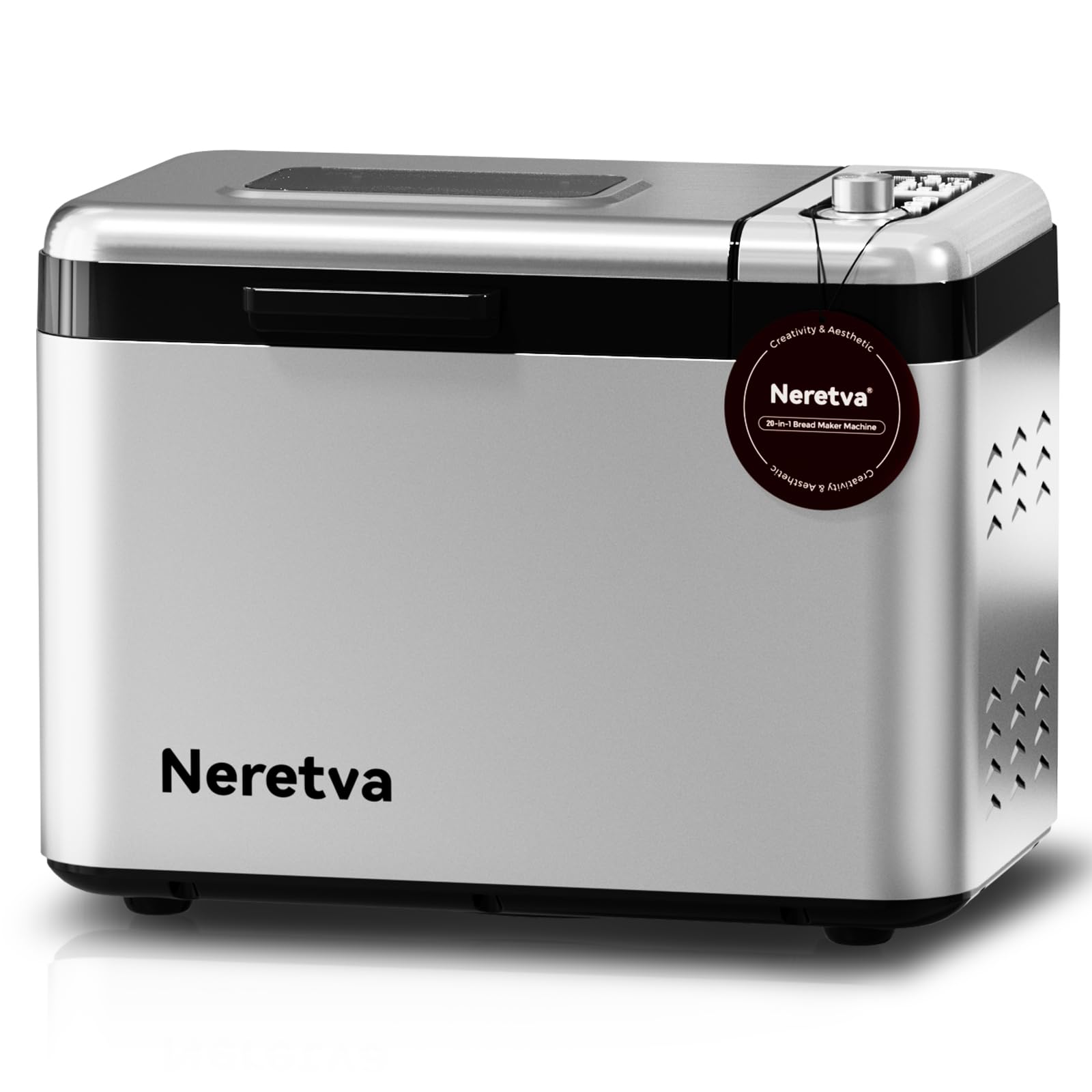
The Neretva PE9806U stretches the definition of “small” — it measures 15.4 inches deep — but it earns a spot here because that depth accommodates a 3.3-pound loaf capacity that no other machine in this roundup can match. For households that bake multiple loaves per week or need bread for five to seven people, this is the only compact-adjacent option that doesn’t force you into multiple batches. The dual kneading paddles handle the larger dough mass more effectively than single-paddle machines, producing a higher, softer rise.
Dual 800W heaters (top and bottom) deliver 360-degree surrounding bake, and the ceramic non-stick pan avoids chemical coatings. The auto fruit and nut dispenser releases ingredients at the optimal moment, and the 15-hour delay timer with finish-time programming (not just countdown) is a genuinely useful detail — you set the time you want the bread done, not the hours until it starts. Verified owners report that the machine is quiet (under 40 db) and that the double-wall viewing window stays cool to the touch.
The trade-off is counter footprint: at 15.4 inches deep, it won’t fit under many standard cabinets unless you pull it forward. The weight is moderate at 8.37 pounds despite the larger pan. The included recipe book tends toward high oil and sugar quantities, but using one-third of the recommended amounts produces better results. For anyone who needs big batches from a machine that doesn’t take up a dedicated appliance island, this is the most capacity-dense option available.
Why it’s great
- 3.3lb capacity is the largest in the compact category — serves 5–8 people.
- Dual kneading paddles handle large dough masses thoroughly.
- Finish-time programming is more intuitive than standard countdown timers.
Good to know
- 15.4-inch depth is too deep for most standard upper cabinets.
- Recipe book needs adjustment; default oil/sugar amounts are excessive.
7. Panasonic Bread Machine (SD-R2550)

The Panasonic SD-R2550 is the most technically sophisticated machine in this group, featuring dual temperature sensors that detect both internal chamber temperature and room temperature, then automatically adjust rise and rest times to compensate. This closed-loop system produces consistently well-structured crumb across varying kitchen climates — humid summers and dry winters don’t change the outcome. The unique kneading blade is shaped to fold dough rather than just stir it, mimicking artisan-style kneading that develops gluten structure more effectively than standard paddles.
The raisin and nut dispenser drops add-ins at precisely timed intervals, and the 20 preset programs cover everything from brioche to pasta dough to sourdough starter. The machine weighs 16.5 pounds, which is nearly double the weight of the Hamilton Beach — that mass anchors it firmly on the counter during kneading and signals the build quality. The metal and plastic construction feels substantial, and the locking bread pan with a twist mechanism prevents leaks and wobbles. Verified users who have made over 60 loaves report consistent results across white, whole wheat, and specialty recipes.
Customer service is a genuine concern — multiple verified buyers report that Panasonic’s phone support is non-functional and that the company’s response to warranty issues is slow. Some users experienced the machine resetting its settings after five months, fixed by unplugging for 15 minutes. The settings screen is not backlit, which is disappointing at this price. For bakers who want the most automated, scientifically precise bread-making experience and are willing to navigate support hurdles, the Panasonic delivers loaf quality that justifies the premium.
Why it’s great
- Dual temperature sensors auto-adjust rise and rest for consistent results in any climate.
- Unique kneading blade mimics artisan folding for better gluten development.
- Heavy 16.5-pound build stays planted during vigorous kneading cycles.
Good to know
- Customer service is difficult to reach; support response times are slow.
- Settings screen lacks backlighting — hard to read in low light.
FAQ
What footprint dimensions should I measure for a small bread machine?
Can a small bread machine make a 2lb loaf that fits a standard toaster?
How does a 550W motor compare to 800W for small-loaf performance?
Are ceramic non-stick pans truly more durable than PTFE in small bread machines?
Final Thoughts: The Verdict
For most users, the best small bread machine winner is the KITCHENARM 19-in-1 Handy because it combines the deepest program library (19 presets including a fully customizable Home Made cycle) with a genuinely compact 13.9-inch depth and quieter operation than the competition at its price tier. If you want the healthiest pan material and a horizontal loaf shape that fits your toaster, grab the Briskind BM8206. And for precision bakers who want temperature-sensor automation and consistent results regardless of kitchen climate, nothing beats the Panasonic SD-R2550 — provided you’re comfortable navigating its customer service limitations.