The tap water from your kitchen sink carries chlorine, sediment, and trace metals that affect both taste and health. A dedicated unit attached directly to the faucet spout removes these contaminants at the point of use, delivering filtered water on demand without sacrificing counter space or requiring a dedicated tap hole.
I’m Mohammad Maruf — the founder and writer behind AirfryerBite. I specialize in analyzing hardware specifications for small kitchen appliances and water filtration systems, breaking down micron ratings, flow rates, and certification standards to help buyers make informed decisions.
After researching filter life cycles, material quality, and installation requirements across the leading models, this guide identifies the water filter for sink faucet that balances effective contaminant reduction with practical everyday use.
How To Choose The Best Water Filter For Sink Faucet
Not all faucet filters handle the same contaminant profile. Before picking a unit, verify your tap water’s specific issues — whether it is chlorine-heavy city supply, sediment-laden well water, or hard water with dissolved minerals. The filter’s media, housing, and flow rate must match what enters your glass.
Filtration Media And Contaminant Reduction
Activated carbon block and activated carbon fiber (ACF) are the two primary media types. Standard carbon block reduces chlorine and improves taste but struggles with heavy metals unless blended with additional media such as KDF. ACF offers a faster adsorption rate, meaning it can handle higher flow rates without sacrificing removal efficiency for chlorine and lead. Always check whether the filter is certified by NSF or WQA for the specific contaminants — lead, microplastics, and volatile organic compounds — you want removed.
Flow Rate And Everyday Usability
Many budget-friendly filters limit the output to roughly 0.5 gallons per minute because the carbon block restricts water passage. Filters that use ACF or a wider housing design can maintain 2.2 GPM without reducing contaminant removal. Lower flow rates become frustrating when filling a pot or a large water bottle. A unit that supports at least 1.5 GPM in filtered mode delivers a better daily experience.
Housing Material And Durability
Plastic housings keep the weight low and the cost down, but the threads on budget plastic units can crack from heat or overtightening. 304 stainless steel housings resist corrosion, handle hot water better, and typically include reinforced sealing gaskets that prevent leaks over months of use. The control valve — the part you twist to switch between filtered and unfiltered modes — is often the first failure point on steel units, so look for metal-reinforced switches rather than all-plastic levers.
Quick Comparison
On smaller screens, swipe sideways to see the full table.
| Model | Category | Best For | Key Spec | Amazon |
|---|---|---|---|---|
| Frizzlife FS99 | Premium Stainless | Heavy metal reduction with dual filter pack | 99% lead reduction, 350 gal per filter | Amazon |
| Kintim KT-FF01 | High Flow | Maintaining pressure with 2.2 GPM flow | 1200 gal capacity, 304 steel housing | Amazon |
| IVO Faucet Filter | Medical-Grade | Microfiltration with mineral retention | 4-stage hollow fiber membrane | Amazon |
| Hansing HS-FM02 | Long Life | Extended 1200-gallon service cycle | 304 steel housing, 200k-cycle valve | Amazon |
| PUR Plus Vertical | NSF Certified | Reducing lead and microplastics | WQA/NSF certified, 100 gal life | Amazon |
| PUR Plus Horizontal | Value Pick | Budget-friendly 3-in-1 filtration | 70 substance reduction, 100 gal life | Amazon |
| Brita Elite Faucet | Brand Standard | Chlorine taste reduction with LED indicator | 100 gal capacity, electronic filter light | Amazon |
In‑Depth Reviews
1. Frizzlife FS99 Water Filter For Sink Faucet
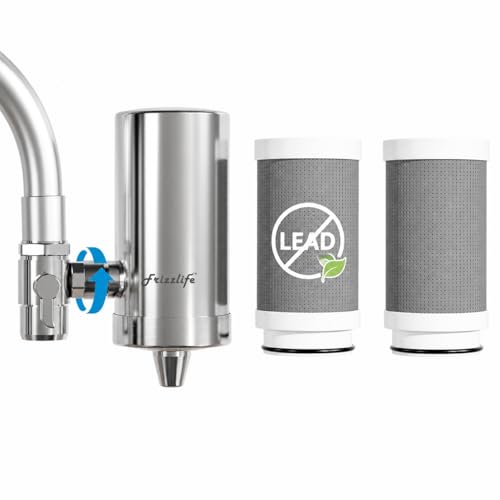
The Frizzlife FS99 uses an activated carbon fiber cartridge that achieves 99% reduction of chlorine, lead, and heavy metals while preserving beneficial calcium and magnesium minerals. Unlike standard carbon block filters, the ACF media handles water flow without a drastic pressure drop, so filling a pitcher remains reasonably quick. The unit includes two replacement cartridges in the box, extending the usable service period to roughly six months before you need to purchase additional filters.
The housing is constructed from food-grade 304 stainless steel with a rust-proof finish and a 360-degree swivel joint that lets you rotate the filter out of the way during dishwashing. Nine included thread adapters cover most standard faucet connection sizes, including both male and female threads, and installation requires no tools — the entire process takes about three minutes. The two-mode lever switches between filtered water and unfiltered raw water for tasks that do not need purification.
Customer reports highlight the strong water pressure even in filtered mode and the noticeable improvement in taste compared to unfiltered tap water. A few users noted that the housing can develop leaks after several months if the hand-tightened seal is not periodically checked, but the company’s responsive customer service and replacement policy address most issues quickly. The absence of a TDS reduction is intentional — this system retains healthy minerals rather than stripping everything out.
Why it’s great
- Two filters included cover six months of typical use
- Stainless steel housing avoids cracking that plagues plastic units
- 360-degree rotation keeps the filter out of the way when not needed
Good to know
- Hand-tightening the housing requires occasional rechecking to prevent leaks
- Not compatible with pull-out or retractable sprayer faucets
2. Kintim KT-FF01 Faucet Water Filter
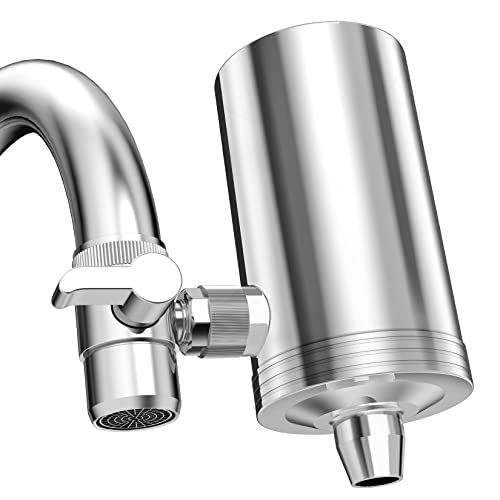
The Kintim KT-FF01 stands apart because its 100 percent carbon fiber cartridge maintains effective chlorine and lead reduction even at a 2.2 GPM flow rate. Most faucet filters force you to trickle water to get proper filtration; this one does not restrict output, making it practical for filling large pots quickly. The 1200-gallon rated capacity translates to roughly six months of service under typical household conditions, which is double the life of many entry-level units.
The housing is machined from 304 stainless steel with a redesigned sealing structure that addresses the leak issues common in earlier stainless models. The 360-degree swivel is reinforced at the pivot point, and the included brass adapter connects to 55/64-inch-27 female threads found on most kitchen faucets. A separate request service provides adapters for less common thread sizes at no extra cost, though the standard kit already fits an estimated 85 percent of popular sinks.
Reviewers consistently mention the substantial build quality and the absence of any chemical aftertaste in the filtered water. Several users with large households report that the filter paid for itself in bottled-water savings within two weeks. The unit does not include a filter-change indicator, so you need to track the six-month replacement window manually. A few customers with older faucets needed to order the extra adapter, but the overall installation process remains straightforward.
Why it’s great
- Full 2.2 GPM flow without sacrificing chlorine reduction
- Six-month filter life reduces replacement frequency
- Leak-resistant sealing gaskets outperform earlier stainless models
Good to know
- No filter-life indicator requires manual tracking of replacement
- Extra adapter may be needed for non-standard faucet threads
3. IVO Faucet Water Filter

The IVO filter uses a four-stage process ending with a medical-grade hollow fiber membrane — the same technology found in dialysis machines — to capture rust, sediment, turbidity, and microscopic impurities down to 0.1 microns. The granular activated coconut carbon pre-stages handle chlorine and organic compounds, while the membrane physically blocks particles that carbon alone cannot trap. A key distinction from reverse osmosis is that IVO retains dissolved minerals, so TDS readings remain unchanged.
Manufactured by Toray Industries, the same company behind Japan’s top-selling faucet filter brand Torayvino, the unit includes a lever that toggles among three settings: filtered spray, unfiltered straight flow, and unfiltered spray. The housing is a non-toxic resin casing that keeps the weight low — approximately 0.86 pounds — and seven adapters cover most standard external aerator threads. The recommended replacement interval is four months or roughly 1500 liters, depending on local water quality.
Users who switch from pitcher-style filters note the elimination of leaks at the connection point and a noticeable improvement in water clarity, particularly for coffee brewing where sediment fines previously left residue. The filtered flow is slower than some alternatives because the membrane restricts passage, so filling a one-liter bottle takes a bit longer. Replacement cartridges cost more than standard carbon block units, but the filtration depth justifies the expense for those targeting fine particulates.
Why it’s great
- Hollow fiber membrane captures contaminants as small as 0.1 microns
- Three-mode lever includes filtered spray for drinking and unfiltered spray for rinsing
- Retains calcium and magnesium for better taste and health
Good to know
- Filtered flow rate is slower than carbon-only designs
- Replacement cartridges have a higher per-unit cost than basic carbon filters
4. Hansing HS-FM02 Faucet Water Filter
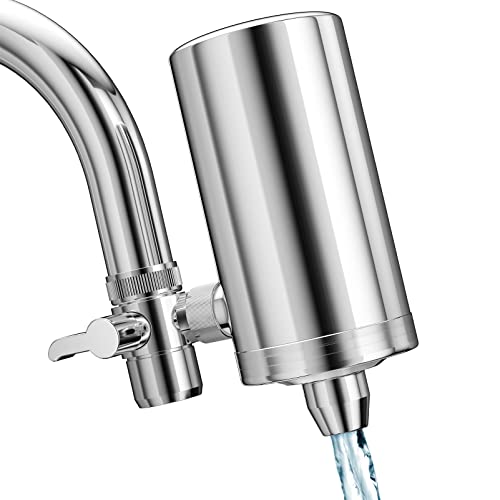
The Hansing HS-FM02 pairs a 304 stainless steel housing with a chromed copper control valve that has passed 200,000 on-off durability tests, making it one of the most mechanically robust faucet filters available. The ACF cartridge inside is sourced from Japan and removes 99 percent of chlorine and 93.7 percent of lead while the stainless body withstands thermal expansion better than plastic alternatives. The dual 360-degree swivel lets you position the outlet exactly where needed without putting torque on the faucet threads.
With a 1200-gallon capacity rated at 2.2 GPM, this filter delivers both longevity and flow. The replacement cartridge (ASIN B07Z2RYF9M) is clearly documented, and the third-party spectrometer test results for chlorine and lead reduction are published. Two included adapters cover faucet connection diameters between 0.55 and 0.94 inches, though the 0.78-inch minimum thread engagement length means very short faucet spouts may not work.
Customer feedback over long-term use — some installations exceeding ten months — indicates that the filter maintains performance well beyond the typical three-month replacement schedule of budget brands. The main criticism centers on the plastic mode-switching valve, which on some units developed cracks after a year of regular use. The initial filter seating can also produce a minor leak if the cartridge is not pressed fully into the housing, but removing and reseating the filter usually resolves this.
Why it’s great
- Stainless housing and copper valve assembly provide exceptional mechanical durability
- Full 2.2 GPM flow rate with no reduction in filtration effectiveness
- Third-party lab testing confirms contaminant removal specifications
Good to know
- Plastic switch lever can crack after extended use
- Faucet thread engagement must be at least 0.78 inches for a secure fit
5. PUR Plus Vertical Faucet Mount Water Filtration System
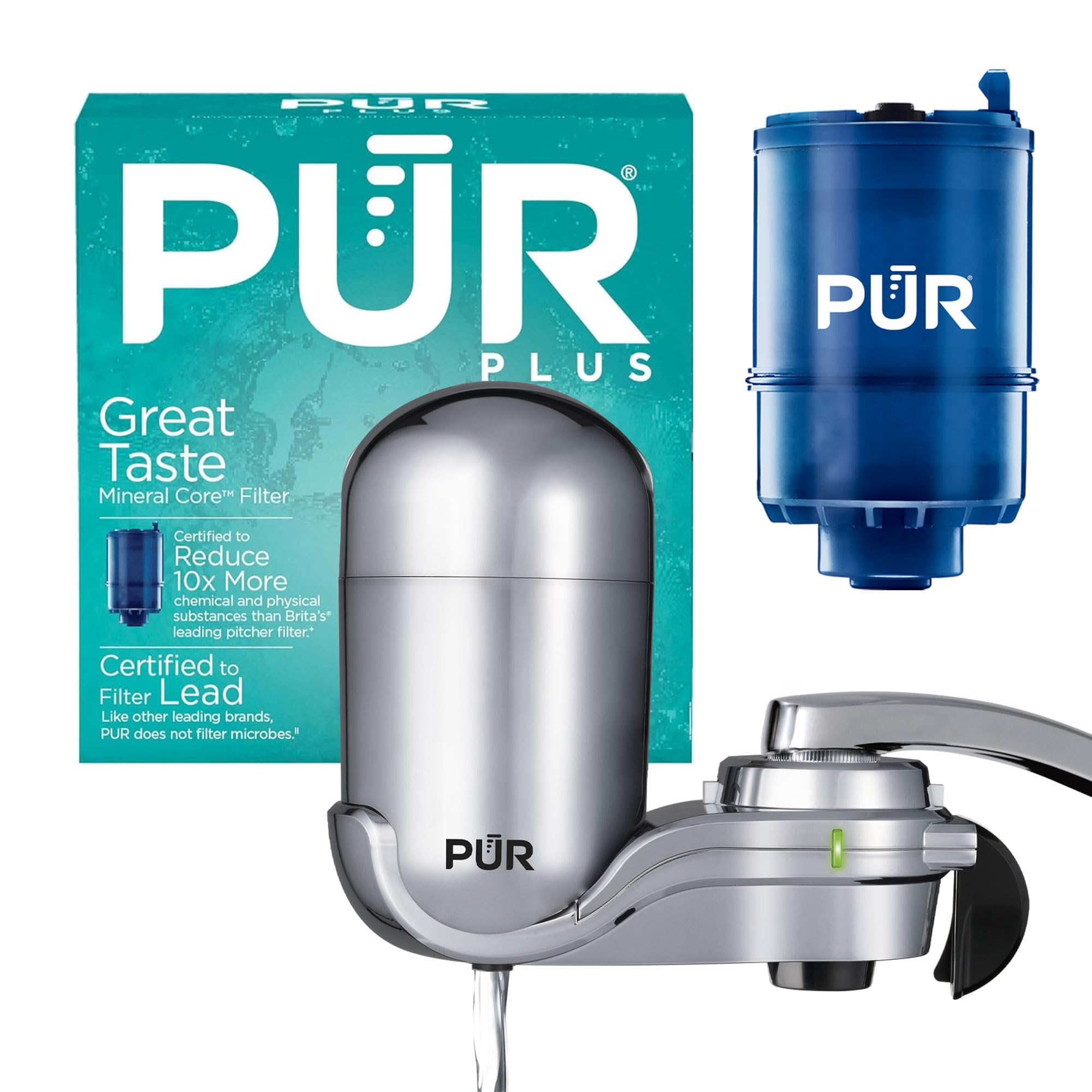
The PUR Plus Vertical model carries WQA certification for lead reduction and NSF certification for microplastics, chlorine, and 70 other chemical and physical substances, giving it one of the most extensive third-party verification lists in the category. The vertical design places the filter housing directly above the faucet spout, making it a good fit for sinks where a horizontal unit might bump into a backsplash or window sill. The 100-gallon filter life lasts about three months under normal use, and the amber filter-change light provides a clear visual reminder when replacement is due.
Installation is genuinely tool-free — the mount screws onto external aerator threads using one of the five included adapters, and the diverter valve engages with a simple push. The filter’s 3-in-1 technology combines activated carbon, ion exchange, and a mechanical pre-filter to capture particles and chemical contaminants in a single pass. The chrome finish blends with most standard faucet hardware, and the unit weighs just over one pound, so it does not stress the faucet neck.
Users consistently praise the simple setup and the immediate improvement in water taste and smell, particularly in homes with municipal chlorine treatment. The vertical orientation works well for shallow sinks where horizontal filters interfere with dish placement. The chrome plating on some units has been reported to chip after a few weeks, exposing the underlying metal, though this does not affect filtration performance. A few users with Moen faucets reported perfect compatibility, while those with non-standard thread patterns may need an additional adapter.
Why it’s great
- WQA and NSF certifications cover lead, microplastics, and 70 other contaminants
- Filter-change light eliminates guesswork about replacement timing
- Vertical form factor clears shallow sink areas effectively
Good to know
- Chrome finish can chip over time on some units
- Not designed for pull-out or handheld sprayer faucets
6. PUR Plus Horizontal Faucet Mount Filtration System

The PUR Plus Horizontal model offers the same 3-in-1 filtration core as the vertical version but in a footprint that extends forward from the faucet spout. The on-off lever switches between filtered and unfiltered water, and the genuine PUR Plus filter includes natural mineral filtration that adds a subtle crispness to the water. The system is certified to reduce 70 substances, including lead and microplastics, making it one of the most thoroughly tested budget-tier options available.
At roughly 0.7 pounds, this is the lightest unit in the lineup, and the plastic body keeps the cost low while maintaining adequate durability for typical residential use. The filter lasts 100 gallons or three months, and the indicator light turns red when replacement is needed, though some users report the light activates earlier than expected. The horizontal positioning works best on faucets with low clearance above the sink — the filter sits parallel to the counter rather than rising above the spout.
Customers highlight the easy setup and the significant taste improvement over straight tap water, especially in areas with heavy chlorination. The unfiltered water outlet has been noted to splash more than expected because the strainer design lacks refinement. The filter light timing inconsistency — some units showing red before the full 100 gallons — is a recurring minor complaint, but the water continues to taste fine past the indicator, suggesting a conservative safety margin rather than premature exhaustion.
Why it’s great
- Extensive third-party certification covering 70 chemical and physical substances
- Lightweight plastic housing keeps the faucet strain minimal
- Horizontal profile fits under cabinets with limited vertical space
Good to know
- Unfiltered outlet spray can splash due to basic strainer design
- Filter-change indicator may turn red before actual capacity is exhausted
7. Brita Faucet Water Filter System with Light Indicator

The Brita Faucet Water Filter System brings the brand’s well-known filtration to a direct-mount format with the addition of an electronic LED indicator that tracks filter life. Unlike the mechanical timer found on some competitors, this system uses a digital readout to signal when the cartridge needs replacement, removing any guesswork. The Focus on chlorine reduction and taste improvement is straightforward — Brita’s carbon-based media targets the most common tap water complaints without attempting heavy metal or microplastic removal at a higher certification level.
The unit attaches to standard faucets with external aerators using included adapters, and the installation takes roughly five minutes without tools. The chrome-finished plastic body keeps the weight at 11.2 ounces, and the filter life is rated at 100 gallons or roughly four months. The handle switches between filtered and unfiltered flow, and the spout aerates the water on both settings.
Customer reviews reveal a split experience. Many users appreciate the brand recognition and the simple operation, noting that filtered water tastes noticeably cleaner. Others report that the plastic chrome housing feels flimsy compared to stainless steel alternatives and that the turning mechanism on the chrome version is excessively stiff, making switching modes difficult for users with reduced hand strength. Several buyers also noted that the LED indicator failed early on some units, and the non-filtered flow lacks aeration, producing a straight stream that splashes more than expected.
Why it’s great
- Electronic LED indicator provides clear filter-replacement timing
- Brita brand compatibility with widely available replacement cartridges
- Lightweight design minimizes stress on faucet threads
Good to know
- Plastic chrome housing feels less durable than stainless steel units
- Mode-selector lever can be stiff, particularly on the chrome version
FAQ
Will a faucet water filter work on a pull-out sprayer faucet?
Why does my faucet filter not reduce TDS reading?
Final Thoughts: The Verdict
For most users, the water filter for sink faucet winner is the Frizzlife FS99 because it combines 304 stainless steel durability with 99 percent heavy metal reduction and includes two filters out of the box. If you prioritize unrestricted flow and a six-month filter life, grab the Kintim KT-FF01. And for those who need microscopic particulate removal with mineral retention, nothing beats the IVO Faucet Filter.