That first sip of tap water after a hard workout can taste like a swimming pool if the chlorine and sediment load is high. A bottle that filters on the go solves this instantly, turning any public fountain or campsite stream into a clean, crisp drink without the metallic or chemical aftertaste.
I’m Mohammad Maruf — the founder and writer behind AirfryerBite. I spend months cross-referencing lab certifications, micron-level pore specs, and real-world backcountry reviews to separate genuine filtration hardware from mediocre plastic bottles with a token screen.
After evaluating over a dozen models from leading brands on real filtration accuracy, flow rate, and durability, I’ve narrowed the field to the five most reliable performers. This guide ranks the best sports bottles with built-in filters for taste, safety, and portability so you never drink murky water again.
How To Choose The Best Sports Bottles With Built-In Filters
Picking a filtered bottle is not just about capacity or color. The filtration mechanism, the micron rating, and the ability to backflush the membrane dictate whether you get drinkable water on day five of a hike or just a clogged straw. Focus on these three factors first.
Filtration Type: Carbon vs. Hollow-Fiber Membrane
A simple activated-carbon cartridge (like the one in the Brita 36386) removes chlorine, bad taste, and odor from municipal tap water — perfect for the gym or office. A hollow-fiber membrane (like the Sawyer Mini or the Membrane Solutions S1) physically blocks bacteria, protozoa, and microplastics down to 0.1 microns. If you plan to fill from a creek, spring, or questionable hotel tap, you must choose a membrane-based filter, not just a carbon puck.
Micron Pore Size and Flow Rate Trade-Off
The smaller the pore size, the more contaminants are trapped, but the harder you must suck or squeeze to get water. A 0.2-micron filter is standard for protozoa removal; a 0.1-micron filter (Sawyer Mini) catches smaller bacteria; a 0.01-micron ultra-filtration membrane (SurviMate) can even reduce some viruses. Balance this against flow rate — the Membrane Solutions S1 delivers 500 ml per minute, while a tighter 0.01-micron filter naturally slows sipping.
Bottle Ergonomics and Field Maintenance
A squeeze-to-drink pouch (Bachgold) or straw-style filter (Membrane Solutions) is lighter and packable but requires manual pressure. A rigid bottle with a push-button lid (Brita) is easier to drink from during a workout but cannot be backflushed. Check whether the filter is replaceable and how often — the Sawyer Mini’s 100,000-gallon capacity will outlast the bottle itself, while carbon cartridges need swapping every two months.
Quick Comparison
On smaller screens, swipe sideways to see the full table.
| Model | Category | Best For | Key Spec | Amazon |
|---|---|---|---|---|
| Sawyer Mini | Membrane | Backcountry bacteria removal | 0.1 micron absolute hollow fiber | Amazon |
| Membrane Solutions S1 | Straw Filter | NSF-certified emergency drinking | NSF/ANSI 42, 401 certified | Amazon |
| Brita 36386 | Carbon | Everyday chlorine taste reduction | 26 oz BPA-free hard-sided plastic | Amazon |
| SurviMate Bottle | UF Membrane | International travel water safety | 0.01 micron hollow fiber UF | Amazon |
| Bachgold Squeeze | Pouch/Squeeze | Ultralight backpacking filtration | 83g foldable pouch, 0.2 micron | Amazon |
In‑Depth Reviews
1. Sawyer Mini Water Filtration System

The Sawyer Mini is the gold standard for lightweight backcountry filtration because its 0.1 micron absolute hollow-fiber membrane removes 99.99999% of bacteria (Salmonella, Cholera, E. coli) and 99.9999% of protozoa (Giardia) while weighing just 2 ounces. It screws directly onto standard 28mm disposable water bottles, so you can ditch the small 16-ounce squeeze pouch that comes in the box and attach it to a 1.5-liter Smartwater bottle for serious trail capacity.
The cleaning plunger included with the kit lets you backflush the membrane in-field, restoring flow rate after filtering silty water — a feature missing from carbon-only bottles. Owners consistently report that a single Mini unit lasts through multiple seasons of Appalachian Trail sections and never imparts a plastic taste to the water when stored dry between trips.
For anyone who needs a verifiable pathogen barrier rather than just taste improvement, this is the most trusted and cost-efficient option on the market. The 100,000-gallon rated lifespan means you will likely replace the bottle long before the filter wears out.
Why it’s great
- Absolute 0.1 micron pore size removes bacteria and protozoa with lab-proven 99.99999% efficiency
- Ultralight at 2 oz and fits any 28mm-thread bottle for modular hydration
- Backflushable with included plunger, extending filter life across hundreds of gallons
Good to know
- The included 16-ounce squeeze pouch is too small for long treks; most users swap it for a standard disposable bottle
- No built-in carbon layer — it needs a separate carbon pre-filter for taste improvement if tap water tastes like chlorine
2. Membrane Solutions Straw Water Filter S1

What makes the Membrane Solutions S1 stand out is the triple NSF certification — NSF/ANSI 42 for chlorine reduction and taste, NSF/ANSI 372 for lead-free materials, and NSF/ANSI 401 for microplastic reduction. That third-party validation means the 5-stage filtration train (coarse screen, double-layer PP cotton, coconut-shell activated carbon, and hollow-fiber ultrafiltration membrane) actually does what the label claims, rather than relying on marketing speak.
The straw design fits any 28mm-thread bottle and delivers a remarkably fast flow rate of 500 ml per minute at a 0.1 micron pore size, so you can drink directly from a stream without feeling like you are fighting the filter. It also works with gravity-fed setups and soft pouches, making it versatile for both solo hikers and small groups on multi-day outings.
Over 1,320 gallons of rated capacity (5,000 liters) means this straw can serve as the primary filter for an entire season of weekend trips. Backpackers who use it daily for stream drinking report no illness and no noticeable degradation in flow after 150 uses.
Why it’s great
- Triple NSF/ANSI 42, 372, 401 certifications for chlorine, lead-free materials, and microplastic reduction
- High-flow 500 ml/min at 0.1 microns — drinks faster than most squeeze-style filters
- Long 1,320-gallon lifespan with replaceable filter elements
Good to know
- No rigid bottle body; the straw must be paired with your own container or pouch
- The 5-stage system does not lower TDS, so mineral sediment taste may remain in hard-water areas
3. Brita 36386 Premium Water Filter Bottle, 26 oz

The Brita 36386 is the definitive pick if your primary concern is chlorine taste at the gym, office, or airport, not bacterial survival in the wilderness. Its carbon-based filter reduces chlorine taste and odor from municipal tap water, and one cartridge replaces up to 300 standard 16.9-ounce single-use plastic bottles, making it an environmentally sound upgrade over disposable water bottles.
The bottle itself is built from BPA-free hard-sided plastic, features a one-handed push-button lid and enclosed straw for sipping during a workout, and fits most car cup holders. Users coming back from Disney World and cruises consistently note that the Brita eliminates the “pool water” taste that plagues many public drinking fountains, and the 26-ounce capacity is generous enough for a full spin class without refilling.
The trade-off is clear: this is not a backcountry filter. It does not remove pathogens, and the carbon cartridge needs replacement every 40 gallons or two months. But for daily hydration where the water source is already potable, the Brita delivers the best taste-to-convenience ratio in the category.
Why it’s great
- Proven Brita carbon filtration removes chlorine taste and odor from tap and fountain water
- Dishwasher-safe hard-sided bottle with push-button lid and carrying loop
- Each filter replaces roughly 300 single-use plastic bottles, reducing waste
Good to know
- No protection against bacteria, protozoa, or microplastics — for treated tap water only
- Not spill-proof if tipped over, and the mouthpiece can be finicky to clean thoroughly
4. SurviMate Purified Water Bottle

The SurviMate uses the smallest pore size in this lineup — a 0.01 micron hollow-fiber ultrafiltration membrane — to catch 99.99% of contaminants including sediment, heavy metals, and organic matter. That is ten times finer than the 0.1 micron standard, which means it can reduce particles that standard membrane filters let through, though it still cannot claim virus removal without chemical treatment.
The 650-milliliter Tritan bottle is BPA-free, glossy, and includes a built-in compass on the top cap — a useful survival touch for navigation without a phone. The 5-stage composite filter combines a coarse screen, sediment PP membrane, purification beads, and activated carbon fiber, and users traveling in Asia with questionable municipal water report that the filtered taste is clean and free of debris.
The biggest downside is the physical effort required to drink: several buyers describe needing “deep suction” to pull water through the tight 0.01 micron membrane. The filter also cracks if frozen, and at 0.52 kg it is noticeably heavier than a squeeze pouch system, so it is best suited for international travel rather than ultralight backpacking.
Why it’s great
- Ultra-fine 0.01 micron UF membrane blocks 99.99% of contaminants, including sediment and heavy metals
- All-in-one rigid bottle with built-in compass for travel and emergency use
- Replaceable filter rated for up to 1,500 liters, reducing long-term cost
Good to know
- Requires strong suction to pull water through the tight membrane — not ideal for quick gulps
- Heavier than squeeze and straw alternatives; filter cracks if frozen
5. Bachgold Squeeze Foldable Water Filter Bottle
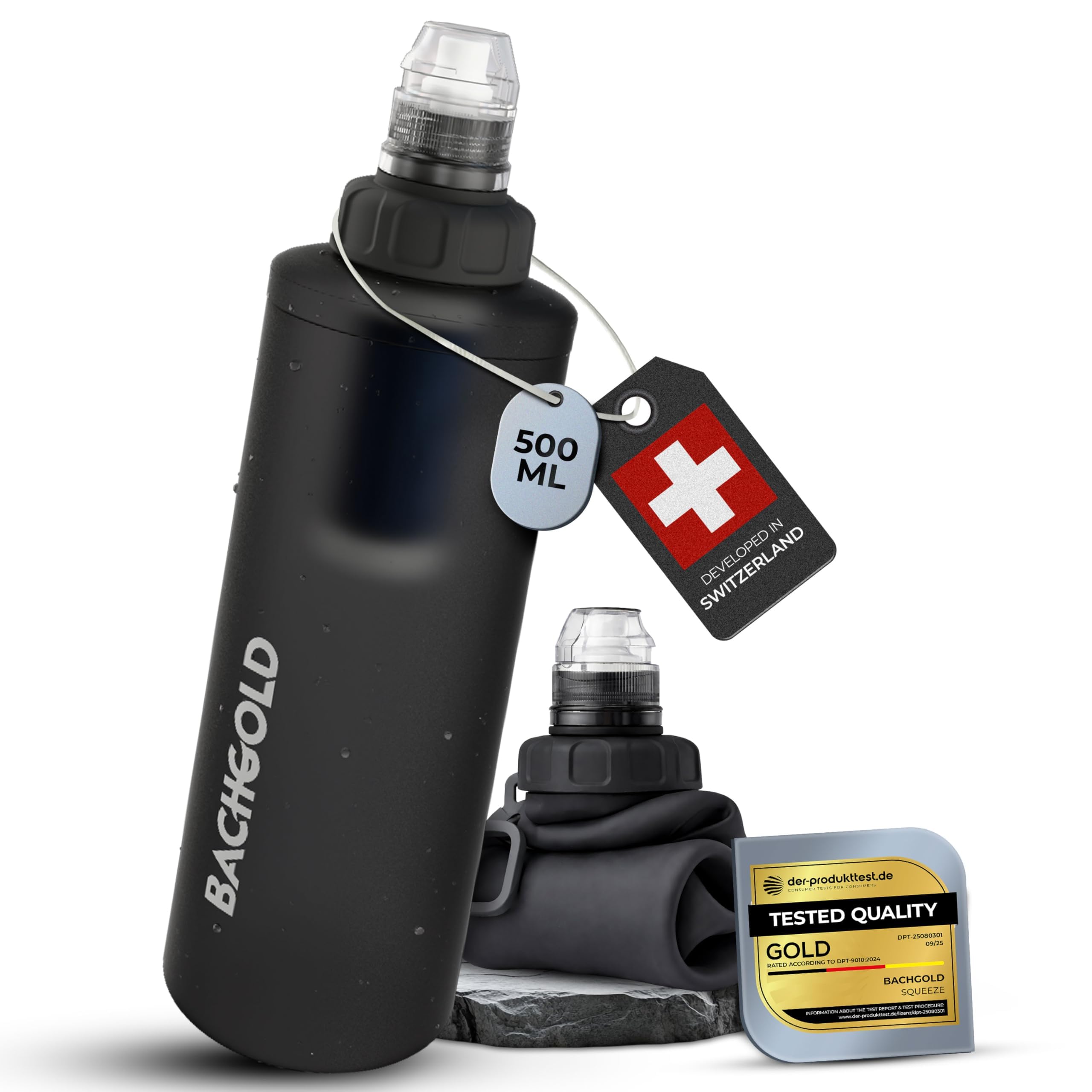
The Bachgold Squeeze redefines packable filtration by weighing just 83 grams for the 500ml version and folding flat when empty. That makes it the lightest entry on this list — practically invisible in a hip belt pocket or emergency go-bag. Its dual-stage system combines an electro-adsorptive nanofiber layer with a 0.2-micron hollow-fiber membrane, designed to capture what standard single-stage filters miss.
The squeeze-to-drink mechanism is intuitive: fill the flexible TPU pouch from any freshwater source, screw on the filter cap, and squeeze. No pumps or gravity setups. Customers drinking straight from creek water report it tastes fine with no after-effects, and the Swiss design has earned a following among thru-hikers who prioritize minimal weight above all else.
Keep in mind that the electro-adsorptive layer is rated for 500 liters and the hollow-fiber membrane for 1,000 liters, so replacement costs can add up if you drink heavily. Also, the lid and filter assembly require a delicate grip to unscrew without cross-threading, so it may not be the best option for cold-weather camping where fine motor control is reduced.
Why it’s great
- Incredibly lightweight at 83g and folds flat for storage in a pocket or emergency kit
- Dual-stage filtration (electro-adsorptive nanofiber + 0.2 micron hollow-fiber) for thorough backcountry use
- Squeeze mechanism delivers fast flow without pumping or gravity rigs
Good to know
- Filter replacement costs recur after 500–1,000 liters depending on the stage
- Lid threading can be fussy; requires careful alignment to avoid cross-threading in the field
FAQ
Can a 0.1 micron filter remove viruses from stream water?
How often should I replace the filter in a Brita sports bottle?
Do squeeze-style filter pouches like the Bachgold leak easily in a backpack?
Final Thoughts: The Verdict
For most users, the sports bottles with built-in filters winner is the Sawyer Mini because it provides verifiable 0.1-micron pathogen protection at a weight and price that beats every other membrane-based option. If you want NSF-certified reliability and a faster flow rate for group trips, grab the Membrane Solutions S1. And for the lightest possible carry with a dual-stage membrane that fits in your palm, nothing beats the Bachgold Squeeze.