That gurgling mountain stream looks pristine, but a single gulp of Giardia can ruin a five-day trek and land you in urgent care. The question isn’t whether you need a water filter—it’s which design fits your pace, pack weight, and water sources. Get this wrong, and you’ll either be stuck pumping for twenty minutes at every creek crossing or carrying a filter that can’t handle the sediment in your local trail’s primary water supply.
I’m Mohammad Maruf — the founder and writer behind AirfryerBite. I spend my time digging through hollow fiber micron ratings, flow rate charts, and field-repair reliability data to separate marketing claims from backcountry performance.
Whether you are a thru-hiker counting every gram or a weekend camper prioritizing speed, this guide breaks down the six best water filters for backpacking that actually earn their spot on your gear list.
How To Choose The Best Water Filters For Backpacking
Picking the right filter starts with understanding the water you’ll encounter and the volume you need. A family camping at a developed site has different requirements than a solo ultra-runner who needs to fill two 500ml bottles in under two minutes. Here’s what to focus on before you buy.
Micron Rating and Pathogen Removal
The most critical spec is the pore size. A 0.1 micron absolute filter stops bacteria like Salmonella and protozoa like Giardia. Filters with a 0.2 micron rating are still effective but may not catch the smallest bacterial strains. If you’re traveling to areas with viral risks (hepatitis, rotavirus), you’ll need a chemical treatment or UV light as a secondary step—mechanical filters alone don’t stop viruses.
System Type: Squeeze, Gravity, Straw, or UV
Each design trades off speed, weight, and convenience. Squeeze filters like the Sawyer Squeeze let you fill a dirty bag and press water through—fast and reliable but require two hands. Gravity systems like the Katadyn BeFree hang from a tree and feed a clean bottle while you set up camp—ideal for groups. Straw filters work for direct drinking but can’t fill a hydration bladder quickly. UV purifiers like the SteriPEN kill everything in under 90 seconds but need batteries and clear water to work effectively.
Field Maintenance and Longevity
A filter that clogs on day two of a six-day trip is worse than no filter at all. Look for models with a backflush syringe or swish-clean design that restores flow without disassembly. Check the rated lifespan—some filters last 1,000 liters, others up to 100,000 gallons. Also verify that the filter element is replaceable, not sealed, so you can swap it out rather than buying a whole new system.
Bottle Compatibility and Pack Fit
The 28mm thread standard is your friend. Many filters screw directly onto Smartwater bottles, Nalgene containers, or hydration packs. If you’re using a gravity system, make sure the dirty water bag has a wide opening for easy filling from shallow streams. Weight matters—keep your total filtration setup under 6 ounces if you’re counting grams, but don’t sacrifice flow rate to shave an ounce if you’re filtering for multiple people.
How To Choose The Best Water Filters For Backpacking
Picking the right filter starts with understanding the water you’ll encounter and the volume you need. A family camping at a developed site has different requirements than a solo ultra-runner who needs to fill two 500ml bottles in under two minutes. Here’s what to focus on before you buy.
Micron Rating and Pathogen Removal
The most critical spec is the pore size. A 0.1 micron absolute filter stops bacteria like Salmonella and protozoa like Giardia. Filters with a 0.2 micron rating are still effective but may not catch the smallest bacterial strains. If you’re traveling to areas with viral risks (hepatitis, rotavirus), you’ll need a chemical treatment or UV light as a secondary step—mechanical filters alone don’t stop viruses.
System Type: Squeeze, Gravity, Straw, or UV
Each design trades off speed, weight, and convenience. Squeeze filters like the Sawyer Squeeze let you fill a dirty bag and press water through—fast and reliable but require two hands. Gravity systems like the Katadyn BeFree hang from a tree and feed a clean bottle while you set up camp—ideal for groups. Straw filters work for direct drinking but can’t fill a hydration bladder quickly. UV purifiers like the SteriPEN kill everything in under 90 seconds but need batteries and clear water to work effectively.
Field Maintenance and Longevity
A filter that clogs on day two of a six-day trip is worse than no filter at all. Look for models with a backflush syringe or swish-clean design that restores flow without disassembly. Check the rated lifespan—some filters last 1,000 liters, others up to 100,000 gallons. Also verify that the filter element is replaceable, not sealed, so you can swap it out rather than buying a whole new system.
Bottle Compatibility and Pack Fit
The 28mm thread standard is your friend. Many filters screw directly onto Smartwater bottles, Nalgene containers, or hydration packs. If you’re using a gravity system, make sure the dirty water bag has a wide opening for easy filling from shallow streams. Weight matters—keep your total filtration setup under 6 ounces if you’re counting grams, but don’t sacrifice flow rate to shave an ounce if you’re filtering for multiple people.
Quick Comparison
On smaller screens, swipe sideways to see the full table.
| Model | Category | Best For | Key Spec | Amazon |
|---|---|---|---|---|
| Katadyn BeFree 3L | Gravity | Group camping, hands-free setup | 0.1 micron / 2 L/min | Amazon |
| MSR TrailShot | Squeeze/Straw | Solo hikers, runners, ultralight | 5 oz / 1 L/min | Amazon |
| LifeStraw (4-Pack) | Straw | Emergency kits, groups sharing | 0.2 micron / 4000L total | Amazon |
| Sawyer Squeeze | Squeeze | Thru-hiking, high-volume filtration | 0.1 micron / 100,000 gal | Amazon |
| Sawyer Mini | Squeeze/Straw | Day hikes, emergency backup | 0.1 micron / 2 oz | Amazon |
| Yuclet (4-Pack) | Straw | Budget, sharing, emergency prep | 0.1 micron / 1300 gal each | Amazon |
| SteriPEN Ultra UV | UV Purifier | Virus protection, travel abroad | UV-C / 16 oz in 60 sec | Amazon |
In‑Depth Reviews
1. Katadyn BeFree Gravity Water Filter 3L

The Katadyn BeFree 3L is the closest thing to set-and-forget filtration on this list. Fill the collapsible TPU bag, hang it from a branch, and let gravity push water through the 0.1 micron EZ-Clean hollow fiber filter at up to 2 liters per minute. You don’t squeeze, pump, or suck—just wait one minute per liter of clean water. The 3-liter capacity makes it ideal for solo campers who want to filter once at camp and have water for dinner, breakfast, and the next morning’s hike.
Field maintenance is refreshingly simple: when the flow slows, just shake or swish the filter in water to dislodge trapped particles. No syringes, no disassembly, no tools. The bag packs flat when empty and weighs just over 6 ounces, so it disappears into your pack. Quick-connect caps allow direct attachment to hydration tubes, and the wide bag opening makes filling from shallow streams straightforward.
One note: the bag material is softer than rigid bottles, so avoid setting it on sharp rocks or cramming it next to tent stakes. A few users reported punctures after rough handling, but with reasonable care it holds up through multiple seasons. If group speed matters most, this filter easily serves two to three people without bottlenecks.
Why it’s great
- No pumping or squeezing required—gravity does the work
- Fast 2 L/min flow rate suitable for small groups
- Tool-free cleaning by swishing in water restores flow instantly
Good to know
- Soft bag can puncture if handled carelessly
- Not designed for filtering directly into a hydration bladder without an adapter
2. MSR TrailShot Ultralight Squeeze Water Filter

The MSR TrailShot solves the biggest pain point of squeeze filters: you don’t need a separate dirty bag. Its integrated pump mechanism lets you drink directly from the source or fill a bottle by squeezing the bulb—one hand, no pouring, no spills. At just 5 ounces and 6 inches long, it fits in a hip stash pocket for trail runners and day hikers who refuse to stop for water chores.
The hollow fiber technology traps bacteria and protozoa at a rate verified by multiple field tests, and the flow hits about 1 liter per minute with consistent pressure. Cleaning is straightforward: back-pump clean water through the filter to dislodge sediment. Users report no illness after hundreds of refills across multiple trips, which is the only reliability metric that truly matters.
Two quirks: the rubber intake tube can get nicked if you’re not careful during storage, and the included hose is slightly short for comfortable sitting use. But the elimination of the dirty bag and syringe makes this the lightest total package for solo hikers who prioritize speed and don’t want to deal with a separate bladder.
Why it’s great
- No separate dirty bag needed—pump directly from the source
- Ultralight at 5 oz and compact enough for a hip pocket
- Simple backflush cleaning without tools
Good to know
- Rubber hose can be damaged by rough packing
- Slower than gravity systems for filling multiple liters at once
3. LifeStraw Personal Water Filter (4-Pack)

The LifeStraw is the gold standard for emergency backup hydration. This four-pack gives you four individual straw-style filters, each rated for 4,000 liters of clean water. The microfiltration membrane removes 99.999999% of bacteria and 99.999% of parasites, plus microplastics down to 1 micron. No batteries, no chemicals, no moving parts—just put the bottom end in the water and drink.
Each straw weighs under 2 ounces and is 9 inches long, making it trivial to stash one in every pack, car door, and emergency kit. The four-unit bundle is ideal for family camping trips where each person carries their own straw, or for Scout groups where sharing between tents is common. Users consistently praise the neutral taste—no plastic or chemical aftertaste—and the durability of the outer casing.
Keep in mind that a straw filter can’t fill a hydration bladder or Nalgene bottle directly. You must bend down to the water source to drink, which is fine for streams but impractical for shallow puddles or when you’re trying to filter into a cooking pot. It’s a personal drinking tool, not a group water collection system. The per-unit cost in this pack makes it the most affordable way to equip multiple people with reliable filtration.
Why it’s great
- Extremely lightweight at under 2 oz each
- Unlimited shelf life—always ready for emergencies
- Four units cover a whole group at a low per-person cost
Good to know
- Requires bending to the water source—can’t fill bottles directly
- Does not remove viruses or chemical contaminants
4. Sawyer Squeeze Water Filtration System

The Sawyer Squeeze is the workhorse of the long-distance trail. Its 0.1 micron absolute hollow fiber membrane is individually tested three times before leaving the factory, and the filter is rated for a staggering 100,000 gallons of water—enough for multiple thru-hikes. The included CNOC 2-liter TPU bladder has a wide mouth for quick filling from shallow streams, and the squeeze mechanism lets you filter directly into a clean bottle.
Water tastes fresh and clean with no plastic off-flavor. The system weighs under 6 ounces total and packs small. Backwashing is straightforward with the included syringe and cleaning coupling—users report restoring original flow after dozens of uses even in silty creeks. Several long-term owners have used the same Sawyer Squeeze for years without replacing the filter element, which speaks to the build quality.
Initial flow can be slow until you develop a rhythm with the squeeze technique, and the bladder’s squeeze pressure can fatigue your hands after filtering multiple liters in a row. Gravity setups are faster for groups, but for solo thru-hikers who value reliability and insane filter longevity, this system is hard to beat. Run a few bottles of clean water through it before your first trip to wet the fibers properly.
Why it’s great
- Industry-leading 100,000 gallon filter lifespan
- Works with standard 28mm bottles and hydration packs
- Individually tested three times for quality assurance
Good to know
- Squeeze technique takes a few trips to master
- Hand fatigue can set in when filtering multiple liters
5. Sawyer Products Mini Water Filtration System

The Sawyer Mini is the filter that fits in your jacket pocket. At just 2 ounces and roughly the size of a deck of cards, it attaches to the included 16-ounce squeeze pouch, standard disposable water bottles, or hydration packs. The 0.1 micron absolute filter removes 99.99999% of bacteria and 99.9999% of protozoa, plus 100% of microplastics—same pore size as the larger Squeeze model in a much smaller package.
Flow rate is decent for a filter this small; users report filling a 3-liter bladder in about 15 minutes with steady squeezing. The included cleaning plunger lets you backflush on the trail without needing a syringe. Many hikers pair the Mini with two Smartwater bottles—one dirty, one clean—for a system that weighs under 5 ounces total. The 28mm threading makes it compatible with most standard outdoor bottles.
The squeeze bag is only 16 ounces, which means frequent refills for group trips. The Mini also requires more effort to squeeze than the full-size Squeeze, so hand fatigue is a factor if you’re filtering for multiple people. But for solo day hikes or as an emergency backup in your glovebox, the weight-to-performance ratio is unmatched. Just secure it in a zippered pocket—its small size makes it easy to lose.
Why it’s great
- Ultra-light at 2 oz—barely registers in your pack
- Fits standard 28mm bottles and hydration packs
- Removes microplastics and all common bacteria/protozoa
Good to know
- Small size is easy to misplace in a messy pack
- Squeeze effort is higher than the full-size Sawyer model
6. Yuclet 4 Pack Water Filter Straw

The Yuclet 4-pack offers SGS-certified 0.1 micron filtration at a per-unit cost that undercuts most single-straw competitors. Each straw is rated for 1,300 gallons of clean water and features a flow rate of 600 ml per minute with strong suction. The dimensions (1.6 inches in diameter, 8.2 inches long) are compatible with standard 28mm threaded water bottles, so you can screw one onto a Smartwater bottle for a clean-drinking setup.
The four-pack format is perfect for equipping an entire family or for scattering one in each vehicle, backpack, and emergency kit. Users report zero illness after using them on hiking and camping trips, and the water tastes clean with no chemical aftertaste. The unlimited shelf life means you can toss them in a go-bag and forget them until you need them.
Some users noted that the included instructions could be clearer about how to use the straw with a larger water collection bag. Also, as with all straw filters, you can’t fill a hydration bladder or Nalgene directly—you drink straight from the source or screw it onto a bottle. The build quality feels solid for the price point, and the seller is responsive to questions about usage.
Why it’s great
- SGS-certified 0.1 micron filtration at a budget-friendly price per unit
- Unlimited shelf life for emergency preparedness
- Four units let you equip a family or group at once
Good to know
- Instructions could be more detailed for first-time users
- Straw-only design limits how you can collect water
7. SteriPEN Ultra UV Water Purifier
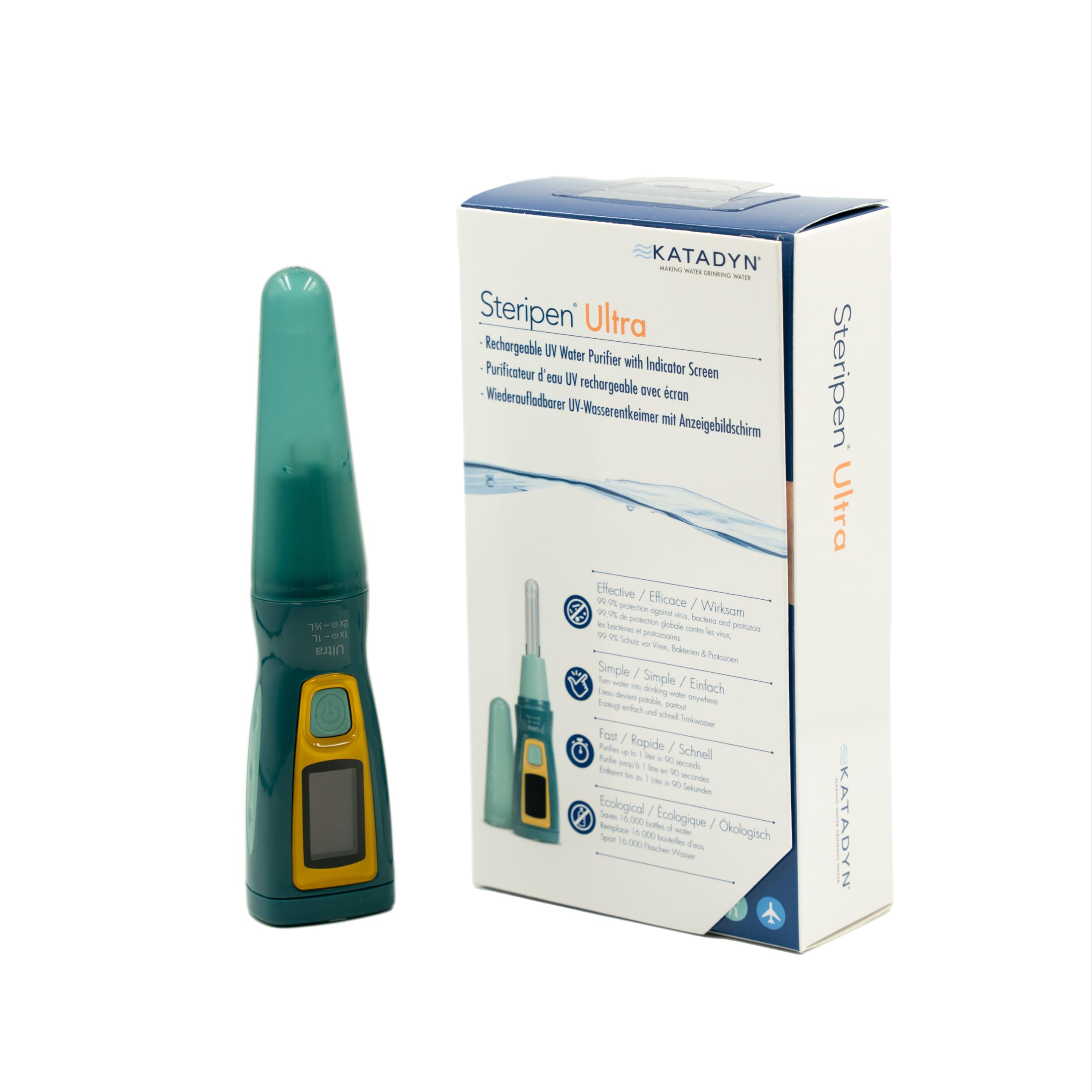
The SteriPEN Ultra takes a completely different approach: UV-C light zaps the DNA of bacteria, viruses, and protozoa, rendering them harmless. It purifies 16 ounces of clear water in under 60 seconds and 32 ounces in 90 seconds—just push the button, insert the wand, and agitate. The 2200 mAh battery recharges via any USB source (solar panel, power bank, laptop), making it ideal for international travel where viral risks are a concern.
At just over half a pound with the neoprene case included, it’s heavier than a straw filter but lighter than carrying chemical tablets for a multi-week trip. Users have relied on it across three continents for everything from trekking in Nepal to nasal irrigation at home. The auto shut-off after treatment ensures you don’t under- or over-expose the water.
There are two important limitations: UV light only works in clear water—turbid or silty water blocks the UV rays and requires pre-filtering. The unit is electronic, so if the battery dies or the UV bulb fails (a few users reported issues after 16+ months), you’re left without purification. It’s best used as a primary filter for travel abroad where viruses are present, or as a secondary treatment to a mechanical filter for extra safety.
Why it’s great
- Kills viruses that mechanical filters cannot capture
- Fast treatment: under a minute for 16 oz
- USB rechargeable for solar or power bank top-ups
Good to know
- Requires clear water—pre-filter if silty
- Electronic components can fail; no backup if battery dies
Understanding the Specs
Micron Rating (Pore Size)
This is the most critical number. A 0.1 micron absolute filter physically blocks bacteria (typically 0.2–0.5 microns) and protozoa (1–15 microns). A 0.2 micron rating may still work for bacteria but is less reliable. Viruses (0.004–0.1 microns) slip through any mechanical filter, which is why UV or chemical treatment is needed in areas with viral risks. The tighter the micron rating, the higher the filtration pressure required, so expect a trade-off between safety and flow rate.
Flow Rate (Liters Per Minute)
Flow rate measures how quickly treated water comes out. Gravity systems like the Katadyn BeFree hit 2 L/min without effort. Squeeze filters average 1 L/min with steady hand pressure. Straw filters depend on your suction strength—typically 500–600 ml/min for most adults. UV purifiers like the SteriPEN treat 0.5L in under a minute but require agitation, not continuous flow. For solo hikers, 1 L/min is adequate; for groups of three or more, aim for 2 L/min or higher.
Filter Lifespan
Manufacturers rate filters in gallons or liters before the element needs replacement. Sawyer’s 100,000-gallon rating is exceptional—essentially a lifetime for a single thru-hiker. Katadyn and LifeStraw rate their filters at 1,000–4,000 liters, which translates to multiple seasons of regular use. Budget straw filters often claim 1,000–1,300 gallons, but real-world capacity depends on water clarity and maintenance frequency. A backflush-capable filter lasts significantly longer than one you can’t clean.
Weight and Packed Size
Backpackers obsess over every ounce. Straw filters like the LifeStraw and Sawyer Mini weigh under 2–3 ounces. Squeeze systems with a bladder typically weigh 5–6 ounces total. Gravity systems with a 3L bag are around 6–7 ounces. UV purifiers weigh 5–9 ounces depending on battery size. The lightest option is always a simple straw, but consider the complete system weight—a straw plus a separate bottle might weigh the same as a combined squeeze system that filters faster.
FAQ
Can a 0.1 micron filter stop viruses?
How often should I backflush my squeeze filter?
Why does my new filter have slow flow at first?
Can I use a backpacking water filter with a hydration bladder?
What happens if my filter freezes in winter backpacking?
Final Thoughts: The Verdict
For most backpackers, the water filters for backpacking winner is the Katadyn BeFree 3L because it delivers the fastest, least effort-intensive filtration for solo and small-group use. If you want the ultimate longevity and thru-hiker durability, grab the Sawyer Squeeze. And for international travel where viruses are a real concern, nothing beats the SteriPEN Ultra UV as a primary or secondary purifier.