A stale hotel-room brew or a lukewarm camp coffee from yesterday’s grounds doesn’t have to define your morning. The difference between a lifeless cup and a vibrant one is the time between grinding and brewing, and when you’re away from your countertop setup, that gap grows fast. A dedicated travel coffee grinder keeps the volatile oils and aromatics locked inside the bean until the exact moment you’re ready to pour, turning any campsite, office break room, or mountain summit into your personal café.
I’m Mohammad Maruf — the founder and writer behind AirfryerBite. Over the past five years I’ve pulled apart dozens of compact burr mills, tested grind consistency across multiple brew methods, and studied how portability, burr geometry, and adjustment mechanics actually hold up in real-world road and trail conditions.
If you want a portable grinder that fits a backpack pocket, delivers uniform grounds from ultra-fine espresso to coarse French press, and won’t feel like a chore to use twice a day, you need the right travel coffee grinder for your specific brewing habits.
How To Choose The Best Travel Coffee Grinder
Buying a portable grinder isn’t about finding the smallest cylinder. It’s about matching the burr’s adjustment range, capacity, and ergonomics to the brew method you actually use on the road. Here are the three decisions that separate a daily-driver from a drawer-filler.
Burr Quality and Click Resolution
Steel conical burrs dominate this category because they grind faster and stay sharper longer than ceramic, especially with dense light roasts. The real differentiator is click resolution — measured in microns per click. A range of 16 to 30 microns per click lets you fine-tune espresso pressure without wasteful trial pours, while coarser step sizes (around 50 microns) work fine for pour-over and French press but lock you out of proper espresso dial-in. Look for 30 or more total click-steps across the adjustment range if you plan to switch brew methods regularly.
Capacity vs. Portability Trade-Off
Most travel grinders hold between 20 and 35 grams of beans, which yields one double-espresso shot or roughly two 10-ounce mugs of pour-over. A 25-gram capacity is the sweet spot for solo travel; anything smaller forces a mid-brew refill, and anything larger often adds height that won’t fit in a standard backpack side pocket. Weigh the grinder’s height and diameter against your typical carry setup — a 6.5-inch cylinder fits most daypacks, while a 7.5-inch one may need to lie flat.
Disassembly and Field Cleaning
Grinds trapped between the burr and the adjustment ring go rancid within days, especially in warm or humid conditions. A grinder that requires tools or excessive force to separate the burr carrier from the housing will be cleaned less often, which directly affects brew flavor. Models with a twist-release mechanism or a push-button cap let you brush out old grounds in under 30 seconds at a campsite, making them far more practical for multi-day trips than designs that need a hex key or screwdriver.
Quick Comparison
On smaller screens, swipe sideways to see the full table.
| Model | Category | Best For | Key Spec | Amazon |
|---|---|---|---|---|
| 1Zpresso J | Premium | Versatile brew switching | 48 mm steel burr, 30 clicks/rotation | Amazon |
| KINGrinder K6 | Premium | Fine espresso dial-in | 16 microns per click, 60 clicks/rotation | Amazon |
| VSSL Java G25 | Premium | Rugged outdoor use | Aircraft aluminum body, 25 g capacity | Amazon |
| TIMEMORE Chestnut C2S | Mid-Range | Balanced build & grind speed | 38 mm S2C burr, 36 adjustment levels | Amazon |
| HEIHOX Manual | Mid-Range | Compact first grinder | 38 mm conical burr, 24+ clicks | Amazon |
| Vivaant Manual | Mid-Range | Fast turbo grinding | Dragon tooth steel burr, 32 g capacity | Amazon |
| Alpaca Ventures Manual | Budget | Entry-level value | Dual bearing, 12 internal settings | Amazon |
In‑Depth Reviews
1. 1Zpresso J Manual Coffee Grinder

The 1Zpresso J sits at the top of this list because it solves the two biggest travel-grinder frustrations: grind consistency across a wide range and tool-free disassembly. Its 48 mm stainless steel conical burrs produce uniform particles from espresso-fine (8–10 clicks from zero) to coarse French press (around 30 clicks), and the 30-click-per-rotation internal adjustment gives enough resolution to switch between brew methods without wasting beans. The compact foldable handle locks flush against the body for storage and extends into a stable crank that requires moderate effort even with light-roast beans — expect 45 to 60 seconds for a pour-over dose.
Build quality is exceptional for its weight class. The aluminum body feels dense and the burrs are factory-calibrated to minimize wobble, which translates to consistent extraction cup after cup. Disassembling for cleaning is intuitive — twist, lift, and brush — no hex keys or tools required. Several long-term users report it still performing like new after grinding well over 100 kg of beans.
Where it falls short is the learning curve for zeroing the dial after reassembly, and the effort required for espresso-range grinding (especially with light roasts) is noticeably higher than pour-over settings. The 30-click adjustment is excellent for general use but less granular than competitors offering 60 clicks per rotation. Still, for the traveler who wants one grinder that handles pour-over, Aeropress, French press, and occasional espresso, this is the most complete package.
Why it’s great
- Wide grind range with 30 precision clicks — fine enough for espresso, coarse enough for cold brew
- Tool-free twist-apart cleaning in under 30 seconds with included brush
- Magnetic catch cup reduces static retention and mess on the trail
Good to know
- Dial-zeroing procedure takes a few tries to master before it feels intuitive
- Light-roast espresso requires noticeably more arm effort than mid-range competitors
2. KINGrinder K6 Manual Coffee Grinder

The KINGrinder K6 is engineered for the traveler who obsesses over dialing in espresso. Its 16-micron step size means 60 clicks per full rotation, which gives finer control than most grinders in this category — you can adjust a single shot’s yield by one or two grams without overshooting. The full-metal body (6061 aluminum with a stainless steel burr set) weighs 620 grams, providing enough heft to stay planted on a picnic table while your non-dominant hand holds the catch cup. Grind speed is impressive: a 14-gram espresso dose finishes in about 45 seconds with moderate effort.
Internal adjustment keeps the mechanism protected from dust and trail grit, and the zero-retention design means every bean that goes in comes out as grounds — no stale pockets building up between brews. The catch cup screws on securely and has proven durable against accidental drops. Several users specifically note that the K6 delivers grind quality comparable to electric grinders costing multiple times its price, making it a serious contender for anyone who wants café-level extraction without plugging in.
The main limitation is the maximum dose: 25 to 30 grams depending on bean density, which is fine for a single shot or two large mugs but forces a refill for group camping. The straight handle, while effective, doesn’t fold as compactly as the 1Zpresso J’s foldable crank, adding a few extra inches to the packed profile. Calibrating the true zero point may also require a quick sensor test on arrival. For the espresso-focused adventurer, however, the K6’s granularity is unmatched.
Why it’s great
- 16-micron resolution with 60 clicks per rotation for ultra-precise espresso tuning
- Full-aluminum body with stainless steel burrs that rival electric grinders twice the price
- Zero retention — no stale grounds mixing into your next brew on multi-day trips
Good to know
- Maximum capacity of 25–30 g means you’ll refill if brewing for more than two people
- Straight handle doesn’t fold as compactly as some competition
3. VSSL Java G25 Manual Coffee Grinder
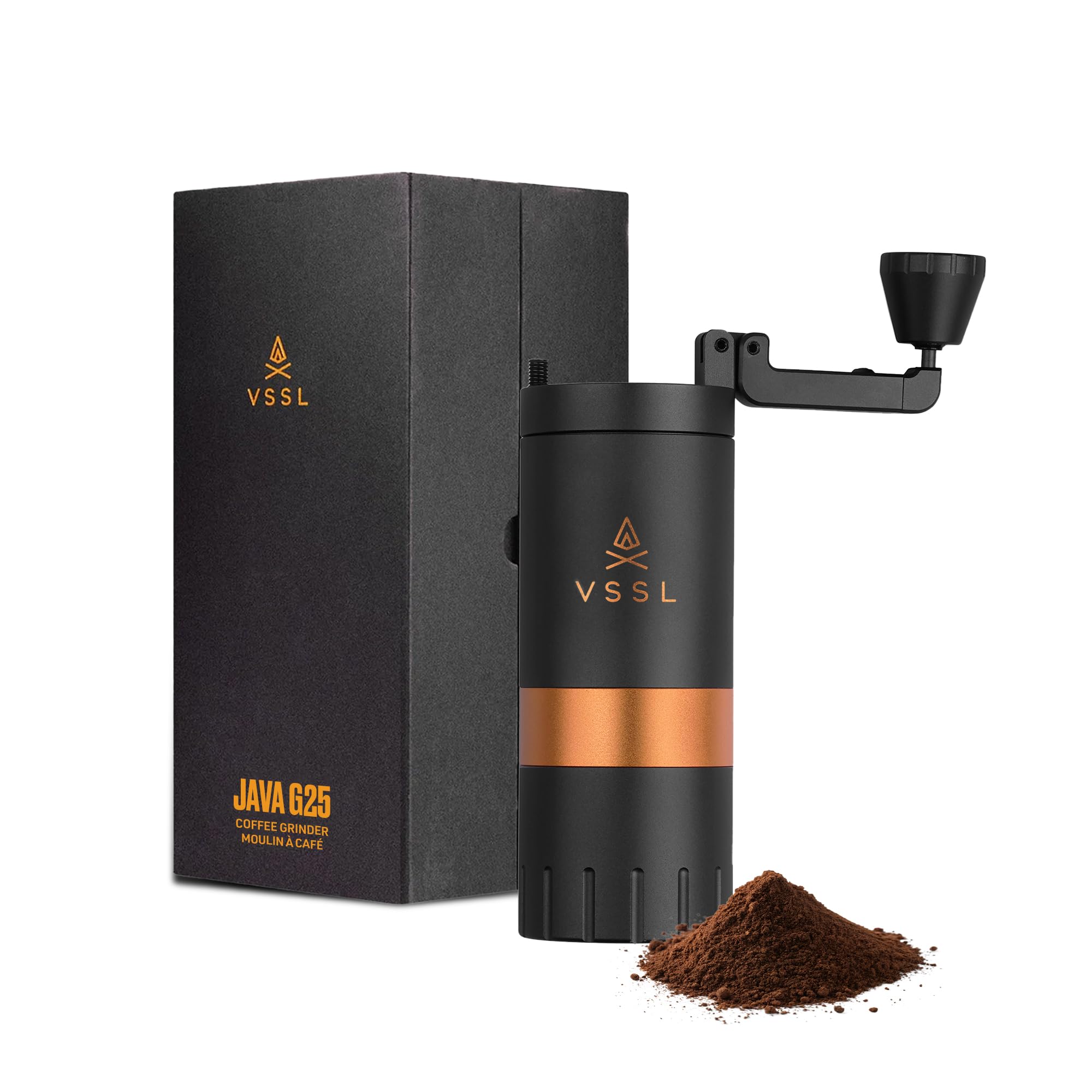
The VSSL Java G25 is built for abuse. Its body is machined from 6061 aircraft-grade aluminum, and the company’s marketing claim — that it survived being run over by a Jeep — tracks with the feel of the unit. At 0.95 pounds and 6.3 inches tall, it’s compact enough to clip onto a backpack carabiner loop using its lockable handle, which doubles as a storage latch. The push-button quick-release cap is a standout design detail: press a button and the top pops off instantly, cutting 10 seconds off every grind session compared to threaded caps.
Grind consistency is solid across the 50-click adjustment range, especially for Aeropress and pour-over. The dual ball bearings eliminate burr wobble, producing uniform particle size distribution that extracts cleanly. The 25-gram capacity is ideal for solo travel — enough for a double shot or a full Aeropress without refilling. Cleaning is straightforward: unscrew the burr carrier, brush out the chamber, and reassemble. The G25’s internals are clearly designed for quick field maintenance.
The tradeoff is that stock burrs don’t reach proper espresso fineness without a modification (some owners swap in Timemore S2C660 burrs), so dialing in true espresso requires an extra investment. The 25-gram capacity also feels tight if you’re brewing for two. And at its price point, you’re paying a premium for the indestructible build and the carry-system features rather than for extreme grind resolution. For the backpacker who prioritizes durability over micron-level espresso control, this is the right tool.
Why it’s great
- Aircraft-aluminum body survived a Jeep run-over — genuinely trail-proof build
- Push-button cap release shaves seconds off every grind-and-clean cycle
- Compact design with built-in carabiner handle clips directly to a backpack loop
Good to know
- Stock burr set does not grind fine enough for espresso without a third-party burr swap
- 25-gram capacity requires a refill for two-drink brew sessions
4. TIMEMORE Chestnut C2S Manual Coffee Grinder

The TIMEMORE Chestnut C2S is the updated version of one of the most popular manual grinders in the enthusiast space. The key upgrade from the C2 is the full-metal unibody construction — the old top cap that cracked under pressure is gone, replaced by a CNC-machined aluminum shell that feels far more premium. The 38 mm S2C stainless steel conical burr is hardened to 55–58 HRC, which holds its edge through dense beans and minimizes the fines generation that can clog a filter or muddy a pour-over cup.
Grinding motion is exceptionally smooth thanks to the dual-bearing positioning system. The handle continues spinning for a rotation or two after you let go, a sign of low-friction internals. The 36 adjustment levels cover the full range from espresso to French press, though the bottom-adjustment nut requires a few turns to change settings — not ideal for frequent method switching but fine for sticking with one brew per trip. Capacity is around 24 grams, which yields two small cups or one strong mug of pour-over.
The C2S is heavier than many competitors at 700 grams, which adds stability during grinding but eats a bit of pack weight budget. Several users note that frequently changing grind size is a minor chore because the adjustment mechanism isn’t as quick as top-mounted dials. Assembly and disassembly for cleaning, however, are straightforward — twist, lift, brush — and the included bag and brush make trail maintenance easy. For the traveler who grinds to one primary brew method and values buttery-smooth mechanics, the C2S delivers.
Why it’s great
- Upgraded unibody metal construction eliminates the top-cap cracking issue of earlier versions
- 58-HRC hardened S2C burr stays sharp through hundreds of grind cycles
- Dual-bearing system provides exceptionally smooth, low-friction cranking motion
Good to know
- Bottom adjustment nut is slower to change between brew methods than top-ring dials
- At 700 grams, it’s heavier than most dedicated travel grinders
5. HEIHOX Manual Coffee Grinder

The HEIHOX is a mid-range value proposition that punches above its price in build quality but not in adjustment precision. The body is aluminum alloy with a stainless steel 38 mm conical burr, and the dual-bearing design delivers smoother rotation than many entry-level hand grinders. The 22-plus click settings (marked by audible clicks rather than numbered dials) cover the range from Turkish-coarse to espresso-fine, but the step size between clicks is wider than premium competitors, meaning you might land between ideal grind sizes for certain brew methods.
Grind speed is decent — a full 30-gram load at a medium-coarse setting finishes in under 60 seconds. The magnetic handle attachment feels solid and prevents the crank from wobbling. Disassembly for cleaning is simple: twist off the bottom adjustment ring, separate the burr, and brush out the grinding chamber. The included drawstring bag keeps the unit protected inside a larger bag. Several long-term owners confirm it maintains consistent grind quality after a full year of daily use.
Where the HEIHOX shows its mid-range status is in ergonomics and fine-tuning. The handle, at roughly 5 inches from pivot, creates a wide rotation circle that can feel awkward when grinding at finer settings — especially if you’re using it on a small table or uneven surface. The adjustment clicks are audible but not indexed by number, so you’ll need to remember your setting by count rather than a reference number. For the traveler who wants an affordable introduction to manual grinding without investing in premium hardware, this is a solid starting point.
Why it’s great
- Dual-bearing 38 mm steel burr for smooth, consistent grinding at a budget-friendly price
- Twist-and-brush disassembly makes trail cleaning quick and tool-free
- Compact 6.9-inch height fits easily into a daypack side pocket
Good to know
- Handle length creates a wide rotation arc that can feel awkward at espresso settings on small surfaces
- No numbered reference on the click dial — you’ll need to count clicks from zero each time
6. Vivaant Manual Coffee Grinder

The Vivaant sets itself apart with raw grinding speed. Its “Dragon Tooth” stainless steel conical burr uses an aggressive tooth geometry that processes beans roughly twice as fast as ceramic-burr grinders — a 15–20 gram dose at Turkish-fine takes about 2 minutes, while a medium-coarse setting finishes in under 60 seconds. The 6 external numbered settings (1–6) are easy to read and adjust without disassembly, making it an approachable choice for travelers who don’t want to memorize click counts. The 32-gram capacity is generous for a manual grinder, producing enough grounds for two full mugs or a large Aeropress.
The construction is stainless steel and glass, giving it a premium heft that dampens vibration during grinding. The glass jar doubles as a storage container with a secure lid, letting you pre-grind beans and carry them without an extra bag. Assembly and disassembly take seconds — the burr carrier threads into the jar base, and a dry toothbrush reaches all the internal surfaces easily. Several users highlight the lifetime warranty and responsive customer support as major confidence boosts for a travel tool that takes abuse.
The glass jar is the unit’s biggest vulnerability — dropping it on rock or concrete will likely shatter it. Replacement jars are available, but the fragility means this isn’t the best choice for ultralight backpacking where every item gets tossed around. The 6-setting adjustment range is also coarser than competition; you get enough resolution for pour-over and French press, but dialing in espresso requires careful experimentation and some users report it lacks the granularity for precise espresso tuning. For road trips, office use, and car camping where speed and capacity matter, the Vivaant is a fast, satisfying option.
Why it’s great
- Aggressive Dragon Tooth burr cuts grind time nearly in half compared to ceramic competitors
- 32-gram capacity — largest in this comparison — fuels two full mugs without refilling
- Numbered external dial (1–6) eliminates guesswork for setting changes
Good to know
- Glass jar is fragile — one drop on hard ground likely means a cracked vessel
- 6-step adjustment range is too coarse for precise espresso dial-in
7. Alpaca Ventures Premium Manual Coffee Grinder

The Alpaca Ventures grinder is the most affordable manual burr grinder in this lineup, and it earns its spot by delivering reliable grind consistency at a minimum investment. The 420 stainless steel conical burr is rust-resistant and paired with a dual-bearing shaft that makes cranking noticeably smoother than single-bearing budget options. The 12 internal click settings (adjusted by rotating the bottom ring) cover pour-over, Aeropress, French press, and espresso, though the step size between settings is quite wide — you may not find a perfect middle ground for certain drip methods.
Build quality is solid for the price: an aluminum alloy body with a stainless steel burr, weighing exactly one pound. The lengthened stainless steel handle provides good leverage, reducing the effort needed to crack through medium roasts. A full 20-gram load at a medium-fine setting takes around 50 to 60 turns, which feels manageable even for users with arthritis or reduced hand strength. Disassembly for cleaning requires a simple twist to separate the burr carrier from the body, and the included brush reaches into the burr chamber effectively.
The limitations are characteristic of entry-level hardware. The 420 steel burr is softer than 58-HRC hardened steel used in premium models, meaning it will dull faster with heavy use over years of daily grinding. The lack of numbered or marked adjustment clicks means you’re counting internal clicks from zero each time you change settings — easy to lose count during a distracted morning routine. There’s no rubber base for countertop stability, so you’ll need to hold the grinder in your hand or brace it against a surface while grinding. For the occasional traveler or the beginner who wants to test manual grinding without a large commitment, this grinder delivers solid fundamentals.
Why it’s great
- Dual-bearing design provides surprisingly smooth rotation for its price tier
- Stainless steel burr and aluminum body resist rust and trail grime
- Low entry price makes it an easy gateway into manual grinding
Good to know
- 420 steel burr is softer and will dull faster than hardened steel alternatives over years of daily use
- No numbered click markings — you’ll need to count clicks from zero each adjustment
FAQ
How many grams of beans should a travel coffee grinder hold?
Can a hand grinder consistently produce espresso-fine grounds?
How do I clean a manual burr grinder in the field?
Does burr material (steel vs ceramic) affect portability?
Final Thoughts: The Verdict
For most travelers, the travel coffee grinder winner is the 1Zpresso J because it combines a wide grind range, intuitive tool-free cleaning, and a foldable handle that stows small — all with burr precision that rivals electric grinders. If you want the finest espresso dial-in on the trail, grab the KINGrinder K6 with its 16-micron click resolution. And for rugged outdoor use where survival-grade durability matters more than micron-level adjustment, nothing beats the VSSL Java G25.