Freshly roasted coffee tastes noticeably better than stale store-bought beans, but finding a home roaster that handles small, consistent batches—without burning the beans or filling your kitchen with smoke—is the real challenge. The market is split between gas-fired drum roasters that produce deeper, more developed flavors and fluid bed machines that deliver clarity and speed with less mess.
I’m Mohammad Maruf — the founder and writer behind AirfryerBite. I’ve spent hundreds of hours analyzing the hardware, thermal designs, and real-world batch limits of over 30 home coffee roasters to separate the machines that produce repeatable, café-quality results from those that waste your time and green beans. In this guide, I break down the best options across gas drum and fluid bed designs so you can match a roaster to your counter space, flavor goals, and budget.
Whether you are a beginner looking for automatic convenience or a seasoned roaster seeking full manual control, this evaluation of the best small batch coffee roaster will help you choose a machine that delivers fresh, flavorful coffee without unnecessary complexity.
How To Choose The Best Small Batch Coffee Roaster
Selecting a home coffee roaster is not about picking the most expensive or cheapest model. The right machine depends on batch size, how much control you want over the roast, how much smoke and chaff you can tolerate indoors, and whether you prefer the flavor profile of drum roasted beans or fluid bed roasted beans. Here is what matters most.
Understand the Two Roasting Technologies: Gas Drum vs Fluid Bed
Gas drum roasters use a rotating metal or glass drum heated directly by a gas burner. The drum’s thermal mass provides even heat distribution, and the direct flame interaction creates a richer, more developed flavor with deeper caramelization. These machines rely on sight, sound, and smell for control, and they generate significant smoke that requires outdoor use. Fluid bed roasters use hot air to suspend and spin the beans inside a glass chamber. These machines produce cleaner, brighter flavor profiles, shorter roast times, and manageable smoke indoors if you have a range hood. They also allow precise digital control over temperature and fan speed, making them easier for beginners.
Match Batch Capacity to Your Consumption
Most small batch roasters handle between 120g and 500g of green beans. A 120g batch yields roughly enough beans for a week of single-user coffee, while 300–400g per batch suits a household of two to three coffee drinkers. Bigger batches save time but require a machine with enough thermal power to avoid stalling the roast. Important: never exceed the manufacturer’s recommended batch size — loading too much green coffee can choke the airflow in a fluid bed roaster or cause uneven heat distribution in a drum roaster.
Evaluate Temperature Control and Monitoring
Precise temperature measurement separates predictable roasters from unreliable ones. Machines with real-time digital temperature displays and adjustable heating or fan controls let you replicate successful recipes. Models that rely solely on an analog thermometer or your own hearing require more experience. For fluid bed roasters, look for nine or more power settings; for drum roasters, a quality probe mounted near the bean mass (not just the drum surface) provides accurate tracking of the bean temperature curve.
Consider Smoke and Chaff Management
Chaff (the papery skin that flakes off beans during roasting) will fly everywhere if the machine lacks a proper collector. Fluid bed roasters typically include a chaff basket that traps this debris. Drum roasters let chaff escape through the drum slots, so you must use them outdoors. Smoke production is heavier with gas drum roasters, while fluid bed machines can be run under a kitchen range hood. Some premium electric roasters now include activated carbon filters that make indoor medium-to-dark roasts feasible.
Quick Comparison
On smaller screens, swipe sideways to see the full table.
| Model | Category | Best For | Key Spec | Amazon |
|---|---|---|---|---|
| Fresh Roast SR800 | Fluid Bed | Precise digital control | 226g capacity, 9 power settings | Amazon |
| MAGO MAGA Roma Pro | Fluid Bed | Auto/manual hybrid | 300g capacity, SCA Award 2025 | Amazon |
| Fresh Roast SR540 | Fluid Bed | Entry-level fluid bed | 120g capacity, variable fan | Amazon |
| DYVEE KAKA-G400 | Gas Drum | Budget outdoor drum roast | 400g capacity, quartz glass drum | Amazon |
| KALDI Mini | Gas Drum | Manual drum quality | 250g capacity, motorized drum | Amazon |
| Fatamorgana 450g | Electric Drum | Indoor electric drum roast | 450g capacity, 1000W, quartz glass | Amazon |
| Precision Coffee Roaster 1lb | Electric Drum | Auto/assist/manual modes | 1lb capacity, touchscreen, smoke filter | Amazon |
| NIASIA PKF-500g | Electric Drum | Upgrade from fluid bed | 500g capacity, 9 auto profiles | Amazon |
| Sandbox Smart R1 | Electric Drum | App-controlled convenience | 150g capacity, 16 preloaded curves | Amazon |
In‑Depth Reviews
1. Fresh Roast SR800 Coffee Roaster
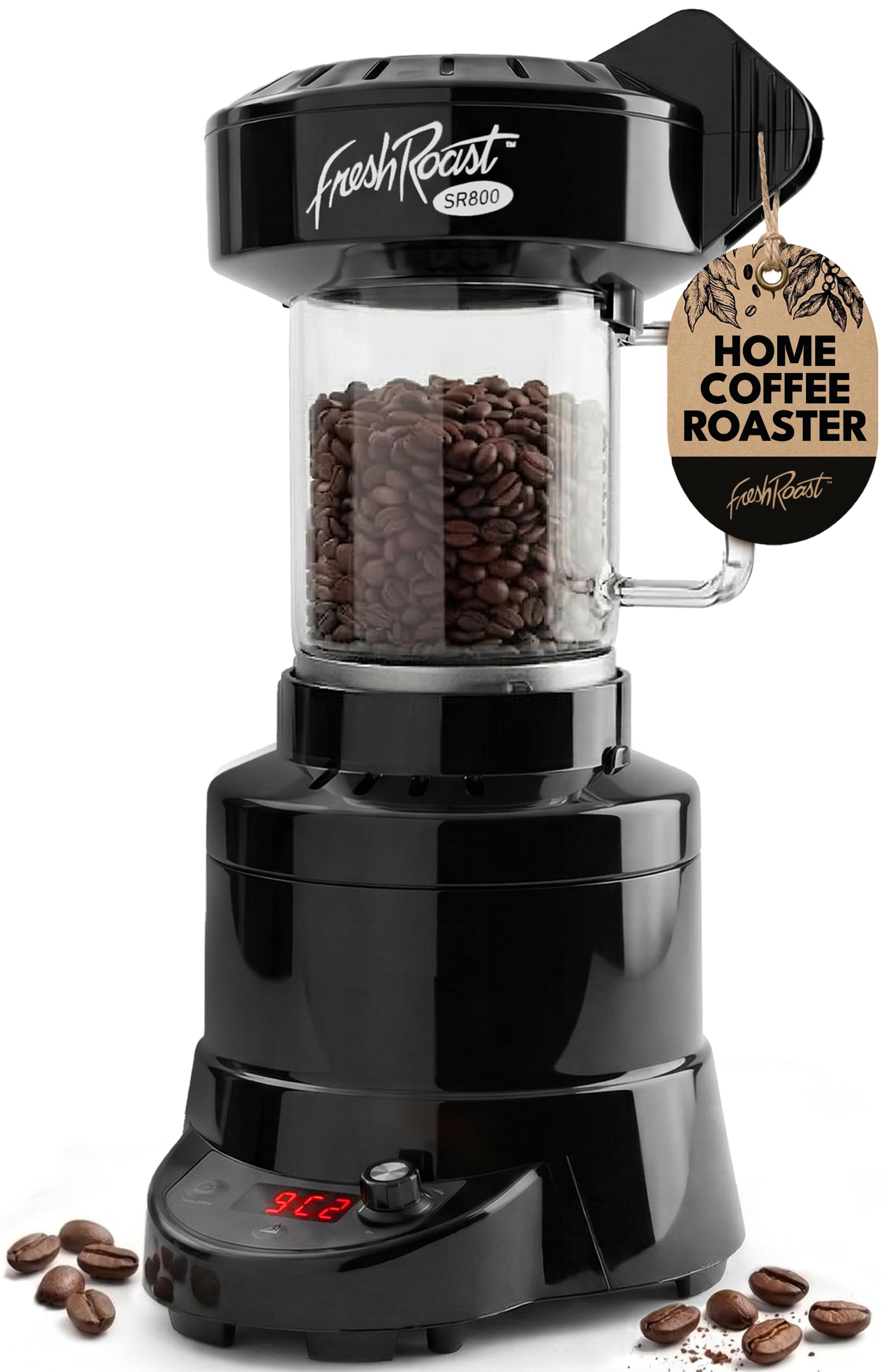
The Fresh Roast SR800 is a fluid bed roaster that doubles the capacity of its predecessor, handling up to 226 grams of green beans per batch—enough for two to three coffee drinkers. Its speed roast fluid motion system suspends beans in a stream of hot air, delivering even roasts without scorching the bean surface. The control board uses a push-and-turn knob to adjust heat, fan speed, and time across nine power levels, with a real-time digital temperature display that helps you replicate successful profiles.
Experienced roasters appreciate the ability to change fan and heat settings mid-roast to shape the temperature curve. A typical method runs the first few minutes at high fan and heat to dry the beans, then reduces both as first crack approaches to avoid stalling. The glass roasting chamber and top-mounted chaff basket make monitoring easy, and the machine fits under a standard microwave range hood for indoor use with acceptable smoke levels. The included sample tray and optional glass extension tube add flexibility for experimentation.
Durability is generally strong—many users report hundreds of batches before needing any repair—though the control knob can become temperamental after heavy use, occasionally causing unintended jumps in heat or fan settings. Fresh Roast offers a one-year warranty on the base unit and a flat-rate repair program after that. For home roasters who want digital precision without moving to a gas drum setup, the SR800 is the most capable fluid bed machine in its segment.
Why it’s great
- Digital temperature display with nine-level power and fan control for repeatable roasts.
- Large 226g batch capacity suits households of two to three coffee drinkers.
- Fluid bed design produces clean, bright flavor with manageable indoor smoke.
Good to know
- Control knob may become less responsive over time, requiring warranty service.
- Top cap and chaff basket are glass and plastic, so handle carefully to avoid cracking.
- Best results require technique adjustments for different bean densities.
2. MAGO MAGA Roma Pro Smart Home Coffee Bean Roaster
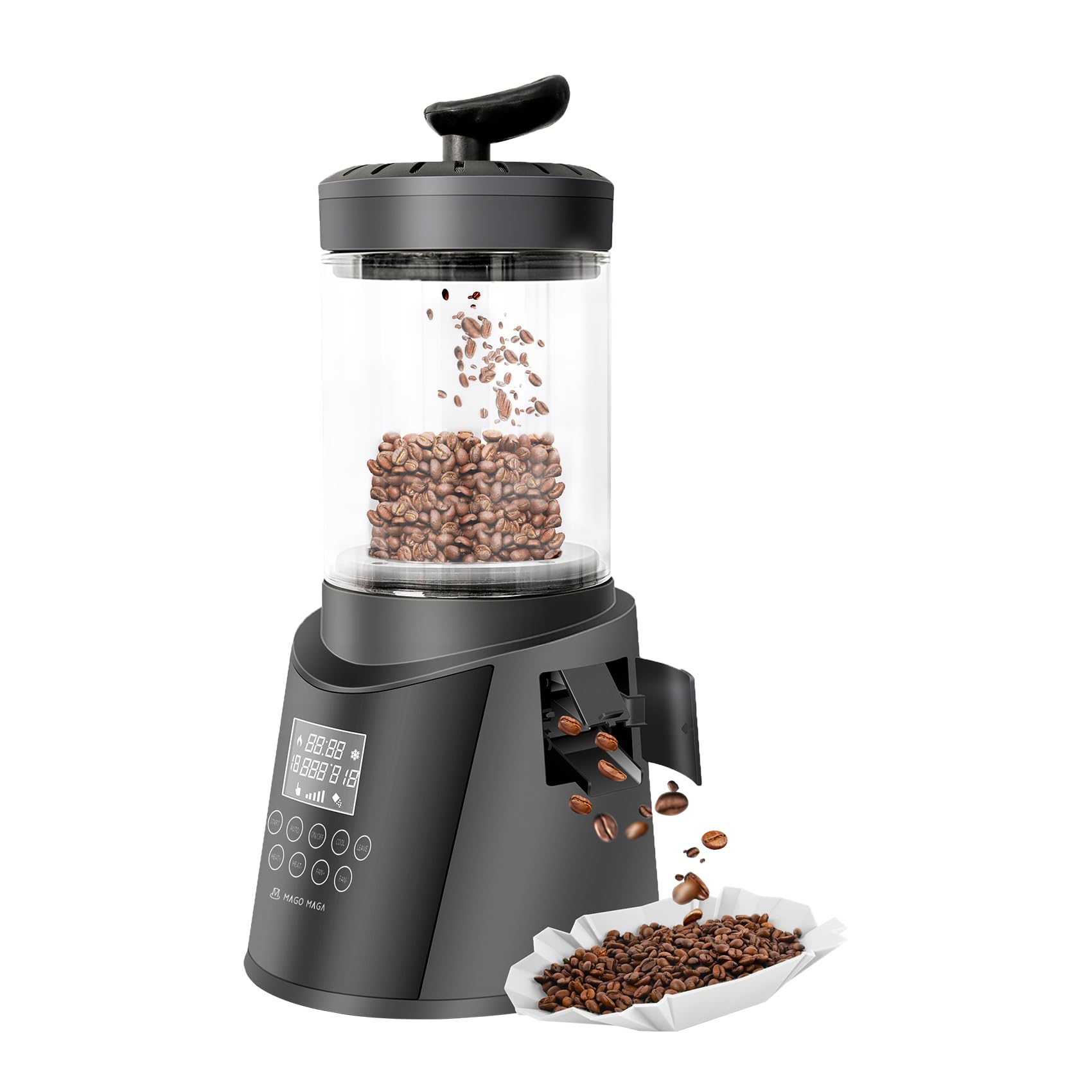
The MAGO MAGA Roma Pro won the 2025 SCA Best New Product Award by combining automatic roasting profiles with manual override in a fluid bed design. The auto mode uses pre-set temperature curves for common bean types, while manual mode lets experienced roasters adjust heat and fan throughout the batch. The double-layer glass window provides clear visibility of the bean color change, and the digital display lets you toggle between Celsius and Fahrenheit without confusion.
Capacity reaches 300 grams of green beans, placing it in the sweet spot for weekly roasting across a household. The ultra-low smoke chaff collector and auto-cooling cycle help lock in flavor quickly after the roast ends. Users consistently report consistent results on Ethiopian and Colombian beans, and the version 1.5 upgrade improved the bean bin door switch for smoother operation. The machine is ETL and CE certified, which addresses safety concerns for a countertop electric appliance.
The main trade-off is speed: 120V power limits the heating element, so city roasts progress slower than gas drum models. Decaf beans may need manual mode to avoid stalling. Customer service is responsive—reports of broken glass tubes or heating element failures were resolved with replacements. For users who want a guided first year of roasting with the option to take full control later, the Roma Pro is a well-built bridge between beginner and advanced.
Why it’s great
- Automatic and manual modes cover beginners and experienced roasters in one machine.
- 300g batch handles a full week of coffee for most households.
- Auto-cooling and efficient chaff collection make indoor roasting practical.
Good to know
- 120V heating slows the roast, which may not satisfy users wanting fast dark roasts.
- Some units arrived with the digital screen misaligned or the heater non-functional.
- Premium price reflects the SCA award and build quality.
3. NIASIA PKF-500g Automatic Coffee Roaster Machine

The NIASIA PKF-500g is an electric drum roaster built for home users who want to batch sizes larger than fluid bed machines can handle. Its stainless steel drum rotates green beans while a 1000-watt heating element and precise temperature probe work together in automatic or manual mode. The machine includes nine preset roasting profiles covering light, medium, and dark roasts, plus specific profiles for sun-dried, washed, and honey-processed beans. The optimal batch range is 350–400 grams, which produces about a week and a half of coffee for a two-drinker household.
The separate high-speed cooling tray and chaff collector are notable upgrades over cheaper drum roasters, preventing the beans from continuing to cook after you hit the target roast level. The smoke filter works well for light roasts indoors, while medium and dark roasts require connecting the included aluminum alloy smoke pipes to vent outdoors. Experienced users have integrated the machine with TC4 and Artisan software for full computer-controlled roasting, tracking bean temperature curves in real time. Build quality is solid, with easy-to-clean components and accessible maintenance.
The main downside reported is paint peeling inside the exhaust chute on some units, which can taint the beans with a chemical smell. Stripped screws on the cooling fan also appear in longer-term reviews. The stock automatic profiles tend to over-roast, so manual mode with your own temperature targets is recommended. At this capacity and price point, the PKF-500g is a capable drum roaster for users who have outgrown fluid bed models and want more batch volume without doubling their budget.
Why it’s great
- 500g batch capacity (350–400g sweet spot) suits heavy coffee drinkers or small families.
- Separate high-speed cooling tray and chaff collector prevent over-roasting after the cycle ends.
- Compatible with TC4/Artisan software for full computer-controlled roasting profiles.
Good to know
- Paint peeling in the exhaust chute has been reported on some units, ruining batches.
- Stock automatic mode tends to over-roast; manual adjustment is recommended.
- Smoke filter only suits light roasts — medium and dark require outdoor venting.
4. Precision Coffee Roaster 1lb Electric Coffee Roaster for Home Use
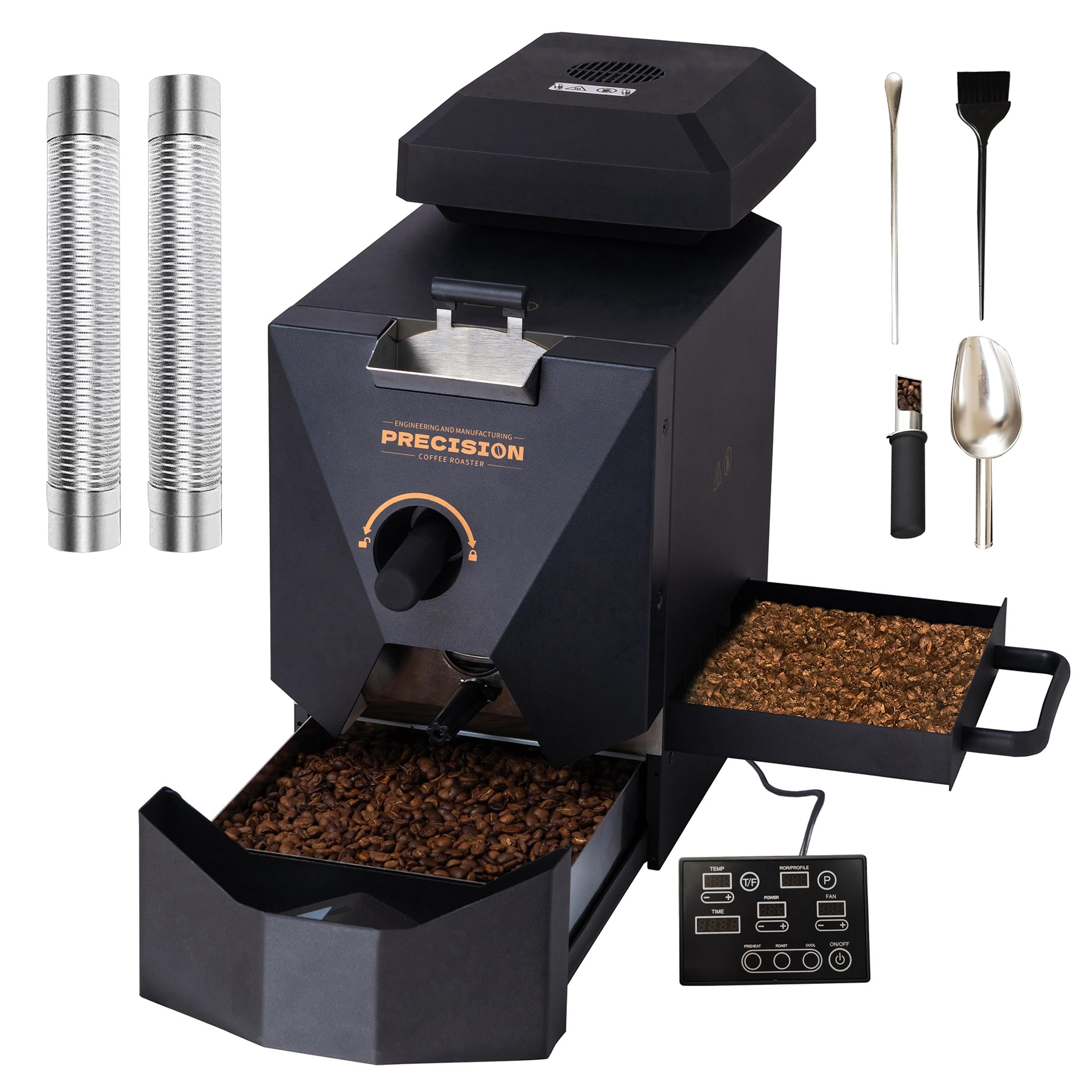
The Precision Coffee Roaster is an electric drum machine with a touchscreen interface and three operating modes: automatic, assisted, and manual. The automatic mode follows built-in programs for light, medium, or dark roast, while assisted mode pauses the machine mid-cycle so you can sample and decide when to continue. The manual mode gives full control over temperature and drum speed. The machine includes a smoke filter for indoor use and a chimney tube that can be routed to a window.
Users report that the auto mode produces a smooth, non-acidic light to medium roast on the first try, which is rare for entry-level drum roasters. The sample spoon and observation window let you check bean color without stopping the cycle. The smoke filter works well for light roasts but struggles with medium-to-dark levels, producing enough smoke to trigger smoke detectors if not vented outside. Preheating takes about five minutes, and the cool-down cycle is similarly fast, making it possible to roast multiple batches in an evening.
The touchscreen has been a weak point — several users mention the display labels are difficult to read in bright light and the interface freezes or ignores inputs after several months of use. More critically, exhaust moisture can drip onto the circuit board, causing control failures that require repairs. The manufacturer has been responsive with warranty replacements, but the long-term reliability is lower than the initial feature set suggests. For users who roast a pound every week and want a guided experience, this is a good value — but expect some maintenance.
Why it’s great
- Three operating modes — auto, assisted, manual — suit beginners through advanced users.
- Built-in smoke filter and chimney tube allow indoor use for light to medium roasts.
- Sample spoon and observation window let you check progress without stopping the cycle.
Good to know
- Touchscreen interface can be unreliable, freezing or rejecting inputs after months of use.
- Exhaust moisture may damage the circuit board, requiring repairs under warranty.
- Not recommended for dark roasts indoors — smoke output becomes significant without external venting.
5. Fresh Roast SR540 Automatic Coffee Bean Roaster
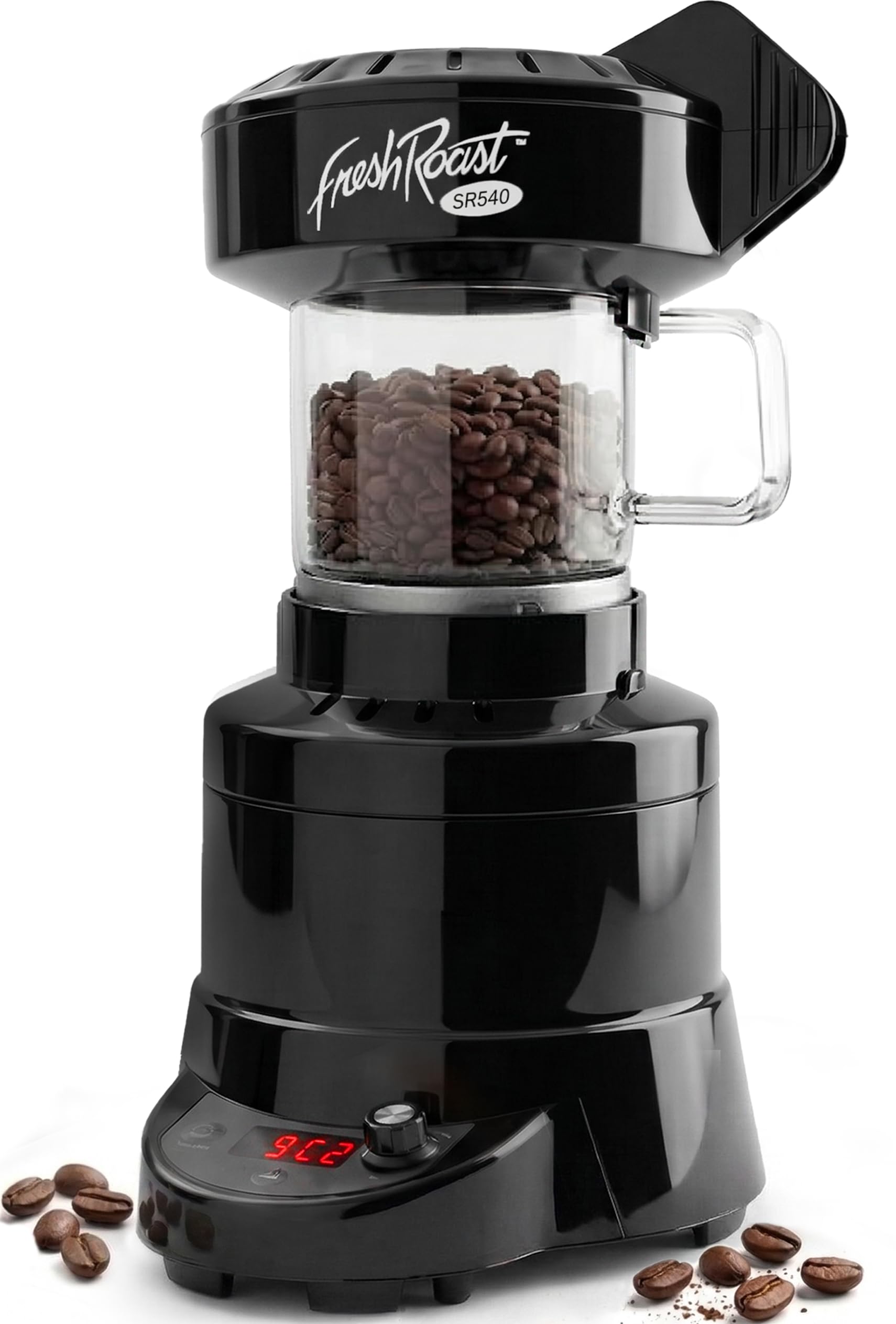
The Fresh Roast SR540 is the smaller sibling of the SR800, handling up to 120 grams of green beans per batch — enough for one to two people who drink a few cups daily. Like the larger model, it uses a fluid bed system with a glass roasting chamber, variable heat and fan control, and a real-time temperature display. The machine includes nine power settings and nine fan speeds, giving precise control over the roast curve from drying through first crack. The four-step process — load, set, roast, cool — is intentionally simple for beginners.
Batch size makes the SR540 ideal for those who want to experiment with different single-origin beans without committing to a full pound. A 120g batch roasts in under 10 minutes, and the machine can be run under a microwave range hood with minimal smoke. Users consistently praise its rugged build and consistent results: one review called it a rugged roaster that produces excellent dark roasts with the right technique (starting with high fan and heat, then dropping both after first crack). The machine is also used by experienced roasters as a second unit for sample roasting.
The analog knob control is functional but lacks the digital precision of the SR800’s push-turn interface, and the glass chamber is fragile if dropped. Replacement parts are available from Fresh Roast, and customer service is generally responsive. Some users report the motor failing after a few years of daily use, but at this price point, the SR540 is still considered a great entry-level fluid bed roaster that’s easy to learn and consistent once dialed in.
Why it’s great
- Simple four-step process and fast roast time make it very beginner friendly.
- Nine fan speed and nine power level settings provide fine-grained control.
- Small 120g batch is perfect for sampling single-origin beans without waste.
Good to know
- Analog knob control is less precise than SR800’s digital push-turn interface.
- Glass chamber can break if dropped; handle with care during cleaning.
- Motor life around 2–3 years with daily use before needing replacement.
6. KALDI Mini Size (200–250g) Home Coffee Roaster

The KALDI Mini is a gas-fired drum roaster built around a motorized stainless steel drum that rotates beans over an external burner. It handles 200 to 250 grams per batch, using a direct heating method where the gas flame contacts the drum to transfer heat. The machine includes a thermometer, a removable hopper, and a sampling spoon, but requires you to supply your own gas burner — grills, camp stoves, and propane burners all work. The manual operation demands constant attention to sight, sound, and smell to locate the first and second cracks.
Users who have owned the KALDI for years report that its motor still runs smoothly after over 70 roasts, and the build quality feels premium compared to cheaper drum roasters. The low noise of the rotating drum makes it easy to hear the cracking sounds, which is the primary cue for deciding when to stop the roast. The stainless steel construction resists rust and heat damage, and the compact size (about 8 x 10 x 8 inches) stores easily. However, the notches on the bottom base cause the unit to tip on standard grill grates without modification, and the 250g limit means any beans over that volume will spill out during first crack.
The main weakness is the motorized gearbox, which sits near the hot drum and can overheat during back-to-back roasts, shortening its life. A cheap aftermarket fan directed at the gearbox helps. The included thermometer provides decent surface temperature readings but is too slow to track rapid temperature changes accurately. This is not a machine for those who want push-button convenience — but for purists who enjoy managing every variable, the KALDI Mini delivers excellent drum roasted flavor in a quiet, manual package.
Why it’s great
- Premium stainless steel build with a noise profile that makes cracking sounds easy to hear.
- Motorized drum produces even, consistent drum roasted flavor without hot spots.
- Compact and portable — ideal for outdoor roasting on a propane burner or camp stove.
Good to know
- Motor gearbox overheats during continuous roasts, requiring active cooling.
- Bottom base notches cause tipping on standard grill grates.
- Steep learning curve — beginners can under- or over-roast several batches before mastering control.
7. Fatamorgana 450g Direct Fired Electric Coffee Roaster
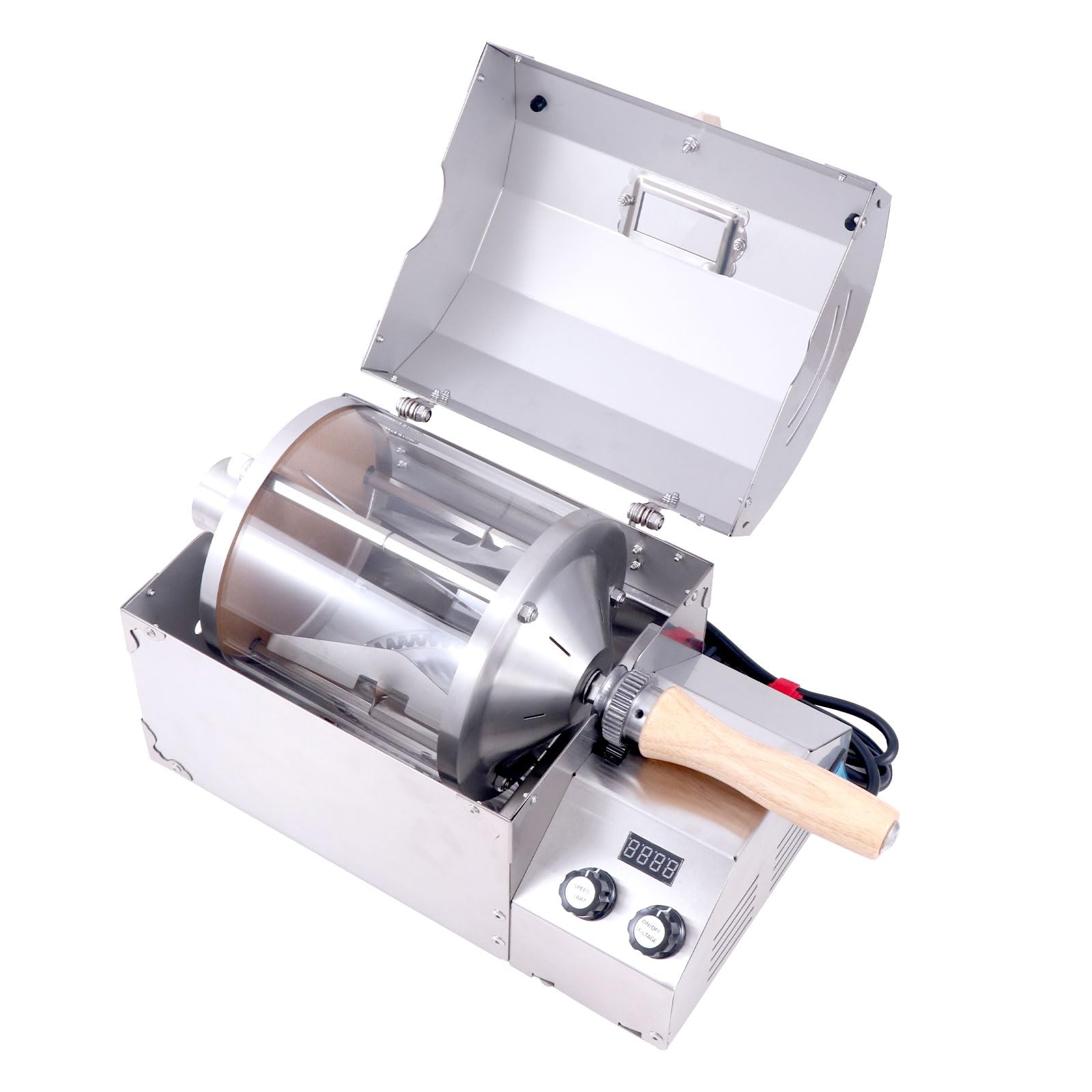
The Fatamorgana electric drum roaster uses a 1000-watt heating element combined with a 5mm thick quartz glass drum that lets you watch the bean color change throughout the entire roast. The direct flame simulation method heats the drum directly, producing a flavor profile closer to gas drum roasters than fluid bed machines. Capacity reaches 450 grams, but the sweet spot for even roasting is around 300–350 grams per batch. The drum is held in place by three spring screws that you can remove by hand for cleaning — no tools needed.
Users with over two decades of home roasting experience report that the Fatamorgana produced perfect results on the first try, which is impressive for a drum roaster at this price point. The stainless steel housing withstands extended use at high temperatures without melting or deforming, and the chaff collection drawer makes daily cleaning straightforward. The machine also handles roasting cashews, peanuts, and other nuts up to 2mm diameter, adding versatility for snack roasting. One reviewer who roasted off and on for 25 years called it absolutely stellar, noting that it solved the problems of too-small capacity and poor temperature control that plagued earlier machines.
The biggest risk is inconsistent quality control — one report describes heating coils that failed to reach roasting temperature on the first batch and died completely the next day. Another user noted sharp metal edges that required deburring and chamber screws that needed tightening before use. Additionally, the machine comes without a user manual, which is a significant omission for buyers who are not already experienced with drum roasters. Its performance when working correctly is excellent for the price, but you are gambling on receiving a defect-free unit.
Why it’s great
- Quartz glass drum provides full visibility of bean color change during roasting.
- 1000W direct-flame simulation delivers deeper flavor than fluid bed machines.
- Tool-free drum removal makes thorough cleaning quick and easy.
Good to know
- Heating element failures have been reported; quality control is inconsistent.
- No user manual included — not suitable for complete beginners without YouTube research.
- Sharp metal edges and loose chamber screws require inspection before first use.
8. Sandbox Smart R1 Home Coffee Roaster with Cooling Tray

The Sandbox Smart R1 is an electric drum roaster controlled entirely through a smartphone app, storing up to 16 preloaded roasting curves and an unlimited number of user-created profiles. The direct-fire drum roasts 100 to 150 grams of green beans in about 15 minutes, and the app guides you through each step while saving your roast history for future replication. The included cooling tray draws room air through the beans to stop the roast quickly, and a pull-out drawer collects chaff for easy disposal. The app also offers community-shared recipes and optional VIP subscription for exclusive curves.
The R1 produces consistent medium-light roasts and is particularly well-suited for apartment dwellers who want to roast indoors without smoke setting off alarms — the chaff and smoke management are among the best in this class. Users note that the preset profiles work well for medium-dark roast levels, and creating custom curves is straightforward once you understand the app interface. However, the temperature probe sits near the drum wall rather than in the bean mass, which means the rate-of-rise curve may not accurately reflect actual bean temperature, requiring trial and error to dial in your preferred roast level.
The biggest long-term concern is the app-based control model: after approximately one year of use, Sandbox Smart moved advanced roasting profiles and features behind a paid VIP subscription, removing functionality that was included at purchase. Users also report that the company provides no changelog for firmware updates and offers no rollback option if an update breaks compatibility. If the company discontinues app support or restricts app access, the machine becomes a paperweight. At this price point, the R1 is a capable roaster when it works, but the subscription model and lack of manual controls make it a risky long-term investment.
Why it’s great
- Excellent smoke and chaff collection for indoor roasting without triggering smoke detectors.
- App saves roasting history and supports custom profiles for repeatable results.
- Cooling tray and pull-out chaff drawer make cleanup very easy.
Good to know
- Advanced profiles were moved to a paid subscription, removing features you bought.
- Temperature probe near drum wall gives inaccurate rate-of-rise data.
- No manual controls — the machine becomes useless if the app loses support.
9. DYVEE KAKA-G400 Gas Burner Coffee Roasting Machine

The DYVEE KAKA-G400 is a budget-friendly gas drum roaster built around a 304 stainless steel frame and a quartz glass drum that allows direct monitoring of bean color. It handles up to 400 grams of green beans per batch, with a recommended sweet spot of 200–300 grams for even results. The machine uses a 12V low-voltage motor for safety, and the drum is driven by gear bushings that require periodic food-grade oil. The package includes a funnel, power adapter, and instruction manual, but you must supply your own propane burner — a standard camp stove or grill burner works well.
Users who have roasted over 30 pounds of coffee through the KAKA-G400 report that the stainless steel base and wooden handle hold up well to repeated high-heat cycles. The quartz glass drum, while breakable if dropped, provides excellent visibility of the beans transitioning from green to first crack to second crack. One experienced user describes it as an ideal solution for weekly outdoor roasting, noting the consistent, simple operation and the ability to dial in 450–500°F gas temperature for a perfect dark roast in under 13 minutes.
The KAKA-G400 has several usability drawbacks. Chaff blows out of the drum slots during roasting, making a mess that requires outdoor use — you cannot roast inside without a dedicated ventilation setup. The included thermometer is slow to respond and mounted in a way that makes it awkward to read while adjusting the gas flame. Also, some beans can get stuck in the metal tubes inside the drum, burning and producing smoke. The build is generally solid for the price, but the quality control issues (sharp edges, loose screws) that appear in other drum roasters also affect this model. For budget-conscious buyers who already own a propane burner and don’t mind the noise and chaff, this is the cheapest entry point into gas drum roasting.
Why it’s great
- 400g capacity is the largest among budget drum roasters — up to 5 lbs per hour.
- Quartz glass drum provides full visibility during roasting.
- Stainless steel frame and wooden handle hold up to extended high-heat use.
Good to know
- Chaff blows everywhere during roasting — must be used outdoors.
- Thermometer is too slow to respond for accurate temperature tracking.
- Small beans can get stuck in drum tubes and burn, causing smoke.
FAQ
Can I use a small batch coffee roaster indoors?
What batch size is best for a single person drinking 2–3 cups daily?
Why do gas drum roasters produce different flavor than fluid bed roasters?
How long does it take to roast a batch of coffee at home?
Do I need special ventilation to roast coffee at home?
Final Thoughts: The Verdict
For most users, the best small batch coffee roaster winner is the Fresh Roast SR800 because it combines digital precision, a 226g batch capacity, and fluid bed convenience in a design that works indoors under a range hood. If you want automatic profiles with the option for manual control and a larger 300g batch, grab the MAGO MAGA Roma Pro. And for those who prefer the deeper, richer flavor of gas drum roasting and already own a burner, the DYVEE KAKA-G400 is the most affordable entry point into serious drum roasted coffee.