Ceramic knives deliver incredible sharpness and edge retention, but their brittle nature means a standard steel sharpener can destroy a blade in seconds. Finding a sharpener that removes material evenly without chipping the thin ceramic edge is the only way to restore performance without a trip to the manufacturer.
I’m Mohammad Maruf — the founder and writer behind AirfryerBite. I analyze the mechanical specs, abrasive materials, and guided angle systems that determine whether a sharpener actually works on high-hardness ceramics or just grinds them into dust.
In this guide, I break down the diamond-wheel and ceramic-hone methods that respect the brittle nature of zirconia blades. This is your complete resource for picking the sharpener for ceramic knives that matches your knife collection and your skill level.
How To Choose The Best Sharpener For Ceramic Knives
Ceramic knives are made from zirconia, a material that is harder than steel but also brittle. Standard sharpening rods or electric grinders designed for metal blades will chip or crack the ceramic edge. You need a sharpener that uses diamond abrasives and controlled-angle guidance to remove material gradually without traumatic force.
Diamond Abrasive vs. Ceramic Hone
Diamond is the only abrasive hard enough to cut zirconia efficiently. A #1000 to #400 grit diamond disc or wheel does the heavy work of reshaping a dull edge. After that, a finer ceramic hone (like a #3000 or #6000 grit disc) polishes the micro-serrations away for a smooth, razor finish. Avoid carbide pull-through sharpeners — they rip chunks out of ceramic blades.
Guided Angle Systems Prevent Fracture
Freehand sharpening on a ceramic blade is risky because the slightest angle deviation creates a stress point that leads to edge chipping. Look for integrated angle guides — 15 degrees for Asian-style ceramic blades, 20 degrees for Western-style — or magnetic positioning blocks that lock the blade in the correct orientation. Battery-powered units with roller assists also reduce user error.
Dual-Functionality for Steel Knives
Many households mix ceramic and steel knives. A sharpener that handles both saves counter space. Diamond-wheel models from Kyocera and Work Sharp are engineered for dual-material use. Just ensure the abrasive disc is coarse enough for steel without being too aggressive for the ceramic edge. A unit with a ceramic hone stage polishes both materials cleanly.
Quick Comparison
On smaller screens, swipe sideways to see the full table.
| Model | Category | Best For | Key Spec | Amazon |
|---|---|---|---|---|
| Kyocera Diamond Wheel | Manual | Budget ceramic touch-up | #1000 grit diamond wheel | Amazon |
| Work Sharp Ceramic Honing Rod | Manual Rod | Ceramic hone maintenance | 15.5-inch fine ceramic rod | Amazon |
| Winklez Rolling Sharpener | Rolling | Diamond + ceramic kit | #400 diamond + #3000 ceramic | Amazon |
| EDOVEN Rolling Sharpener | Rolling | High-grit polish finish | #400 diamond + #6000 ceramic | Amazon |
| USELUCK Adjustable | Pull-Through | Multi-angle precision | 6 adjustable angles 14°–24° | Amazon |
| Kyocera Diamond Hone | Battery-Powered | Automated wheel sharpening | Battery-powered diamond wheel | Amazon |
In‑Depth Reviews
1. Kyocera Advanced Diamond Hone Knife Sharpener (DS-38)

Kyocera’s DS-38 is a battery-operated diamond wheel sharpener designed specifically for their own ceramic knives and steel blades. The unit runs on 4 AA batteries and uses a rotating diamond wheel to grind material away in a controlled, consistent path. A user-friendly knife guide and roller assist keep the blade angle steady throughout the process, reducing the risk of edge fracture common with freehand methods. The grinding dust collects inside a safety cover compartment, which is a thoughtful touch for countertop cleanliness.
Real-world feedback from users confirms it works effectively on both Kyocera’s 7-inch and 5-inch full-length ceramic blades, as well as smaller 3-inch paring knives. A few owners noted that blades that sit flush with the handle — lacking a visible tang — cannot be sharpened because the handle interferes with the wheel. The motor has enough torque for thin ceramic edges, but some users report that heavier steel knives can stall the machine, especially if too much pressure is applied.
For home cooks who own multiple Kyocera ceramic knives and want a quick, repeatable sharpening routine, this is the closest thing to a set-and-forget solution. The battery-powered design makes it portable, though you’ll need to keep a fresh set of AAs on hand. It is not a heavy-duty grinder, but for edge maintenance on properly stored ceramic blades, it delivers consistent results with minimal learning curve.
Why it’s great
- Guided roller assist maintains the correct angle for ceramic blades
- Dust containment compartment keeps grinding debris off the counter
- Works on both ceramic and steel knives in one machine
Good to know
- Battery motor lacks torque for heavy steel knives or aggressive reprofiling
- Cannot sharpen blades that lack exposed metal below the handle
2. USELUCK Knife Sharpener (6 Adjustable Angles)
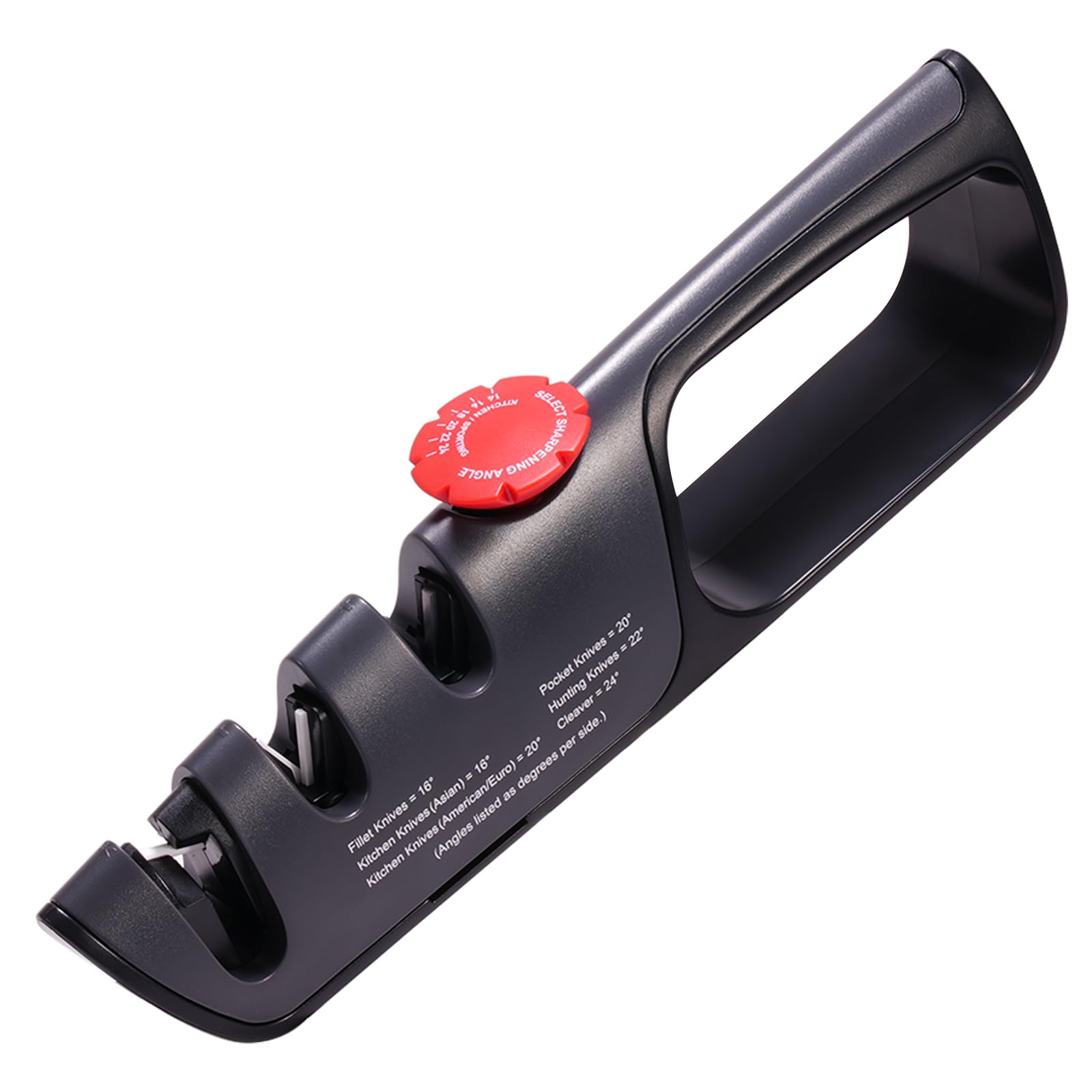
The USELUCK sharpener stands out because it offers six adjustable sharpening angles — 14, 16, 18, 20, 22, and 24 degrees — packed into a compact pull-through body. This is unusually versatile for a manual sharpener. The coarse stage uses diamond-coated stones to repair and reshape dull edges, while the fine ceramic stage hones and polishes. A dedicated slot for scissors adds kitchen utility, and the non-slip rubber base keeps the unit stable during use.
Customer reviews highlight the coarse slot’s ability to restore very dull chef knives after about 20 pulls, and the fine slot cleans up the edge to paper-cutting sharpness. The guide slots keep the blade at a consistent angle without requiring the user to maintain a steady hand — a meaningful advantage for ceramic knives that are sensitive to uneven pressure. Some owners noted that the instructions are printed on the box rather than a separate manual, so keep the packaging nearby during first use.
At this price tier, the USELUCK delivers pro-level adjustable angles that are usually found on much more expensive fixed-angle systems. For anyone managing a mixed collection of ceramic and steel kitchen knives, this is a one-device solution that covers the spectrum from everyday edge maintenance to moderate blade restoration.
Why it’s great
- Six adjustable angles accommodate ceramic, steel, and outdoor blades
- Diamond-coated coarse stones handle ceramic edge repair effectively
- Non-slip base and ergonomic handle reduce operator fatigue
Good to know
- Instructions are only on the box, not included as a separate booklet
- Scissor slot is functional but requires patience to learn
3. Winklez Rolling Knife Sharpener (Diamond & Ceramic Discs)

The Winklez rolling sharpener uses a two-stage abrasive system — a #400 diamond disc for coarse edge restoration and a #3000 ceramic disc for final polishing — housed in a beech wood base. The knife rests on a magnetic holder that aligns it to either 15 or 20 degrees, eliminating the guesswork of freehand angle holding. Instead of pulling the blade through a slot, you roll the sharpener back and forth over the magnetically held blade, which feels intuitive even for beginners.
Owner reports confirm that the diamond side rejuvenates dull knives in about 5 minutes, and the ceramic side leaves a clean, polished finish. A few users mentioned that small blades like paring knives occasionally pop off the magnetic holder during rolling, so a light touch is required. The build quality is solid — the beech wood base has a pleasant heft and the N42 magnets hold standard chef knives firmly.
If you prefer a hands-on sharpening experience with visual feedback rather than a slot-based system, this rolling design gives you direct control over the stroke count and pressure. The included wooden gift box also makes it a viable present for home cooks who own ceramic knives but have been intimidated by traditional sharpening methods.
Why it’s great
- Rolling motion is intuitive and reduces the chance of chipping ceramic edges
- Magnetic 15° and 20° angle guides lock the blade securely
- Beech wood construction provides stability and a premium feel
Good to know
- Small or curved blades may lift off the magnetic holder during rolling
- Diamond disc is #400 grit, which is coarse enough for heavy restoration but requires care on thin ceramic edges
4. EDOVEN Rolling Knife Sharpener Kit
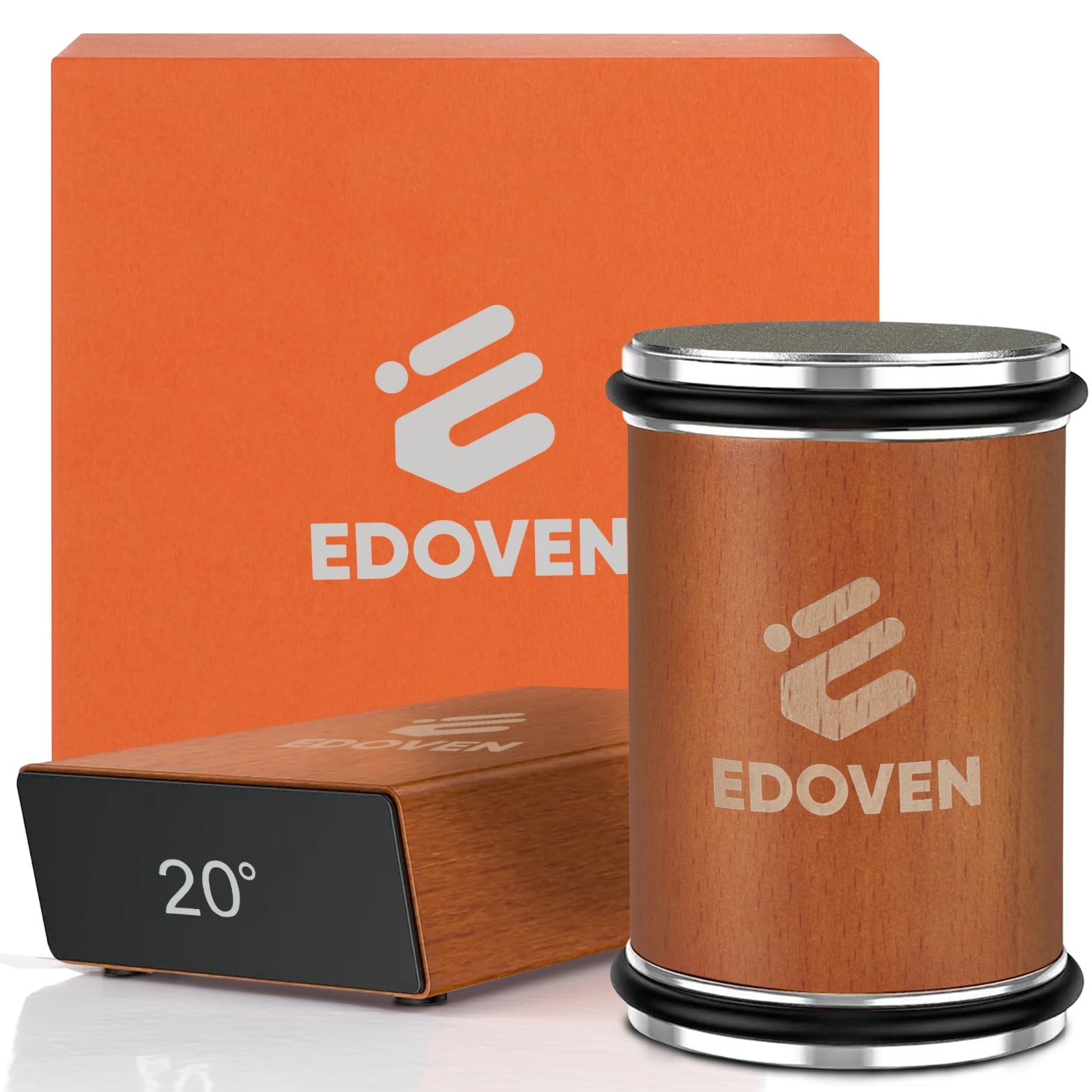
The EDOVEN rolling sharpener follows the same magnetic-angle concept as the Winklez but differentiates itself with a finer #6000 grit ceramic disc for the polishing stage. The sharpening sequence starts with a #400 diamond disc that reshapes the edge, then moves to the #6000 ceramic disc for a mirror finish. N48 neodymium magnets hold the blade in place, and the non-slip base keeps the assembly stable during rolling.
Users consistently report that it turns dull blades into sharp cutters in minutes. The finer #6000 grit produces a smoother edge than the Winklez’s #3000 disc, making it a better match for ceramic knives that benefit from a polished, low-friction bevel. Some users noted that the magnetic holder works best with full-sized chef knives and struggles with very small utility blades or penknives — the magnet’s hold area is optimized for blades at least 3 inches wide.
For anyone who wants the cleanest possible edge finish on ceramic knives without investing in a multi-hone waterstone setup, the EDOVEN’s high-grit ceramic disc is a real advantage. The beech wood build is identical in quality to other rolling sharpeners at this price point, but the higher polish stage gives it an edge for fine-edge maintenance.
Why it’s great
- #6000 ceramic disc produces a polished, smooth edge ideal for ceramic knives
- Strong N48 magnets hold the blade securely during rolling passes
- Non-slip base stays planted on wet or dry counter surfaces
Good to know
- Magnetic holder is less reliable for very small or curved blades
- Requires technique to maintain consistent pressure across the entire edge
5. Work Sharp Kitchen Ceramic Honing Rod (Angle Guided)

The Work Sharp Ceramic Honing Rod is not a full sharpener — it is a maintenance tool for refreshing edges that have gone slightly dull from regular use. The rod is made from a fine-grit ceramic that removes a tiny amount of material to realign the blade’s micro-edge. Built-in angle guides on the handle provide a consistent 15/20 degree reference, so you do not have to guess the angle each time. The rubber tip rests on the cutting board for stable, one-handed operation.
Customer feedback emphasizes that this rod works exceptionally well for slightly dull kitchen knives and even kitchen shears. One reviewer saved a pair of OXO shears from the trash bin. However, it is not designed for seriously chipped or neglected edges — it refines, it does not repair. Users also note that the 15.5-inch length accommodates chef knives comfortably, and the lanyard hole in the handle lets you hang it within arm’s reach near the knife block.
If you keep your ceramic knives in good shape and want a quick before-use touch-up that does not risk over-grinding, this rod is the safest option. The ceramic material is less aggressive than diamond, which makes it ideal for edge maintenance without shortening the blade’s lifespan. Pair it with a dedicated diamond sharpener for the times your ceramic blade actually needs a full edge restoration.
Why it’s great
- Angle guides remove the guesswork from rod-based honing
- Ceramic rod is gentle on ceramic edges compared to steel hones
- Rubber tip and lanyard hole add stability and storage flexibility
Good to know
- Will not restore badly chipped or very dull ceramic blades
- Not a full sharpener — best paired with a diamond abrasive system
6. Kyocera Advanced Ceramics Diamond Wheel Knife Sharpener (#123592)

This manual Kyocera sharpener uses a stationary #1000 grit diamond wheel — you draw the blade through two guiding slots that control the angle. The design is intentionally simple: a plastic base with a diamond wheel embedded inside, no batteries, no moving parts. It is compatible with both left- and right-handed users and handles ceramic and steel knives. At under a pound, it takes up virtually no drawer space.
Customer experiences are mixed but informative. Many users report that it effectively removes micro-chips from aging Kyocera ceramic knives and restores tomato-slicing ability. One reviewer broke a ceramic blade on the first use, which highlights the risk of applying too much downward force on the brittle edge. Others noted that after many passes, the blade improved but never returned to factory-sharp — likely because the fixed angle in the slots does not match every blade’s original grind angle precisely.
For the price, this is an accessible entry point for anyone who owns a single ceramic knife and wants a simple way to extend its useful life. Go slow, use light pressure, and accept that the result will be “usable sharp” rather than “shaving sharp.” It is a good backup sharpener to keep in a kitchen drawer for quick edge touch-ups between more thorough maintenance sessions.
Why it’s great
- Inexpensive and simple — no batteries or complicated setup required
- #1000 diamond wheel is appropriate for minor edge restoration on ceramic blades
- Lightweight and compact for drawer storage or travel
Good to know
- Fixed slot angles may not match every knife’s original grind, limiting sharpness recovery
- Excessive downward force can chip or break ceramic blades
FAQ
Can I use a regular steel hone on a ceramic knife?
How often should I sharpen a ceramic knife?
Will a rolling sharpener damage my ceramic knife?
What is the difference between a #400 and #1000 diamond disc for ceramic knives?
Final Thoughts: The Verdict
For most users, the sharpener for ceramic knives winner is the Kyocera Advanced Diamond Hone (DS-38) because its guided roller assist and diamond wheel are purpose-built for ceramic blades, delivering repeatable results without the guesswork of manual systems. If you want adjustable angles for a mixed collection of steel and ceramic knives, grab the USELUCK pull-through. And for polished, high-grit finishing on ceramic edges, nothing beats the EDOVEN rolling sharpener with its #6000 ceramic disc.