That unevenly reheated casserole — hot on the edges, cold in the middle — is the direct result of a conventional microwave cycling power on and off. Inverter technology replaces this crude on/off pulsing with a steady, adjustable power stream, delivering consistent energy to your food from start to finish. For anyone who defrosts raw chicken, reheats leftovers daily, or cooks delicate vegetables, a microwave with inverter technology is the single upgrade that changes how even and reliable your results are.
I’m Mohammad Maruf — the founder and writer behind AirfryerBite. I’ve spent years analyzing the core hardware inside modern countertop appliances, and inverter microwave performance — from wattage and turntable size to sensor logic and cavity materials — is where most manufacturers either get it right or cut corners.
This guide breaks down the nine best models available right now, comparing build quality, heating consistency, defrost precision, and smart features so you can confidently pick the right microwave with inverter technology for your kitchen and cooking habits.
How To Choose The Best Microwave With Inverter Technology
Inverter microwaves differ from standard models in one critical way: they deliver continuous, adjustable power rather than cycling between full power and off. This changes how evenly food cooks, how gently it defrosts, and how well basic sensor presets function. Before you buy, focus on the specs that actually affect daily performance — not just brand recognition.
Wattage and Power Delivery
Output power for inverter microwaves typically falls between 1000 and 1250 watts. Higher wattage means faster cooking and reheating, but the real advantage of inverter technology is the ability to use lower power levels without pulsing. A 1250-watt inverter unit can run at 30 percent power (roughly 375 watts) continuously, perfect for melting butter or softening cream cheese without sudden hot spots. Stick with 1200 watts or more for the best balance of speed and defrost control.
Cavity Size and Turntable Diameter
Capacity ranges from 1.0 to 2.2 cubic feet. The turntable diameter — typically 13 to 16.5 inches — matters just as much as total volume. A larger turntable improves coverage of the inverter’s energy distribution, reducing the chance of cold spots. If you regularly cook casseroles, frozen pizzas, or multiple plates at once, look for at least 1.5 cubic feet with a 14-inch or larger turntable.
Sensor Cooking and Preset Accuracy
Built-in humidity sensors measure steam released during cooking and automatically adjust time and power. On inverter models, this works more predictably because the power doesn’t cycle off mid-sensor reading. Look for microwaves with at least five sensor presets covering common items like fresh vegetables, frozen entrees, and rice. Units with fewer presets or no sensor cooking require more manual guesswork.
Build Quality and Inner Materials
Stainless steel cavities resist stains and odors better than painted or enamel interiors. Some premium models add ceramic or EasyClean coatings that wipe down with minimal effort. Door mechanisms — push-to-open, soft-close, or standard handle — affect long-term reliability. Soft-close doors from Breville and child-lock systems that can be physically disabled (not just electronically reset) are signs of thoughtful engineering we look for during selection.
Combination and Multi-Function Features
Several inverter models now combine microwave cooking with air frying, convection, or broiling. These all-in-one units save counter space but often compromise on pure microwave power density. If defrost and reheating speed are your top priorities, a dedicated microwave with higher wattage is the better call. If you want a small appliance that replaces two or three devices, a combo unit with inverter technology and a separate air fryer element is worth consideration.
Quick Comparison
On smaller screens, swipe sideways to see the full table.
| Model | Category | Best For | Key Spec | Amazon |
|---|---|---|---|---|
| Panasonic NN-SN76LS | Inverter | Even cooking and defrost | 1250W / 1.6 cu.ft / Cyclonic Wave | Amazon |
| LG 2.0 cu.ft Smart Inverter | Inverter | Large family meals | 1200W / 2.0 cu.ft / 7 Sensor Cooks | Amazon |
| Breville BMO850BSS | Inverter | Precision and quiet operation | 1250W / 1.2 cu.ft / Sensor iQ | Amazon |
| Panasonic NN-SN97JS | Inverter | Maximum capacity and power | 1250W / 2.2 cu.ft / 20 Preset Menus | Amazon |
| SHARP 2.2 cu.ft Inverter | Inverter | Quiet operation and large interior | 1200W / 2.2 cu.ft / 16.5″ Turntable | Amazon |
| TOSHIBA ML2-EC10SAITC | Combo Inverter | Microwave + air fryer in one | 1000W / 1.0 cu.ft / Air Fry + Broil | Amazon |
| TOSHIBA ML2-STC13SAIT | Combo Inverter | Smart screen and multi-function | 1100W / 1.3 cu.ft / Alexa Compatible | Amazon |
| LG 1.5 cu.ft Smart Inverter | Inverter | Mid-sized family cooking | 1200W / 1.5 cu.ft / Glass Touch Panel | Amazon |
| Emerson MWI1212SS | Inverter | Budget-friendly inverter entry | 1000W / 1.2 cu.ft / Push Open Door | Amazon |
In‑Depth Reviews
1. Panasonic NN-SN76LS
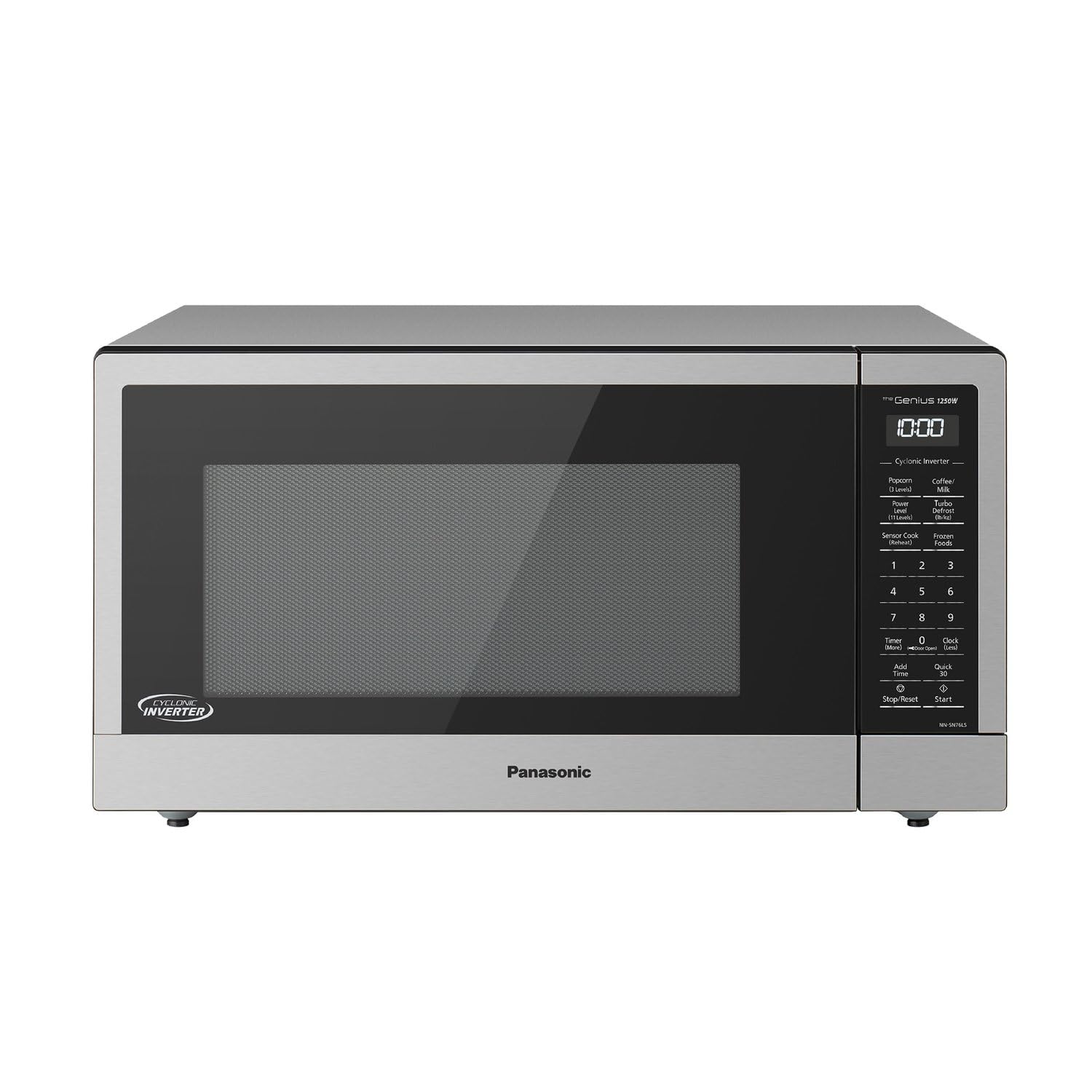
Panasonic’s patented Cyclonic Wave Inverter technology circulates heat in three-dimensional waves, a different engineering approach from the straight energy distribution used by most competitors. At 1250 watts and 1.6 cubic feet, the NN-SN76LS sits in the high-power sweet spot — fast enough for quick reheats, yet capable of maintaining ultra-low continuous power for gentle defrosting and melting. The Genius Sensor includes 15 preset cooking options covering fresh vegetables, frozen entrees, oatmeal, pizza, and rice, all calibrated to adjust power and time automatically based on steam release.
The compact footprint (21.88” W x 19.44” D x 11.94” H) gives you more interior space relative to exterior size, a direct benefit of the inverter’s smaller electronics package. Dedicated buttons for Popcorn, Keep Warm, Quick 30, and a kitchen timer simplify navigation without diving into menus. Turbo Defrost uses the inverter’s continuous power to thaw meats faster and more evenly than conventional cycling defrost systems, which tend to cook the edges before the center finishes thawing.
Users consistently report even heating and near-silent operation. The three-stage cooking capability allows you to program defrost, cook, then warm in a single cycle. The stainless steel exterior resists fingerprints reasonably well, and the child lock adds safety. Some owners note the control panel can feel slightly recessed, but the overall build quality and inverter performance make this the most balanced choice for most households.
Why it’s great
- Cyclonic Wave 3D heat distribution eliminates cold spots
- Turbo Defrost thaws meat without cooking the edges
- 15 sensor presets cover the most common foods
- Compact exterior with large 1.6 cu.ft interior
Good to know
- Control panel layout takes a few days to memorize
- Door mechanism feels slightly light compared to premium competitors
2. Panasonic NN-SN97JS
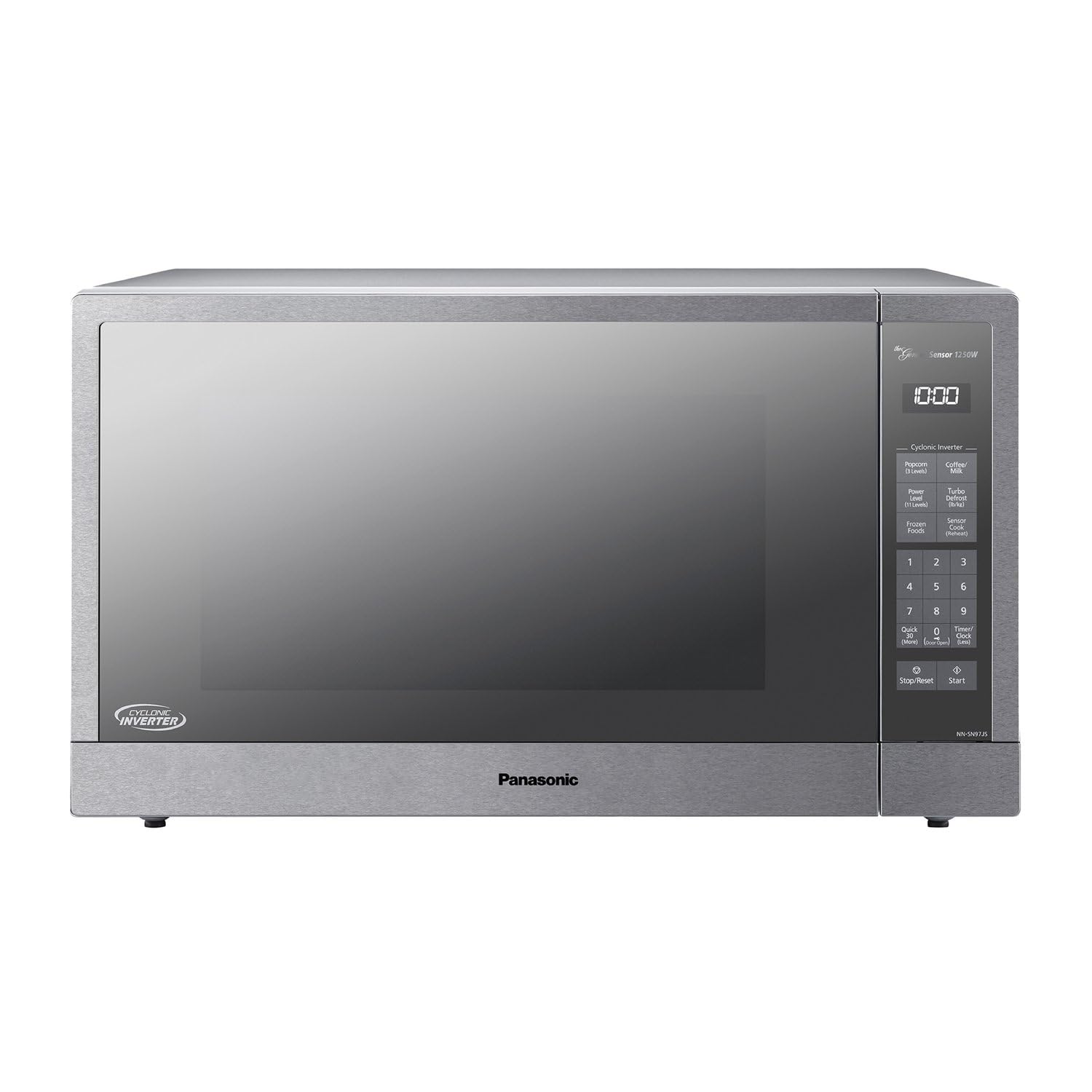
The NN-SN97JS scales up everything the NN-SN76LS does well — same Cyclonic Wave Inverter technology, same 1250-watt output, but a massive 2.2-cubic-foot cavity with a 16.5-inch turntable. This is the largest inverter microwave in Panasonic’s current lineup, designed for families that regularly need to reheat full casserole dishes, roast a whole chicken, or defrost large cuts of meat. The interior dimensions (18.44” W x 18.5” D x 10.94” H) accommodate a 13×9 baking dish with room to spare.
Twenty preset menu items expand on the 15 found in the NN-SN76LS, including dedicated settings for beverages, pasta, frozen pizza, and soup. The Inverter Turbo Defrost system detects weight and adjusts power sequencing to reduce thaw time without cooking the outer layers. A Keep Warm function maintains food at serving temperature for up to 30 minutes, useful when meal components finish at different times. The stainless steel interior resists staining and is easier to wipe clean than painted cavities.
Long-term owners frequently note that the NN-SN97JS outlasts previous non-inverter microwaves by several years, with some reporting over a decade of reliable service. The door push bar — a touch-button mechanism rather than a traditional handle — can occasionally require two presses to register. The child lock resets after a power outage, a minor inconvenience. Overall, the combination of 1250 watts, inverter precision, and the largest usable interior makes this the top pick for serious users who cook and reheat in volume.
Why it’s great
- 2.2 cu.ft cavity fits full casserole dishes and large platters
- 20 preset menus with automatic weight detection
- Turbo Defrost thaws quickly without cooking edges
- Stainless steel interior resists odors and stains
Good to know
- Door push bar can be inconsistent after extended use
- Child lock resets on power loss
3. Breville BMO850BSS

Breville’s Smooth Wave Microwave uses Power Smoothing Inverter technology to adjust intensity continuously, but what sets this unit apart is Sensor iQ — a system that detects steam patterns and automatically selects the correct power level and duration. Fifteen built-in smart presets cover Smart Cook, Smart Defrost, and Smart Reheat. The Smart Reheat setting, for example, measures the steam released from a plate of leftovers and determines exactly when to stop, preventing the rubbery, overheated edges common with traditional microwaves.
The build quality is immediately noticeable. The soft-close door operates about 80 percent quieter than standard hinges, and the operation sound is roughly 50 percent quieter than average. A dedicated Mute button and the Breville Sound Suite allow you to silence all beeps permanently — a feature rare among inverter microwaves. The interior cavity is brushed stainless steel with a bright LED light, making it easy to see food without opening the door. The control panel uses physical buttons and a central dial, giving you precise 1-second increments without endless scrolling.
Analog control fans will appreciate the independent time dial that lets you set cook time by rotating, which feels more intuitive than hunting for numbered buttons. The “A Bit More” button adds extra time at the end of a sensor cycle without starting a new program. The 1.2-cubic-foot capacity is smaller than other premium competitors, but the turntable-off mode accommodates rectangular dishes. Some users report the soft-close mechanism failing after 12 to 18 months, and the transformer can blow after several years. When it works — which for most owners is years — it delivers the most precise, quiet, and intuitive experience of any inverter microwave on the market.
Why it’s great
- Sensor iQ automatically adjusts power and duration for perfect reheats
- Soft-close door and mute option make it the quietest unit tested
- Analog dial offers 1-second precision without menu scrolling
- Bright LED interior with excellent food visibility
Good to know
- Soft-close mechanism can wear out over time
- 1.2 cu.ft capacity is smaller than mid-range competitors
4. LG 2.0 cu.ft Smart Inverter
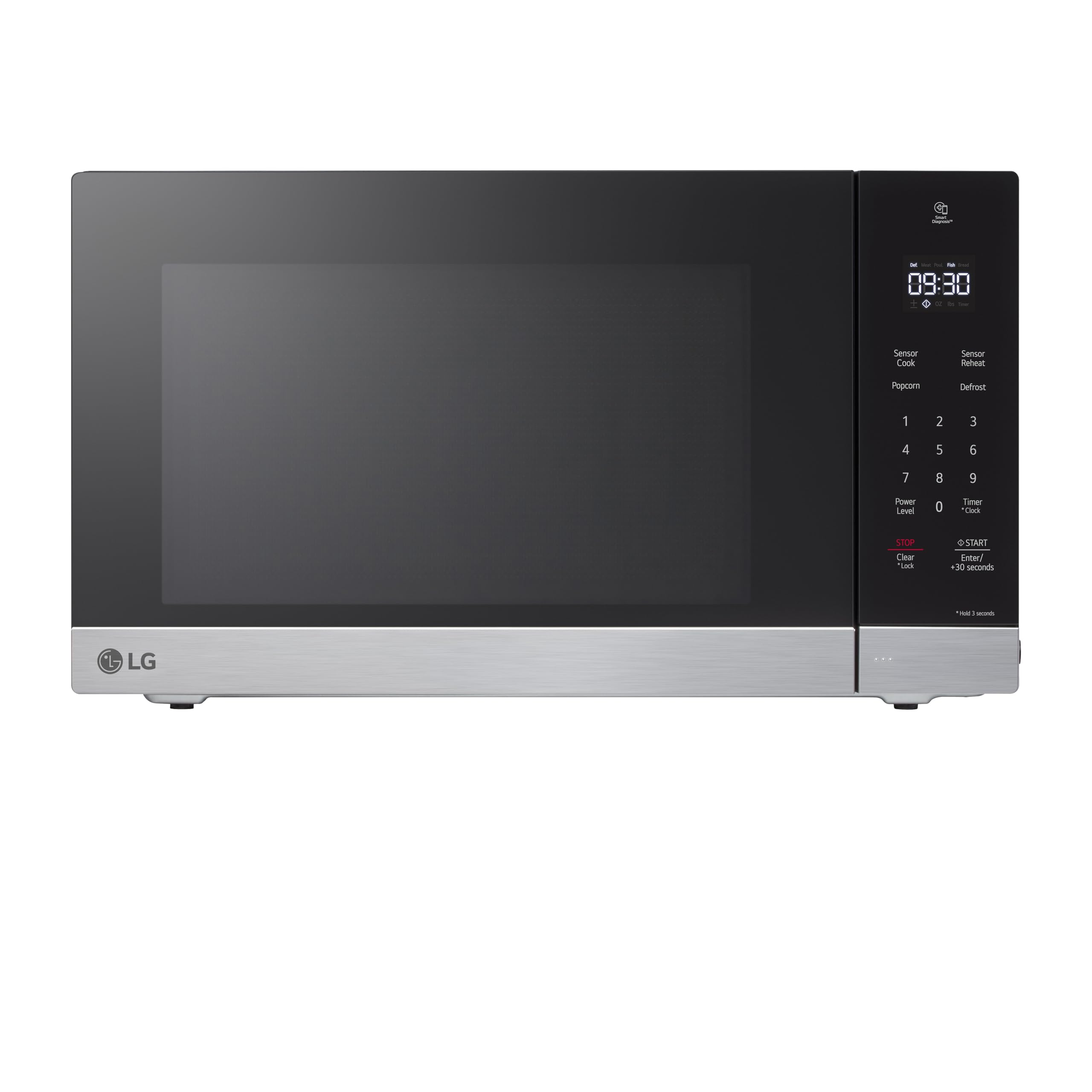
LG’s NeoChef 2.0-cubic-foot Smart Inverter Microwave delivers 1200 watts of power through a glass touch control panel called SmoothTouch. The 2.0-cubic-foot interior is designed for large dinner plates, oval platters, and family-sized casserole dishes. Seven sensor cook presets — Bacon, Fresh Vegetable, Frozen Entrée, Frozen Vegetable, Oatmeal, Potato, and Rice — automatically adjust cooking time and power based on real-time humidity readings. The LG Smart Inverter technology maintains steady power at any level, so you can run at 20 percent power to gently soften butter or 80 percent power for even reheating without the pulsing that creates hot spots.
The EasyClean interior has a non-stick coating that resists food splatters and wipes clean with a damp cloth — no harsh scrubbing required. The stainless steel exterior matches most kitchen finishes, and the compact exterior footprint (23.9” W x 19.8” D x 13.6” H) is surprisingly modest for a 2.0-cubic-foot cavity. The LED interior lighting provides good visibility, and the child safety lock can be physically disabled with a small Phillips screwdriver, a detail that power-outage-prone households will appreciate since electronic-only locks reset when the microwave loses power.
Users note that the “I am done” chime is pleasant and unobtrusive, and the microwave can be set to silent mode by pressing and holding the Stop and Clock buttons simultaneously. Some owners wish the display showed the current power level during operation — it only shows time. The push-to-open door is smooth and reliable. Overall, the LG 2.0 cu.ft model offers a compelling balance of large capacity, inverter precision, and thoughtful user experience at a mid-range price point.
Why it’s great
- 2.0 cu.ft capacity fits oversized plates and platters
- EasyClean interior coating simplifies maintenance
- Quiet operation with a discreet chime
- Physical child lock disable option prevents reset frustrations
Good to know
- Display does not show power level during cooking
- Touch panel can be sensitive to moisture
5. SHARP 2.2 cu.ft Inverter Microwave
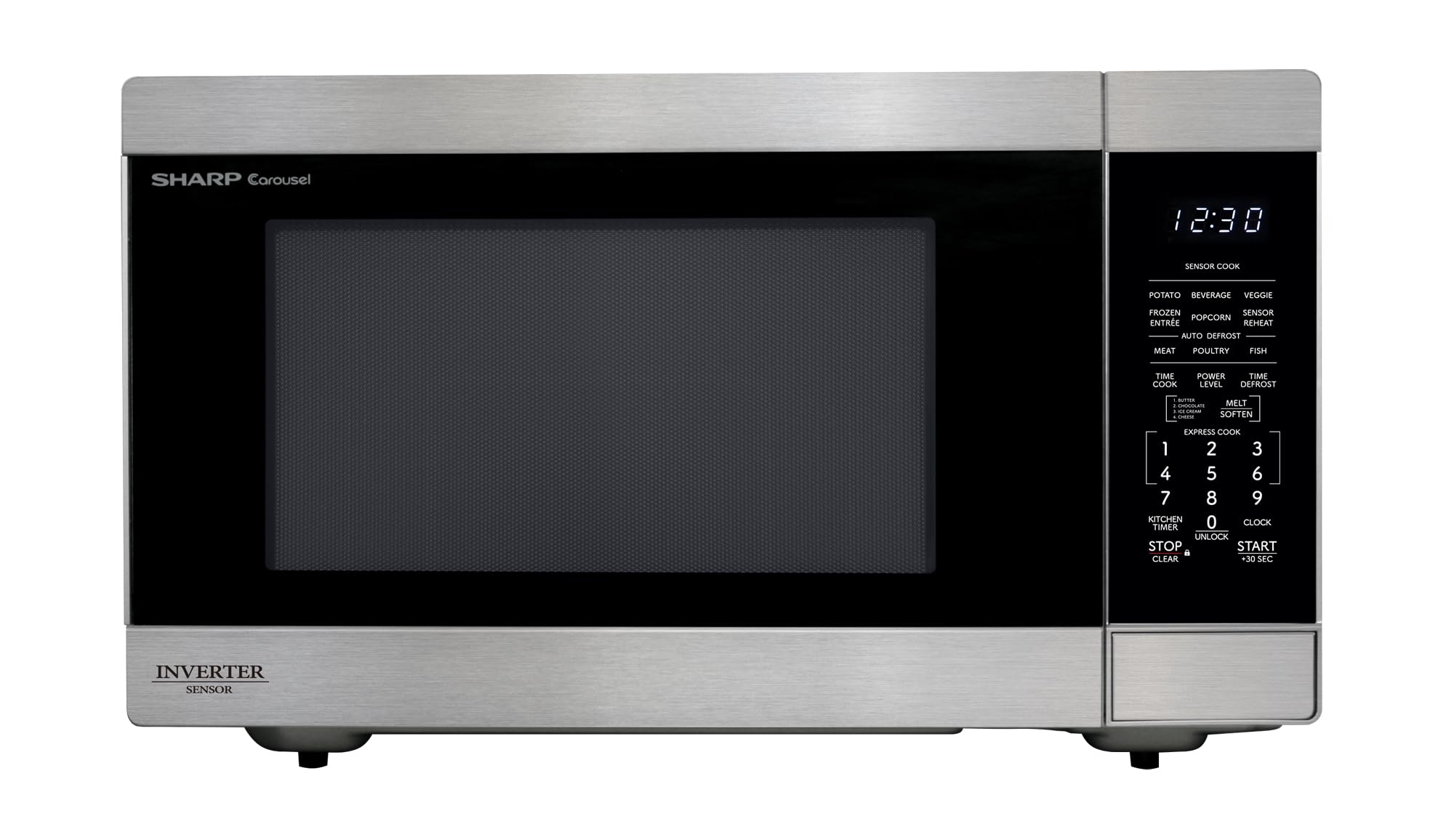
Sharp brings inverter cooking technology to a 2.2-cubic-foot footprint at a more accessible price point than Panasonic’s equivalent models. The 1200-watt output is paired with a 16.5-inch Carousel turntable — the largest diameter in this comparison — which ensures the inverter’s consistent energy reaches every angle of your food. The gray interior is a departure from the standard stainless or white cavities, chosen to reduce glare and make it easier to see food inside while the white LED display stays crisp and readable.
The control panel includes a dedicated Melt/Soften function and Sensor Cook for automatic reheating. The Express Cook feature activates with a single press for up to six minutes of cooking time, while the +30 Seconds key adds time in increments. Weight and Time Defrost modes give you both options — enter the weight of frozen meat for automatic inverter-adjusted thawing, or set a specific defrost duration manually. Two-stage cooking allows you to program defrost followed by cook in one seamless cycle.
Users consistently describe operation as quiet and the heating as even, with the 1200-watt inverter handling large dishes without cold spots. The child lock can be disabled permanently, similar to LG’s design. Some owners note that the Express Cook function requires a few extra button presses if you want precise times under 30 seconds — the one-touch presets jump in 30-second increments up to six minutes. The stainless steel exterior resists smudges reasonably well. Sharp’s larger turntable and spacious cavity make this the best value for shoppers who prioritize capacity and even cooking without paying a premium for brand badge engineering.
Why it’s great
- 16.5-inch turntable provides maximum coverage for large dishes
- 1200W inverter with consistent, even heat distribution
- Quiet operation with permanently disableable child lock
- Gray interior reduces glare and improves food visibility
Good to know
- Express Cook presets only increase in 30-second jumps
- Control panel layout is not backlit
6. LG 1.5 cu.ft Smart Inverter
LG’s 1.5-cubic-foot Smart Inverter Microwave shares the same NeoChef platform as its larger sibling but with a more compact footprint (21.44” W x 16.19” D x 12.13” H) that fits on tighter countertops. The 1200-watt inverter delivers the same steady power delivery, and the seven sensor cook options — Bacon, Fresh Vegetable, Frozen Entrée, Frozen Vegetable, Oatmeal, Potato, Rice — are identical to the 2.0 cu.ft model. The 14.2-inch turntable is slightly smaller than Sharp’s offering but still adequate for standard dinner plates and round casserole dishes.
The Glass Touch SmoothTouch control panel responds to light taps, and the EasyClean interior coating prevents baked-on splatters from bonding to the cavity walls. The stainless steel finish and dark interior glass create a cohesive look. Users can disable the door lock with a small Phillips screwdriver, identical to the larger LG model. The “Ez On” (+30 seconds) button provides quick access, and the child lock engages easily.
Owners highlight the fast, even heating and quiet operation. The “I am done” song is a short, pleasant chime that doesn’t grate after repeated use. The interior LED light is bright enough to clearly see food. Some users wish the display showed the power level after start, but the inverter’s consistent performance means you rarely need to verify it anyway. The exterior dimensions are well-proportioned for standard cabinets, and the overall build quality feels solid for the mid-range price. This is a solid pick for smaller households that want inverter technology from a trusted brand without paying for extra cubic feet they don’t need.
Why it’s great
- 1200W inverter in a compact footprint ideal for small kitchens
- Seven sensor presets cover daily cooking needs
- EasyClean interior reduces scrubbing time
- Quiet operation with a pleasant completion chime
Good to know
- Power level not visible on display during cooking
- 1.5 cu.ft interior can feel tight for large platters
7. TOSHIBA ML2-EC10SAITC OptiChef Pro
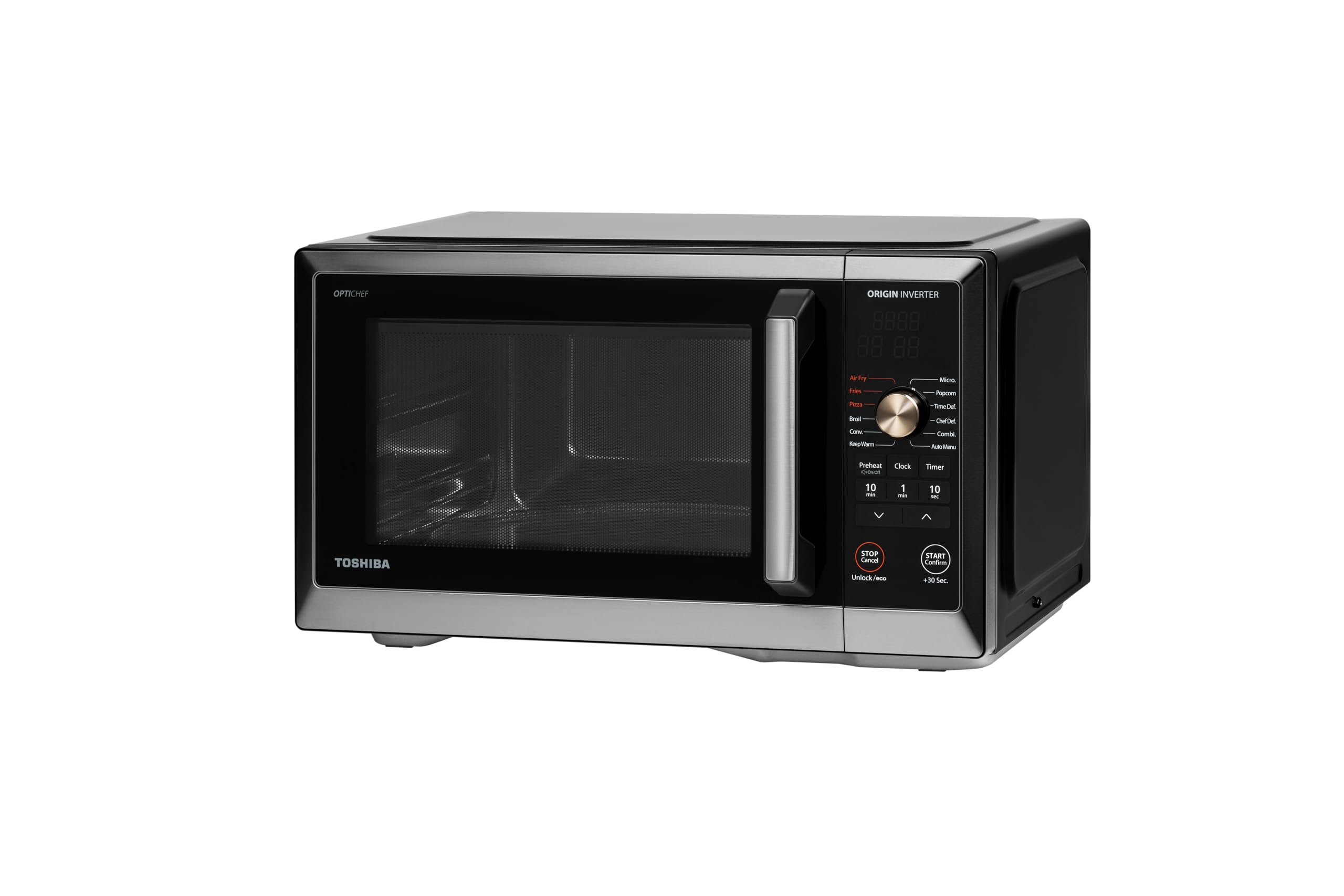
The TOSHIBA OptiChef Pro combines inverter microwave operation with a top-mounted air fryer heating element that circulates hot air 360 degrees around food — a true hybrid approach rather than a standard microwave with a convection fan tacked on. The 1000-watt Origin Inverter ensures even microwave heating, while the separate air fryer mode uses 1100 watts of input power to crisp wings, fries, and frozen snacks without the need for preheating. ChefDefrost thaws food 40 percent faster than standard defrost by using the inverter’s continuous low power and intelligent weight detection to prevent edge cooking.
The 1.0-cubic-foot capacity is the smallest in this lineup, but the combination of microwave, air fryer, convection, and broiler functions replaces up to three separate countertop appliances. The large LED screen with 24 one-touch auto menus simplifies mode selection, and the included baking tray, grill rack, and microwave rack provide tools for each function. The black stainless steel finish hides fingerprints better than standard stainless steel.
Users who try the air fryer function report crispy exteriors and tender interiors on foods like chicken wings, french fries, and frozen nuggets. The inverter microwave mode handles reheating and defrosting reliably, though some owners note that the 1000-watt microwave output feels slightly less powerful than standalone 1200-watt inverter units. The compact size works well for small families or individuals. The all-in-one design saves significant counter space, but the 1.0 cu.ft interior limits the size of casserole dishes and platters you can use. If you need both microwave and air fryer functionality and counter space is at a premium, this is a strong value proposition.
Why it’s great
- Combines inverter microwave, air fryer, broiler, and convection in one unit
- ChefDefrost thaws 40% faster than standard defrost
- 24 one-touch auto menus simplify multi-mode cooking
- Includes baking tray, rack, and grill rack for versatile use
Good to know
- 1000W microwave output is lower than dedicated inverter models
- 1.0 cu.ft capacity may be limiting for large cookware
8. TOSHIBA ML2-STC13SAIT OptiChef Ultra

The TOSHIBA OptiChef Ultra takes the combo concept a step further with a 2.4-inch color touchscreen interface, Alexa compatibility, and an enlarged 1.3-cubic-foot cavity compared to the ML2-EC10SAITC. The 1100-watt Origin Inverter technology powers the microwave mode, while the ChefFry Plus top fan system provides air frying, baking, and broiling capabilities. The built-in humidity sensor continuously monitors steam levels and adjusts cooking parameters to retain moisture, a feature that benefits both microwave and air fryer modes by preventing drying.
Ceramic and glass interior materials improve heat retention and make cleaning easier than standard stainless steel. The 1.3 cu.ft cavity accommodates a 13-inch pizza and fits an entire chicken for roasting using the air fryer or convection mode. Alexa integration allows voice control for starting, stopping, and adjusting cooking cycles. An Eco Mode reduces standby power consumption, and the Express Cook feature provides quick single-touch access to common settings. The stainless steel and ceramic build feels robust, and the color touchscreen responds quickly to inputs.
Owner feedback mirrors the ML2-EC10SAITC — the multi-function versatility is highly valued, but some users find the microwave output slightly less aggressive than dedicated 1200-watt inverter microwaves. The color screen and presets reduce the learning curve for switching between modes, and the included microwave rack expands cooking options. For users who want a connected, countertop-saving appliance that handles microwave, air fryer, convection, and broiler tasks with smart home integration, the OptiChef Ultra delivers the most complete feature set in this category.
Why it’s great
- 2.4-inch color touchscreen with intuitive controls
- Alexa voice control for hands-free operation
- Humidity sensor preserves moisture in both microwave and air fryer modes
- Ceramic and glass interior simplifies cleanup
Good to know
- 1100W microwave output is moderate compared to dedicated units
- 1.3 cu.ft capacity is smaller than large standalone inverter models
9. Emerson MWI1212SS

The Emerson MWI1212SS is the entry-level gateway into inverter technology, offering inverter power delivery at a price point significantly below the rest of this lineup. The 1000-watt inverter and 1.2-cubic-foot capacity are paired with a push-open door mechanism that eliminates the traditional handle, creating a clean, modern front profile. The stainless steel front and black cabinet finish match most kitchen decors without clashing. Eight pre-programmed settings and 10 power levels provide flexibility for defrosting, reheating, and cooking basic meals.
The 99-minute, 99-second digital timer is straightforward to set, though users should read the manual for secondary functions like setting exact cook times in seconds — the unit interprets a press of “1” as one minute of cooking rather than entering a specific number of seconds. The inverter technology is the same fundamental concept found in premium units: steady continuous power instead of alternating on/off cycling. This makes a noticeable difference when defrosting frozen chicken by weight — the inverter prevents the rubbery cooked edges that standard microwaves produce during long defrost cycles.
Some owners report the unit is louder during operation than mid-range and premium inverter microwaves. There have been isolated reports of the glass door shattering after a few months of use, which raises a reliability concern despite the majority of positive feedback. The 1000-watt output is sufficient for daily reheating and defrosting but feels slower than 1200-watt models for larger portions. For budget-conscious shoppers who want the core benefit of inverter technology — consistent power delivery — without paying for high-end extras like sensor cooking or soft-close doors, the Emerson MWI1212SS delivers the essential feature at the lowest cost.
Why it’s great
- Inverter technology at the most accessible price point
- Push-open door creates a clean, handleless front
- Defrosts frozen chicken evenly without rubbery edges
- 10 power levels provide good control for different foods
Good to know
- 1000W output is slower than 1200W+ inverter models
- Reported louder than average during operation
- Isolated reliability issues with door glass
FAQ
Does inverter technology actually make food taste different?
Can I use metal cookware in an inverter microwave?
How does inverter defrost compare to traditional defrost?
Is 1000 watts enough for a microwave with inverter technology?
Do inverter microwaves last longer than standard microwaves?
Final Thoughts: The Verdict
For most users, the microwave with inverter technology winner is the Panasonic NN-SN76LS because its Cyclonic Wave three-dimensional heating and 1250-watt inverter provide the best balance of even cooking, defrost precision, and compact footprint at a mid-range price. If you want the largest possible interior without sacrificing inverter performance, grab the Panasonic NN-SN97JS with 2.2 cubic feet and 20 preset menus. And for quiet operation with the most intuitive controls, nothing beats the Breville BMO850BSS despite its smaller cavity — the soft-close door, mute function, and Sensor iQ make it the most pleasant inverter microwave to interact with daily.