That metallic tang in your morning coffee or the earthy odor clinging to your ice cubes isn’t a mystery — it’s unfiltered tap water delivering chlorine, heavy metals, and sediment straight to your glass. A pure water filter stages an intervention before that water hits your lips, stripping out the contaminants that ruin taste and raise health concerns without draining your wallet on bottled water.
I’m Mohammad Maruf — the founder and writer behind AirfryerBite. I’ve spent months cross-referencing NSF certifications, flow rate data, and micron ratings to map exactly which pure water filter deserves a spot under your sink.
Whether you’re battling lead from aging pipes, tackling well water sediment, or just want restaurant-quality ice, the right under-sink system transforms your tap without the plastic waste of jugs. This guide breaks down the best pure water filter options by filtration depth, install effort, and long-term value so you can stop guessing and start drinking cleaner water today.
How To Choose The Best Pure Water Filter
Buying a pure water filter isn’t about picking the shiniest housing; it’s about matching filtration technology to the specific contaminants in your local supply. Municipal water and well water demand completely different approaches, and the wrong filter can leave you with unchanged TDS or a frustrating trickle.
Filtration Technology: Carbon Block vs. Reverse Osmosis
Carbon block filters — found in systems like the Frizzlife MK99 — excel at removing chlorine, taste, odor, and sediment down to 0.5 microns while preserving beneficial minerals. Reverse osmosis systems like the Waterdrop T3-C use a semi-permeable membrane at 0.0001 microns to strip out dissolved solids, heavy metals, fluoride, and nitrates. Choose carbon block if your water tastes fine but has chlorine or odor issues; choose RO if your TDS is high or you want the closest thing to distilled purity.
NSF/ANSI Certification: The Only Metric That Matters
Certification from NSF or IAPMO against standards 42 (chlorine/taste/odor) and 53 (lead/cysts/VOCs) is non-negotiable. A filter claiming removal without third-party testing is just marketing. Look for explicit NSF 53 certification for lead reduction — the Culligan US-DC3 and APEC ROES-50 both carry it, giving you legal protection and verified performance.
Flow Rate and Service Life
Flow rate, measured in gallons per minute (GPM), determines how fast your glass fills. Carbon block systems typically deliver 1.5 GPM or more, while RO systems hover around 0.4-0.5 GPM due to the membrane’s restrictiveness. Service life — measured in gallons or months — tells you when to swap cartridges. A 4,750-gallon cartridge like the Culligan’s lasts a full year for most households, while smaller 300-gallon filters need quarterly changes.
Installation Complexity and Space
Direct-connect systems (Aqua Crest FQSVF, Frizzlife MK99) twist onto existing filter housings or feed valves with no drilling — perfect for renters. Tankless RO units save under-sink space but require a power outlet and drain connection. Storage-tank RO systems need more cabinet real estate but operate without electricity. Measure your under-sink clearance before buying: the Waterdrop TST-UF stands 14.5 inches tall and can be hung on the cabinet wall or placed on the floor.
What the Filter Does Not Remove
Not all filters are equal. Carbon block systems do not reduce TDS or dissolved minerals — they leave the good stuff in but also leave dissolved contaminants. Standard RO systems strip everything and often require an alkaline remineralization stage if you prefer mineral-balanced water. Ultra-filtration systems like the Waterdrop TST-UF explicitly state they do not reduce TDS, so if your tap measures 500+ ppm, you need RO.
Quick Comparison
On smaller screens, swipe sideways to see the full table.
| Model | Category | Best For | Key Spec | Amazon |
|---|---|---|---|---|
| Waterdrop TST-UF | Ultra-Filtration | Municipal tap water, stainless steel build | 0.01 µm ultrafiltration | Amazon |
| Waterdrop T3-C RO | Tankless RO | High purity, space saving | 450 GPD, 2:1 drain ratio | Amazon |
| Culligan US-DC3 | Carbon Block | Lead reduction, long life | 4,750 gallon cartridge | Amazon |
| APEC ROES-50 | RO with Tank | Total dissolved solids removal | 50 GPD, 5-stage | Amazon |
| Frizzlife MK99 | Carbon Block | Easy DIY install, compact | 0.5 micron, 1600 gal | Amazon |
| Aqua Crest FQK2J | Carbon Block | Multi-pack value, GE compatible | 1,350 gal per filter | Amazon |
| Aqua Crest FQSVF | Carbon Block | Budget replacement, coconut carbon | 300 gal, NSF 42 | Amazon |
In-Depth Reviews
1. Waterdrop TST-UF 0.01μm Ultra-Filtration Under Sink Water Filter System

The Waterdrop TST-UF swaps plastic for heavy-gauge 304 stainless steel, giving you a filtration housing that won’t crack or leak over the long haul. Its three-stage ultra-filtration system — PP sediment, coconut carbon block, and a 0.01-micron UF membrane — targets chlorine, heavy metals, and microbial cysts while keeping beneficial minerals like calcium and magnesium intact.
Installation is genuinely straightforward: hang the unit on your cabinet wall or set it on the floor, connect to a 3/8″ or 1/2″ cold water line, and you’re filtering at up to 1.59 GPM — enough to fill an 8-ounce cup in about 2.3 seconds. Filter life is impressive too: the PP filter lasts 6-8 months, the UF filter goes a full year, and the carbon filter stretches to 12-24 months depending on your water quality.
The one hard limitation is that this system does not reduce TDS — it retains dissolved solids, so if your tap water measures high on a TDS meter, this will not soften it. It’s designed specifically for municipal tap water, not well water or hot water sources. For city dwellers wanting great taste without stripping minerals, this is a premium long-term solution.
Why it’s great
- Lead-free 304 stainless steel housing is durable and recyclable
- 0.01-micron ultrafiltration reduces bacteria and cysts
- No drilling or power required for installation
- Flow rate rivals unfiltered tap water
Good to know
- Does not reduce TDS — not suitable for high-TDS or well water
- Requires faucet with 1/2″ or 3/8″ female NPT thread or separate quick-connect fitting
- Push-connect fittings can be tricky to secure
2. Waterdrop T3-C Reverse Osmosis Water Filter
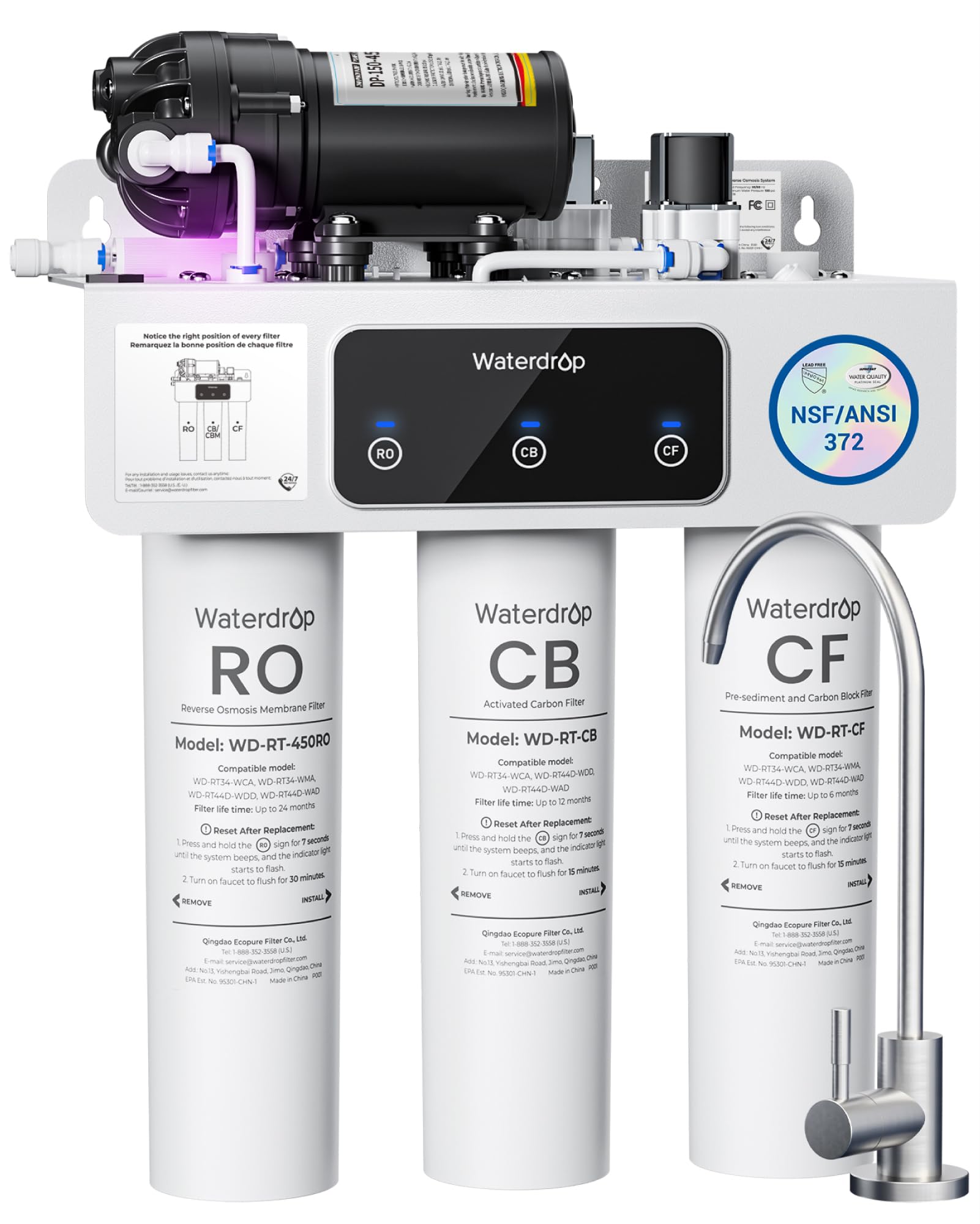
The Waterdrop T3-C represents the evolution of home reverse osmosis — tankless, smart, and compact. Its 8-stage filtration chain includes a 0.0001-micron RO membrane that strips heavy metals, chlorine, PFOA/PFOS, and nitrates, while an integrated post-carbon and remineralization stage adds back a balanced mineral profile for crisp, clean taste.
At 450 gallons per day, this is one of the fastest tankless RO units available, filling a standard cup in seconds. The 2:1 pure-to-drain ratio means you waste half the water of conventional 1:1 RO systems — a serious consideration for eco-conscious households. Smart alerts on the faucet remind you when each filter stage needs replacement, and the all-in-one cartridge design swaps in seconds without wrestling with multiple housings.
Installation requires a power outlet (the unit plugs in to drive the booster pump) and drilling a hole for the dedicated faucet — not a job for someone who can’t use a drill or call a handyman. The compact footprint saves 70% of under-sink space compared to traditional tank systems, but the initial setup is more involved than a simple carbon block filter.
Why it’s great
- 450 GPD tankless design delivers high-volume, on-demand pure water
- 2:1 pure-to-drain ratio reduces water waste significantly
- Smart LED alerts for filter replacement and auto-flush function
- NSF/ANSI 372 certified for lead-free construction
Good to know
- Requires electrical outlet and countertop drilling for faucet
- Push-connect fittings may need additional adapters for some setups
- Exposed wiring on unit could be cleaner in design
3. Culligan US-DC3 Under Sink Water Filter System
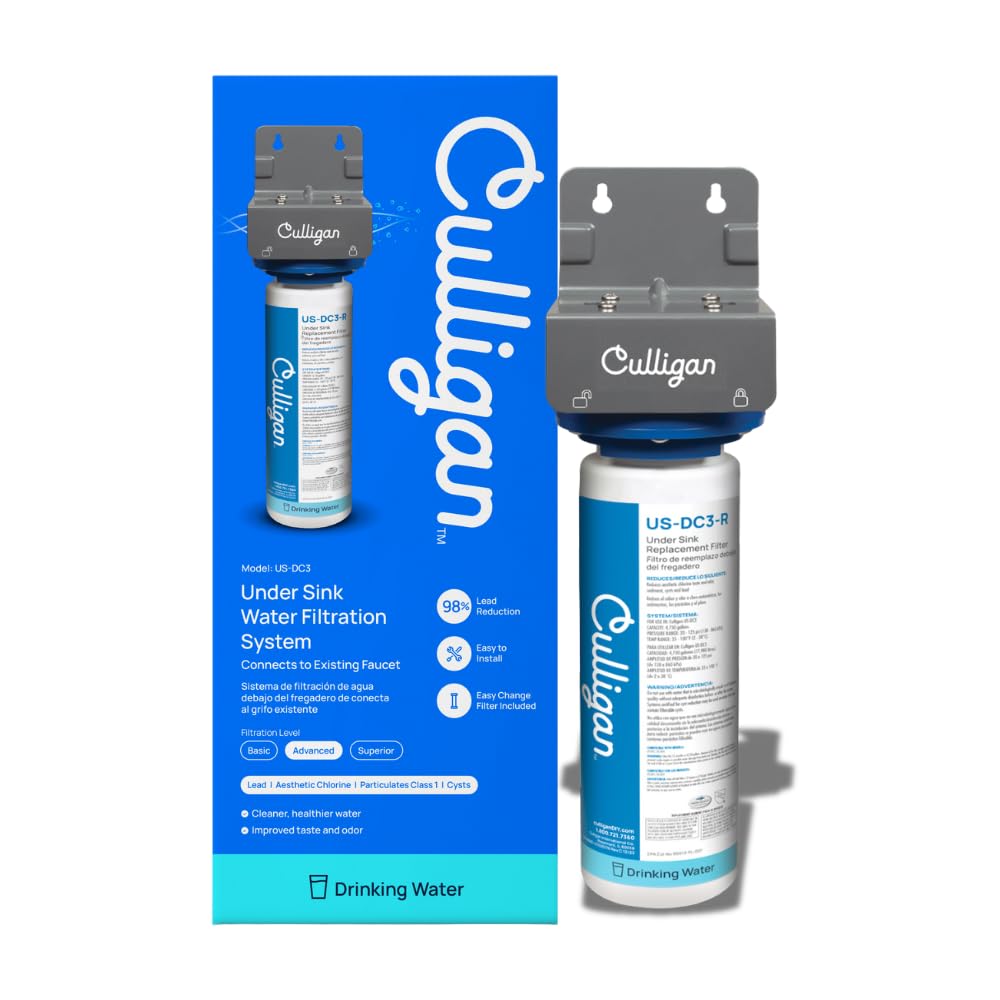
Culligan brings decades of water treatment expertise to the US-DC3, a direct-connect carbon block system that fits under virtually any sink. Its claim to fame is certified reduction of 99% of lead — backed by NSF/ANSI 53 testing — alongside chlorine, taste, odor, mercury, and microbial cysts. For households with older plumbing or known lead concerns, this is the carbon-block gold standard.
The standout spec is the cartridge lifespan: 4,750 gallons or 12 months between changes, which translates to roughly one replacement per year for a family of four. Flow rate holds steady at 1.5 GPM, meaning no noticeable slowdown compared to unfiltered tap water. The twist-lock replacement is genuinely tool-free — just twist off the old canister and snap on a new one (replacement part US-DC3-R).
Installation is straightforward for anyone comfortable with basic plumbing: the kit includes 3/8-inch plastic tubing, a supply adapter, and a mounting bracket. A common gotcha is the pre-cut tubing end — some users report the factory cut can cause a slow leak, so re-cutting the tube with a sharp blade before insertion is a smart precaution. One missing piece: the system is not explicitly ANSI/NSF 42 or 53 listed on the product page despite the claims, which caused a minor deduction in some customer reviews.
Why it’s great
- 4,750-gallon cartridge means only one filter change per year
- Certified 99% lead reduction for older pipe safety
- Tool-free twist-lock replacement is fast and clean
- Maintains 1.5 GPM flow rate with no noticeable drop
Good to know
- Factory tubing cut may cause leaks; re-cut recommended
- Not explicitly ANSI/NSF 42/53 listed on product page
- Plastic housing may not feel as premium as stainless steel options
4. APEC Water ROES-50 5-Stage Reverse Osmosis System

The APEC ROES-50 is the classic workhorse of residential RO — a 5-stage system with a 50-gallon-per-day membrane that reduces up to 99.99% of impurities including arsenic, chlorine, lead, fluoride, heavy metals, PFAS, and microplastics. It is NSF certified under standards 58 (RO systems) and 372 (lead-free), giving you third-party verification that the water leaving your faucet is genuinely purified.
Installation is DIY-friendly with color-coded tubing and quick-connect fittings, though it takes 1-2 hours and ideally two people to mount the tank and unit under the sink. The system includes everything: a brushed nickel faucet, a 5-gallon storage tank, the complete 5-stage filter set, and all necessary hardware. Filter replacement cadence is 6-12 months for the pre-filters and 24 months for the RO membrane, depending on incoming water quality.
The obvious trade-off is the storage tank — it occupies significant under-sink real estate (steer clear if your cabinet already crammed with cleaning supplies). Once the tank empties, it takes about 2-3 hours to refill, so you can’t draw endless glasses back-to-back without a wait. Some users report cracked housing caps after 2-3 years from overtightening, but APEC’s customer support is well-regarded for shipping replacement parts quickly.
Why it’s great
- NSF 58 and 372 certified for genuine RO performance
- Reduces 99.99% of impurities including fluoride and PFAS
- Included brushed nickel faucet and 5-gallon tank for complete installation
- Replacement filters are widely available and reasonably priced
Good to know
- Storage tank takes up significant under-sink space
- Slow recovery — 2-3 hours to refill tank after heavy use
- Plastic housing caps can crack if overtightened
5. Frizzlife MK99 Under Sink Water Filter System
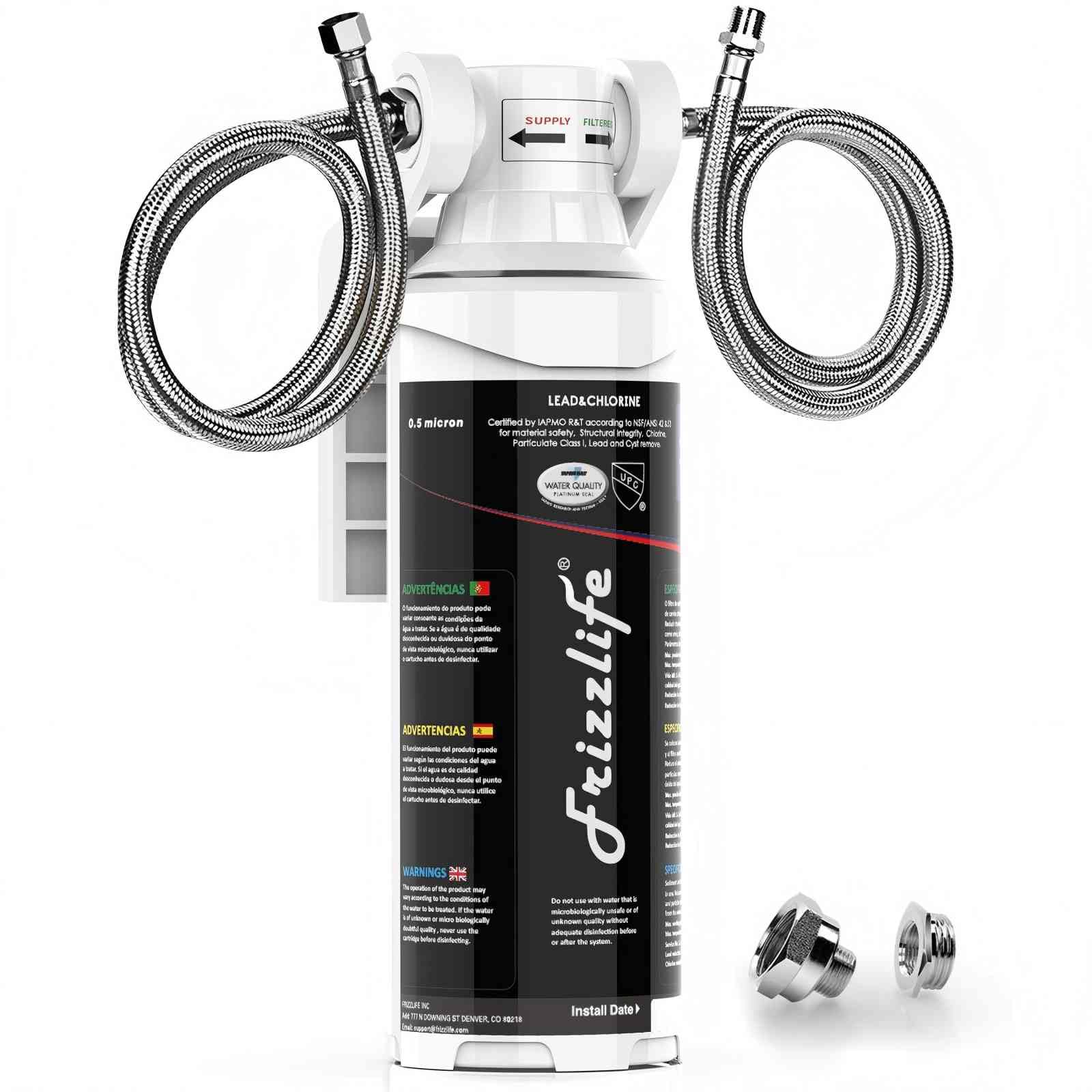
The Frizzlife MK99 punches above its price tier with IAPMO certification against NSF/ANSI 53 and 42 — a rare combo at this level. Its two-stage carbon block filter reduces lead, chlorine, taste, odor, and particulates down to 0.5 microns, while the clever “core-only” replacement design lets you swap just the filter media (not the entire plastic housing), cutting waste and long-term costs.
Installation is the fastest of any system on this list — under 3 minutes if your cold water line has a standard 3/8-inch fitting. The built-in auto shut-off valve means you don’t need to turn off the main water supply when replacing the cartridge, and the twist-in design requires no tools. Flow rate starts around 2+ GPM fresh out of the box, though some reviewers on NYC municipal water reported it dropping to a trickle within weeks, requiring a pressurized tank to restore performance.
Its 1,600-gallon capacity translates to roughly 6-8 months for a typical household. The system works with both 1/2-inch and 3/8-inch cold water lines (converters included), and the compact housing fits easily in tight under-sink spaces. One reviewer noted that the filter media replacement was difficult to twist due to the included wrench stripping the plastic — hand-tightening is the safer bet.
Why it’s great
- NSF/ANSI 53 & 42 certified for lead and chlorine reduction
- Core-only replacement cuts plastic waste and ongoing costs
- Install in under 3 minutes with auto shut-off valve
- Flexible fittings for both 1/2″ and 3/8″ cold water lines
Good to know
- Flow rate may degrade quickly in high-pressure municipal systems
- Filter media replacement can be stiff and wrench may strip
- Does not reduce TDS or dissolved minerals
6. Aqua Crest FQK2J Under Sink Water Filter 4-Pack
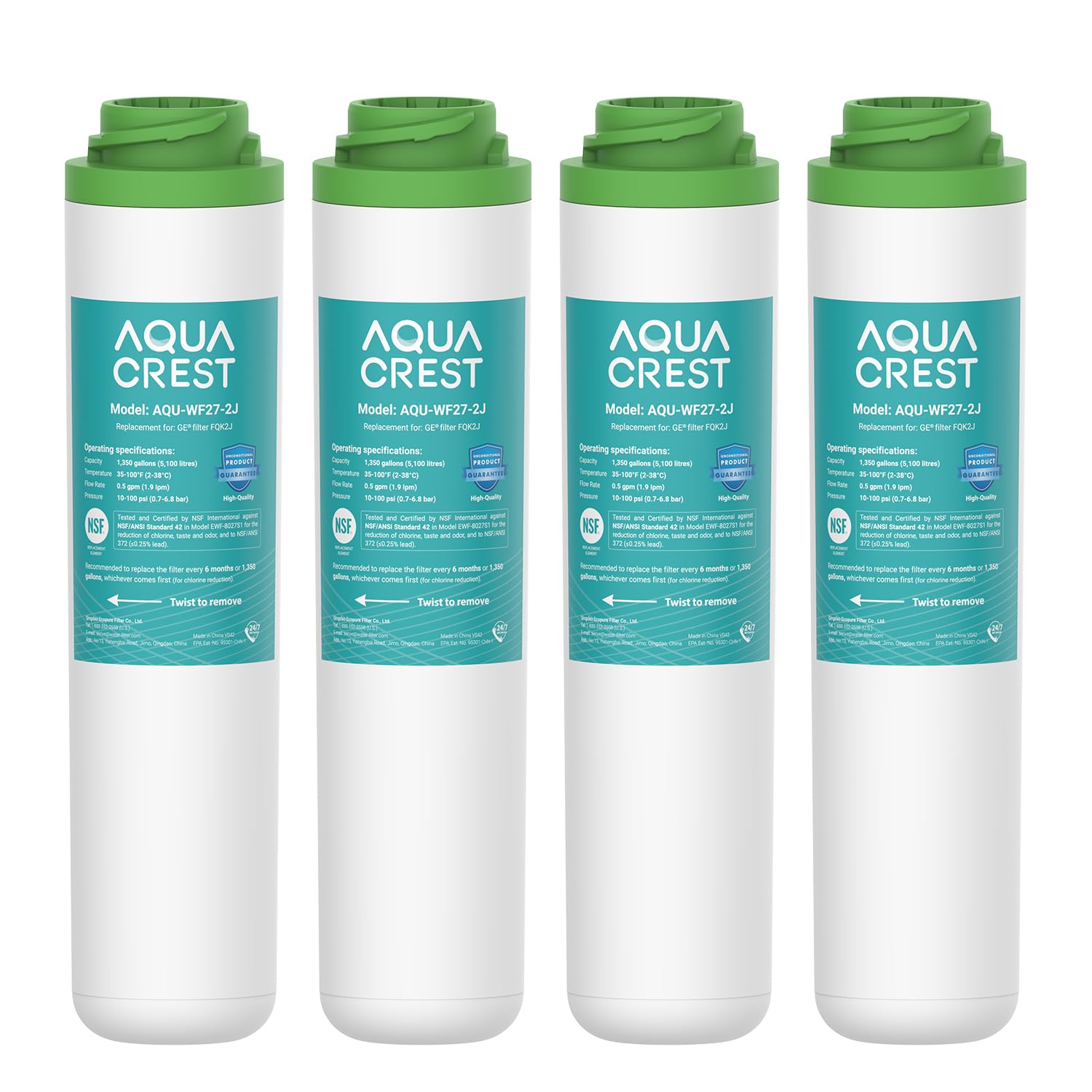
Aqua Crest’s FQK2J replacement filters are the budget-savvy way to keep a GE GXK255TBN or compatible filtration system running without paying OEM prices. Each cartridge uses natural coconut carbon block to reduce chlorine, heavy metals, bad taste, and sediment, and the 4-pack covers two years of filtration at a per-filter cost that undercuts the name-brand alternative by a wide margin.
The filters carry IAPMO testing against NSF/ANSI 42 and 372, ensuring certified reduction of chlorine and lead-free materials. At 1,350 gallons per filter (roughly 6 months), you get solid longevity. Multiple reviewers specifically noted that the water tasted better than the OEM GE filters and that their ice cubes came out crystal clear — a strong indicator that the coconut carbon is doing its job on taste and odor compounds.
Installation is a simple twist-on replacement — no tools, no Teflon tape, no shut-off valve required. The plastic housing is BPA-free and lead-free, though it doesn’t carry NSF 53 certification like some pricier options. A few early reviews mentioned brief dark water discharge at first use (normal carbon fines flushing out), and the tight fit may require a bit more muscle than the original filter to seat properly.
Why it’s great
- 4-pack provides two years of filtration at a low per-filter cost
- Natural coconut carbon block improves taste noticeably over OEM
- NSF/ANSI 42 and 372 certified for chlorine and lead-free safety
- Compatible with multiple GE systems and easy twist-on install
Good to know
- Not NSF 53 certified for lead reduction
- Filters may fit very tightly compared to OEM replacements
- Does not reduce TDS — dissolved solids remain
7. Aqua Crest FQSVF FQSVN Under Sink Water Filter 2-Pack

The Aqua Crest FQSVF 2-pack is the no-nonsense entry point for pure water filtration: a pair of replacement filters for GE FQSVF/FQSVN systems that deliver NSF 42 certified reduction of chlorine, taste, odor, and sediment. Each cartridge serves 300 gallons (about 6 months), so the 2-pack covers a full year for households on a tight budget.
What makes these stand out is the material choice — renewable coconut shell carbon instead of coal-based media. Customers consistently report that water flow is noticeably better than with OEM GE filters and that installation is leak-free with zero tools required. The lead-free construction (NSF 372) gives peace of mind for homes with children or pregnant family members.
The limitation is clear: at 300 gallons per cartridge, you’ll be swapping every 6 months, and the 0.5-micron rating isn’t as fine as some competitors. There’s no NSF 53 certification here, so if lead or cyst reduction is your priority, look to the Frizzlife MK99 or Culligan US-DC3 instead. But as a drop-in replacement for an existing GE system at a fraction of the OEM price, this 2-pack is hard to beat.
Why it’s great
- Two-pack covers a full year of filtration at a very low per-filter cost
- Renewable coconut shell carbon reduces environmental footprint
- NSF 42 and 372 certified for chlorine and lead-free safety
- Leak-proof design and easy tool-free replacement
Good to know
- 300-gallon capacity means more frequent replacements
- No NSF 53 certification for lead or cyst reduction
- Flow rate may be slower than some OEM and premium alternatives
FAQ
Can a pure water filter remove fluoride from tap water?
How often should I replace the filter cartridge in an under-sink pure water filter?
What is the difference between a direct-connect and a standard under-sink pure water filter?
Final Thoughts: The Verdict
For most users, the best pure water filter winner is the Frizzlife MK99 because it balances NSF/ANSI 53 certification for lead reduction, a tool-free 3-minute installation, and a core-only replacement design that minimizes long-term cost and plastic waste. If you want the depth of reverse osmosis without the storage tank footprint, grab the Waterdrop T3-C for its 450 GPD tankless output and 2:1 water efficiency ratio. And for a budget-friendly drop-in replacement that keeps a GE system running on coconut carbon at a fraction of OEM prices, nothing beats the Aqua Crest FQSVF 2-Pack.