Whether you’re breaking down the fibers of a tough chuck roast or pounding a chicken breast to an even thickness, the tool you use directly dictates the texture and juiciness of the finished dish. Reaching for the wrong tenderizer means uneven cooking, squashed proteins, or an arm workout that delivers mediocre results.
I’m Mohammad Maruf — the founder and writer behind AirfryerBite. I’ve spent years analyzing the engineering behind kitchen tools, from the gauge of stainless steel to the ergonomics of a balanced mallet, ensuring the best meat tenderizer picks here are built on hard specs and real-world performance rather than marketing fluff.
This guide breaks down the four top-rated models that solve distinct problems — from needle-style tenderizers that preserve shape to heavy mallets that flatten fast. Each review focuses on the materials, weight, and design details that separate a one-hit wonder from a kitchen staple.
How To Choose The Best Meat Tenderizer
The right tenderizer starts with understanding two distinct mechanisms: piercing (needle-style) and pounding (mallet-style). A needle tenderizer uses sharp stainless steel prongs to slice through muscle fibers without flattening the meat, ideal for steaks and roasts. A mallet physically compresses and spreads the protein, perfect for chicken breasts and cutlets. Your choice hinges on the cut of meat you handle most often.
Material and Build Quality
304 stainless steel offers superior rust resistance and is dishwasher-safe — critical for a tool that contacts raw protein. Die-cast aluminum is lighter and heats up less in hand but may show wear faster. Single-piece mallet designs prevent the head from loosening over time, a common failure point on two-part constructions. Avoid plastic handles bonded to metal heads if you plan for years of use.
Weight and Balance
Mallet weight directly correlates with the force delivered per swing. A 1.1 lb mallet is controllable for precise flattening, while a 1.8 lb model drives deeper with less arm effort but risks over-tenderizing delicate cuts. Ergonomic rubber handles reduce wrist strain and improve grip when wet — a non-slip handle is non-negotiable for safety during repetitive impact.
Needle Density and Design
Needle-style tenderizers should feature at least 18–21 sharp, corrosion-resistant prongs in a uniform grid. The needles must be long enough to penetrate the full thickness of a standard steak (roughly 1 inch). More needles mean more connective tissue broken per press, which cuts marination time significantly — a well-pierced piece of beef can absorb marinade in five minutes versus hours.
Quick Comparison
On smaller screens, swipe sideways to see the full table.
| Model | Category | Best For | Key Spec | Amazon |
|---|---|---|---|---|
| Stainless Steel 21-Needle Tenderizer | Needle | Steaks and roasts without flattening | 21 x 304 stainless steel needles | Amazon |
| Bellemain Meat Pounder | Mallet | Flattening chicken breasts evenly | 1.8 lb stainless steel head | Amazon |
| TheDOM Stainless Steel Mallet | Dual-Sided Mallet | Versatile tenderizing and flattening | 1.1 lb single-piece, dual-sided head | Amazon |
| OXO Good Grips Die Cast | Mallet | Comfort-focused, less arm fatigue | Die-cast aluminum, 0.23 kg head | Amazon |
In‑Depth Reviews
1. Stainless Steel Meat Tenderizer Tool with 21 Sharp Needles
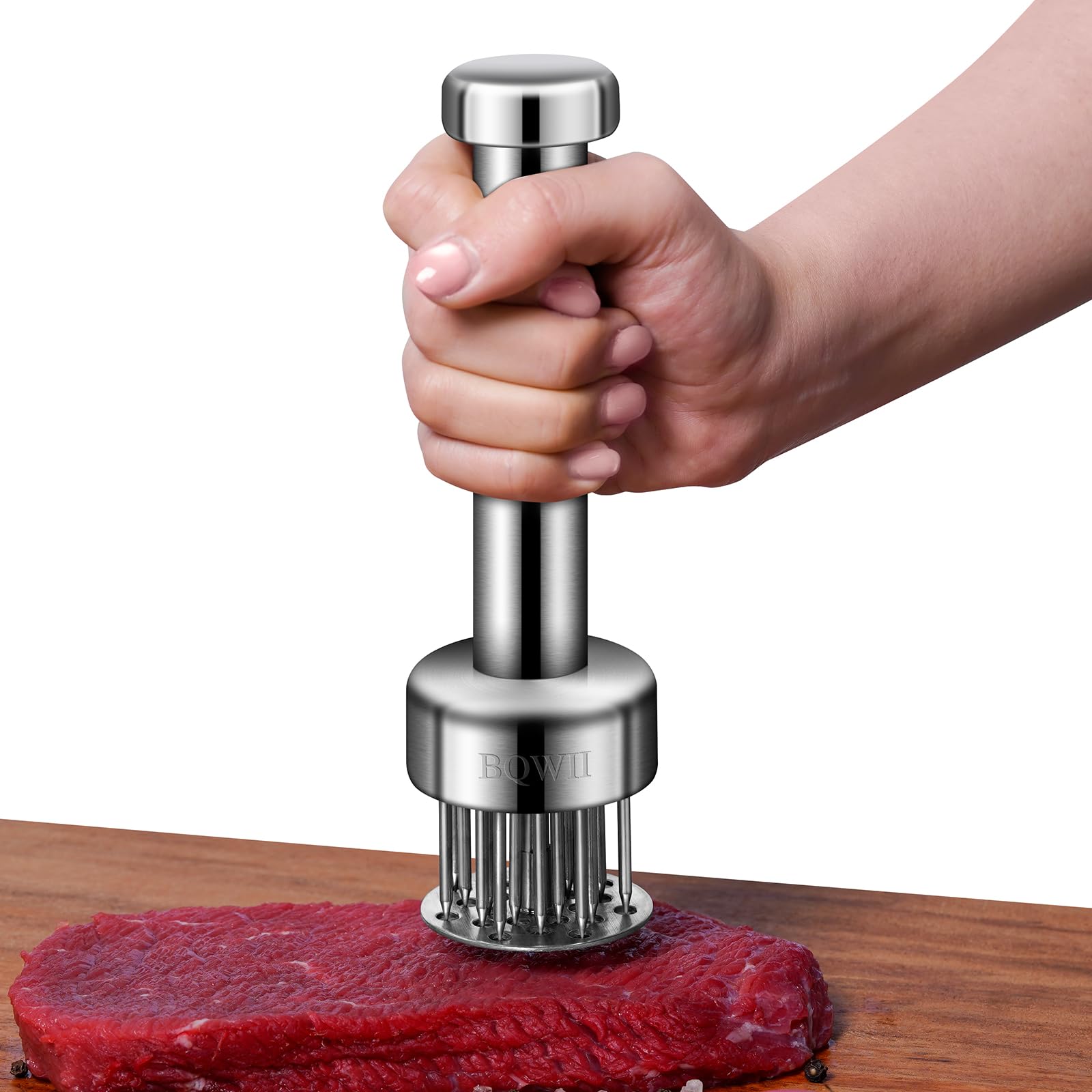
This needle-style tenderizer skips the flattening approach entirely and uses 21 sharp 304 stainless steel prongs to punch clean holes through beef, chicken, and pork. The mechanism preserves the original shape and thickness of the meat — crucial for steaks where you want a uniform sear without a squashed profile. Each press cuts through connective tissue without mashing the fibers together, leaving the muscle structure intact for better moisture retention during cooking.
The tool weighs 10.8 ounces, making it noticeably lighter than a heavy mallet, and the needle grid covers enough surface area to tenderize a standard ribeye in three or four presses. Because the needles create micro-channels, marinade absorption accelerates to about five minutes, and the manufacturer claims a cooking time reduction of up to 40 percent due to more efficient heat penetration. The entire unit is dishwasher-safe, and the 304 stainless steel body resists rust even after repeated cycles.
Customer feedback highlights the absence of mess during use — no splattered juices or crushed meat — and the clean perforations that allow seasonings to stick deeper into the surface. The single-piece construction eliminates crevices where raw protein residue can hide, and the rounded handle offers a comfortable palm fit for repetitive pressing.
Why it’s great
- Preserves meat shape and thickness while tenderizing
- 21 sharp 304 stainless steel needles resist rust and stay sharp
- Dishwasher-safe for quick, hygienic cleaning
- Accelerates marinade absorption to roughly five minutes
Good to know
- Not designed for flattening chicken breasts or cutlets
- Requires a firm pressing motion rather than swinging
2. Bellemain Meat Pounder Flattener

Built with a solid iron core beneath a stainless steel exterior, the Bellemain mallet tips the scale at 1.8 pounds — the heaviest option in this roundup. That mass delivers decisive flattening force with minimal arm effort, making it the best choice if you regularly pound thick chicken breasts or London broil into even sheets. The broad 3.25-inch head covers more surface area per strike, cutting down the number of whacks needed to reach uniform thickness.
The ergonomic rubber handle is contoured to fit the palm and stays grippy even when wet, reducing the risk of the mallet slipping mid-swing. The head is smooth on all sides — no textured tenderizing surface — so its purpose is purely flattening. If your goal is uniform cutlets for schnitzel or chicken parmesan, this tool removes the guesswork. The weight also doubles as a convenient garlic smasher or nut cracker for quick kitchen tasks.
The trade-off is that the rubber handle makes the mallet unsuitable for the dishwasher — hand washing is required to preserve the grip. Some users with larger hands noted the handle feels narrow, and the heavy head means you need to be deliberate with each swing to avoid over-thinning delicate cuts. Still, the overwhelming consensus from reviewers is that the solid construction and balanced weight justify the extra care during cleaning.
Why it’s great
- 1.8 lb solid iron core delivers maximum flattening force
- Ergonomic rubber handle stays non-slip when wet
- Wide 3.25-inch head reduces number of strikes needed
- Versatile enough to smash garlic or crack nuts
Good to know
- Not dishwasher-safe; hand wash only
- Handle may feel narrow for users with larger hands
3. TheDOM Stainless Steel Meat Mallet Hammer Tenderizer

TheDOM strikes the ideal balance between tenderizing and flattening with a dual-sided head — one face studded with pyramid-shaped teeth for breaking down fibers, the other smooth for pounding meat to even thickness. At 1.1 pounds, it carries enough heft to work efficiently without fatiguing the wrist during extended prep sessions. The single-piece stainless steel construction eliminates the risk of the head detaching mid-use, a common failure on cheaper two-part mallets.
The ergonomic handle features an anti-slip texture that improves grip when your hands are slick from handling raw meat. The textured side creates small indentations that help seasonings cling to the surface while the flat side rolls out chicken breasts for even cooking. Reviewers consistently praise the balance — heavy enough to tenderize a tough pork chop in a few strikes but light enough to control for precision work like cracking crab legs.
Every component is dishwasher-safe, and the polished stainless steel finish resists staining and odors from repeated contact with raw proteins. The included presentation box makes it a solid gift option, and the five-year warranty provides added confidence in the build quality. The pronged side does require a bit more pressure than a needle-style tenderizer, but for a single tool that handles both tenderizing and flattening, this mallet covers more ground than any dedicated model.
Why it’s great
- Dual-sided head (textured for tenderizing, smooth for flattening)
- Single-piece stainless steel build — no head detachment risk
- 1.1 lb weight offers good power without wrist fatigue
- Dishwasher-safe with a 5-year warranty
Good to know
- Textured side requires more pressure than needle-style tenderizers
- Prone to leaving small indentations if overused on delicate cuts
4. OXO Good Grips Die Cast Meat Tenderizer

The OXO Good Grips model takes a different approach with a die-cast aluminum head that weighs just 0.23 kilograms — the lightest mallet here, but precisely engineered to reduce arm strain during repetitive use. The textured side features pyramid-shaped teeth that tenderize without needing heavy swings, and the smooth side maximizes surface area to flatten chicken breasts quickly. OXO optimized the angle and weight distribution so the mallet does the work for you, requiring less force per strike.
The soft, non-slip handle is designed for comfort and safety, even when wet, and the overall length of 9.75 inches provides good leverage without feeling oversized. The aluminum construction makes it easy to maneuver in tight spaces, and the compact profile fits into crowded kitchen drawers. OXO is known for its emphasis on ergonomics, and this tenderizer reflects that priority — users with arthritis or hand fatigue will appreciate the lighter build.
The die-cast aluminum is not dishwasher-safe — hand washing is required — and the lighter weight means you may need more passes on thick cuts compared to a 1.8 lb mallet. The pyramid teeth also create a distinct pattern on the meat surface that some cooks prefer for visual reasons. For a daily driver that prioritizes comfort and ease of handling over brute force, the OXO delivers consistent results without tiring your arm.
Why it’s great
- Lightweight die-cast aluminum reduces arm fatigue
- Soft non-slip handle provides excellent grip when wet
- Optimized head angle for efficient tenderizing with less effort
- Compact size fits easily in standard kitchen drawers
Good to know
- Not dishwasher-safe — hand wash only
- Lighter weight requires more passes on very thick cuts
FAQ
Can I use a mallet on a steak without destroying its texture?
How often should I replace a stainless steel needle tenderizer?
Final Thoughts: The Verdict
For most users, the best meat tenderizer winner is the TheDOM Stainless Steel Meat Mallet because its dual-sided head, single-piece construction, and balanced 1.1 lb weight handle both tenderizing and flattening without compromising durability. If you want a needle-style tool that preserves meat shape while slashing marination time, grab the 21-Needle Stainless Steel Tenderizer. And for a comfortable, lightweight mallet that minimizes arm fatigue during long prep sessions, nothing beats the OXO Good Grips Die Cast Tenderizer.