A flimsy board that slides under pressure or dulls your chef’s knife after a single roast is the fastest way to ruin a cooking session. For anyone who breaks down whole chickens, slices brisket, or chops raw pork with regularity, the surface under your blade matters more than almost any other kitchen tool.
I’m Mohammad Maruf — the founder and writer behind AirfryerBite. I’ve analyzed hundreds of cutting board specifications, from Janka hardness ratings to glue-bond integrity, to understand exactly which wood species and construction methods keep a board flat, knife-safe, and sanitary over years of heavy meat prep.
This guide compares seven top contenders based on real-world criteria like grain type, thickness, juice management, and long-term durability to help you find the best wood cutting board for meat for your kitchen.
How To Choose The Best Wood Cutting Board For Meat
A dedicated meat board faces a different set of demands than a general-purpose vegetable board. You need a surface that can absorb heavy cleaver blows, contain pooling juices, resist deep gouges, and hold its shape after repeated washing. Choosing the wrong construction or wood species leads to warping, bacterial hiding spots, and prematurely dull knives. Pay attention to these four factors before you buy.
Grain Construction: End-Grain vs. Edge-Grain vs. Face-Grain
End-grain boards expose the wood fibers vertically, allowing knife edges to slide between the fibers rather than cutting across them. This self-healing property keeps your knives sharper longer and leaves less visible scarring on the board. Edge-grain boards offer excellent durability and a cleaner look, but they show cuts more readily. Face-grain boards, common in cheap grocery-store boards, are the least forgiving on knife edges and most prone to warping. For heavy meat work, end-grain or high-quality edge-grain is the practical minimum.
Thickness and Weight for Stability
A board thinner than 1.2 inches tends to shift or bounce when you apply downward force from a meat cleaver. Thicker boards—1.5 inches or more—add enough mass to stay planted on the counter without requiring a damp towel underneath. Heavier boards also resist bowing over time, especially if you routinely rinse them with warm water after raw meat prep. If you plan to use the board over a sink or stovetop, look for models with non-slip rubber feet or recessed handles that give you a secure grip.
Juice Groove Capacity and Depth
Carving a roast or breaking down a whole bird releases a surprising volume of liquid. A shallow groove (less than 0.2 inches deep) overflows quickly, sending meat juices onto your counter. The best meat boards feature a generously routed juice groove that wraps around one side of the board, leaving a flat reverse side for dry tasks like chopping vegetables. Measure the groove depth by reading customer reviews that mention real-world carving sessions—specs often omit this dimension.
Wood Species and Natural Antimicrobial Properties
Hardwoods like maple, walnut, acacia, and teak have closed-grain structures that resist absorbing moisture and bacteria better than more porous woods. Maple is the classic American butcher-block wood because it is hard enough to resist deep cuts yet gentle on knife edges. Walnut offers similar durability with a striking dark color that hides stains. Acacia provides good water resistance at a lower weight. Bamboo, technically a grass, is harder than maple but can dull knives faster due to its high silica content. For dedicated raw meat use, stick with maple, black walnut, or teak.
Quick Comparison
On smaller screens, swipe sideways to see the full table.
| Model | Category | Best For | Key Spec | Amazon |
|---|---|---|---|---|
| BABILONIA Black Walnut | Premium End-Grain | Knife-friendly heavy prep | 1.7 in end-grain walnut | Amazon |
| WoodForChef Maple | Premium Edge-Grain | Large-format butchery | 24 x 18 x 1.5 in maple | Amazon |
| Socisen Teak (20 in) | Mid-Range Hardwood | Non-slip moisture resistance | 0.8 in teak with rubber feet | Amazon |
| Socisen Bamboo (24 in) | Large Bamboo | Over-sink / stovetop use | 24 x 18 x 1 in with non-slip feet | Amazon |
| GAOMON Acacia (24 in) | XXL Acacia | Maximum coverage / dough kneading | 24 x 18 x 1.1 in acacia | Amazon |
| FANICHI Acacia (17 in) | Entry-Level Acacia | Budget-friendly reversible board | 17 x 13 x 1.5 in acacia | Amazon |
| SOULFINO Bamboo (17 in) | Budget Bamboo | Entry-level heavy chopping | 17 x 13 x 1.5 in bamboo | Amazon |
In‑Depth Reviews
1. BABILONIA American Black Walnut Cutting Board
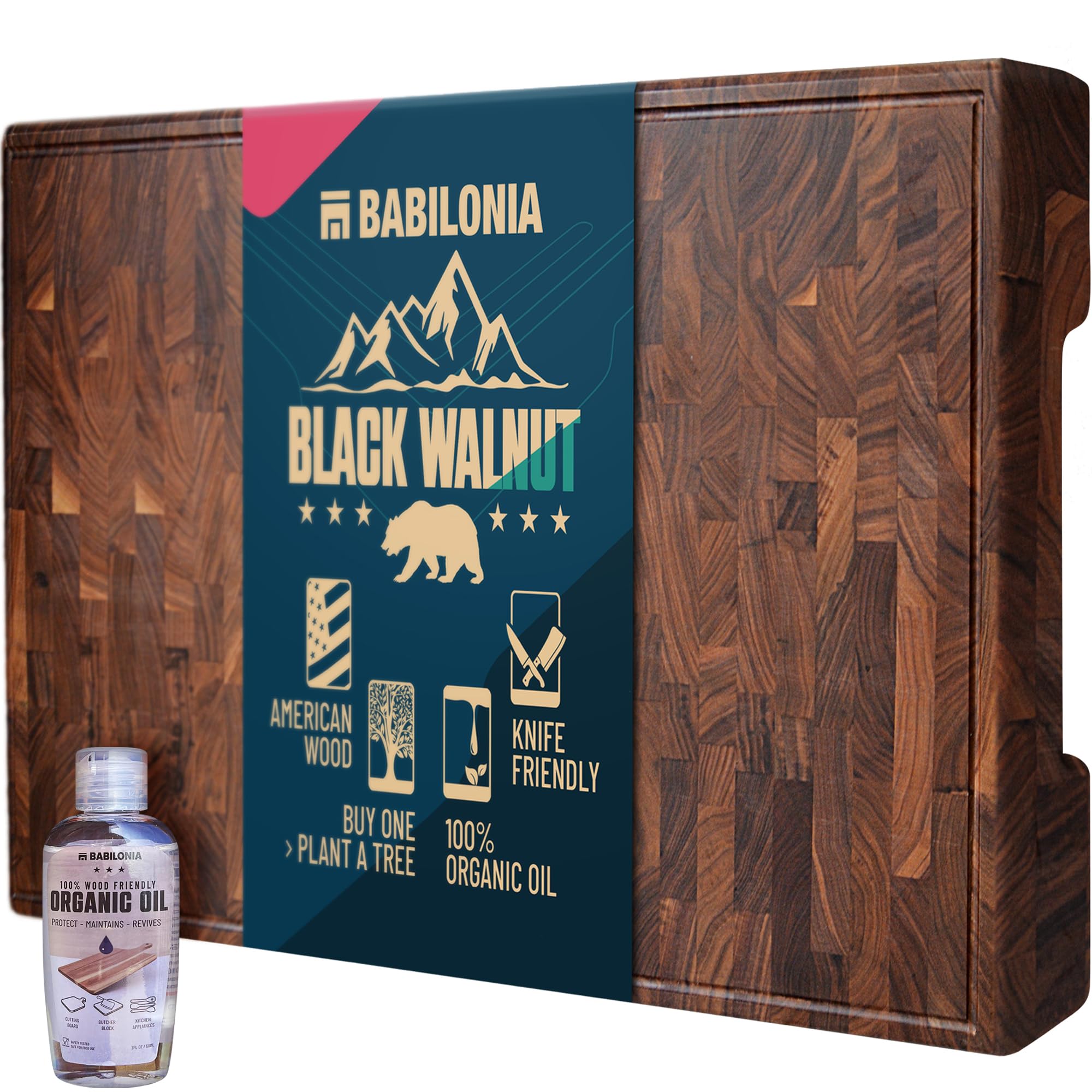
This Italian-designed board delivers what serious meat cooks demand: a full 1.7-inch thickness of end-grain black walnut. The vertical fiber orientation absorbs knife impacts without transferring shock to the blade edge, meaning your carbon-steel chef’s knife stays sharp noticeably longer than it would on a face-grain or bamboo board. At 8.8 pounds, it sits solidly on the counter during heavy cleaver work—no sliding, no bouncing.
The built-in juice groove runs around the perimeter to contain pooling beef and poultry juices, while the reversible design lets you flip to a flat surface for chopping vegetables or arranging a charcuterie spread. A clever undercut slot holds the included small plate directly beneath the board, letting you scrape chopped onions or garlic straight into the bowl without lifting the board. The pre-seasoned mineral oil coating means it is ready for immediate use, though monthly re-oiling will preserve the deep walnut color and prevent moisture intrusion.
Buyers report the board remains flat and crack-free after months of daily use, and the included organic oil bottle simplifies routine maintenance. The only durability caveat from long-term reviews is a small crack that appeared after three months in one case despite regular seasoning—a rare occurrence that the brand’s 2-year warranty covers. For premium end-grain performance at a mid-range price, this board sets the standard for the category.
Why it’s great
- True end-grain construction protects knife edges
- Included plate slot and oil bottle add real convenience
- 1.7-inch thickness prevents warping and bounce
Good to know
- Small crack reported by one user after three months
- Walnut absorbs oil quickly; monthly conditioning expected
2. WoodForChef Maple Cutting Board

When you need the largest stable work surface for breaking down primal cuts or portioning whole briskets, this North American maple board offers 432 square inches of edge-grain real estate. At 1.5 inches thick and nearly 19 pounds, it is the heaviest board in this lineup—mass alone keeps it planted during aggressive chopping. Maple has a Janka hardness rating around 1450, dense enough to resist deep gouges but still gentle on knife edges compared to bamboo or glass.
The deep juice groove channels running liquids effectively, and the reversible flat side handles dry-prep tasks like dicing carrots or mincing garlic. This board arrives pre-seasoned with a food-safe mineral oil and beeswax blend, so it is ready out of the box. The edge-grain construction strikes a practical balance: it shows cut marks more visibly than end-grain, but it requires less maintenance and stays flatter over time in humid environments.
Owners praise the board’s stability and the way it absorbs cleaver impacts without transferring vibration to the counter. A few buyers noted their unit arrived dry and needed three or four initial oil coats before the surface felt smooth; this is typical for maple and not a defect. If you prioritize maximum surface area, a sturdy maple foundation, and a board that will not dull your daily driver, this model earns its reputation as a heavy-duty workhorse.
Why it’s great
- Extra-large 24 x 18 inch work surface
- Nearly 19 pounds of mass for zero-slip stability
- Deep juice groove contains meat run-off effectively
Good to know
- May require multiple initial oil treatments
- Edge-grain shows cut marks more than end-grain
3. Socisen Teak Wood Cutting Board (20 x 14 in)
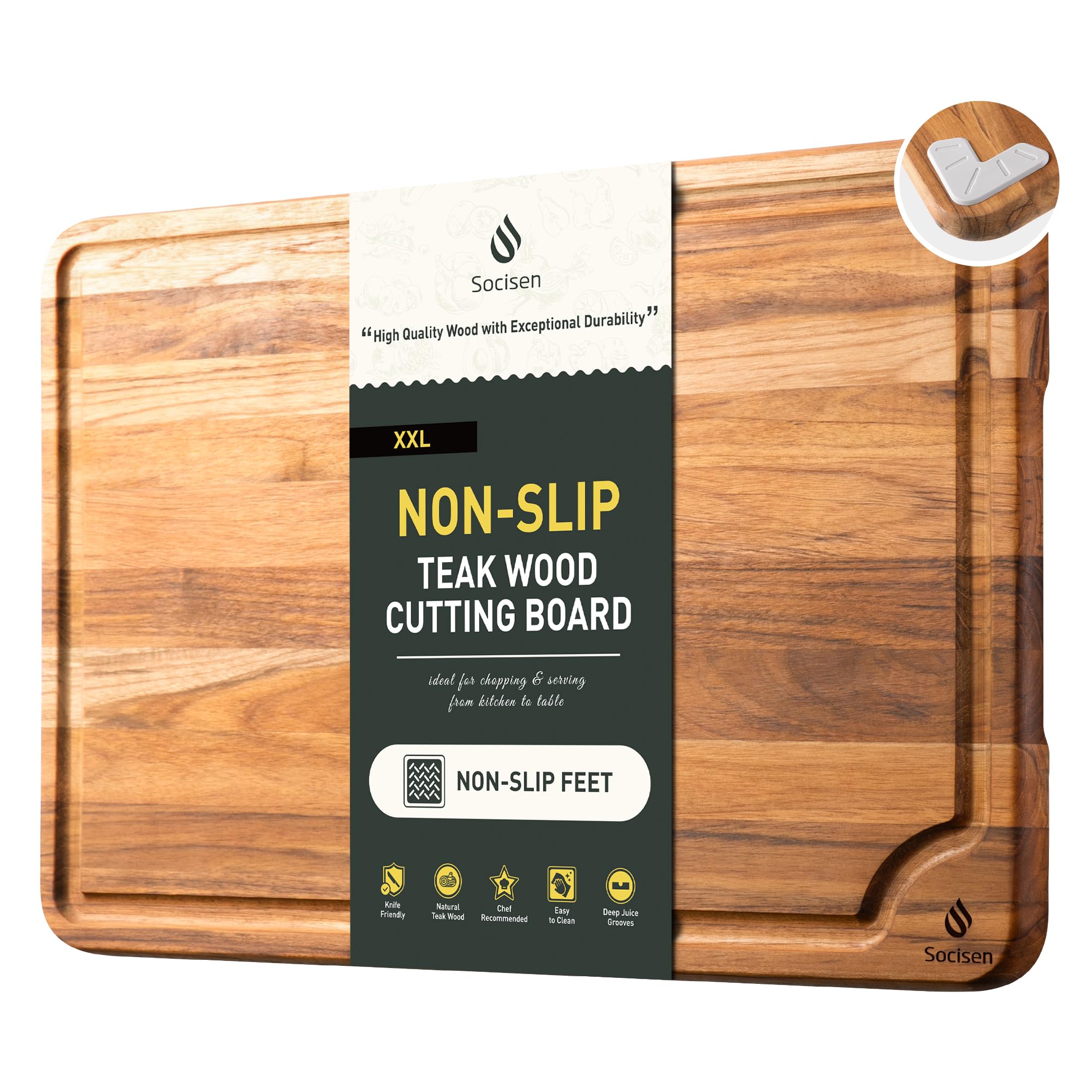
Teak contains natural oils that repel moisture far more effectively than maple or walnut, making this FSC-certified board an excellent choice if you routinely handle wet raw meat or rinse the board frequently during prep. The 0.8-inch thickness is thinner than the premium contenders, but the rubber non-slip feet compensate by locking the board in place on both countertops and over-sink installations. At 20 x 14 inches, it provides ample room for carving a whole turkey or breaking down a large pork shoulder.
The built-in juice groove is positioned along one edge to catch runoff, and the rounded edges offer a comfortable grip when lifting. The teak grain naturally hides knife marks better than lighter woods, keeping the board presentable for serving charcuterie or cheese. The board arrives pre-oiled but benefits from an occasional mineral oil treatment to maintain its golden-brown hue and prevent the surface from drying out in low-humidity kitchens.
Customer feedback consistently highlights the non-slip feet as a standout feature—the board does not budge even during vigorous chopping. Some users mentioned that the larger board in a multi-pack felt slightly rough despite multiple oil applications, so expect a brief break-in period. If you want a low-maintenance hardwood that resists moisture absorption and stays put on wet counters, this teak board delivers solid performance at a mid-range investment.
Why it’s great
- Natural teak oil resists water absorption
- Rubber feet prevent sliding on wet surfaces
- FSC certification ensures sustainable sourcing
Good to know
- Thinner profile (0.8 in) may feel less substantial
- Some boards arrive with a rougher surface texture
4. Socisen Bamboo Cutting Board (24 x 18 in)
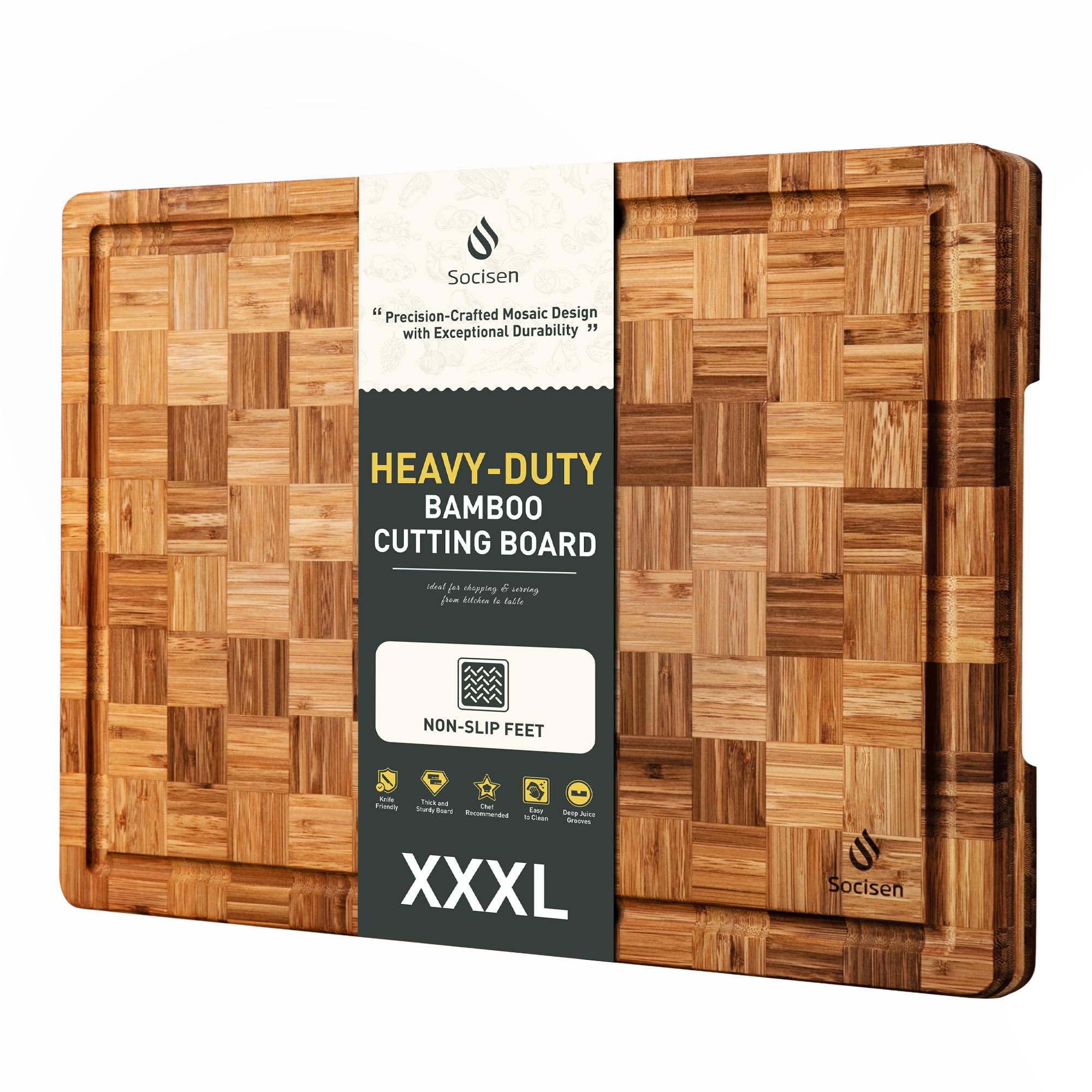
Bamboo is harder than maple—around 1800 on the Janka scale—which means this 5-layer laminated board resists deep cut marks and warping exceptionally well. The 24 x 18 inch surface gives you enough room to prep a full tray of steaks, slice multiple roasts, or use the board as a stovetop cover for extra counter space. Non-slip rubber feet and recessed side handles make it easy to lift and move the board, even when loaded with prepped ingredients.
The juice groove is present but some buyers noted it is shallower than ideal for medium-rare steaks that release significant juices; you may need to wipe the counter if you carve a particularly juicy roast. The bamboo construction is eco-friendly—it regenerates in 3-5 years compared to decades for hardwood trees—and the FSC certification confirms responsible sourcing. The board arrives pre-seasoned with food-grade mineral oil, though re-oiling every few weeks helps maintain the smooth surface.
Long-term owners report that the layered construction resists cracking and delamination better than single-piece boards, and the non-slip feet remain secure after six months of daily use. A few customers mentioned that bamboo can dull knives faster than maple or walnut due to its higher silica content, so keep this in mind if you use high-end Japanese knives. For large-volume meat prep on a budget, this board offers exceptional surface area and stability.
Why it’s great
- Massive 24 x 18 inch surface at a reasonable cost
- 5-layer construction resists cracking and warping
- Non-slip feet keep board stable on any counter
Good to know
- Bamboo’s silica content may dull knives faster
- Juice groove depth may overflow with very juicy meats
5. GAOMON Acacia Cutting Board (24 x 18 in)

Acacia offers a Janka hardness of roughly 1700, giving this board a strong resistance to visible scarring while still being lighter than maple boards of the same size. At 24 x 18 inches with a 1.1-inch thickness, this GAOMON board is designed for cooks who need maximum coverage—it fits over sink openings and gas stovetops to create instant extra work surface. The recessed handholds on the sides make it easy to grab and reposition even when your hands are wet or greasy.
The juice groove runs along one edge to capture released liquids during carving, and the reversible flat side works for dough kneading or chopping vegetables. Several buyers mention using this board as a permanent stovetop cover to gain counter space in small kitchens, and the acacia grain pattern adds a warm, natural look that complements most kitchen décors. The board is free from paint or chemical coatings, so you do not have to worry about finishes leaching into raw meat.
Users report that the surface shows cut marks quickly because the acacia is softer than maple, but this also means your knives stay sharper longer—a worthwhile trade-off. Some reviews noted that the edge indentations feel slightly coarse or unfinished, though this does not affect functionality. If you need a budget-friendly extra-large board for heavy meat prep and occasional dough work, this acacia board delivers surprising versatility for the price.
Why it’s great
- Extra-large 24 x 18 inch surface fits over sinks
- Lightweight construction for easy repositioning
- Natural acacia grain hides stains well
Good to know
- Soft wood shows cut marks immediately
- Edge indentations feel slightly rough on some units
6. FANICHI Acacia Wood Cutting Board (17 x 13 in)
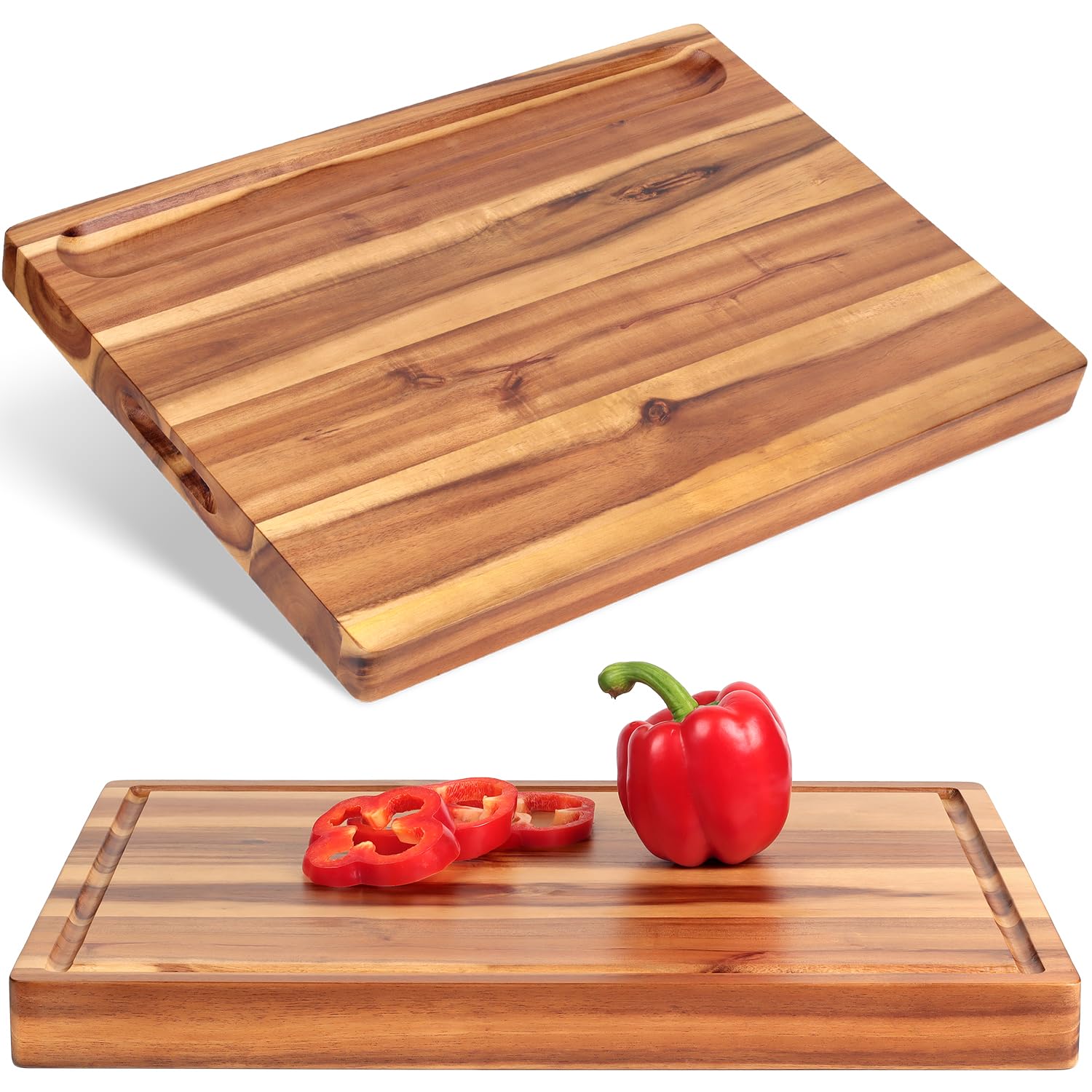
This board proves that you do not have to invest heavily to get a thick, functional acacia board for meat prep. At 17 x 13 inches with a full 1.5-inch thickness, the dimensions are compact enough for smaller kitchens while still providing enough surface area to break down a whole chicken or carve a roast. The reversible design features a juice groove on one side for meat and a cracker or bread holder on the reverse, giving you two distinct functions in a single board.
The acacia wood is sourced from sustainable forests and finished with a natural, paint-free surface that will not leach chemicals into food. The inner side handles make lifting and moving the board easy, even when it is loaded with prepped ingredients. Buyers consistently note that the board arrives pre-oiled and requires minimal initial conditioning—just a routine mineral oil wipe every few weeks to maintain the luster and prevent drying.
Customer feedback highlights the board’s beauty and durability, with many using it as a daily driver for both meat prep and serving. A few owners noted that despite the box labeling, this is an edge-grain board rather than end-grain, so it will show cut marks over time. If you want a compact, thick, and well-priced acacia board that handles both meat and serving duties, this FANICHI model is a solid entry-level pick.
Why it’s great
- Thick 1.5-inch construction resists warping
- Reversible design with juice groove and bread holder
- Compact size fits smaller kitchen counters well
Good to know
- Edge-grain surface shows cut marks over time
- Slightly smaller surface area for large roasts
7. SOULFINO Bamboo Cutting Board (17 x 13 in)
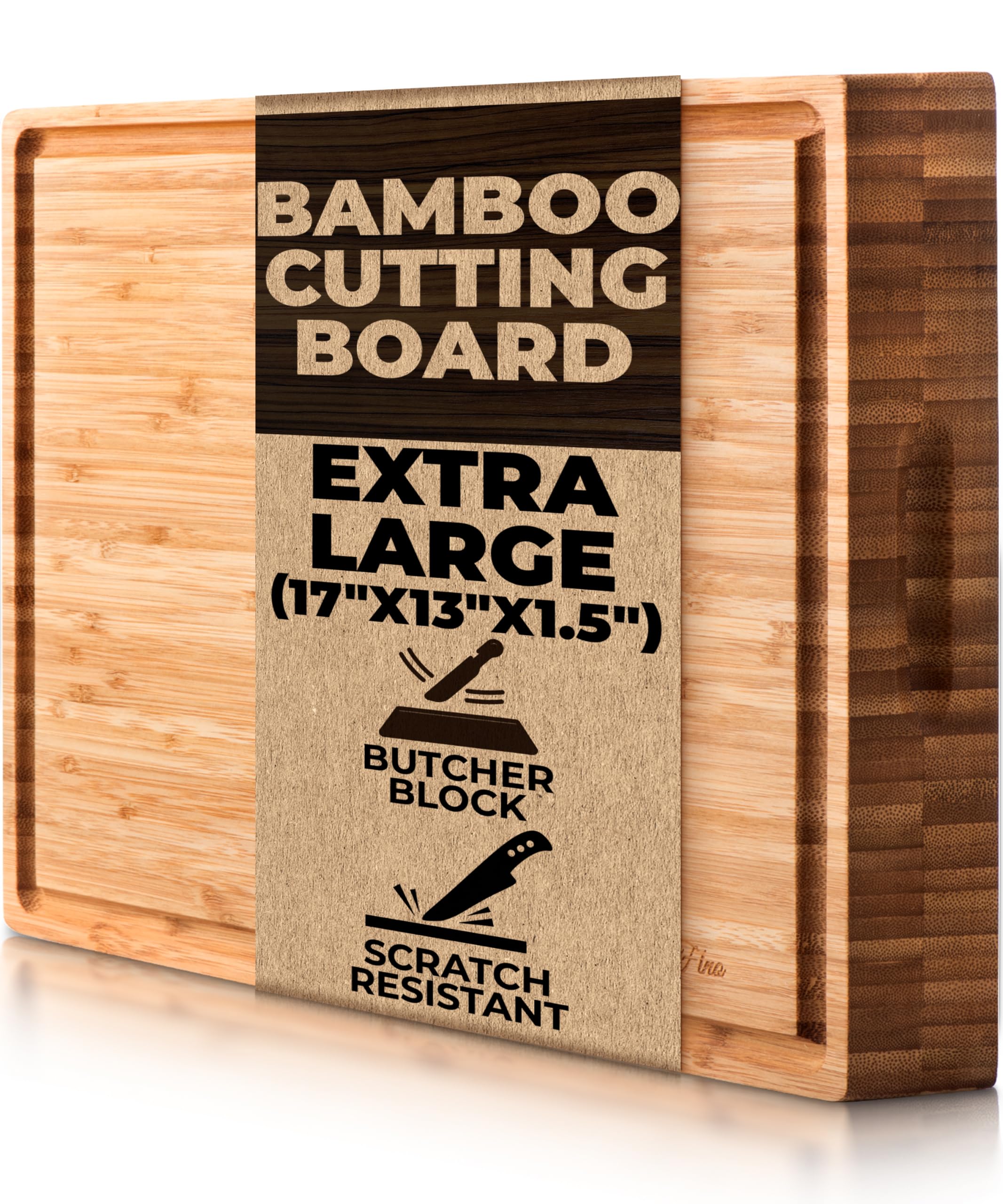
Bamboo offers a unique trade-off: exceptional hardness and scratch resistance at the cost of accelerated knife dulling. This 17 x 13 x 1.5-inch board from SOULFINO provides the same thickness as premium options but at a fraction of the cost, making it accessible for anyone who needs a heavy-duty meat board without stretching the budget. The juice groove runs along one side to capture liquids, and the side handles make it easy to transport from counter to sink.
The board is pre-seasoned with mineral oil, so it is ready for use straight out of the packaging. At nearly 7 pounds, it has enough heft to stay stable during chopping, though it is lighter than comparably sized maple boards. The bamboo material is also an eco-friendly choice—it regenerates quickly and requires fewer resources than hardwood forestry.
Long-term reviews are mixed regarding durability. Some owners report that the laminated bamboo layers can separate after several months of heavy use, and a few noted that the board sheds bamboo fibers over time. However, the seller’s responsive customer service—including free replacements for defective units—mitigates the risk. If you are willing to accept the trade-offs of bamboo density against knife sharpness, this board offers a functional entry point for meat preparation.
Why it’s great
- Competitive pricing for a thick 1.5-inch board
- Juice groove and side handles for convenience
- Responsive seller support and replacement policy
Good to know
- Bamboo can dull knives faster than hardwood
- Lamination layers may separate over extended use
FAQ
Is end-grain or edge-grain better for a meat cutting board?
Can I use a bamboo cutting board for raw meat?
How thick should a wood cutting board be for chopping meat?
How do I sanitize a wood cutting board after cutting raw meat?
Final Thoughts: The Verdict
For most users, the best wood cutting board for meat winner is the BABILONIA American Black Walnut because its true end-grain construction, generous 1.7-inch thickness, and included plate slot offer the best balance of knife protection, stability, and convenience for serious home cooks. If you want a massive work surface for whole-bird butchery and large roasts, grab the WoodForChef Maple. And for a budget-friendly entry into hardwood meat prep, nothing beats the value of the FANICHI Acacia.