That dull knife pressing through a tomato instead of slicing it is the first sign you need a proper sharpening stone. The difference between a frustrating drag and a clean, effortless cut comes down to the abrasive surface you choose—and knowing how to use it.
I’m Mohammad Maruf — the founder and writer behind AirfryerBite. I’ve spent years evaluating the grit composition, binder hardness, and dimensional stability of sharpening stones to separate the tools that actually hold a burr from those that wear out in a season.
Whether you are maintaining a pocket folder or restoring a chef’s knife, finding the right sharpening stone means matching grit range, material type, and stone size to the steel you own.
How To Choose The Best Sharpening Stone
Selecting a sharpening stone comes down to the steel you sharpen, the edge finish you need, and how much time you want to spend preparing the stone itself. Three factors narrow the field quickly.
Grit Rating and Edge Progression
A single grit rarely solves every sharpening task. Coarse grits around 100 to 400 repair chips and reset bevels. Medium grits in the 1000 to 3000 range refine the edge. Ultra-fine stones above 4000 grit polish the apex to a mirror finish. If you only sharpen dull kitchen knives, a dual-grit stone covering both coarse and fine ranges is the most practical choice.
Stone Material: Diamond, Ceramic, Novaculite, or Corundum
Diamond stones cut aggressively on hard modern steels and never need flattening, but they wear differently over time. Natural Arkansas novaculite delivers a fine edge without loose grit but works slowly on high-alloy blades. Ceramic water stones like the King 6000 offer a creamy polishing action with a slow cutting speed. Corundum-based stones (Norton, Work Sharp) balance durability and cutting speed across a wide range of steels.
Stone Size and Stability
A stone that measures at least 7 inches long lets you sharpen an 8-inch chef’s knife in full strokes without stopping. Stones under 5 inches work fine for pocket knives but force extra passes on larger blades. A non-slip base or rubber mat prevents the stone from shifting mid-stroke, which is the most common cause of inconsistent bevels and accidental edge rounding.
Quick Comparison
On smaller screens, swipe sideways to see the full table.
| Model | Category | Best For | Key Spec | Amazon |
|---|---|---|---|---|
| Work Sharp Benchtop Whetstone | Water Stone | Guided home sharpening | 1000 / 6000 grit | Amazon |
| Norton Combination Oil Stone | Oil Stone | Heavy edge repair | 100 / 280 grit | Amazon |
| King 6000 Water Stone | Water Stone | Polishing and honing | 6000 grit | Amazon |
| YCAMMIN Diamond Stone | Diamond Plate | Budget-friendly versatility | 400 / 1000 grit | Amazon |
| Dan’s Arkansas Pocket Stone | Natural Stone | Field touch-ups | Fine grit | Amazon |
In‑Depth Reviews
1. Work Sharp Benchtop Whetstone

The Work Sharp Benchtop Whetstone delivers the most beginner-friendly sharpening experience in this lineup thanks to its magnetic 15° and 17° angle guides. You slide the knife spine along the guide while sweeping the edge across the 1000 grit side, flip to the 6000 grit side for a polished finish, and the included water control base keeps the mess contained. The stone measures 4 by 2.25 inches, which is smaller than a full bench stone but large enough for 8-inch chef’s knives when you use full-length strokes.
The 1000 grit side cuts efficiently on carbon and stainless steel, removing the dull edge in roughly four to six passes per side. The 6000 grit side refines the scratch pattern to a near-mirror finish that slices printer paper without snagging. The corundum (aluminum oxide) material soaks for only five minutes before use, which is a fraction of the soak time required by traditional Japanese water stones.
Some users note the plastic base feels less substantial than the stone itself, but the anti-skid mat prevents sliding on countertops. The limited lifetime warranty from Work Sharp, a fourth-generation American company, adds confidence for long-term use. If you want consistent edges without freehand guesswork, this is the most complete package at a mid-range investment.
Why it’s great
- Includes 15° and 17° angle guides for consistent bevels every pass
- Dual 1000/6000 grit eliminates the need for a separate honing stone
- Short five-minute soak time compared to traditional water stones
Good to know
- Stone surface is smaller than a full-size bench stone
- The plastic base feels less premium than the stone itself
2. Norton Combination Oil Stone

The Norton Combination Oil Stone is the workhorse of this list, built for users who need to repair damaged edges and reshape bevels quickly. The coarse side sits at 100 grit, which aggressively removes steel from chipped blades, hatchets, and plane irons. The opposite side at 280 grit refines that edge into something functional, though most users follow up with a finer stone for a truly sharp finish. The stone measures 8 by 2 inches, providing a stable platform for long-bladed tools.
Unlike water stones, this corundum-based stone requires oil or WD-40 as a lubricant, which prevents metal particles from loading the surface and keeps the abrasive cutting freely. There is no soaking, no flattening, and no rust risk. The stone itself weighs 1.5 pounds and sits solidly on a bench without sliding. Customers consistently report that the coarse side handles big game processing knives and workshop tools without wearing down.
The trade-off is that the 280 grit side is closer to an extra-medium finish than a true honing surface. Users who want a razor edge will need a 1000 grit or higher stone in their progression. The Norton is not a one-stone solution for fine cutlery, but it is an extremely durable foundation stone for any shop that maintains tools and outdoor gear. If your primary goal is re-profiling rather than polishing, this is the most cost-effective entry point.
Why it’s great
- 100 grit coarse side removes material fast for chip repair and re-profiling
- Oil lubrication means no soaking, no flattening, and no water mess
- Full 8-inch length accommodates axes, chisels, and long chef’s knives
Good to know
- 280 grit side is not fine enough for a polished, shaving-sharp edge
- Requires oil or WD-40 lubricant—cannot be used dry or with water
3. King 6000 Water Stone
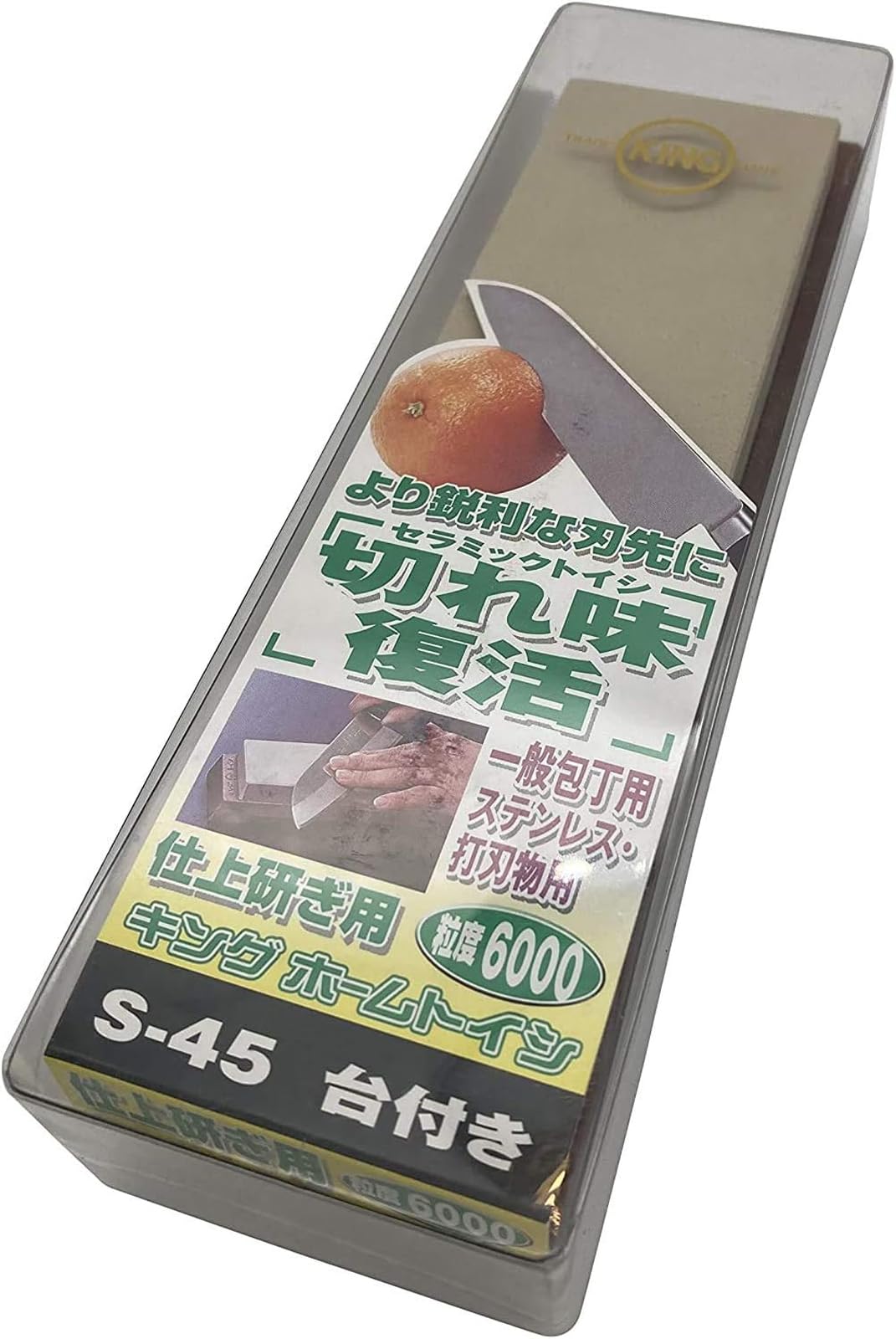
The King 6000 Water Stone is a polishing specialist that belongs in the final stage of any sharpening progression. At 6000 grit, the ceramic-bonded abrasive produces a mirror finish that removes the burr left by lower grit stones and leaves the apex smooth enough for push-cutting paper and shaving arm hair. The stone measures 7 inches long and about 1 inch wide, providing enough surface area for straight razors and kitchen knives when you use the entire length.
This is a splash-and-go stone with a catch—it performs best when soaked until the bubbles stop, which takes about five to ten minutes. During use, a damp rag under the stone prevents sliding, and building a light slurry on the surface accelerates the polishing action. Users who pair the King 6000 with a 1000 grit stone report a buttery, clean-cutting edge on Shun and Miyabi knives, though the process takes more cycles on softer German stainless steel.
The main drawback is the stone’s fragility. Several customers report receiving the stone cracked horizontally during shipping, and while the crack does not always affect sharpening performance, it indicates the ceramic binder is less impact-resistant than diamond or corundum alternatives. The King 6000 is not a standalone stone—it requires a coarser stone beforehand—but as a finishing stone, its value-to-performance ratio is hard to beat. This is the premium choice for anyone chasing a polished, refined edge.
Why it’s great
- 6000 grit delivers a true mirror-polish finish on high-carbon Japanese steel
- Slurry formation during use accelerates the polishing action effectively
- 7-inch length provides adequate stroking room for kitchen knives
Good to know
- Ceramic binder is prone to cracking during shipping
- Requires a coarser stone—cannot sharpen a truly dull knife on 6000 grit alone
4. YCAMMIN Diamond Stone

The YCAMMIN Diamond Stone offers the most aggressive material removal in a budget-friendly package, thanks to its monocrystalline diamond-plated surface. The 400 grit side cuts through dull stainless steel and high-alloy blades with minimal pressure, while the 1000 grit side refines the edge to a kitchen-sharp finish that slices paper. The honeycomb pattern on the surface is designed to trap swarf so the abrasive stays exposed, though some users find the pattern catches the tip of small paring knives.
The stone measures 7 by 3.5 inches, providing a wide, stable platform for full-length knife strokes. The included plastic base has a non-slip pad, but the base is lightweight and can slide on smooth countertops if you apply heavy pressure. A damp paper towel underneath solves the problem. Unlike water stones, diamond plates require no soaking or conditioning—you can use them dry, with a spritz of water, or with a light oil.
The diamond coating feels aggressive out of the box and often needs a short break-in period to smooth out. Once broken in, the 400 grit side removes steel fast enough to repair small chips, and the 1000 grit side leaves a functional edge without needing a third stone. The YCAMMIN is an excellent entry-level diamond stone for kitchens and outdoor tools. If you want to try diamond sharpening without a premium investment, this is the stone to buy.
Why it’s great
- Diamond surface cuts aggressively on hardened and wear-resistant steels
- No soaking or conditioning needed—use dry or with a water spritz
- Large 7×3.5-inch work surface accommodates full chef’s knife strokes
Good to know
- Lightweight base slides under heavy sharpening pressure
- Honeycomb pattern can catch the tip of small or thin blades
5. Dan’s Arkansas Pocket Stone

Dan’s Arkansas Pocket Stone is a natural novaculite stone quarried in the Ouachita Mountains of Arkansas, making it the only natural stone in this comparison. The fine grit equivalent starts around 200 and wears to roughly 1500 grit as the surface breaks in, producing a surprisingly keen edge on small blades. The stone measures only 3 inches by 1 inch, designed intentionally for pocket carry and field use rather than kitchen counter work. The included leather pouch protects the stone in a pack or tackle box.
This is a splash-and-go stone that must be used wet—sharpening dry damages the porous novaculite surface. Users report excellent results on AUS8 and other common pocket knife steels, and the stone fits easily into a hunting pack for trail touch-ups. The natural variation in color and grain pattern means each stone is unique, and some units arrive lighter or darker than others. The fine grit handles touch-ups well but is not suitable for re-profiling a damaged edge.
The biggest limitation is size. Sharpening a 4-inch blade requires multiple passes in sections, and larger blades are frustratingly slow. The stone also has no base or handle, so your fingers are exposed to the edge during each stroke. For its intended purpose—keeping a pocket knife sharp in the field—the Dan’s Arkansas stone is a durable, natural alternative to synthetic stones. If you need a portable touch-up tool, this is the smallest and most authentic option available.
Why it’s great
- 100% natural Arkansas novaculite produces a unique, fine-grit finish
- Compact 3-inch size fits in a pocket, pack, or tackle box
- Wears in over time from aggressive to polishing grit
Good to know
- Small surface area makes sharpening large knives tedious
- No handle or base means fingers are near the blade edge during use
FAQ
Should I use an oil stone or a water stone for kitchen knives?
Can a diamond stone replace both a coarse and fine water stone?
How often do I need to flatten a water stone?
Final Thoughts: The Verdict
For most users, the sharpening stone winner is the Work Sharp Benchtop Whetstone because it combines a practical 1000/6000 grit range with included angle guides that eliminate the guesswork for beginners and experienced sharpeners alike. If you want an aggressive repair-focused stone that handles tools and heavy blades, grab the Norton Combination Oil Stone. And for a portable field touch-up that keeps a pocket knife hair-sharp, nothing beats the Dan’s Arkansas Pocket Stone.