The difference between a frustrating dice and a perfect chiffonade often comes down to the geometry of your blade. Unlike a chef’s knife with a belly designed for rocking, the Nakiri knife uses a flat, straight edge that makes full contact with the cutting board on every stroke, delivering clean cuts through dense vegetables without wasted motion.
I’m Mohammad Maruf — the founder and writer behind AirfryerBite. I’ve spent years analyzing blade geometry, steel hardness ratings, and handle ergonomics to help home cooks find kitchen tools that genuinely improve their prep work.
After reviewing dozens of models for edge retention, balance, and fit-and-finish, I’ve narrowed the field to the top contenders for the best rated nakiri knife category where straight-edge precision and vegetable slicing performance define the standard.
How To Choose The Best Rated Nakiri Knife
A Nakiri knife is defined by its blade geometry, steel composition, and handle balance. Three factors separate a frustrating cleaver-like experience from a nimble vegetable-slicing tool: the steel’s hardness rating, the blade’s edge angle, and the handle’s ergonomic profile.
Steel Hardness and Edge Retention
Look for a Rockwell hardness between 58 and 62 HRC. Softer steels dull faster against hard squash and root vegetables, while overly hard steels become brittle and prone to chipping. Japanese VG10 cores and high-carbon German steels in this range hold a fine edge through heavy prep sessions without requiring constant steeling.
Blade Geometry and Knuckle Clearance
A true Nakiri blade stands between 1.8 and 2.5 inches tall from edge to spine. That height provides essential knuckle clearance during rapid chopping — your fingers should never scrape the board. The straight edge should meet the board across its full length so every stroke cuts cleanly without rocking. A 12 to 16 degree edge angle per side offers the best balance between aggressive sharpness and edge stability.
Quick Comparison
On smaller screens, swipe sideways to see the full table.
| Model | Category | Best For | Key Spec | Amazon |
|---|---|---|---|---|
| WÜSTHOF Classic 7″ Nakiri | Premium | Everyday heavy vegetable prep | 58 HRC, PEtec edge retention | Amazon |
| HOSHANHO 7 Inch Nakiri | Premium | High-volume chopping precision | 60±2 HRC, 12-15° edge angle | Amazon |
| Dalstrong Gladiator 7″ | Premium | Professional kitchen durability | NSF certified, 56+ HRC | Amazon |
| Global 7″ Hollow Ground | Premium | Lightweight one-piece design | 8 inch blade, hollow edge profile | Amazon |
| KYOKU Shogun Series 7″ | Mid | Damascus aesthetic and edge retention | VG10 steel core, 67 layers | Amazon |
| Mercer Culinary Genesis 7″ | Mid | Budget-friendly professional quality | Forged high-carbon German steel | Amazon |
| PAUDIN 7 Inch Cleaver | Budget | Entry-level multipurpose cutting | 56+ HRC, 2.3mm blade thickness | Amazon |
In‑Depth Reviews
1. WÜSTHOF Classic 7″ Nakiri Knife

The WÜSTHOF Classic Nakiri brings seven generations of Solingen forging tradition into a 7-inch straight-edge blade designed for sustained vegetable prep. The high-carbon stainless steel is precision forged from a single block and tempered to 58 HRC, delivering a blade that holds its edge through heavy use without becoming brittle. The Precision Edge Technology (PEtec) sharpens the edge at a 10 degree angle per side, producing a blade that is 20 percent sharper than previous WÜSTHOF models.
The hollow edge features evenly spaced vertical indentations that create air pockets between the blade and sliced food, preventing starchy vegetables from sticking during rapid chopping. The full tang extends through the synthetic polypropylene handle with triple rivets, providing balanced weight distribution that reduces wrist fatigue during extended prep sessions. The handle resists fading, discoloration, and impact from repeated washing.
At this tier, the blade height offers comfortable knuckle clearance for most hand sizes, and the straight edge makes full contact with the board for clean, accordion-free cuts through carrots, celery, and cabbage. The limited lifetime warranty reflects the build quality expected from a family-owned German cutlery house operating since 1814.
Why it’s great
- PEtec edge yields exceptional sharpness and twice the edge retention of standard forging
- Hollow edge reduces sticking on dense vegetables like potatoes and beets
- Triple-riveted full tang handle provides balanced weight and secure grip
Good to know
- Premium price point puts it above entry-level options
- Not dishwasher safe — hand washing required to preserve the edge
2. HOSHANHO 7 Inch Nakiri Knife

The HOSHANHO Nakiri employs a premium 10Cr15CoMoV steel core — a high-performance alloy closely related to VG10 — clad in nine layers of composite steel that produce a distinctive Damascus pattern. The blade is cryogenically treated to stabilize the molecular structure, achieving a hardness of 60±2 HRC while maintaining sufficient toughness to resist chipping during heavy chopping. The double-bevel edge is sharpened to a 12-15 degree angle per side, providing extreme sharpness for clean cuts through hard squash and leafy greens alike.
The blade’s hammered (tsuchime) texture reduces friction during slicing and prevents food from adhering to the surface, which is especially useful when cutting starchy vegetables or wet ingredients. The octagonal rosewood handle offers an ergonomic profile that fits naturally in a pinch grip, and the two embedded copper wires add a subtle visual accent while reinforcing the handle structure. The stonewashed and black oxide finish on the blade provides corrosion resistance without a reflective surface that could cause glare under kitchen lights.
At 2.5 mm blade thickness, the HOSHANHO strikes a balance between rigidity and thinness — thick enough to handle dense roots without flexing, yet thin enough at the edge to produce paper-thin slices of cucumber or carrot. The tall blade profile provides excellent knuckle clearance, and the balanced weight distribution keeps the knife nimble during fast chopping.
Why it’s great
- 10Cr15CoMoV core with cryogenic treatment offers superior edge retention at 60±2 HRC
- Hammered texture prevents food sticking without a hollow edge
- Octagonal rosewood handle provides comfortable control for pinch-grip users
Good to know
- Rosewood handle requires hand drying and periodic oiling to maintain appearance
- Not dishwasher safe — the wood handle and blade finish need gentle care
3. Dalstrong Gladiator 7″ Nakiri Knife

The Dalstrong Gladiator Series targets the professional kitchen environment with National Sanitation Foundation (NSF) certification and a full-tang forged construction built from imported high-carbon German steel. The blade is hand-polished to a satin finish with a 16-18 degree edge angle per side, carefully tapered for improved hardness at the edge while retaining flexibility through the spine. The 56+ Rockwell hardness rating prioritizes toughness — this blade absorbs abuse from heavy prep without chipping.
The black G10 handle is triple-riveted and laminated for a sanitary, non-porous surface that resists moisture absorption in busy kitchens. G10 is a glass-epoxy composite originally developed for knife handles in demanding environments; it provides a secure grip even when wet and withstands temperature extremes without cracking. The blade’s tall profile offers useful knuckle clearance, and the hollow edge features vertical indentations that reduce friction and sticking during slicing.
At this price tier, the Gladiator delivers a balance of professional insulation (NSF certification) and performance — the steel composition holds a working edge for extended shifts, and the straight-edge geometry handles vegetables, boneless meats, and fish with equal competence.
Why it’s great
- NSF certification confirms suitability for commercial food service environments
- G10 handle resists moisture and provides reliable grip in wet conditions
- Full-tang forged German steel with satin finish offers corrosion resistance
Good to know
- Hollow edge can be difficult to sharpen without a tapered rod
- Weight feels slightly heavier than traditional Japanese Nakiri knives
4. Global 7″ Hollow Ground Vegetable Knife
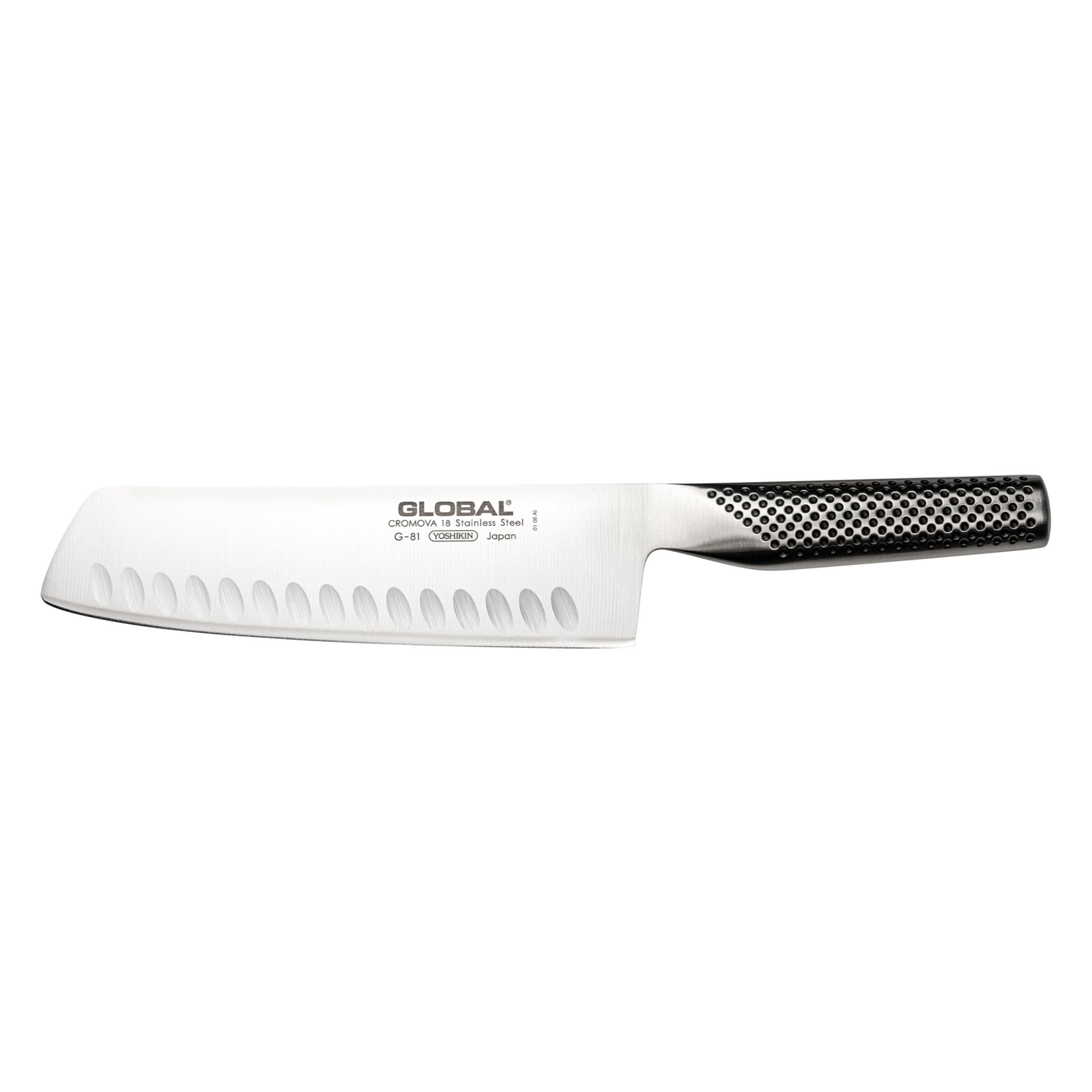
The Global Vegetable Knife defies convention by forging the handle and blade from a single piece of high-hardness stainless steel, eliminating any joint or seam where debris could collect. The 8-inch blade extends the cutting surface beyond the standard 7-inch Nakiri length, providing extra reach for slicing large cabbages, melons, and sheet-pan prep work. The hollow ground edge creates a pronounced concave bevel behind the cutting edge, reducing drag during slicing and allowing food to release cleanly.
The all-metal construction weighs just 216 grams — notably lighter than most Nakiri knives — and the dimpled handle pattern provides grip without a rubber coating or wooden scales. The handle is filled with sand during production to balance the weight profile, preventing the blade-heavy feel common in one-piece designs. The steel is hardened to approximately 56-57 HRC, prioritizing sharpness retention while maintaining enough toughness for daily use.
The straight edge maintains full board contact across its length, and the wider blade profile offers ample knuckle clearance. The hollow grind geometry means the blade tapers more aggressively toward the edge, creating a thinner cross-section that glides through dense vegetables with minimal effort.
Why it’s great
- One-piece forged steel eliminates handle gaps that trap food particles
- 8-inch blade provides extra slicing reach for large produce
- Hollow ground edge minimizes friction and sticking during cuts
Good to know
- All-metal handle can feel slippery when hands are greasy or wet
- Hollow grind requires specialized sharpening equipment to maintain profile
5. KYOKU Nakiri Knife – Shogun Series 7″
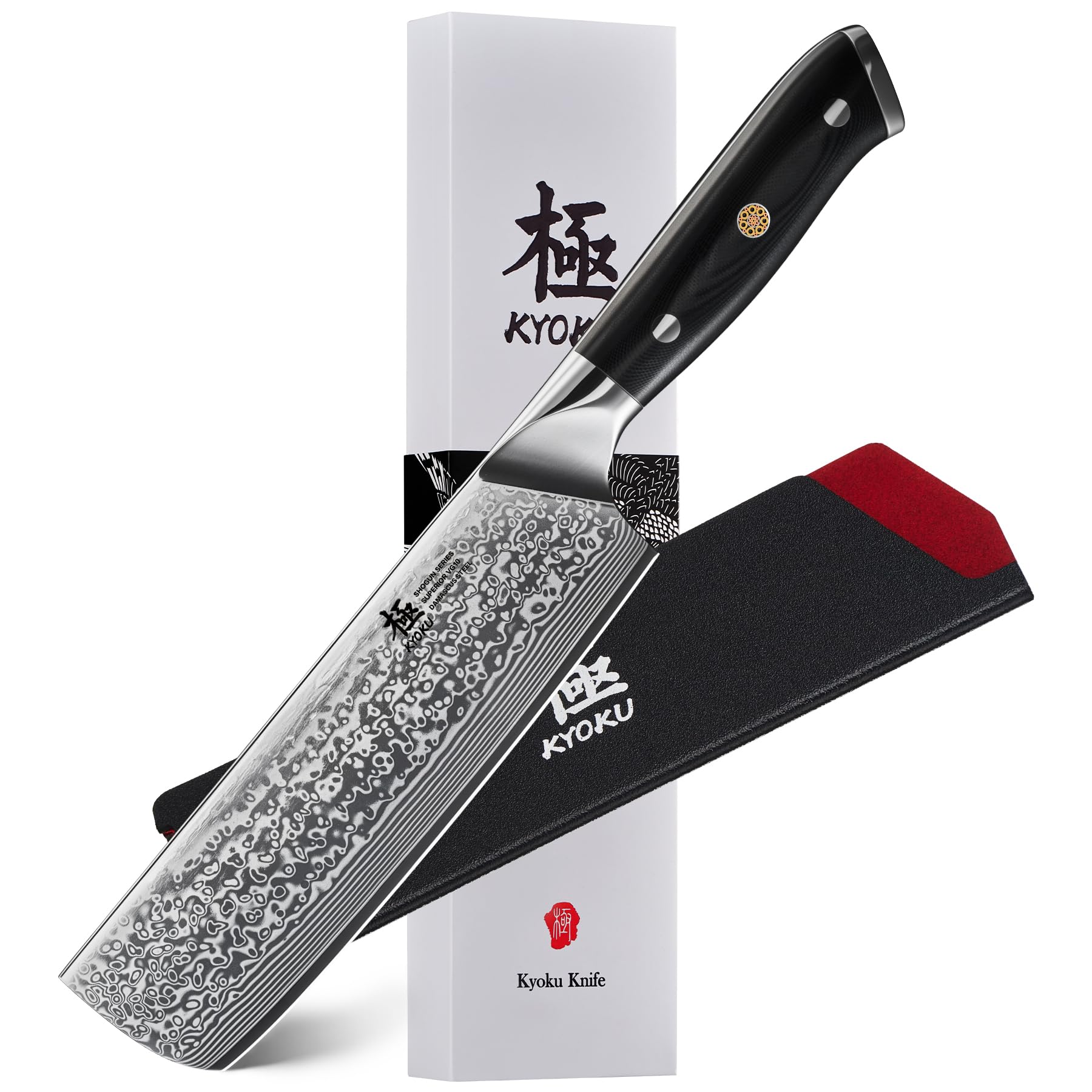
The KYOKU Shogun Series Nakiri delivers a Japanese-style blade built around a VG10 stainless steel core — widely regarded as one of the best edge-retention alloys in production cutlery. The core is clad in 67 layers of Damascus steel, creating the distinctive wave pattern while adding corrosion resistance and structural toughness. The 7-inch blade is forged with a straight edge and a tall profile, designed specifically for the push-cut motion that defines Nakiri technique.
The G10 handle provides a textured, non-slip grip that feels secure during repetitive chopping. Unlike wood handles, G10 does not absorb moisture or expand with humidity, making this knife suitable for kitchens where the blade may be used and rinsed frequently. The full-tang construction extends through the handle for balanced weight distribution, and the included sheath protects the edge during storage.
This is one of the few Nakiri knives in this review listed as dishwasher safe, though hand washing is still recommended to preserve the Damascus finish and edge geometry. The VG10 core at approximately 60 HRC holds a razor edge through extended prep sessions and requires only periodic honing between sharpenings.
Why it’s great
- VG10 steel core delivers superior edge retention for heavy vegetable prep
- 67-layer Damascus cladding provides corrosion resistance and visual appeal
- G10 handle remains stable in humid environments without swelling
Good to know
- Listed as dishwasher safe, but machine washing may dull edge and damage finish over time
- Damascus pattern is cosmetic — does not directly affect cutting performance
6. Mercer Culinary Genesis 7″ Nakiri Knife

The Mercer Culinary Genesis Nakiri proves that professional forging does not require a premium budget. The blade is precision-forged from high-carbon German steel with a taper-ground edge that widens slightly at the spine for rigidity while thinning at the cutting edge for efficiency. The steel composition targets a hardness that balances edge retention with easy resharpening — a practical choice for home cooks who may not own diamond stones.
The Santoprene handle is the standout feature at this tier. Santoprene is a thermoplastic vulcanizate that provides a rubber-like grip without the tackiness that attracts dust and debris. The handle contours fit the hand naturally in a pinch or handle grip, and the soft-touch surface prevents slipping even when wet. The blade’s straight edge maintains consistent board contact across its full length, producing even slices without the rocking motion of a curved chef’s knife.
At 7 inches, this Nakiri fits comfortably in most kitchen drawers and provides enough blade height for knuckle clearance during chopping. The forged construction and German steel composition make this a reliable daily driver for home cooks who want professional-level performance without the professional-level price.
Why it’s great
- Forged high-carbon German steel delivers professional sharpness at an accessible tier
- Santoprene handle provides superior wet-grip compared to wood or plastic handles
- Taper-ground edge balances rigidity at spine with thin cutting edge
Good to know
- Not dishwasher safe — hand washing required to preserve Santoprene and steel
- Steel hardness is lower than premium Japanese alloys, requiring more frequent honing
7. PAUDIN 7 Inch Cleaver Knife

The PAUDIN Cleaver Knife positions itself as a multipurpose blade that handles meat cleaver duties alongside vegetable slicing. The high-carbon stainless steel is hardened to 56+ Rockwell with a V-shaped edge sharpened to 16 degrees per side. While the blade thickness of 2.3 mm is notably thicker than traditional Nakiri profiles, this gives the knife structural rigidity for tasks like splitting chicken cartilage or flattening garlic cloves that would risk damaging a thinner blade.
The pakkawood handle provides a comfortable grip with a slight ergonomic contour, though it lacks the moisture resistance of synthetic handles — the manufacturer recommends hand washing and drying before storage. The included sheath protects the edge in a drawer, and the knife arrives in anexquisite box suitable for gifting. The 7-inch blade length and 2.3 mm thickness make this knife more of a hybrid between a Chinese cleaver and a Japanese Nakiri, offering versatility at the cost of the thin, nimble feel that pure Nakiri users prefer.
For beginners exploring the straight-edge cutting style without a major investment, the PAUDIN delivers functional performance. The steel sharpens easily with standard kitchen stones, and the lifetime warranty against material defects provides peace of mind for entry-level use.
Why it’s great
- Thicker 2.3 mm blade handles heavy tasks that would risk chipping a thin Nakiri
- High-carbon steel sharpens easily with standard kitchen stones
- Lifetime warranty included for material and workmanship defects
Good to know
- Blade thickness sacrifices the nimble slicing feel of traditional thin Nakiri knives
- Pakkawood handle requires careful hand drying to prevent moisture damage
FAQ
What is the ideal blade length for a Nakiri knife?
Can I sharpen a Nakiri knife on a standard whetstone?
What is the point of a straight edge on a Nakiri?
Final Thoughts: The Verdict
For most users, the best rated nakiri knife winner is the WÜSTHOF Classic 7″ Nakiri because it combines precision forging, 58 HRC German steel, and PEtec edge technology into a balanced daily driver that handles heavy vegetable prep without compromising edge retention. If you want a higher Rockwell hardness with a Japanese Damascus aesthetic, grab the HOSHANHO 7 Inch Nakiri. And for professional kitchen durability with NSF certification, nothing beats the Dalstrong Gladiator 7″ Nakiri.