Well water brings its own set of challenges—sediment, heavy metals, chlorine for shock treatment, and the constant worry about iron and sulfur odors. You need an under-sink system that handles high sediment loads without killing your flow rate, all while fitting in the limited space beneath your sink.
I’m Mohammad Maruf — the founder and writer behind AirfryerBite. I’ve spent years analyzing water filtration hardware, from sediment pre-filters to advanced reverse osmosis membranes, specifically for private well systems that demand robust contaminant reduction.
This guide breaks down the critical specs—filter micron ratings, gallon capacity, and certification types—so you can confidently choose the right under sink filter for well water that delivers clean, great-tasting water every day.
How To Choose The Best Under Sink Filter For Well Water
Well water is not treated at a municipal plant, so you carry the burden of filtering out sediment, iron, manganese, and sometimes bacteria. A standard carbon block filter alone often isn’t enough. You need a system that matches the specific contaminants in your well test results. Here are the three most important factors to consider.
Filtration Stages and Micron Rating
For well water, a multi-stage system is essential. Look for at least a sediment pre-filter (20-50 microns for large particles) followed by a fine carbon block (5-1 micron) or a 0.01-micron ultrafiltration membrane. If your water has high TDS or heavy metals, a reverse osmosis system with a 0.0001-micron RO membrane is the gold standard. Systems claiming “0.01 micron” or “0.0001 micron” precision are built for the toughest well water profiles.
Filter Lifespan and Total Capacity
Well water often contains more sediment and dissolved solids, which can clog filters faster. Check the total gallon capacity rating (e.g., 40,000 gallons or 700 gallons) and the manufacturer’s recommended replacement cycle. A longer lifespan (like 5 years or 48 months) saves you money and maintenance hassle. For heavy well sediment, consider a system with a higher-capacity pre-filter stage to extend the life of the more expensive RO membrane.
Certification and Material Safety
Certifications matter. NSF/ANSI 42 (taste and odor), NSF/ANSI 53 (health-related contaminants like lead and PFAS), and NSF/ANSI 58 (reverse osmosis systems) are the benchmarks. For well water, look for certification specifically for heavy metals (lead, arsenic, cadmium) and PFOS/PFOA reduction. Also, ensure the system is certified lead-free (NSF/ANSI 372) and uses BPA-free materials to avoid leaching chemicals into your drinking water.
Quick Comparison
On smaller screens, swipe sideways to see the full table.
| Model | Category | Best For | Key Spec | Amazon |
|---|---|---|---|---|
| iSpring RCC7AK | RO + Alkaline | Mineralized alkaline well water | 75 GPD, 6-stage, NSF 58 certified | Amazon |
| VIOMI V8 (800GPD) | Tankless RO | High-flow, PFAS reduction | 800 GPD, 9-stage, 0.0001 μm membrane | Amazon |
| VIOMI V6 (600GPD) | Tankless RO | Space-saving, 600 GPD flow | 600 GPD, 9-stage, smart LED faucet | Amazon |
| SimPure T1-400UV | RO + UV | Bacteria/virus protection | 400 GPD, 8-stage, UV sterilization | Amazon |
| Waterdrop G5P500 | Tankless RO | Compact, 2:1 pure-to-drain ratio | 500 GPD, 7-stage, 0.0001 μm membrane | Amazon |
| KRAUS Purita FS-1001 | 2-Stage Carbon | Budget-friendly sediment reduction | 700 gallon capacity, digital monitor | Amazon |
| CuZn Under Sink Filter | Inline Carbon | Simple installation, chlorine taste | 5-year filter life, inline connection | Amazon |
| Waterdrop TST-UF | Ultrafiltration | High flow, mineral retention | 0.01 μm UF membrane, 304 stainless steel | Amazon |
| ICEPURE WFS5300A-20 | Direct Connect | Maximum capacity, budget pick | 40,000 gallons, 5-year lifespan | Amazon |
In‑Depth Reviews
1. iSpring RCC7AK

The iSpring RCC7AK is a top-tier 6-stage reverse osmosis system designed for well water users who want mineralized, alkaline water. Its patented top-mounted faucet makes installation simpler than traditional under-sink RO systems. With NSF/ANSI 58 certification for the entire system, it provides verified reduction of TDS by 93-98%, lead by >98.9%, and fluoride by >97.4%.
The additional alkaline (AK) stage adds back essential minerals like calcium and magnesium, raising the pH for a smoother taste. The transparent first-stage housing lets you visually monitor sediment buildup, which is a real advantage for well water with heavy particle loads. The system delivers 75 GPD, which is adequate for a family of four, though not as fast as tankless alternatives.
This system does require a storage tank that takes up some under-sink space. The initial installation is more involved than inline filters, but iSpring provides clear instructions and lifetime support from Atlanta. For well water users who want proven contaminant reduction plus the benefit of alkaline water, this is the premium choice.
Why it’s great
- NSF 58 certified for the entire system, not just individual components
- Alkaline stage adds beneficial minerals and balances pH
- Transparent first-stage housing for easy sediment monitoring
- Lifetime technical support from a US-based company
Good to know
- Storage tank takes up under-sink space
- 75 GPD flow is slower than tankless units
- More complex installation than inline or direct-connect filters
2. VIOMI Vortex 8 (800GPD)
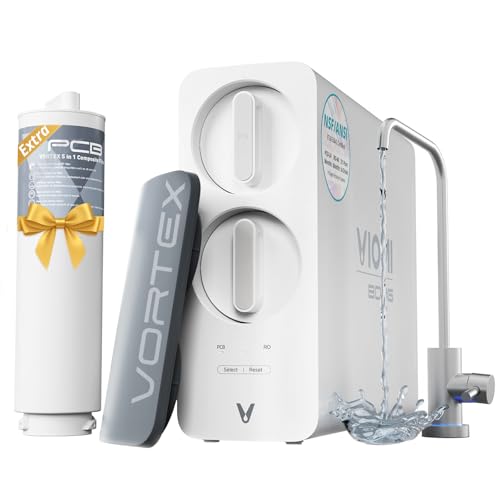
The VIOMI Vortex 8 delivers an impressive 800 GPD flow, filling a 6oz cup in just 5 seconds. This tankless RO system uses a 0.0001-micron RO membrane across 9 stages to reduce TDS up to 90.35%, with targeted PFOS reduction >99.88% and PFOA >99.6%. It’s NSF/ANSI 53, 42, and 372 certified, covering lead reduction, chlorine taste, and lead-free material safety.
The compact design measures just 16.3″D x 5″W x 12.8″H, saving up to 65% of under-sink space compared to tank-based systems. The 3:1 pure-to-drain ratio is efficient, producing 3 cups of clean water for every cup of wastewater. The smart LED faucet turns orange to remind you when filters need replacement—RO filter every 48 months and PCB filter every 24 months.
One limitation: this system works only with the included faucet and cannot connect to refrigerators or ice makers. Installation requires a dedicated electrical outlet and two drilled holes. For well water users with higher contamination levels, the 800 GPD flow and robust PFAS reduction make this a strong candidate.
Why it’s great
- 800 GPD tankless design provides instant, high-flow water
- NSF/ANSI 53, 42, and 372 certified for broad contaminant reduction
- Long filter lifespan with 48-month RO membrane
- 3:1 pure-to-drain ratio reduces water waste
Good to know
- Cannot connect to refrigerator or ice maker
- Requires dedicated electrical outlet and two holes for installation
- Countertop faucet installation needed
3. VIOMI Vortex 6 (600GPD)

The VIOMI Vortex 6 offers a 600 GPD flow with the same 9-stage filtration architecture as the Vortex 8, using a 0.0001-micron RO membrane. It’s NSF/ANSI 42, 53, and 372 certified, reducing lead, chlorine, and PFOA/PFOS at rates similar to its larger sibling. TDS reduction reaches up to 94.75%, making it suitable for well water with moderate to high dissolved solids.
This tankless system shares the compact footprint (16.3″D x 5″W x 12.8″H) that saves 65% under-sink space. The 3:1 pure-to-drain ratio is efficient, and filters last up to 48 months for the RO membrane and 24 months for the PCB filter. The smart LED faucet provides filter life reminders, turning orange when it’s time for a change.
Like the Vortex 8, it works only with the included faucet and cannot connect to other appliances. It requires a standard electrical outlet and two holes for installation. For well water users who don’t need the extreme 800 GPD flow, the Vortex 6 provides excellent performance at a slightly lower investment.
Why it’s great
- 600 GPD tankless design with fast water delivery
- High TDS reduction up to 94.75%
- NSF/ANSI certified for lead, chlorine, and PFAS reduction
- Compact design saves significant under-sink space
Good to know
- Dedicated faucet only, no refrigerator connection
- Requires electrical outlet and drilled holes
- PCB filter needs replacement every 24 months
4. SimPure T1-400UV

The SimPure T1-400UV brings UV sterilization to under-sink RO filtration, which is a major advantage for well water that may carry bacterial or viral contamination. It uses an 8-stage filtration process including a 0.0001-micron RO membrane and UV light to achieve near 0 TDS from tap water. SGS tested against NSF/ANSI 58, it removes over 99.99% of 1000+ contaminants including PFAS, lead, fluoride, and nitrates.
The tankless design delivers 400 GPD with a 1.5:1 pure-to-drain ratio, producing 1.5 gallons of clean water for every gallon of wastewater. The UV system operates automatically based on water flow, so no manual switches are needed. Filters deliver up to 1057 gallons of purified water, equivalent to around 8,000 bottled waters.
Flow rate is 0.27 GPM, which is noticeably slower than the 600-800 GPD units. Installation requires an electrical outlet and under-sink space of about 15.6″ x 5.3″ x 15.7″. For well water users concerned about bacteria or viruses, the UV stage provides an extra layer of safety that standard RO systems lack.
Why it’s great
- UV sterilization for bacteria and virus protection
- SGS tested to NSF/ANSI 58 for broad contaminant removal
- Achieves near 0 TDS from well water
- 1.5:1 pure-to-drain ratio minimizes wastewater
Good to know
- Flow rate (0.27 GPM) is slower than higher-GPD units
- Requires electrical outlet for UV and pump
- Relatively compact but still takes cabinet space
5. Waterdrop G5P500

The Waterdrop G5P500 is a 7-stage tankless RO system with a 500 GPD capacity, delivering a 6-oz cup in just 8 seconds. It features a 0.0001-micron RO membrane and is NSF/ANSI 58 and 372 certified. The system reduces PFOA, PFOS, chlorine, lead, fluoride, and heavy metals, making it a solid choice for well water with mixed contaminants.
One standout feature is the 2:1 pure-to-drain ratio, producing 400% more pure water than traditional RO systems and reducing water waste significantly. The tankless design saves up to 70% under-sink space compared to tanked units. It also supports connection to ice makers and refrigerators via the Waterdrop XT kit, offering more flexibility than many tankless competitors.
The system measures 5.69″L x 16.69″W x 13.9″H, so it’s relatively wide but shallow. Installation requires a dedicated electrical outlet and countertop drilling for the faucet. For well water users who want a balance of flow rate, contaminant reduction, and appliance connectivity, the G5P500 is a versatile mid-range option.
Why it’s great
- 2:1 pure-to-drain ratio reduces water waste
- Can connect to refrigerator and ice maker (with XT kit)
- 7-stage filtration with 0.0001-micron RO membrane
- Compact tankless design saves under-sink space
Good to know
- Requires electrical outlet for pump
- Faucet installation needs countertop drilling
- XT kit for refrigerator connection sold separately
6. KRAUS Purita FS-1001

The KRAUS Purita FS-1001 is a 2-stage under-sink filtration system designed for well water with moderate sediment and taste/odor concerns. It uses a polypropylene sediment filter to reduce larger particles and a compressed carbon block filter to target nanoparticles and improve taste. The digital display monitor tracks filter life, taking the guesswork out of replacement timing.
Each set of cartridges filters up to 700 gallons and lasts about 6 months. The filter housing is made from 100% recycled ocean-bound plastic, giving it an eco-friendly edge. Installation is straightforward with a twist-and-lock cartridge mechanism that doesn’t require disconnecting hoses or water lines.
This system does not use RO technology, so it will not reduce TDS, fluoride, or dissolved heavy metals effectively. It’s best used as a sediment and taste pre-filter for well water that has already been softened or treated. The compact dimensions (9.5″L x 4.88″W x 15.5″H) make it easy to fit in tight under-sink spaces.
Why it’s great
- Digital display monitor for filter life tracking
- Easy twist-and-lock cartridge replacement
- Compact size fits most under-sink cabinets
- Eco-friendly housing from recycled ocean-bound plastic
Good to know
- Does not reduce TDS, fluoride, or dissolved heavy metals
- 700-gallon capacity is lower than some competitors
- Best used as a pre-filter with additional treatment
7. CuZn Under Sink Water Filter
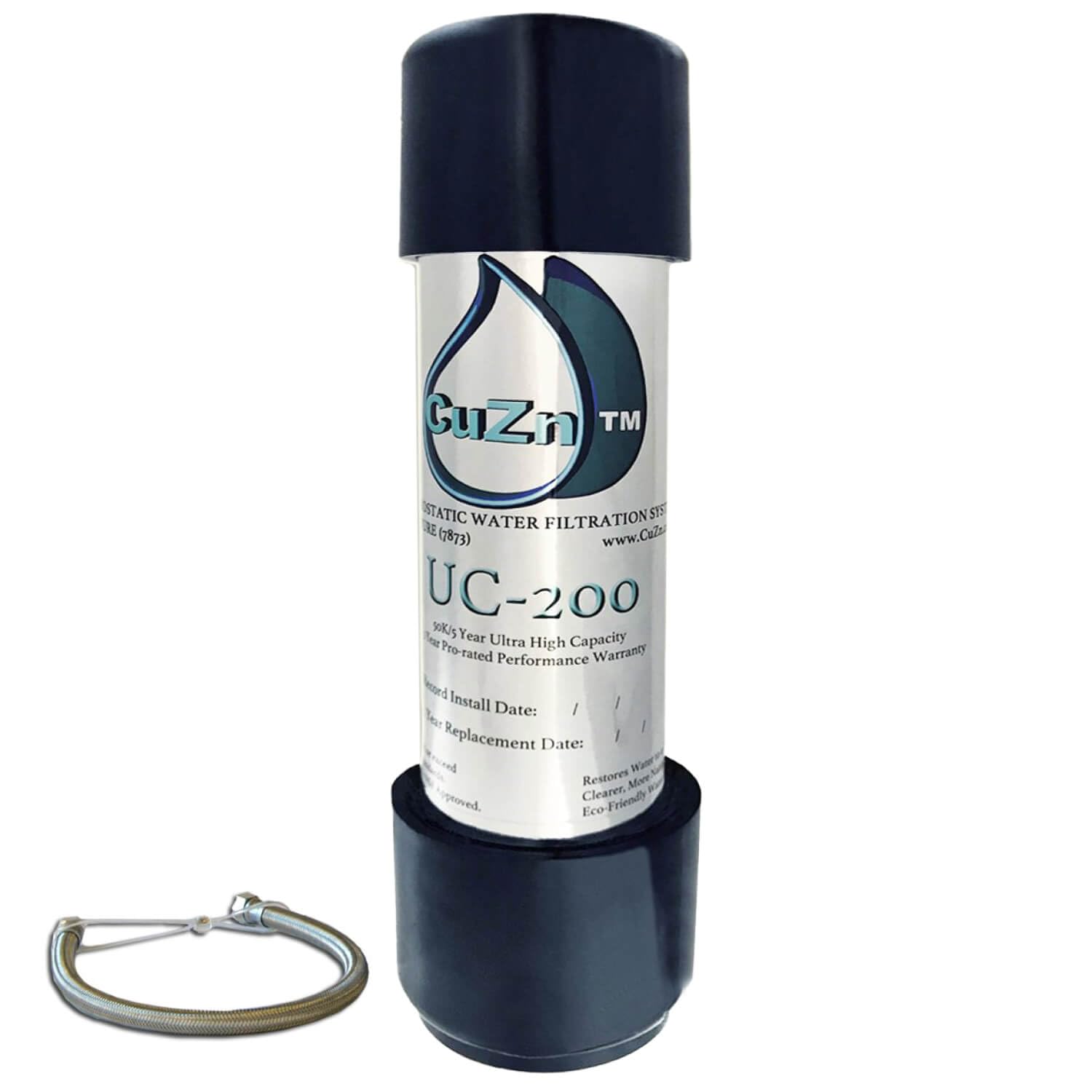
The CuZn Under Sink Water Filter uses a direct inline connection that fits standard 1/2″ or 3/8″ cold water lines without needing a dedicated faucet. It’s NSF/ANSI 42 and 372 certified, reducing chlorine, taste, and odor while ensuring lead-free materials. The manufacturer claims a 5-year filter life, making it one of the longest-lasting options available.
This filter uses a copper-zinc media blend to reduce chlorine and heavy metals, along with a coconut shell carbon block for taste improvement. The inline design means it feeds directly into your existing faucet, so no countertop drilling or new faucet installation is needed. This makes it ideal for well water users who want a simple, low-maintenance setup.
The system is best suited for well water that has already been treated for sediment and bacteria. It won’t reduce TDS or provide the comprehensive filtration of an RO system. Its strength lies in quick installation and long-lasting filter life without the complexity of multi-stage or tankless RO systems.
Why it’s great
- Very simple inline installation with existing faucet
- 5-year filter life reduces maintenance frequency
- NSF/ANSI 42 and 372 certified
- No countertop drilling or new faucet needed
Good to know
- Does not reduce TDS or dissolved heavy metals
- Requires pre-treated well water for best results
- Copper-zinc media may not suit all water chemistries
8. Waterdrop TST-UF

The Waterdrop TST-UF uses a 0.01-micron ultrafiltration (UF) membrane housed in a lead-free 304 stainless steel body. This system is designed to reduce chlorine, heavy metals, odors, and substances larger than 0.01 microns while retaining beneficial minerals like potassium, calcium, and magnesium. It delivers a high flow rate of 1.59 GPM, filling an 8-oz cup in just 2.3 seconds.
The UF membrane lasts 12-24 months, while the PP pre-filter and CT filter have shorter replacement cycles. The system can be installed on the cabinet wall or placed on the floor, offering flexibility for tight spaces. Installation requires a 1/2″ or 3/8″ Female NPT thread faucet and does not need drilling.
This system does NOT reduce TDS and is explicitly not recommended for well water by the manufacturer. It’s designed for municipal tap water where the main concerns are chlorine, taste, and sediment. For well water users, this system should only be considered if you have already installed a separate sediment pre-filter and water softener.
Why it’s great
- High flow rate (1.59 GPM) for fast water dispensing
- Stainless steel 304 housing is durable and lead-free
- Retains beneficial minerals while reducing contaminants
- Multiple installation options (wall or floor)
Good to know
- Not designed for well water per manufacturer
- Does not reduce TDS
- Requires pre-filter for high-sediment well water
9. ICEPURE WFS5300A-20

The ICEPURE WFS5300A-20 is a direct-connect under-sink water filter with an extraordinary 40,000-gallon capacity and 5-year lifespan. It uses a 0.5-micron coconut shell carbon block to reduce heavy metals, chlorine, sediment, rust, and odors while retaining beneficial minerals. The system is NSF/ANSI 42 and 372 certified for material safety and contaminant reduction.
Installation is straightforward—the plug-and-play design takes about 3 minutes with no professional help needed. It connects directly to your existing faucet using 1/2″ or 3/8″ Female NPT threads. The flow rate is tested at 2.5 GPM at 60 PSI, which is excellent for an under-sink filter. The unit is tall at 21.1 inches, so measure your under-sink space carefully before purchasing.
This is a single-stage carbon block filter, not an RO system. It won’t reduce TDS, fluoride, or nitrates. For well water with high sediment, you’ll likely need a separate sediment pre-filter to prevent premature clogging. Its best use case is as a high-capacity taste and sediment filter for well water that has been softened or pre-filtered.
Why it’s great
- Massive 40,000-gallon capacity with 5-year life
- High flow rate at 2.5 GPM
- Very easy 3-minute installation
- NSF/ANSI 42 and 372 certified
Good to know
- Does not reduce TDS or fluoride
- Tall housing (21.1 inches) requires adequate cabinet height
- Best suited as a pre-filter for treated well water
FAQ
Can I use a standard under-sink filter directly with well water?
What is the difference between ultrafiltration and reverse osmosis for well water?
Do I need a water softener before an under-sink filter for well water?
Final Thoughts: The Verdict
For most users, the under sink filter for well water winner is the iSpring RCC7AK because it combines NSF 58 certification, a 6-stage RO process, and an alkaline stage that adds beneficial minerals—all backed by lifetime support. If you want instant high-flow water with PFAS reduction, grab the VIOMI Vortex 8. And for well water with potential bacterial issues, nothing beats the SimPure T1-400UV with its UV sterilization stage.