A manual meat slicer isn’t a retreat to the past — it’s a tactical choice for anyone who wants thin, uniform slices of fresh beef or jerky without the noise, cleaning hassle, or counter-hogging footprint of a motorized unit. The best models lock the blade angle, brace the product, and let your arm do the work with mechanical advantage that makes short work of a whole brisket or batch of bacon.
I’m Mohammad Maruf — the founder and writer behind AirfryerBite. I’ve spent years digging into the hardware specs of kitchen gear, from blade steel composition to frame rigidity, to find which manual slicers actually hold up to weekly use without frustrating you.
Whether you’re a home jerky maker looking for uniform strips or a busy cook who wants to portion raw meat efficiently, this guide unpacks the real differences in blade material, base stability, and thickness control to help you find the best manual meat slicer for your kitchen.
How To Choose The Best Manual Meat Slicer
When you remove the motor from the equation, everything comes down to edge geometry, frame rigidity, and how the machine fixes the meat in place. Here are the three specs that separate a slicer that works from one that collects dust after two uses.
Blade Material and Edge Retention
The blade is the heart of any manual slicer. Lower-tier models use 420 stainless steel — it resists rust well but needs more frequent sharpening to maintain that 8° edge. Mid-range slicers often switch to 3Cr14 stainless, which holds a keen edge longer and handles harder foods like hard cheese or dense root vegetables without chipping. For heavy jerky or biltong work, a blade that can be sharpened with an integrated sharpener is a massive time-saver.
Adjustable Thickness and Multi-Blade Configurations
Most manual slicers offer two fixed thickness settings — typically 2 mm and 4 mm. Some designs use a set of 17 blades to cut 18 slices in a single pass, which is ideal for meal prepping large batches of stir-fry meat or jerky strips. Others rely on a single long blade and a sliding carriage, giving you infinite variability between thin and thick. Consider how often you slice uniform strips versus irregular chunks when choosing between a multi-blade press and a guided-sled design.
Base Stability and Anchoring System
A slicer that slides across the counter is dangerous. Premium units use a large suction cup or heavy rubberwood base to lock the unit down on smooth surfaces. Some add a secondary grip handle on the side for extra leverage. If your countertops are textured or uneven, look for a model with screw-clamp or rubber feet that bite into the surface without slipping.
Quick Comparison
On smaller screens, swipe sideways to see the full table.
| Model | Category | Best For | Key Spec | Amazon |
|---|---|---|---|---|
| Weston Manual Jerky Slicer | Premium | Heavy jerky & biltong batches | Aluminum frame; 5″ wide cut | Amazon |
| Paladin 2-in-1 Tenderizer | Premium | Tenderizing & cubing in one pass | Aluminum body; dual blade sets | Amazon |
| Huanyu Manual Grinder | Premium | Grinding fresh meat & sausage | Stainless steel body; hand crank | Amazon |
| Radiused Biltong Slicer | Mid-Range | Biltong & delicate meat slicing | Magnetic tray; 10″ blade | Amazon |
| Meat Slicer Stainless Board | Mid-Range | Carving & slicing on one board | 10″ carving knife included | Amazon |
| Moongiantgo Biltong Slicer | Mid-Range | Jerky, bacon, hard vegetables | 3Cr14 blade; built-in sharpener | Amazon |
| ZTQCSQ Steady Grip Slicer | Budget | Batch slicing fresh meat for meal prep | 17 blades; 2/4mm adjustable | Amazon |
In‑Depth Reviews
1. Weston Manual Support Beef Jerky Slicer (07-3801-W-A)

The Weston Manual Jerky Slicer is built like a commercial tool: a charcoal-gray aluminum frame that doesn’t flex, paired with stainless steel blades that slice meat up to 5 inches wide and 1.25 inches thick. The sliding carriage glides on smooth rails, giving you consistent thickness across a whole batch of biltong or jerky. It uses a simple lever to advance the meat, so you don’t need to push the blade by hand — the mechanical advantage does the work. This is the most capable manual slicer for anyone who processes whole muscle cuts regularly.
The base is heavy enough to stay planted on a stainless steel counter without suction cups, and the entire unit disassembles without tools for cleaning. The blade is easily removable for sharpening, and Weston sells replacement parts if you ever need them. Because it’s a guided-sled design rather than a multi-blade press, you get infinite thickness adjustment rather than a fixed 2 mm or 4 mm choice.
If you’re making jerky in serious volume or want a slicer that feels like it belongs in a butcher shop, the Weston delivers. Its price point reflects the build quality — this is not a gadget you’ll outgrow in a year.
Why it’s great
- Rigid aluminum chassis eliminates blade chatter
- Accepts meat up to 5″ wide, ideal for brisket flats
- Disassembles for deep cleaning without tools
Good to know
- Requires counter space; not a tuck-away gadget
- Higher price bracket among manual slicers
2. Paladin Equipment 2-in-1 Meat Tenderizer

The Paladin 2-in-1 is a hybrid tool that both tenderizes and slices, making it a space-saving option for cooks who regularly prep chicken breast, beef cube steak, or pork cutlets. Its heavy-duty aluminum construction houses two sets of interchangeable stainless steel blades — one for tenderizing (breaking down fibers) and one for cubing or slicing uniform strips. The hand crank operates with a smooth gear mechanism, so you don’t have to muscle through tough sinew.
Because it’s a crank-fed design rather than a press, you can process continuous strips of meat without stopping to reload. The whole unit clamps to the counter via suction feet, and the blades are removable for rinsing. The aluminum body resists corrosion and adds enough heft to keep the machine from walking across the counter during use.
This is a premium pick for anyone who wants a single tool that handles both tenderizing and slicing. It doesn’t do paper-thin deli slices — it’s built for jerky strips, schnitzel-thin cutlets, and cubed stew meat. If that matches your workflow, it’s a rugged addition to the kitchen.
Why it’s great
- Two blade sets for tenderizing and slicing
- Smooth hand crank reduces arm fatigue
- Aluminum frame stays planted on the counter
Good to know
- Not designed for thin deli-style slices
- Blade changes require a few extra minutes
3. Huanyu Manual Meat Grinder
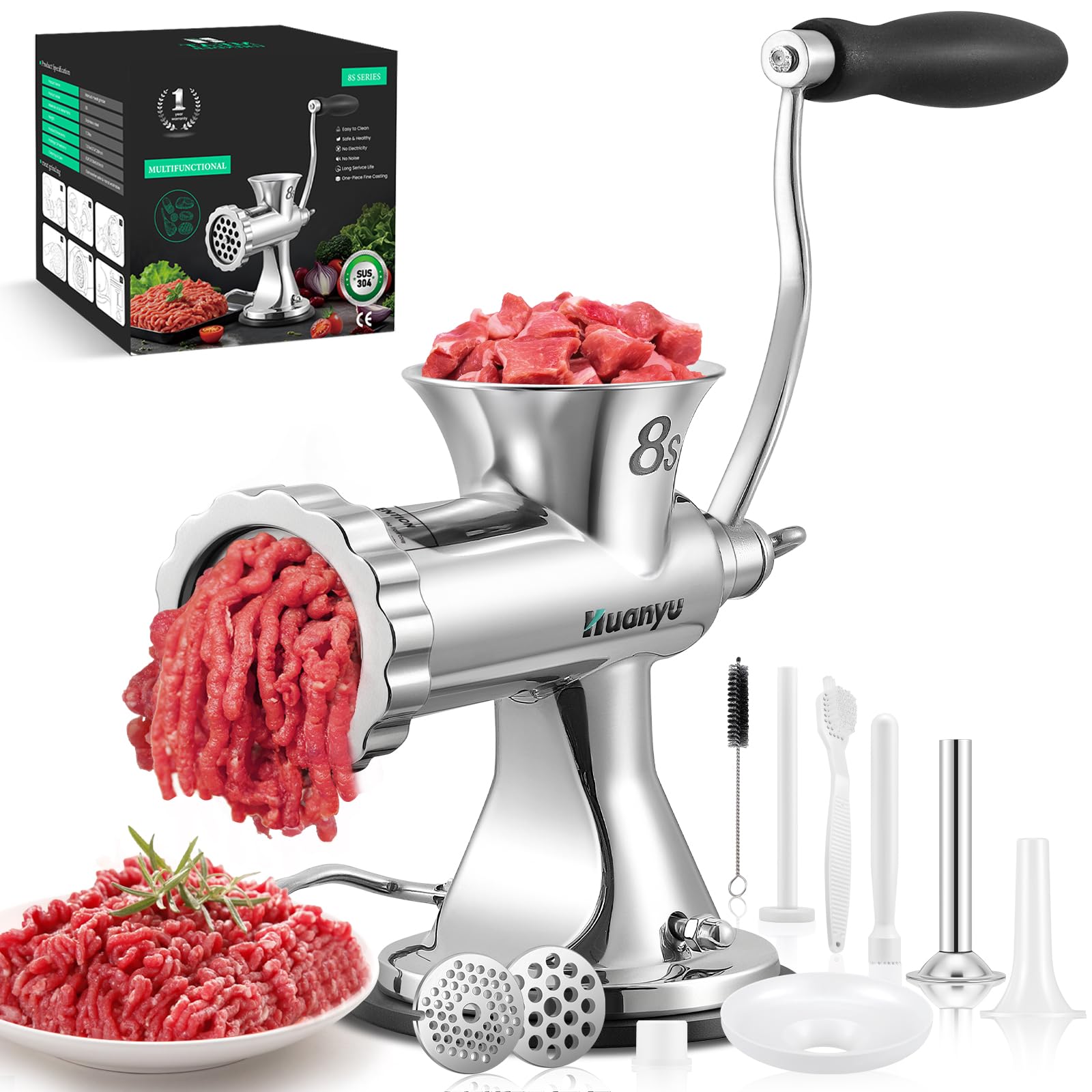
The Huanyu Manual Grinder is a different kind of tool — it grinds fresh meat rather than slicing it — but it earns its place on this list for anyone who wants to control both grind and slice in a manual workflow. The heavy-duty stainless steel body and hand crank let you process whole cuts of beef, pork, or poultry into ground meat for sausages, burgers, or pet food without relying on an electric motor. The grinding plate and blade are made from hardened stainless steel and are fully dishwasher safe.
The suction base holds the grinder firmly on smooth surfaces, and the wide hopper accommodates large chunks of meat without pre-cutting into tiny cubes. Because it’s fully manual, you control the feed rate and get consistent grind texture every time. The unit disassembles completely for cleaning, and all food-contact parts are corrosion-resistant.
If your manual meat prep involves both slicing whole muscles and grinding trimmings, this grinder fills the gap that a pure slicer cannot. It is not a jerky slicer — it is a grinder — but paired with a good manual slicer, it gives you a complete manual meat processing setup.
Why it’s great
- Stainless steel grinding head resists corrosion
- Suction base keeps the unit stable during cranking
- Fully dishwasher-safe for easy cleanup
Good to know
- Not a slicer — for grinding only
- Hand crank requires some upper-body effort for large batches
4. Radiused Biltong Slicer with Magnetic Tray

The Radiused Biltong Slicer takes a different approach: it combines a long, sharp stainless steel blade with a detachable magnetic tray that catches slices as they fall, keeping your work surface clean. The 10-inch blade glides through dried biltong and jerky with minimal resistance, and the radiused edge reduces drag so you can make long, continuous strokes without tearing the meat. The magnetic tray attaches via strong magnets and lifts off for easy transfer of sliced meat to a storage bag or serving plate.
The base is made from solid rubberwood, which provides a stable cutting surface without suction cups. The wood is finely ground and treated to resist absorbing moisture and odors from meat. Because the blade is fully removable, you can sharpen it on a stone or steel, and the magnetic tray makes cleanup faster than a fixed-board design.
This is a specialized tool for biltong and jerky enthusiasts who want precise, even slices from dried meat. If your main use case is slicing wet raw meat, the open board design works well but may need more frequent wiping. For dried meat, it’s an ergonomic upgrade over a standard chef’s knife.
Why it’s great
- Magnetic tray catches slices cleanly
- 10″ radiused blade for smooth strokes
- Solid rubberwood base resists slipping
Good to know
- Best for dried meat, not raw or wet
- Blade is long but thin — handle with care
5. Meat Slicer Stainless Steel Cutting Board Set

This set bundles a 10-inch stainless steel carving knife with a dedicated cutting board designed for meat slicing. The knife blade is made from high-carbon stainless steel with a fine edge that holds up well through whole briskets, roasts, and jerky blocks. The board features a juice groove and a non-slip rim to keep it from sliding on the counter. It’s a straightforward system: you get a professional-grade knife and a board that’s purpose-built for slicing rather than a press-style slicer.
The advantage of this approach is flexibility — you can slice any thickness you want, at any angle, without being limited by a fixed blade gap or press width. The knife can be sharpened with any standard steel or stone, and the board is made from a material that resists warping and knife scarring better than typical plastic boards.
If you prefer the control of a freehand knife over a guided slicer, this set gives you quality components at a mid-range price. It doesn’t offer the speed of a multi-blade press, but for cooks who value precision and don’t mind a little technique, it’s a solid pick.
Why it’s great
- High-carbon stainless steel knife holds a keen edge
- Juice groove and non-slip board design
- Full thickness control with freehand slicing
Good to know
- Slower than guided slicers for large batches
- Requires knife skills for consistent slices
6. Moongiantgo Biltong Slicer Jerky Cutter
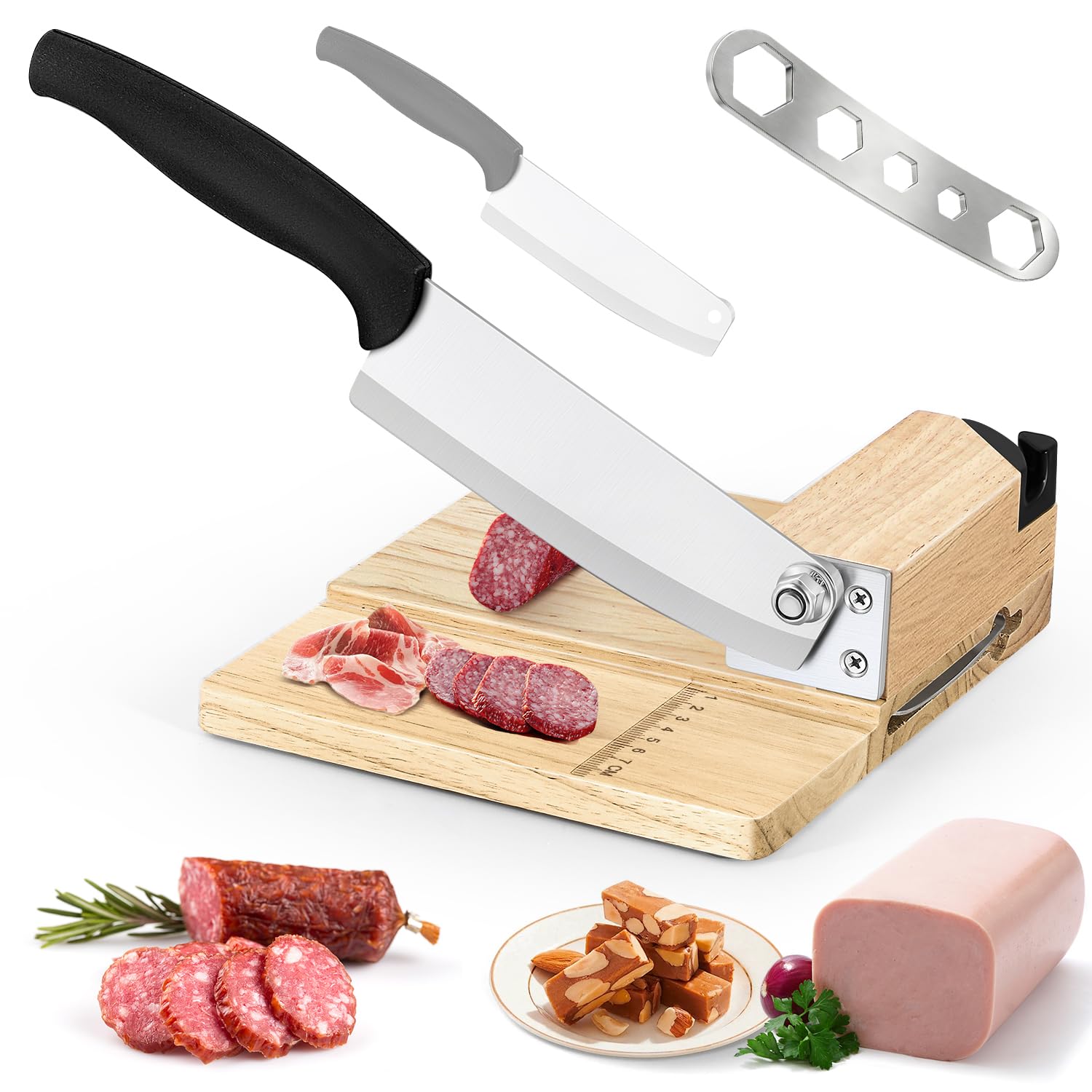
The Moongiantgo Biltong Slicer uses a 3Cr14 stainless steel blade that offers better edge retention than the 420 steel found on many budget models, and it includes a built-in knife sharpener that also works on other straight-edge blades. The rubberwood base is smooth and non-stick, which helps when slicing sticky foods like nougat, dried fruit, or aged cheese. The blade is detachable using the included small wrench, turning the unit into a standalone cutting board and knife for easy cleaning or separate use.
This slicer is versatile beyond just biltong — it handles jerky, bacon, cooked deli meats, hard vegetables like carrots and cucumbers, and even herbs or ginseng. The solid wood base doesn’t rely on suction cups, so it works on textured counters where suction fails. The 3Cr14 blade is corrosion-resistant and takes a fine edge, and the sharpener lets you maintain that edge without buying extra equipment.
For the price, you get a durable blade, a practical sharpener, and a wood base that feels premium. If you want a single slicer that covers jerky, deli, and vegetable duty without breaking into the premium tier, this is the sweet spot.
Why it’s great
- 3Cr14 steel blade with built-in sharpener
- Rubberwood base resists sticking and slipping
- Detachable knife and board for separate use
Good to know
- Blade is 6.5 inches — shorter than premium models
- Not ideal for large whole cuts wider than the blade
7. ZTQCSQ Steady Grip Manual Meat Slicer
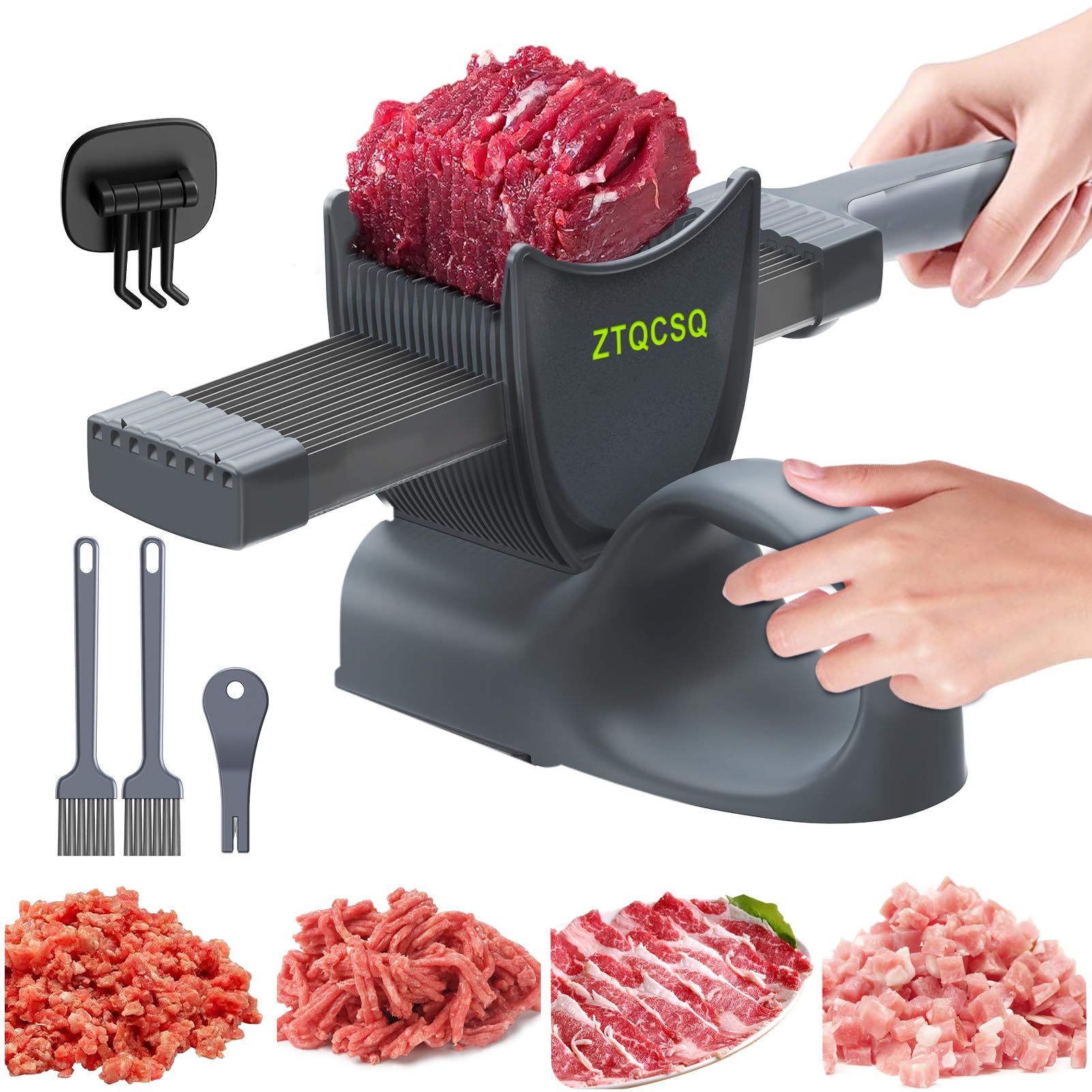
The ZTQCSQ slicer is a multi-blade press that cuts 18 slices in a single push, making it the fastest option on this list for batch-slicing fresh, boneless meat. It uses 17 individual 420 stainless steel blades set at a sharp 8° angle, and you can switch between 2 mm and 4 mm slice thickness by swapping blade sets. The container base has a large suction cup and an additional steady grip handle to keep the unit from sliding while you press down on the armrest.
This design is purpose-built for fresh meat only — the manufacturer explicitly warns against using it with Spam, frozen meat, cooked meat, or bone-in cuts. The blades are dishwasher safe, but the ABS base is not recommended for high-temperature dishwasher cycles, as it can warp and cause misalignment. Cleaning the blades requires a stiff brush rather than a cloth to avoid cuts.
For under , this slicer delivers remarkable speed for weekly meal prep — slicing a whole chicken breast into uniform strips takes seconds. The trade-offs are the fixed thickness settings and the limitation to fresh meat only. If your routine is all about fresh raw protein, this is an efficient budget entry.
Why it’s great
- 18 slices per press for fast batch prep
- Adjustable 2 mm or 4 mm thickness
- Suction cup and grip handle for stability
Good to know
- Only for fresh, boneless meat — no frozen or cooked
- ABS base may warp in high-heat dishwasher
FAQ
Can I slice frozen meat with a manual meat slicer?
How do I clean the blades on a multi-blade press slicer?
Final Thoughts: The Verdict
For most users, the best manual meat slicer winner is the Weston Manual Jerky Slicer because its aluminum frame and guided sled deliver consistent, controllable slices for years without binding or flexing. If you want the versatility of a tool that tenderizes and slices in one, grab the Paladin 2-in-1. And for budget-friendly batch prep of fresh meat, nothing beats the ZTQCSQ Steady Grip for sheer speed per dollar.