Making fresh pasta at home transforms a simple weeknight dinner into a culinary experience. The whir of a motor or the steady crank of a handle, the scent of flour and eggs, and the satisfaction of cutting your own fettuccine or spaghetti are unmatched by any boxed variety. But the path to that perfect al dente bite starts with the right machine.
I’m Mohammad Maruf — the founder and writer behind AirfryerBite. I’ve spent years analyzing the internal gearing, roller tolerances, and motor torque of dozens of pasta makers to understand what separates a machine that clogs from one that delivers silky sheets every time.
Whether you’re a seasoned home cook or a curious beginner, finding the right pasta maker requires understanding the trade-offs between manual precision, attachment convenience, and fully automatic extrusion.
How To Choose The Best Pasta Maker
The pasta maker market splits into two primary design philosophies: manual roller/cutter machines and automatic extruder models. Your choice depends on how much physical effort you want to invest, how many portions you typically cook, and whether you value texture control over shape variety.
Manual vs. Electric: Understanding the Workflow
Manual machines, like the classic hand-crank models from Italy, force you to pass dough through rollers repeatedly, gradually reducing the thickness. This process gives you direct tactile feedback on dough hydration and elasticity. Electric extruders, by contrast, mix and push dough through a die in one automated step — faster but with less control over gluten development. If you enjoy the ritual of pasta making and want silky lasagna sheets, go manual. If you want 8 portions of spaghetti in 10 minutes with minimal hands-on time, an electric extruder is your best friend.
Roller Materials and Thickness Settings
The heart of any sheeting pasta maker is the roller pair. Stainless steel rollers resist corrosion and maintain their surface finish for years, while chrome-plated steel offers a similar feel at a slightly lower cost. Pay attention to the number of thickness settings — 8 or 10 incremental positions allow you to fine-tune dough from thick sheets for ravioli down to paper-thin layers for lasagna. Machines with a wider roller (about 6 inches) accept larger dough pieces, reducing the number of passes needed.
Motor Power in Electric Models
For electric pasta makers, motor wattage directly correlates with consistency. A low-wattage motor (under 100W) often stalls with stiff dough or requires you to add extra water, compromising texture. Premium models like the Philips 7000 series deploy a 150W motor with planetary mixing to evenly hydrate flour without hot spots. If you plan to make gluten-free or whole-wheat pasta, which requires more torque to extrude, a higher wattage motor is non-negotiable.
Quick Comparison
On smaller screens, swipe sideways to see the full table.
| Model | Category | Best For | Key Spec | Amazon |
|---|---|---|---|---|
| Philips 7000 Series | Electric Extruder | Automatic batch cooking | 150W motor, 8 discs | Amazon |
| MARCATO Atlas 150 Classic | Manual Roller | Texture-focused sheeting | 10 thickness positions | Amazon |
| MARCATO PASTASET Gift Set | Manual Set | All-in-one shape variety | 5 shapes included | Amazon |
| KitchenAid KPSA Roller | Mixer Attachment | Stand mixer owners | 6‑inch wide sheets | Amazon |
| Imperia 190 Manual | Manual Roller | Entry-level manual | Alloy steel body | Amazon |
| NEWSETS 3-in-1 Attachment | Mixer Attachment | Budget 3‑in‑1 set | 8 thickness settings | Amazon |
| ZACME 3-Piece Attachment | Mixer Attachment | Stainless cutters | Food-grade stainless | Amazon |
In‑Depth Reviews
1. Philips 7000 Series Pasta Maker (HR2660/03)

The Philips 7000 Series redefines what an automatic pasta maker can do. Its 150W ProExtrude motor, combined with Perfect Mixing Technology, hydrates flour evenly and extrudes dough through one of eight included discs in under 10 minutes. The machine produces up to 8 portions per batch, making it ideal for families or meal-preppers who want fresh pasta without babysitting the process.
Durability is addressed through dishwasher-safe parts and a non-stick coating on the mixing chamber that resists dough buildup. The HomeID app provides step-by-step recipes for vegan, gluten-free, and egg-free pasta, expanding your options beyond traditional semolina. The unit weighs 20 pounds, so it occupies permanent counter space rather than being stored away.
On the downside, the extruder design limits you to shapes defined by the discs — you cannot roll sheets for lasagna or ravioli. The plastic internal housing also means the machine should not be run with extremely dry or stiff dough that could strain the motor gearbox. For pure speed and convenience, however, this is the most capable electric option on the market.
Why it’s great
- 150W motor handles stiff gluten-free dough without stalling
- Dishwasher-safe parts simplify cleanup
- Mixes and extrudes in one seamless cycle under 10 minutes
Good to know
- Cannot produce flat sheets for lasagna or ravioli
- Heavy 20-pound footprint requires dedicated counter space
2. MARCATO Atlas 150 Classic Manual Pasta Maker

The MARCATO Atlas 150 is a benchmark for manual pasta machines. Made in Italy from chrome-plated steel, it features a 10-position adjustment knob that lets you roll dough from 4.8 mm down to a translucent thinness. The hand crank provides direct feedback, allowing you to feel when the dough has been sheeted enough times for optimal gluten alignment.
This model excels at producing lasagna sheets and fettuccine or tagliolini when paired with the optional cutting attachments. The included clamp secures firmly to any countertop up to 2 inches thick, and the resin scrapers naturally clean the rollers during use — no water needed. At 2.6 kg, the machine feels substantial without being immovable.
One limitation is that the Atlas 150 ships as a standalone roller; cutters are sold separately. If you plan to make multiple pasta shapes regularly, the initial investment plus accessory costs can add up. The manual operation also requires both hands and a bit of rhythm, which may not appeal to everyone.
Why it’s great
- 10 precise thickness settings for uniform sheets
- Chrome-plated steel resists corrosion and stays smooth
- Resin scrapers self-clean rollers during operation
Good to know
- Cutting attachments sold separately
- Requires two hands and a stable counter clamp
3. MARCATO PASTASET Gift Set

The MARCATO PASTASET bundles the Atlas 150 machine with dedicated spaghetti and ravioli attachments, creating the most complete manual system available. Right out of the box you can produce lasagna sheets, fettuccine, tagliolini, spaghetti, and ravioli — five shapes without buying any extra accessories. The ravioli attachment alone justifies the set for anyone who loves stuffed pasta.
Build quality mirrors the standalone Atlas 150: chrome-plated steel rollers, aluminum cutter blades, and a 10-position thickness dial. The included handcrank and counter clamp match the fit and finish of the main unit. The overall weight of 4.6 kg reflects the additional metal components, and the set stores neatly in its original packaging.
The trade-off is that this set represents a premium investment for a manual machine. If you only eat spaghetti and fettuccine, the basic Atlas 150 plus one cutter would be more economical. The ravioli attachment also requires some practice to avoid tearing the dough during stamping.
Why it’s great
- Five pasta shapes from one integrated set
- Ravioli attachment included for stuffed pasta
- All components Made in Italy with durable chrome steel
Good to know
- Premium price for a manual system
- Ravioli attachment has a learning curve
4. KitchenAid KPSA Stand-Mixer Pasta-Roller Attachment

For existing KitchenAid stand mixer owners, the KPSA roller attachment leverages the mixer’s motor to drive the rollers, eliminating the need for hand cranking. The metal construction produces 6-inch-wide sheets that are perfectly sized for the KitchenAid pasta cutter attachments. The thickness adjustment dial on the side offers fine control from thick to thin, and the rollers are engineered to KitchenAid’s internal tolerances for consistent alignment.
Because the mixer provides the power, the roller runs at a consistent speed without the variable pace of a manual crank. This makes it easier to produce long, unbroken sheets for lasagna or cannelloni. The attachment attaches and detaches in seconds via the mixer’s power hub, and it stores in a relatively small footprint.
The catch is that this is a roller-only attachment — you still need the separate cutter attachments for spaghetti or fettuccine. The KPSA has been discontinued, so availability depends on remaining stock or third-party sellers. Hand washing is recommended, and the roller should be dried immediately to prevent any moisture damage to the metal gears.
Why it’s great
- Leverages mixer motor for hands-free rolling
- Sturdy metal gears aligned to KitchenAid specs
- Creates wide 6-inch sheets ideal for lasagna
Good to know
- Roller only; cutters sold separately
- Discontinued model, limited availability
5. Imperia Pasta Maker Machine Model 190

The Imperia Model 190 is a no-nonsense manual pasta maker built from heavy-duty alloy steel with a wood grip handle. The easy-lock dial secures the machine to your countertop, and the rollers produce uniform sheets for lasagna that can then be hand-cut or run through optional cutters. This is one of the most affordable ways to enter the world of fresh pasta without relying on a mixer or electricity.
The machine weighs just 1 pound, making it highly portable. The wood handle provides a comfortable grip even after repetitive cranking, and the lack of plastic components means the body will not warp or crack over time. The included recipe book offers basic dough ratios to get you started.
Because the budget-focused design uses alloy steel rather than chrome or stainless, the rollers may be more susceptible to surface wear over years of frequent use. The cutting attachments are also sold separately, and the narrow roller width means you will need to divide dough into smaller pieces before sheeting.
Why it’s great
- Alloy steel body with comfortable wood handle
- Ultra-light at 1 lb, easy to store or transport
- Affordable entry point for manual pasta making
Good to know
- Alloy steel rollers less corrosion-resistant than chrome
- Cutting attachments not included
6. NEWSETS 3-in-1 Pasta Maker Attachment for KitchenAid

The NEWSETS 3-in-1 attachment combines a pasta roller, fettuccine cutter, and spaghetti cutter into one package that mounts directly to any KitchenAid stand mixer. The stainless steel blades and precision gears produce clean cuts, and the 8-position thickness knob lets you dial in settings from 0.01 inches up to 0.1 inches. A cleaning brush is included to clear dough residue from the cutters.
The all-in-one design eliminates the need to swap attachments mid-project. After rolling the dough sheet, you simply press it through the integrated cutters. The power from the KitchenAid motor ensures consistent rolling speed, and the white plastic housing keeps the weight manageable at 1.6 kg.
The plastic housing and non-stainless internal components mean this attachment is not dishwasher safe and should not be soaked. Long soaks can corrode the gear mechanism. Some users also report that the spaghetti cutter produces noodles that can stick together if freshly rolled dough is not floured generously.
Why it’s great
- Three functions in one housing — no swapping needed
- Stainless steel blades for clean fettuccine and spaghetti cuts
- Affordable price for a complete attachment set
Good to know
- Not dishwasher safe; hand wash only
- Plastic shell may feel less premium than all-metal alternatives
7. ZACME 3-Piece Pasta Maker Attachment for KitchenAid
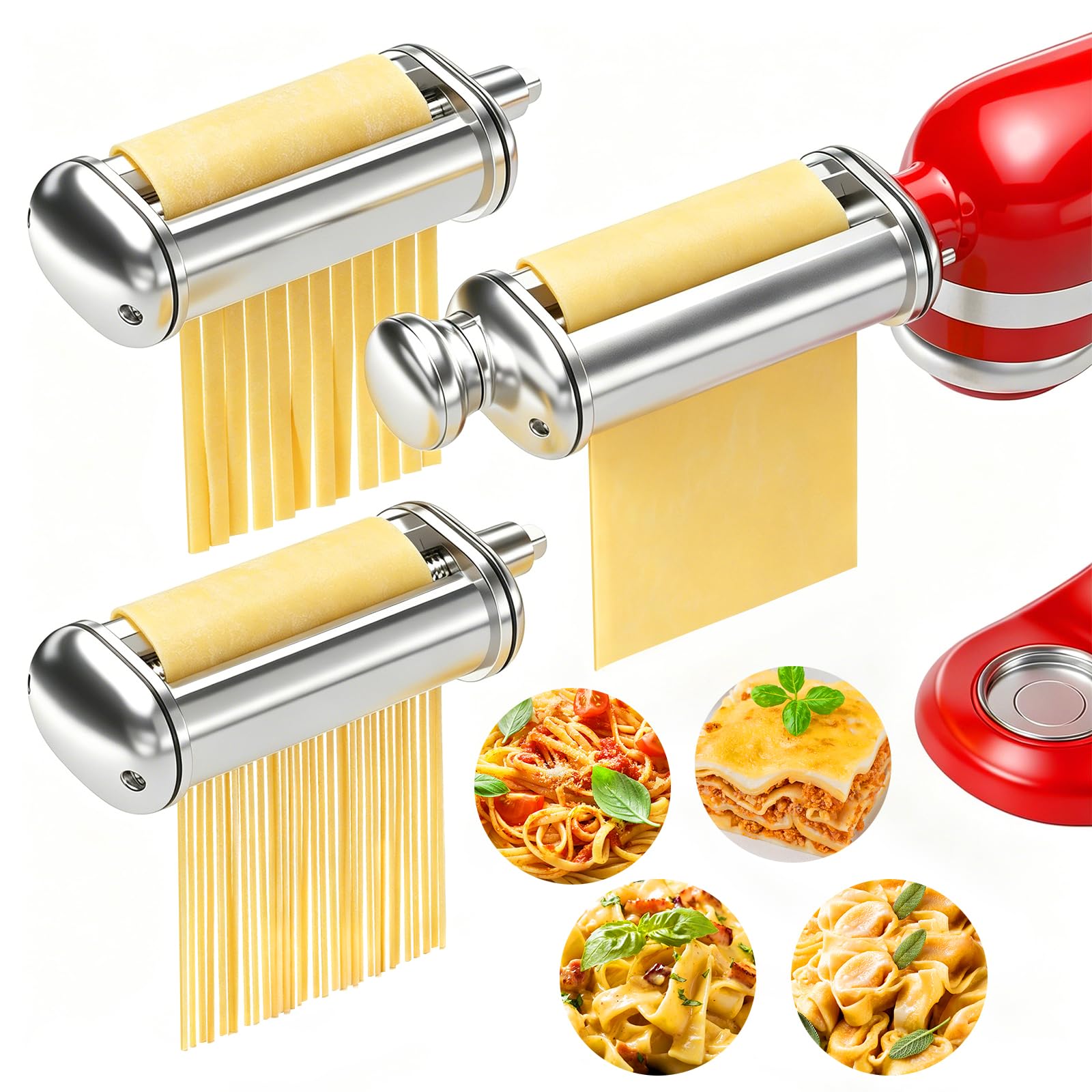
The ZACME 3-piece attachment set includes a pasta roller, fettuccine cutter, and spaghetti cutter, all constructed from food-grade stainless steel. The roller features 8 thickness settings ranging from 0.4 mm to 2 mm, giving you precise control for everything from delicate angel hair dough to thick pappardelle sheets. The heavy-duty build weighs 2.64 kg, lending stability during operation.
Compatibility extends beyond KitchenAid to Cuisinart stand mixers SM-50, SM-50BC, and SM-50R. The cutters produce evenly sized noodles, and the stainless surface minimizes sticking. Cleaning is straightforward — a dry brush handles most residue, while warm water and mild soap can be used for stubborn spots if the attachment is air-dried thoroughly.
The main drawback is that each attachment is separate, so you must physically swap the roller out for a cutter after sheeting. This takes seconds, but it is less convenient than the integrated NEWSETS design. The 1-year warranty provides peace of mind, though the all-metal construction should last well beyond that period with proper care.
Why it’s great
- All food-grade stainless steel for long-term durability
- Works with KitchenAid and select Cuisinart mixers
- Precise 0.4 mm to 2 mm thickness adjustment
Good to know
- Separate attachments require swapping between roller and cutters
- Must be thoroughly air-dried after washing
FAQ
Can I use a pasta maker for gluten-free dough?
How do I clean a manual pasta maker without damaging the rollers?
What is the advantage of a 10-position thickness dial over an 8-position dial?
Are pasta maker attachments compatible with all stand mixers?
Final Thoughts: The Verdict
For most users, the pasta maker winner is the Philips 7000 Series because it automates the entire process — mixing, kneading, and extruding — with a 150W motor that handles even gluten-free dough without issue. If you want tactile control over sheet thickness and enjoy the ritual of hand-cranking, the MARCATO Atlas 150 Classic delivers Italian-made precision with 10 adjustable settings. And for a complete shape-making system right out of the box, nothing beats the MARCATO PASTASET Gift Set with its included ravioli and spaghetti attachments.