A chef’s knife is the single most used tool in any kitchen, yet most home cooks settle for blades that dull within weeks. The difference between a frustrating chop and a clean, effortless slice comes down to three things: the steel composition, the edge geometry, and the handle’s balance. This guide cuts through the marketing to find the knives that actually hold an edge.
I’m Mohammad Maruf — the founder and writer behind AirfryerBite. I’ve analyzed over 200 chef’s knife specifications, from Rockwell hardness ratings to blade tang construction, to separate real performance from decorative packaging.
Whether you’re breaking down a whole chicken or mincing garlic paper-thin, the right blade transforms your workflow. This deep-dive review narrows the field to the five best contenders in the best chef’s knife category, ranked by actual edge retention, balance, and handle ergonomics.
How To Choose The Best Chef’s Knife
A chef’s knife is a long-term investment in your cooking efficiency. Choosing poorly means struggling with a blade that won’t take an edge, feels unbalanced, or fatigues your wrist after fifteen minutes of prep. Here’s what actually matters.
Blade Steel and Rockwell Hardness (HRC)
The steel’s hardness rating, measured on the Rockwell C scale, directly dictates edge retention. A blade rated 56-58 HRC is tough and easy to sharpen but loses its edge faster. A blade at 58-60 HRC holds an edge significantly longer while remaining resilient enough to resist chipping. VG-10 core steel, common in mid-range Japanese-style knives, typically hits 60-61 HRC for superior edge hold. Avoid anything below 55 HRC — you will be sharpening every other week.
Handle Construction and Balance
A fully-tanged blade — where the steel runs the entire length of the handle — provides proper weight distribution and prevents the knife from feeling blade-heavy. Handle materials matter for grip durability: textured Fibrox resists slipping when wet, Pakkawood offers a warm, natural feel that molds to your hand over time, and G10 composite is impervious to moisture and heat. An unbalanced knife forces your grip to compensate, leading to hand cramps during long prep sessions.
Edge Geometry and Blade Profile
The angle at which the blade is sharpened determines how it interacts with food. A 15-degree edge per side is common for Japanese-style knives and delivers aggressive sharpness for clean slices through vegetables and raw fish. A 20-degree edge is standard for Western-style German blades and offers more durability for heavy chopping and bone work. The 8-inch blade length is the industry standard because it provides enough belly for a rocking chop while remaining nimble enough for detail work.
Quick Comparison
On smaller screens, swipe sideways to see the full table.
| Model | Category | Best For | Key Spec | Amazon |
|---|---|---|---|---|
| KYOKU Shogun Series | Premium | Culinary enthusiasts who want VG-10 edge retention | VG-10 Core, 60 HRC, 8-12° Edge | Amazon |
| Victorinox Fibrox Pro | Mid-Range | Professional kitchens needing a slip-resistant handle | High-Carbon Steel, 56 HRC, Non-Slip Fibrox | Amazon |
| KEEMAKE Kiritsuke | Mid-Range | Home cooks wanting a Damascus aesthetic with solid edge hold | Damascus Clad, Pakkawood Handle | Amazon |
| imarku Japanese Chef Knife | Budget-Friendly | Entry-level users wanting high-carbon performance under budget | 0.6-0.75% Carbon, 56-58 HRC | Amazon |
| Sunnecko 8 Inch Chef Knife | Budget-Friendly | First-time buyers seeking a sharp 12-15° edge on a budget | 12-15° Edge, Pakkawood & Sheath | Amazon |
In‑Depth Reviews
1. KYOKU Shogun Series 8-Inch Chef Knife

The KYOKU Shogun delivers the highest edge performance in this lineup thanks to its VG-10 steel core clad in 67 layers of Damascus. Sharpened to an 8 to 12-degree edge using the traditional Honbazuke method, this blade glides through bell peppers, raw salmon, and even butternut squash with negligible resistance. The 58-60 HRC rating means you will not be honing every third use — the edge stays aggressive through a week of heavy prep.
The handle is a fiberglass-reinforced G10 composite with a mosaic pin, which withstands heat, moisture, and impact better than any natural wood handle. This material does not swell or crack over time, and it provides a secure grip even when your hands are slick with oil. The included sheath and case offer practical storage that protects the delicate edge.
At 8 inches, this knife hits the sweet spot between a nimble petty knife and a heavy cleaver. The blade’s weight distribution is center-balanced, reducing wrist fatigue during long chopping sessions. The only real trade-off is that G10 handles feel firmer and less warm than natural Pakkawood — a minor ergonomic preference for users who prioritize a traditional tactile feel.
Why it’s great
- VG-10 core delivers exceptional edge retention at 60 HRC
- 8-12° Honbazuke edge is factory-sharp enough for paper-thin cuts
- G10 handle resists moisture and heat without swelling
- Includes both a sheath and storage case
Good to know
- G10 handle feels less organic than Pakkawood alternatives
- Premium build comes with a higher investment than entry-level options
2. Victorinox Fibrox Pro Chef’s Knife, 8 Inch
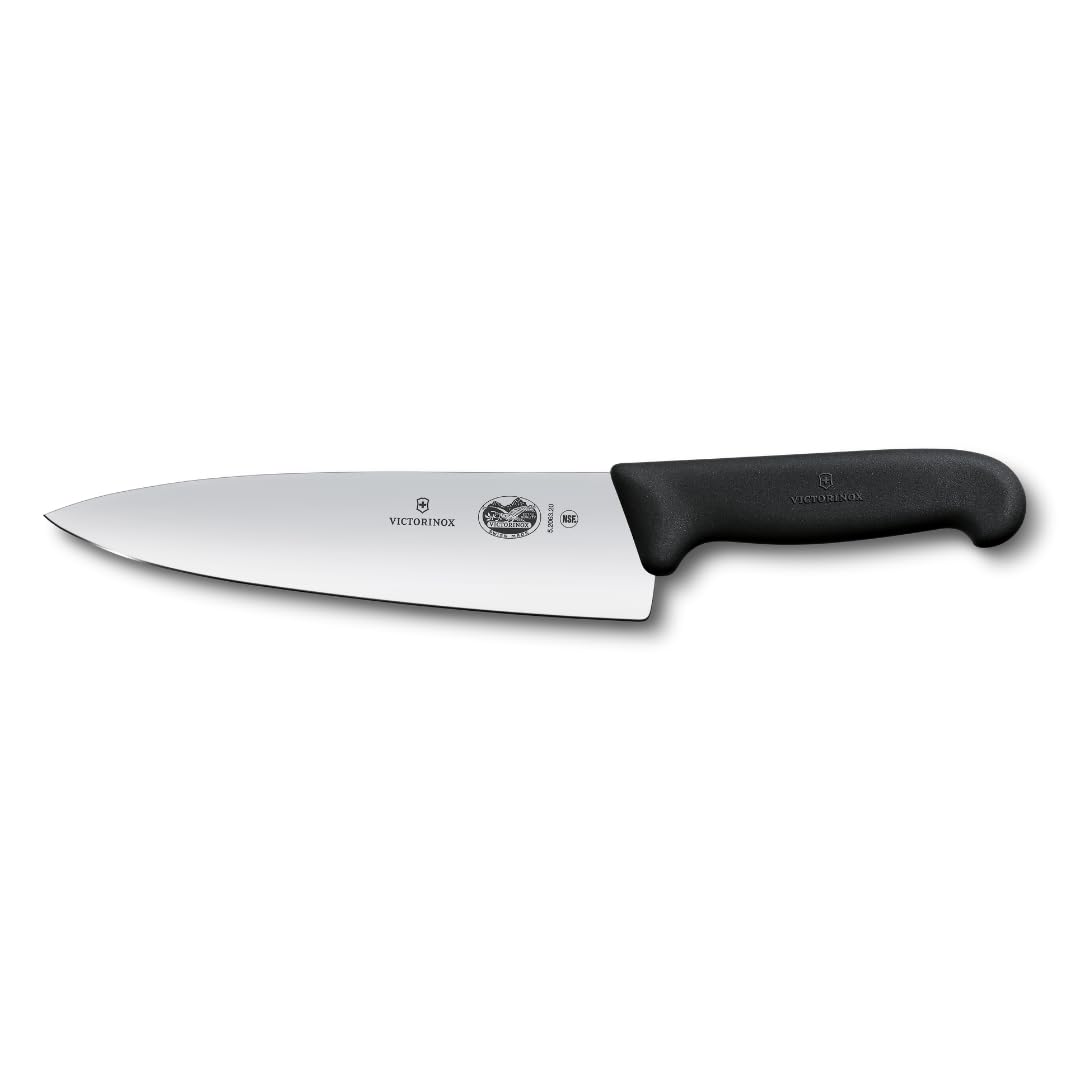
The Victorinox Fibrox Pro is the most ubiquitous chef’s knife in professional kitchens for one reason: it works reliably every single day without breaking the bank. The high-carbon stainless steel blade is stamped rather than forged, which lowers the cost while maintaining a consistent 56 HRC hardness that is easy to sharpen on a stone or rod. The 8-inch blade has a slight curve that allows an effective rocking chop for mincing herbs or dicing onions.
The Fibrox handle is the real standout feature here. The textured synthetic material provides a secure grip even with wet or greasy hands — no slipping, no hot spots. It is also completely dishwasher safe, which matters for busy kitchens where hand-washing is not always practical. However, repeated dishwasher cycles will dull the edge faster than hand-washing, so treat the blade itself with care.
This knife lacks the aesthetic appeal of a Damascus pattern or a Pakkawood handle, but it makes up for it with sheer utility. The blade is lightweight at roughly 7 ounces, which reduces fatigue during marathon prep shifts. While the edge retention is not in the same league as a VG-10 blade, the trade-off is that the steel is tougher and less likely to chip if you accidentally strike a cutting board bone or a hard squash seed.
Why it’s great
- Fibrox handle is the most slip-resistant grip on the market
- Dishwasher-safe construction for easy cleaning
- Lightweight blade reduces wrist strain during long prep sessions
- Tough 56 HRC steel resists chipping on hard ingredients
Good to know
- Edge retention is lower than VG-10 alternatives
- Stamped blade lacks the heft of forged knives
3. KEEMAKE Kiritsuke Chef Knife, 8 Inch Damascus
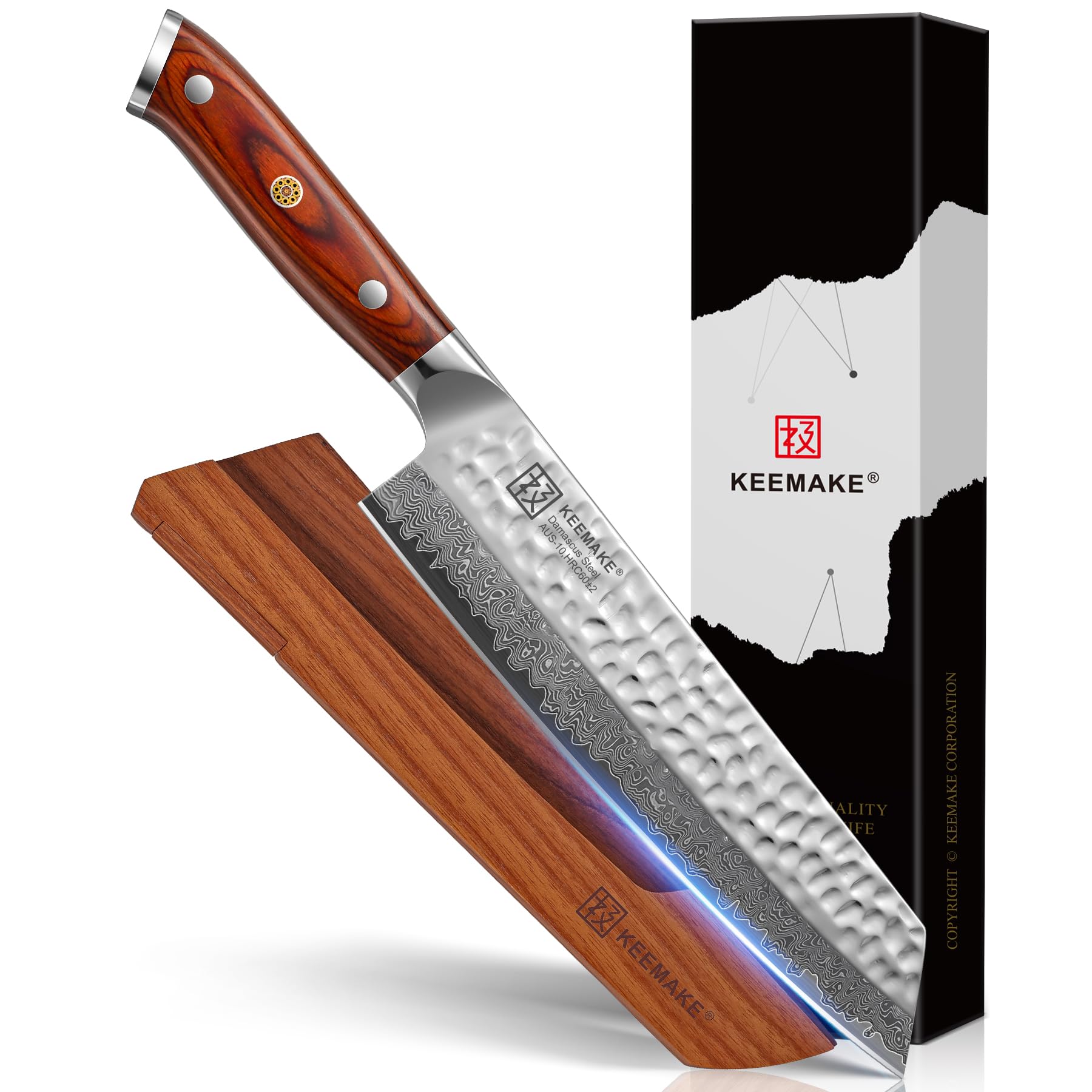
The KEEMAKE Kiritsuke brings the striking visual appeal of a Damascus pattern to a mid-range price point without sacrificing core cutting performance. The layered steel cladding produces a wavy aesthetic that is not just decorative — it also helps minimize friction as food releases from the blade surface. The kiritsuke profile, with its flat edge and angled tip, offers excellent push-cutting control for precise vegetable work and protein slicing.
The Pakkawood handle is contoured to fit the palm comfortably, reducing pinch-grip fatigue during extended use. Unlike cheaper wood handles, this composite is stabilized to resist moisture absorption and cracking over time. The included ash sheath adds protection for storage, which is important because the fine edge is more delicate than a typical German blade profile.
This knife performs exceptionally well for home cooks who prioritize both function and presentation. The blade’s hardness is comparable to the imarku at roughly 58 HRC, but the Damascus layers give it a smoother cutting feel through dense ingredients like sweet potatoes. The only minor drawback is that the kiritsuke tip is more fragile than a traditional chef’s knife curve, so it is not ideal for heavy rocking motions on hard herbs.
Why it’s great
- Damascus cladding reduces food sticking to the blade
- Contoured Pakkawood handle offers comfortable palm fit
- Included ash sheath protects the edge during storage
- Flat kiritsuke profile excels at push-cutting vegetables
Good to know
- Kiritsuke tip is more fragile than a traditional curved tip
- Not ideal for heavy rocking chop motions
4. imarku Japanese Chef Knife, 8 Inch

The imarku Japanese Chef Knife is a budget-oriented entry that punches above its price tier by using a high-carbon stainless steel composition with 0.6-0.75% carbon content. This carbon level is significantly higher than basic 0.3% stainless knives, resulting in a blade that takes a keen edge and holds it noticeably longer than supermarket-grade alternatives. The Rockwell hardness rating of 56-58 is right in the sweet spot for toughness and edge retention balance.
The handle is constructed from Pakkawood, the same stabilized composite used in knives costing several times more. It provides a natural finger contoured grip that minimizes hand fatigue during extended cutting tasks. The blade is fully corrosion-resistant thanks to 16-18% chrome content in the alloy, so it will not develop rust spots even with occasional moisture exposure between uses.
Where this knife falls short of the Victorinox is in handle texture — the Pakkawood is smooth and can become slippery when wet, whereas the Fibrox handle locks into your hand regardless of conditions. Additionally, the edge out of the box is good but not laser-sharp; it will benefit from a quick pass on a honing rod before heavy use. For the price, however, you are getting a proper Japanese-style gyutou profile that slices, dices, and chops with notably less resistance than a typical Western blade.
Why it’s great
- 0.6-0.75% carbon steel takes and holds a better edge than basic stainless
- Pakkawood handle offers a comfortable, natural wood feel
- Corrosion-resistant chrome content prevents rusting
- Japanese gyutou profile provides versatile cutting performance
Good to know
- Smooth Pakkawood handle can be slippery when wet
- Factory edge may need a light honing before first heavy use
5. Sunnecko 8 Inch Chef Knife

The Sunnecko 8 Inch Chef Knife is the most aggressive value proposition in this roundup, offering a 12-15 degree ultra-sharp edge and a full Pakkawood handle at an entry-level price. The blade is made from high-carbon stainless steel and is sharpened at an angle that rivals premium Japanese knives for cutting aggression. Out of the box, this knife will slide through a ripe tomato or a sheet of paper with zero pressure required.
The handle uses the same Pakkawood composite found on more expensive knives, providing a stable, moisture-resistant grip that does not swell or crack over time. A matching sheath is included for safe storage, which is a practical bonus at this price tier. The overall build quality is solid for the cost, with a full tang that provides reasonable balance despite the lightweight feel.
The trade-off for the aggressive 12-15 degree edge is that it will dull faster than a blade with a more obtuse angle, especially if you use a glass cutting board or cut through hard items like chicken bones. This knife is best suited for soft vegetable prep, fruit slicing, and boneless protein work where the ultra-sharp geometry can be fully exploited. For the price, it is an excellent second knife or a first knife for someone learning proper cutting technique without a major financial commitment.
Why it’s great
- 12-15° edge is exceptionally sharp right out of the box
- Pakkawood handle offers good moisture resistance at this price
- Includes a protective sheath for edge safety
- Full tang design provides decent balance for the cost
Good to know
- Aggressive edge angle dulls faster with hard use or bone contact
- Best reserved for soft vegetable and boneless protein prep
FAQ
Is a 60 HRC knife too brittle for everyday home use?
What is the real difference between a Forged and Stamped chef’s knife blade?
Why does my chef’s knife feel unbalanced after heavy use?
Final Thoughts: The Verdict
For most users, the best chef’s knife winner is the KYOKU Shogun Series because it combines a true VG-10 core, a 60 HRC edge that lasts through weeks of prep, and a G10 handle that will never swell or crack. If you want the most slip-resistant grip at a mid-range price, grab the Victorinox Fibrox Pro. And for budget-conscious shoppers seeking a sharp 12-15 degree edge with full Pakkawood construction, nothing beats the Sunnecko 8 Inch Chef Knife.