When you feed your starter at 7 a.m. and realize your stand mixer stalls halfway through the first fold, the promise of a crusty artisan loaf dies with the motor. Sourdough demands raw torque — a mixer that won’t bog down on stiff, high-hydration doughs and can handle batch after batch without overheating. The wrong motor leaves you with under-mixed flour pockets and a strained electrical hum that signals an early burnout.
I’m Mohammad Maruf — the founder and writer behind AirfryerBite. I analyze motor torque curves, planetary action geometry, and bowl-drive dynamics to separate units that fake heavy-duty from those that actually muscle through a 2-kilo boule without walking across the counter.
After evaluating nine mixers on dough hook design, wattage sustainability, bowl capacity, and build rigidity, one thing became clear: many tilt-head models popular with casual bakers simply lack the structural bite for weekly sourdough. Finding a reliable sourdough mixer requires looking past shiny finishes and focusing on the drivetrain that handles gluten development without stalling.
How To Choose The Best Sourdough Mixer
Sourdough dough is among the stiffest, stickiest mixtures a stand mixer encounters. A unit that whips egg whites effortlessly can choke on 70% hydration dough. Before buying, isolate three critical parameters that separate a true sourdough workhorse from a general-purpose mixer that merely tolerates bread.
Motor Type and Sustained Torque
DC brushless motors deliver consistent torque at low RPM without overheating, making them ideal for the long knead cycles sourdough requires. AC motors typical in budget tilt-head mixers lose torque as they heat, often triggering thermal shutdown mid-batch. Look for DC motor specs and check reviews for stalling reports on dough loads above 1.5 kilograms.
Bowl Capacity and Dough Hook Geometry
A 6-quart bowl sounds generous until you realize sourdough bulks significantly during fermentation. A spiral dough hook that reaches the bowl edges ensures full gluten development without leaving unmixed flour at the bowl bottom. Bowl-lift designs generally maintain better hook-to-bowl clearance than tilt-head models when handling heavy doughs.
Stability and Weight Distribution
A 33-pound unit with suction feet will not walk off the counter during a 15-minute knead. Lightweight plastic-housed mixers under 15 pounds often vibrate excessively or shift across the counter when working stiff dough. Die-cast metal construction with a wide base provides the stationary platform needed for consistent kneading.
Quick Comparison
On smaller screens, swipe sideways to see the full table.
| Model | Category | Best For | Key Spec | Amazon |
|---|---|---|---|---|
| ZACME 8.4QT Commercial | Mid-Range | High-volume batch baking | 800W DC motor, 8.4 qt | Amazon |
| Bosch Universal Plus | Mid-Range | Whole grain dough up to 15 lbs | 500W belt drive, 6.5 qt | Amazon |
| GE Profile Smart | Premium | Precision weighing and guided recipes | Auto Sense torque feedback, 7 qt | Amazon |
| Kenwood Chef KVC3100S | Premium | Multifunction with planetary action | 1000W motor, 4.6L bowl | Amazon |
| Ooni Halo Pro Spiral | Premium | Pizza and artisan bread dough | Spiral mixing, 58 speeds, 7.3 qt | Amazon |
| KitchenAid Commercial KSM8990 | Premium | Commercial-grade durability | NSF certified, 8 qt bowl lift | Amazon |
| Cuisinart SM-50BCNAS | Mid-Range | Everyday sourdough with 12 speeds | 500W motor, 5.5 qt | Amazon |
| NutriMill Artiste | Mid-Range | Bottom drive for easy scraping | 500W motor, 6.5 qt bowl | Amazon |
| GE Tilt-Head G8MSAAS1RRS | Entry-Level | Budget-friendly light dough batches | 350W motor, 5.3 qt | Amazon |
In‑Depth Reviews
1. ZACME 8.4QT Commercial Stand Mixer
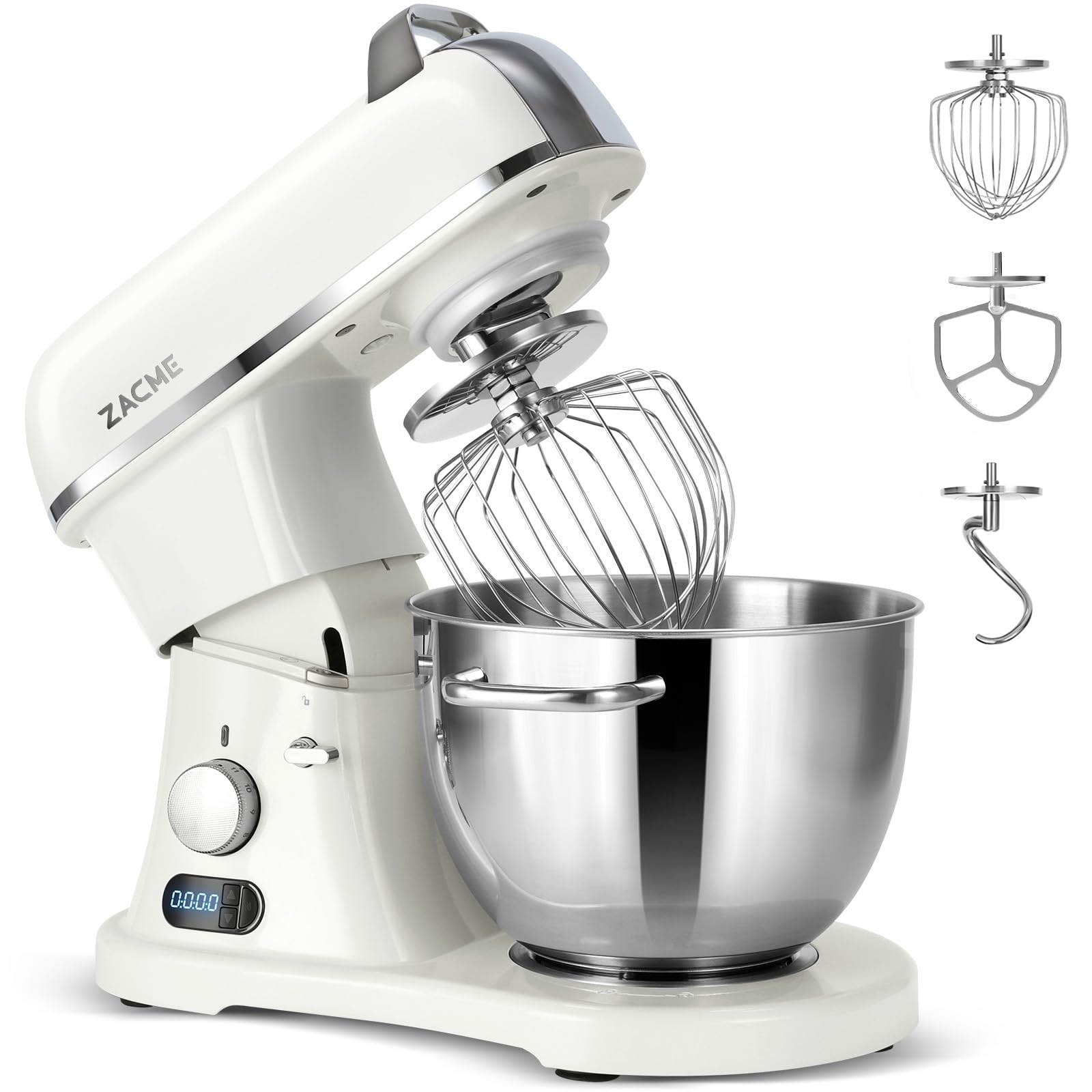
The ZACME 8.4QT sits at the intersection of commercial-grade capacity and home-kitchen usability. Its 800W DC motor drives an 8.4-quart stainless steel bowl that handles up to 3 kilograms of dough — enough for two large boules in a single cycle. The tilt-head design combined with a digital LCD timer lets you set a countdown for a 12-minute knead and walk away, and the planetary mixing action ensures the dough hook reaches every edge of the bowl without leaving dry flour pockets.
Noise levels stay under 48 dBA on the first gear, which matters when you run the mixer early in the morning before the rest of the house wakes up. The die-cast aluminum housing weighs 33 pounds, and the adjustable height design accommodates both small and large batches without losing hook-to-bowl contact. The stainless steel dough hook, flat beater, and wire whip are all dishwasher safe, reducing cleanup friction after a heavy bake session.
The ZACME meets NSF/ANSI 8-2023 standards for commercial use, a certification that validates its food-grade material safety and thermal performance under sustained operation. For sourdough bakers who want a single mixer that transitions from weekly home loaves to occasional bulk bakes for family gatherings, this unit delivers the torque and capacity without jumping to four-figure pricing tiers.
Why it’s great
- 800W DC motor provides consistent torque through stiff dough kneads without overheating
- 8.4-quart capacity handles 3 kg dough batches for bulk bakers
- Digital timer with countdown function allows multitasking during long knead cycles
Good to know
- 33-pound weight requires dedicated counter space rather than cabinet storage
- Tilt-head mechanism may require occasional tightening to maintain alignment
2. Bosch Universal Plus Stand Mixer

The Bosch Universal Plus takes a fundamentally different approach to dough mixing: a bottom drive system with dual beaters that produce triple whipping action. For sourdough, this translates to thorough gluten development without the dough climbing up a single central hook. The powerful 500W belt-driven transmission provides adequate torque for up to 15 pounds of whole grain bread dough, which covers serious bulk bakes for home bakers who maintain a large starter population.
The 6.5-quart BPA-free plastic bowl includes an easy-grip handle and a removable drive shaft that simplifies cleaning. The included dough hook extender from NutriMill improves hook-to-bowl clearance for low-hydration doughs, ensuring the hook reaches the bowl bottom rather than riding above the dough mass. The bowl lid with splash ring prevents flour dust from escaping during initial mixing, and the plastic construction keeps the overall weight manageable at under 15 pounds.
One trade-off is the 4-speed manual control system, which offers less granularity than digital 12-speed units. The belt drive is quieter than gear-driven alternatives but can require belt replacement after heavy use over several years. For bakers who prioritize large batch capacity and easy bowl access over speed precision, the Bosch Universal Plus delivers reliable performance at a mid-range price point.
Why it’s great
- Bottom drive design prevents dough from climbing and allows easy ingredient addition during mixing
- Belt-driven transmission kneads up to 15 pounds of whole grain dough without stalling
- Lightweight plastic bowl with handle makes pouring and cleaning effortless
Good to know
- Only 4 speed settings limit fine control for delicate tasks like whipping cream
- Plastic housing may feel less durable than die-cast metal alternatives
3. GE Profile Smart Stand Mixer

The GE Profile Smart Mixer introduces Auto Sense Technology, which uses motor torque feedback to monitor dough texture and viscosity in real time. For sourdough, this means the mixer automatically adjusts speed to maintain consistent kneading action as gluten develops, preventing overworking or under-mixing. The built-in smart scale allows you to weigh flour, water, and starter directly into the 7-quart stainless steel bowl, eliminating the need for separate measuring vessels and reducing the margin for hydration errors.
The advanced digital brushless DC motor runs at a low temperature for extended life, generating consistent high power through the toughest batches without stalling. The 11-speed control with touch interface provides precise speed selection, and the automatic shutoff feature turns the mixer off when the timer ends, which is particularly useful for the long, timed autolyse and knead phases of sourdough preparation. The commercial-grade stainless steel dough hook, flat beater, and 11-wire whip come standard, and the 44-pound zinc die-cast construction ensures the mixer stays planted during heavy kneading.
WiFi connectivity opens the door to guided recipes that update over the air, though this feature is more useful for learning new techniques than for experienced bakers who have their sourdough routine dialed in. The smart scale needs calibration before first use, and the touch controls may feel less intuitive than a traditional knob for users accustomed to manual speed adjustment. For bakers who value precision and want a mixer that actively adapts to dough conditions, this is a premium option that integrates seamlessly into a modern kitchen workflow.
Why it’s great
- Auto Sense torque feedback adjusts mixing speed in real time for optimal gluten development
- Built-in smart scale enables direct in-bowl weighing for precise hydration ratios
- Brushless DC motor runs cool during extended knead cycles without thermal shutdown
Good to know
- Touch controls require a learning curve compared to traditional knob-based interfaces
- WiFi connectivity features are not essential for experienced bakers with established routines
4. Kenwood Chef Silver KVC3100S

The Kenwood Chef KVC3100S packs a 1000W motor into a relatively compact metal body with a 4.6-liter stainless steel bowl. The planetary mixing action ensures the dough hook, K-beater, or whisk covers the entire bowl surface, which is critical for even gluten development in sourdough. The 4.6-liter capacity is smaller than most mixers on this list — it handles roughly 1.5 kilograms of dough per batch — but the power-to-bowl ratio means even stiff, low-hydration doughs get fully kneaded without the motor straining.
The speed variator offers continuous adjustment rather than preset speeds, giving you fine control over kneading intensity. The metal body provides stability without the bulk of commercial-grade units, and the tilt-head design allows quick access to the bowl and attachments. Over 30 optional accessories are available, including a pasta maker and meat grinder, making this a versatile platform beyond bread baking. The K-beater, dough hook, and whisk are all dishwasher safe.
The smaller bowl capacity is the primary limitation for bakers who need to produce more than two loaves per batch. The 4.6-liter bowl fills quickly with a standard sourdough formula, and the hook clearance can be tight when working with very wet doughs above 80% hydration. For bakers with limited counter space who still want industrial-grade motor power, the Kenwood Chef offers a premium build in a footprint that fits under standard cabinets.
Why it’s great
- 1000W motor delivers exceptional torque for stiff doughs despite the compact form factor
- Continuous speed variator allows precise RPM adjustment for delicate mixing tasks
- Metal body construction provides stability without dominating counter space
Good to know
- 4.6-liter bowl limits batch size to approximately 1.5 kg of dough per cycle
- Bowl capacity may require splitting large recipes into multiple batches for bulk bakes
5. Ooni Halo Pro Spiral Mixer

The Ooni Halo Pro Spiral Mixer is a category outlier: it uses spiral mixing technology — a rotating bowl paired with a stationary spiral dough hook and a patent-pending removable breaker bar — rather than planetary action. This configuration, standard in professional pizzerias and bakeries, develops stronger gluten networks by stretching and folding dough rather than smearing it against the bowl wall. For sourdough, this means better oven spring and a more open crumb structure in the final loaf.
The 7.3-quart stainless steel bowl rotates while the spiral hook remains stationary, and 58 speed settings from 60 RPM to over 1,000 RPM provide granular control over mixing intensity. The included attachments — breaker bar, flexible beater, spiral dough hook, and geared whisk — cover whisking, beating, and mixing tasks beyond bread dough. The die-cast aluminum and stainless steel construction weighs 32 pounds, providing a stable base that prevents walking during the rotating bowl operation.
The Ooni Halo Pro is not dishwasher safe, and the specialized spiral mixing mechanism has a learning curve for users accustomed to standard planetary mixers. The rotating bowl design also takes up more counter depth than a tilt-head unit. For dedicated sourdough and pizza enthusiasts who want the closest approximation to professional bakery equipment in a home kitchen, the Halo Pro delivers dough quality that planetary mixers cannot replicate.
Why it’s great
- Spiral mixing technology develops gluten more effectively than planetary action for artisan bread
- 58 speed settings from 60 to 1,000+ RPM provide unmatched mixing precision
- Rotating bowl design ensures consistent dough contact without manual scraping
Good to know
- Not dishwasher safe — bowl and attachments require hand washing
- Spiral mixing mechanism has a steeper learning curve than standard planetary mixers
6. KitchenAid Commercial KSM8990

The KitchenAid Commercial KSM8990 is NSF certified for commercial use, meaning it meets public health standards for material safety, durability, and cleanability in high-volume environments. The 8-quart bowl-lift design provides stable support during heavy mixing, and the lever mechanism smoothly raises the bowl into position for efficient beater-to-bowl contact. This feature is critical for sourdough bakers because the bowl-lift maintains consistent hook alignment even when working with dense, stiff doughs that would cause a tilt-head mixer to wobble or lose contact.
The high-efficiency DC motor runs longer with less heat buildup compared to universal motors, which is essential for the extended mixing cycles sourdough requires. The 25-pound mixer includes a stainless steel flat beater, spiral dough hook, and 11-wire elliptical whip. The speed control protection feature reduces the risk of accidentally turning the mixer on during cleaning, a practical safety consideration for busy kitchens.
The KSM8990 is not dishwasher safe, and the bowl-lift design requires more counter height than tilt-head alternatives. The 8-quart capacity handles batches of up to 4 kilograms of dough, but the mixer occupies a footprint that requires dedicated permanent placement. For bakers who need a mixer that can handle daily sourdough production for a small commercial bakery or an exceptionally active home kitchen, the KitchenAid Commercial provides proven reliability backed by decades of engineering.
Why it’s great
- NSF certification validates material safety and commercial-grade durability for daily use
- 8-quart bowl-lift design maintains hook alignment during heavy dough kneading
- DC motor runs cool and efficient through extended mixing cycles without thermal shutdown
Good to know
- Not dishwasher safe — all components require hand washing and drying
- Bowl-lift design requires more counter height clearance than tilt-head models
7. Cuisinart Stand Mixer SM-50BCNAS

The Cuisinart SM-50BCNAS delivers a 500W motor with a 5.5-quart polished stainless steel bowl in a die-cast metal body that weighs 17 pounds. The 12-speed control provides enough granularity to transition from a slow fold-in of starter to a medium knead for gluten development. The tilt-back head secures automatically upon closure, and the single power outlet allows optional attachments like a pasta extruder or meat grinder for expanded functionality beyond bread baking.
The included chef’s whisk, dough hook, flat mixing paddle, and splash guard with pour spout cover standard mixing tasks. The dough hook is coated to prevent dough from sticking, and the splash guard reduces flour dust during the initial combine phase. The BPA-free construction and limited 3-year warranty provide peace of mind for regular home bakers. For sourdough batches up to 1.5 kilograms, the Cuisinart performs reliably without the bulk of larger commercial units.
The 5.5-quart bowl fills quickly when working with a double-batch sourdough formula, and the 500W motor can struggle with very stiff doughs above 75% hydration if pushed continuously for more than 10 minutes. The tilt-head design, while convenient, can lose alignment over time under the stress of heavy dough, requiring occasional adjustment. For bakers who make sourdough weekly but do not need industrial capacity, this is a solid mid-range option that balances performance with counter footprint.
Why it’s great
- 12-speed control provides precise speed selection for each phase of sourdough mixing
- Die-cast metal construction offers good stability at a moderate weight of 17 pounds
- Splash guard with pour spout reduces mess during initial flour incorporation
Good to know
- 500W motor may strain on stiff doughs above 75% hydration during extended kneading
- Tilt-head alignment can shift over time under repeated heavy dough stress
8. NutriMill Artiste Electric Stand Mixer

The NutriMill Artiste uses a bottom drive system that delivers power directly from the motor base to the accessories, bypassing the tilt-head mechanism common in other mixers. For sourdough, this design means the dough hook connects through the bowl bottom, providing direct torque transfer without the gear slop that can develop in tilt-head units over time. The 6.5-quart bowl handles batches of up to 3.6 kilograms of dough, and the suction cup feet prevent the mixer from walking across the counter during heavy kneading.
The 500W motor powers the included extended length dough hook, wire whips, and easy-open bowl cover with a window for monitoring mixing progress. The bowl and accessories are dishwasher safe, and the stainless steel drive is built to last with a 1-year manufacturer warranty. The plastic bowl with easy-grip handle is lighter than stainless steel alternatives, making it easier to lift and pour, though some bakers prefer metal bowls for thermal stability during long fermentations.
The bottom drive design means you cannot tilt the head to access the bowl — you must remove the entire bowl to change attachments or scrape down the sides. This adds a step to the workflow compared to tilt-head or bowl-lift designs. The plastic construction of the bowl and housing may feel less premium than all-metal mixers, but it keeps the weight under 19 pounds. For bakers who prefer a stable, bottom-driven platform for regular sourdough batches, the NutriMill Artiste offers a functional alternative to traditional top-drive mixers.
Why it’s great
- Bottom drive system delivers direct torque transfer without gear slop common in tilt-head designs
- 6.5-quart bowl capacity handles up to 3.6 kg of dough for large batch baking
- Suction cup feet keep the mixer stable during high-torque kneading cycles
Good to know
- Bowl must be fully removed to swap attachments or scrape bowl sides
- Plastic bowl and housing feel less premium than all-metal alternatives
9. GE Tilt-Head Electric Stand Mixer G8MSAAS1RRS

The GE Tilt-Head Electric Mixer is an entry-level option for bakers who want a stand mixer for occasional sourdough without investing heavily. The 350W motor is adequate for light to medium dough batches up to about 1 kilogram, but it will struggle with stiff, high-hydration sourdough or double batches. The 5.3-quart stainless steel bowl is smaller than most competitors, limiting batch size to a single loaf per cycle, and the die-cast aluminum construction keeps the weight at a manageable 19 pounds.
The 7-speed control and 59-point mixing cycle design aim to improve bowl coverage, and the tilt-head auto-lock feature secures the head upon closure for safety. Included components — coated flat beater, coated dough hook, wire whisk, and pouring shield — cover basic mixing tasks. The accessory port is compatible with third-party attachments, which adds future expandability for a budget platform. The mixer runs relatively quietly for its class, which is a practical advantage for early-morning bakes.
The 350W motor is the primary constraint for serious sourdough work. Extended kneading cycles cause the motor to heat up, and the tilt-head design can lose alignment under sustained heavy load. The coated dough hook is less durable than stainless steel and may show wear with frequent use. For beginners exploring sourdough or bakers who make bread infrequently, the GE Tilt-Head offers a functional start point, but regular sourdough practitioners will reach its limits quickly.
Why it’s great
- Entry-level price point makes sourdough mixing accessible for beginners
- Auto-lock tilt-head design provides safety and easy bowl access
- Quiet operation suitable for early morning baking sessions
Good to know
- 350W motor struggles with stiff doughs and extended kneading cycles
- 5.3-quart bowl limits batch size to approximately one loaf per cycle
FAQ
Can I use a tilt-head mixer for stiff sourdough dough?
What is the minimum wattage I need for kneading sourdough?
Is a spiral mixer worth the extra cost for sourdough?
Can I knead sourdough in a plastic bowl mixer?
Final Thoughts: The Verdict
For most users, the sourdough mixer winner is the ZACME 8.4QT Commercial Stand Mixer because it combines an 800W DC motor, 8.4-quart capacity, and NSF certification at a mid-range price that outperforms units costing hundreds more. If you want smart weighing and torque-adaptive mixing, grab the GE Profile Smart Stand Mixer. And for professional-level dough quality that rivals bakery equipment, nothing beats the Ooni Halo Pro Spiral Mixer.