A thin bamboo board warps after a single wash, and the cheap composite slab dulls your chef’s knife within a month. This is the reality of a low-quality wooden cutting board—a surface that should protect your blades and stay flat ends up costing you more in replacement gear. Finding a real wood board that actually holds up without draining your wallet is the genuine challenge.
I’m Mohammad Maruf — the founder and writer behind AirfryerBite. My research focuses on kitchen hardware durability, knife-edge retention, and sustainable material sourcing for home cooks who need reliable gear without the premium price tag.
After evaluating dozens of models on grain density, warp resistance, and non-toxic finishing, I have narrowed the field down to the five most reliable options available today. This guide covers the best budget wooden cutting board picks that deliver real acacia or composite wood performance without the sticker shock.
How To Choose The Best Budget Wooden Cutting Board
Buying a low-cost wooden board means you are trading some craftsmanship for value, but you do not have to sacrifice knife safety or a flat surface. The key is understanding which trade-offs matter and which will ruin your prep experience. Focus on these three factors before you click buy.
Material: Acacia, Bamboo, or Compressed Wood Fiber
Acacia wood is the sweet spot for budget buyers: it is naturally hard, resists water absorption, and does not dull knives as fast as bamboo. Bamboo is technically a grass, not a true hardwood, and its silica content can micro-chip your blade edge over time. Compressed wood fiber boards, like those from Freshware, are engineered for heat resistance and dishwasher safety, but they lack the natural grain density that gives traditional wood its self-healing properties. For a budget board, choose acacia for real wood performance or compressed fiber for easy maintenance.
Thickness and Warp Resistance
A cutting board thinner than 1.5 inches is prone to bowing, especially if you wash it with hot water or leave it near a heat source. Budget boards often come in at 0.2 to 0.75 inches thick, which works for light chopping but will warp under heavy daily use. Boards like the FANICHI and GAOMON models, both 1.5 inches thick, offer real stability at a reasonable price. The rule is simple: the thicker the board, the longer it stays flat.
Juice Groove vs. Flat Surface
A deep juice groove prevents meat juices from spilling onto the counter, but it also creates a crevice where bacteria can hide if not cleaned promptly. Budget boards with shallow or absent grooves are easier to clean but less practical for raw proteins. If you primarily chop vegetables and bread, a flat surface is fine. If you cut meat or carve roasts, look for a board with an edge groove that is at least 0.25 inches deep.
Quick Comparison
On smaller screens, swipe sideways to see the full table.
| Model | Category | Best For | Key Spec | Amazon |
|---|---|---|---|---|
| FANICHI Acacia Board | Solid Wood | Heavy-duty chopping & serving | 1.5 inches thick, 17×13 inches | Amazon |
| GAOMON Acacia Board | Solid Wood | Large-format carving & feasts | 20×15 inches, 1.5 inches thick | Amazon |
| AIDEA Acacia Set | Set | Multi-size prep variety | Three boards: 15, 12, and 9 inches | Amazon |
| Freshware Composite Set | Composite | Dishwasher-safe, lightweight prep | 0.2 inches thick, heat resistant to 350°F | Amazon |
| Keechee Bamboo Board | Bamboo | Reversible everyday chopping | Bamboo with juice groove | Amazon |
In‑Depth Reviews
1. FANICHI Acacia Wood Cutting Board
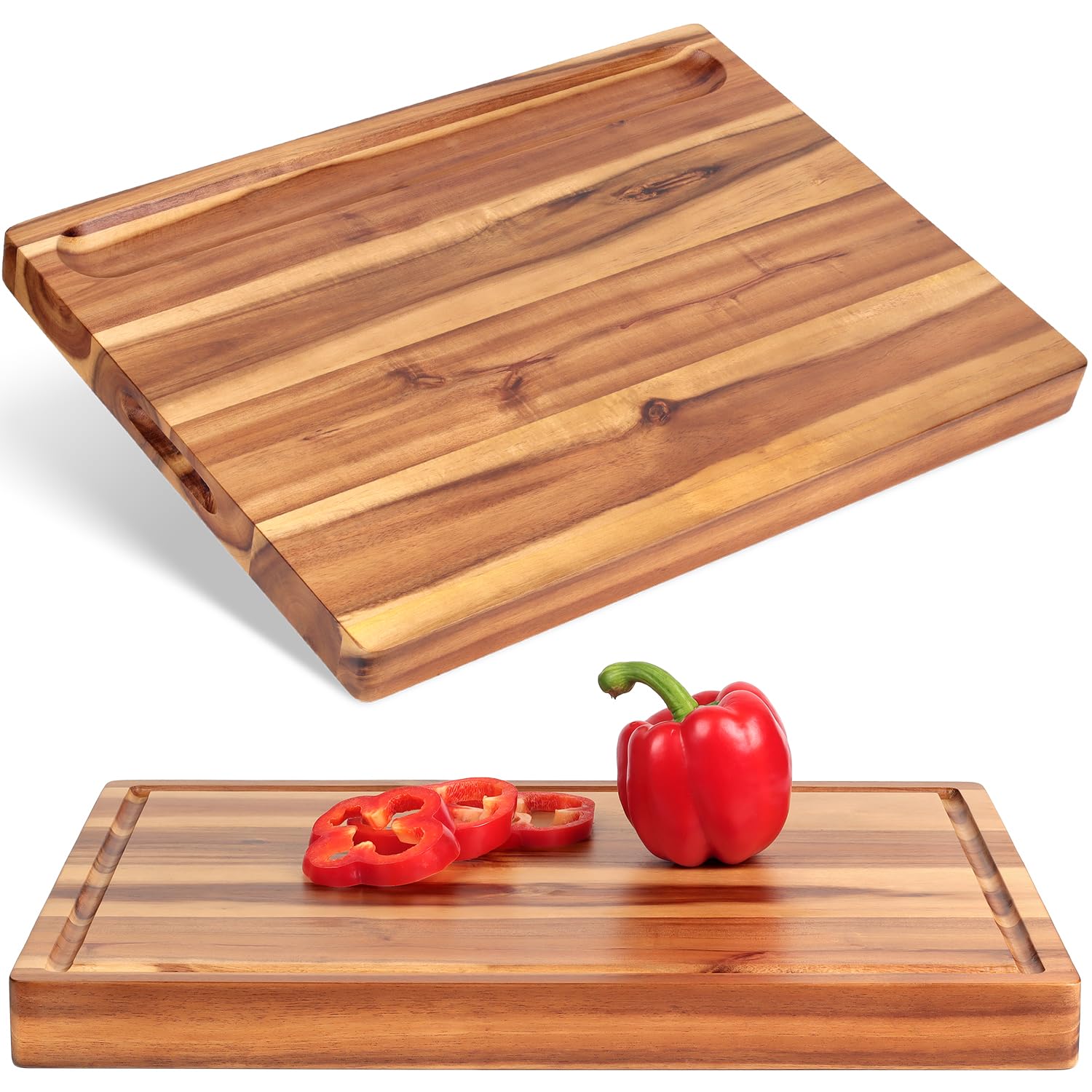
The FANICHI board at 17x13x1.5 inches is thick enough to resist warping under heavy cleaver work, and the full 1.5-inch depth gives it a reassuring heft that lighter boards simply lack. Made from 100% natural acacia wood with no paint or sealant, it avoids the chemical leaching concerns that come with cheaper composite surfaces. The front side has a skillfully carved juice groove that channels meat runoff, while the reverse side offers a flat plane perfect for cutting bread or cheese without fluid collection.
The inner side handles are cut directly into the wood, so they do not protrude and take up extra cabinet space. You can slide the board from counter to table without touching the cutting surface, which matters when you are carrying a pile of diced ingredients. At 3.22 kilograms, it is not a board you move idly, but that mass is what keeps it planted during aggressive chopping.
This board requires hand washing and occasional mineral oil treatment to maintain its natural grain appearance. The absence of a dishwasher-safe rating is the trade-off for real solid wood longevity, but for a premium-feel board at a mid-range price point, the construction quality punches well above its weight.
Why it’s great
- Thick 1.5-inch slab resists warping and absorbs knife impact
- Reversible design with juice groove on one side, flat on the other
- Natural acacia wood with no painted finish for food safety
Good to know
- Hand wash only; not dishwasher safe
- Requires periodic mineral oil conditioning
- At 3.22 kg, it is heavy for frequent repositioning
2. GAOMON Large Acacia Wood Cutting Board
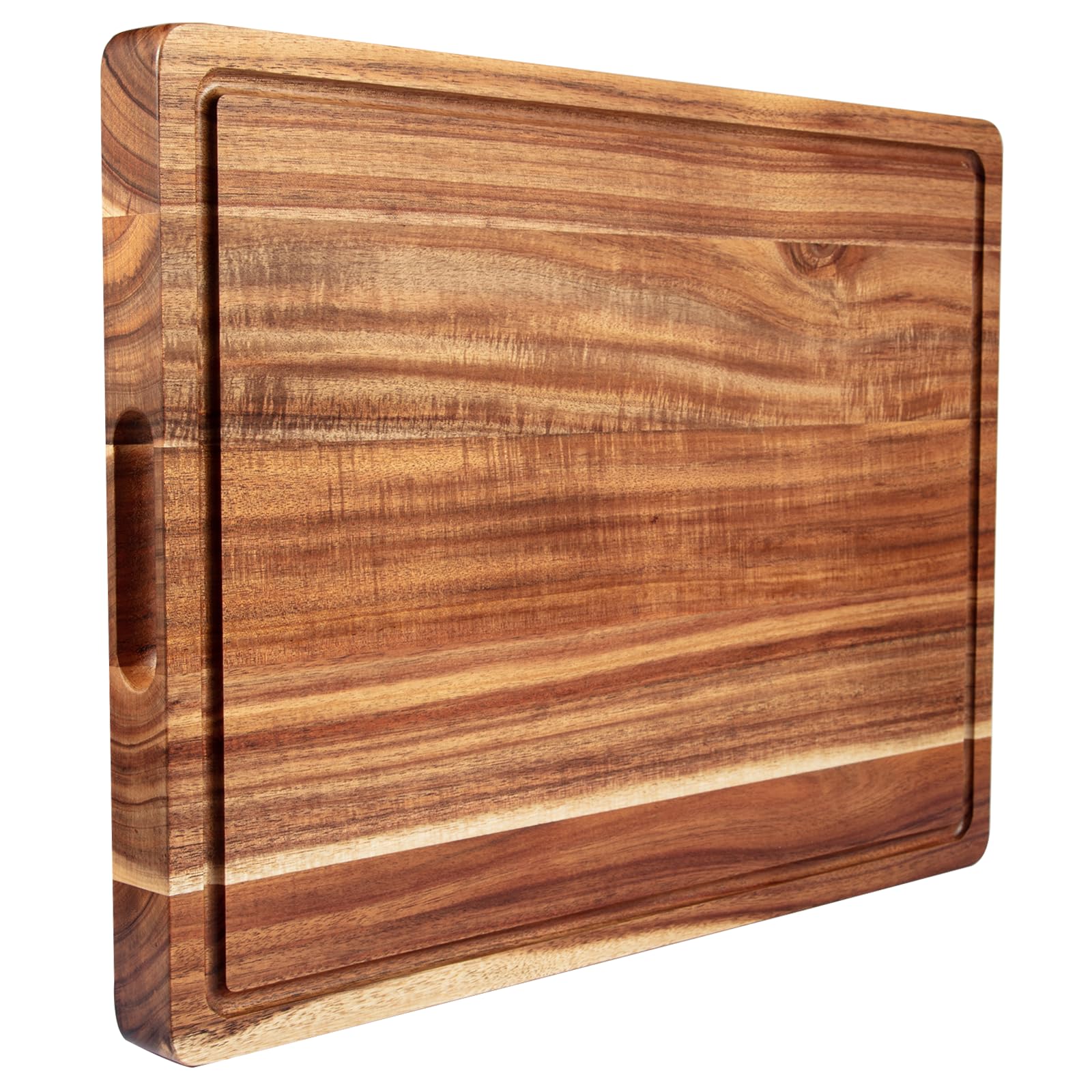
At 20×15 inches, the GAOMON board is the largest option in this roundup, offering enough real estate to carve a whole turkey or prep a multi-vegetable stir-fry in one go. The four-sided grooves run around the entire perimeter, which means juices from a resting roast are contained from any angle you rotate the board. The 1.5-inch thickness matches the FANICHI, giving it the same warp-resistant stability for heavy-duty slicing.
The inner handle design is similar to the FANICHI—carved directly into the side profile—but the GAOMON board feels slightly lighter at 4.4 kilograms despite being larger, likely due to the specific acacia density grade used. The surface is polished smooth without any burrs, and the natural wood grain gives it a serving-tray aesthetic that works for charcuterie or cheese presentation right on the countertop.
This board is strictly hand wash only, and the large surface area makes it a bit awkward to dry thoroughly if you do not have a large dish rack. However, for anyone who regularly cooks large-format proteins or bakes bread that needs a wide cooling plank, the extra square footage is a legitimate workflow advantage that smaller boards cannot replicate.
Why it’s great
- Massive 20×15 inch surface handles big roasts and multiple ingredients
- Deep four-sided juice grooves catch liquids from any angle
- Thick 1.5-inch acacia construction resists warping
Good to know
- Hand wash only and awkward to dry due to large size
- No reversible design; juice groove is only on one side
- Heavier than the FANICHI board despite being larger
3. AIDEA Acacia Wood Cutting Board Set

The AIDEA set gives you three boards—15×10, 12×8, and 9×6 inches—for a price that typically buys a single mid-range board. The acacia wood construction offers the same natural hardness and water resistance as the larger single boards, but the thin profile (roughly 0.75 inches thick) means these are more suited for quick prep and serving than heavy cleaver work. Each board includes a deep juice groove, a feature rarely found on budget-priced boards, which keeps countertops clean when slicing tomatoes or carving a small roast.
The 9×6 inch board is particularly useful as a travel board or a dedicated fruit station, preventing cross-contamination without needing a separate plastic board. The 15×10 inch board is large enough for a full loaf of bread or a family-size salad prep. The three sizes stack neatly, so they do not hog drawer space, and the light brown acacia grain looks presentable enough for cheese board service at a dinner party.
All three boards are hand wash only, and the thinner acacia may develop a slight curve over time if exposed to prolonged moisture. For the price, the set delivers the most surface area per dollar in this lineup, making it a smart choice for cooks who want dedicated boards for different tasks without spending for individual units.
Why it’s great
- Three acacia boards for the cost of one—excellent value
- Deep juice grooves on all three sizes
- Compact stacking design saves storage space
Good to know
- Thinner construction (around 0.75 inches) prone to warping over time
- Hand wash only; not dishwasher safe
- Smallest board may be too thin for heavy knife impact
4. Freshware Composite Wood Cutting Board Set

The Freshware boards are not traditional solid wood; they are made from compressed pine wood fibers fused under high heat, creating a dense composite surface that is remarkably heat resistant up to 350°F. This means you can rest a hot pan on the board without scorch marks, something you would never risk with a solid acacia or bamboo board. The set includes a 15×11.25 inch board and a 12×9 inch board, both only 0.2 inches thick, making them ultra-light and easy to hang from the built-in hole.
The big advantage here is dishwasher safety. You can toss both boards in the top rack after cutting raw chicken or garlic, and the high-temperature cycle will sanitize them without warping or cracking. The wood fiber surface is gentle on knife edges—softer than glass or plastic—so your blades stay sharper longer. At just 1 pound total for the set, they are also the most portable option if you cook in multiple locations or need a board for camping kitchens.
Because the boards are so thin, they do not absorb knife impact the way a thick solid wood board does. You will feel the cutting surface flex slightly under heavy pressure, and the boards are prone to sliding on slick countertops without a damp towel underneath.
Why it’s great
- Dishwasher safe for effortless sanitation
- Heat resistant up to 350°F—safe for hot pans
- Ultra-light at 1 pound total for both boards
Good to know
- Only 0.2 inches thick; flexes under heavy cutting pressure
- Prone to sliding on smooth countertops
- Composite material lacks the grain durability of solid wood
5. Keechee Dishwasher Safe Bamboo Cutting Board
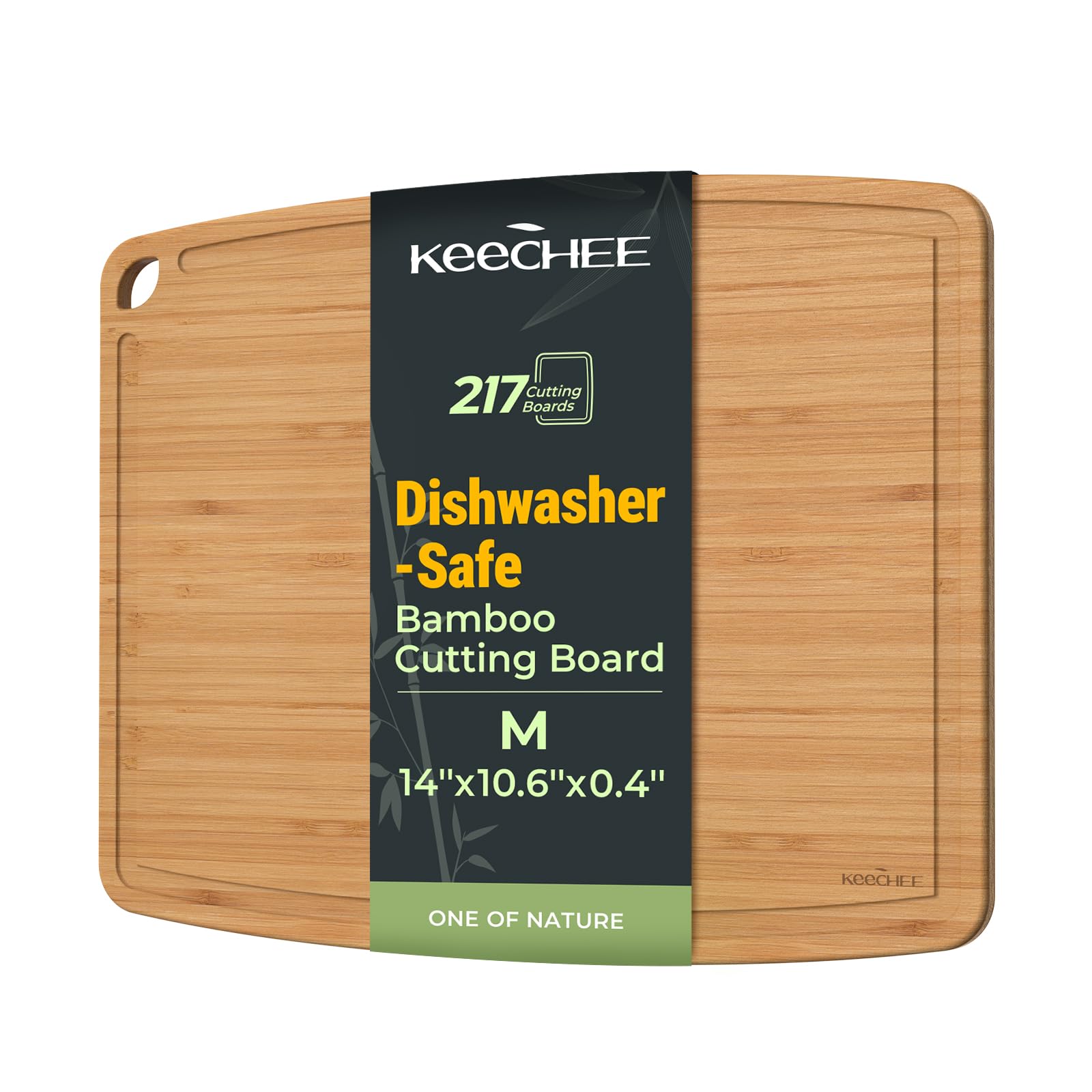
The Keechee board is made from bamboo, which is technically a grass that is harder than most domestic hardwoods but contains silica crystals that can accelerate knife edge wear. For home cooks using mid-range knives, this trade-off is often unnoticeable, but for those with high-carbon steel blades, it is a real consideration. The board is reversible, with a juice groove on one side for meat prep and a flat side for vegetables or bread, doubling its utility in a compact footprint.
Keechee markets this board as dishwasher safe, though bamboo’s natural moisture absorption means repeated dishwasher cycles may eventually cause splitting or delamination at the glue seams. For occasional top-rack cleaning, it should hold up fine, but hand washing will extend its life significantly. The board includes a hanging loop for storage, and the lightweight bamboo is easy to retrieve from a crowded cabinet.
The board thickness is not listed in the product data, but based on the category standard for budget bamboo boards, expect around 0.5 to 0.75 inches. This makes it slightly more substantial than the Freshware composite boards but still thinner than the solid acacia options. It is a good entry-level choice for someone who wants a natural wood look and the convenience of dishwasher cleaning without the higher price of a solid acacia board.
Why it’s great
- Reversible design with juice groove on one side
- Dishwasher safe for quick cleaning
- Lightweight bamboo is easy to handle and store
Good to know
- Bamboo may dull knife edges faster than acacia
- Dishwasher cycles may cause bamboo splitting over time
- Thinner than solid wood boards; less impact absorption
FAQ
Is a budget wooden cutting board safe for raw meat?
How often should I oil a budget wooden cutting board?
Can I put a budget wooden cutting board in the dishwasher?
Final Thoughts: The Verdict
For most users, the best budget wooden cutting board winner is the FANICHI Acacia Board because it delivers solid 1.5-inch acacia construction, a reversible juice groove design, and genuine warp resistance at a price that undercuts most solid wood boards. If you want maximum surface area for big carving projects, grab the GAOMON Large Acacia Board for its 20×15 inch prep zone. And for quick, dishwasher-safe cleanup with heat resistance, nothing beats the Freshware Composite Set.