The search for a value cooler often leads to a frustrating trade-off: cheap plastic that leaks warm air by noon on day two, or a rotomolded beast that costs as much as a weekend vacation. Most buyers assume a cooler is just an insulated box, but the real difference lies in construction density, gasket seal quality, and the cubic feet of polyurethane foam between your ice and the 90°F sun.
I’m Mohammad Maruf — the founder and writer behind AirfryerBite. I’ve spent over a decade analyzing thermal retention tests, rotomolding versus injection-molded construction, and real-world ice life data across hundreds of hard coolers to separate marketing claims from measurable performance.
This guide breaks down seven hard coolers spanning mid-range workhorses and premium rotomolded tanks so you can find a value cooler that actually holds ice for days without draining your wallet.
How To Choose The Best Value Cooler
The hard cooler market splits into three construction tiers: injection-molded budget units, mid-range coolers with improved insulation, and rotomolded premium chests. A true value cooler sits in the sweet spot where ice life meets a reasonable weight and feature set.
Construction Method — Rotomolded vs Injection-Molded
Rotomolded coolers use rotational molding to create a single, seamless polyethylene shell with uniform wall thickness. This process costs more but produces a cooler that can double as a bench or withstand bear-grade abuse. Injection-molded coolers use two halves joined together; they’re lighter and cheaper but more prone to hinge failure and heat transfer at the seam. If you plan to haul the cooler in a truck bed or leave it on a boat, rotomolded construction is the better long-term investment.
Insulation Density and Gasket Quality
Ice retention depends on two factors: the thickness of the polyurethane foam and the seal of the lid gasket. Coolers with 2 inches of closed-cell foam can hold ice for 10 days; coolers with thinner, open-cell foam might last 3 days. A freezer-style rubber gasket is far superior to a simple foam strip because it compresses and blocks external heat. Never judge ice life by the brand’s “up to X days” claim — check the foam thickness in the technical specs.
Real Capacity vs Can Count
A 100-quart cooler should hold roughly 160 cans, but that number assumes no ice. The usable capacity shrinks by nearly half when you add a 20-pound bag of ice. For weekend trips with four people, a 100-quart cooler is the minimum. For a family of six or a multi-day fishing trip, 110–120 quarts gives you the buffer you need without requiring a second cooler.
Quick Comparison
On smaller screens, swipe sideways to see the full table.
| Model | Category | Best For | Key Spec | Amazon |
|---|---|---|---|---|
| Igloo Maxcold Glide 110Qt | Mid-Range | Everyday camping with easy rolling | 6-day ice retention at 90°F | Amazon |
| RTIC 110 QT Ultra-Tough | Premium | Extreme durability and ice life | 2.6 inches closed-cell foam | Amazon |
| Grizzly 100 Cooler | Premium | Lifetime warranty, US-made | 2 inches Ecomate polyurethane | Amazon |
| Blue Coolers Ark Series 110Qt | Premium | Maximum ice retention (10 days) | 2 inches polyurethane foam | Amazon |
| Igloo Polar 120Qt | Mid-Range | Large capacity on a budget | 120-quart capacity (168 cans) | Amazon |
| Coleman Classic 100Qt | Budget | Affordable rolling cooler | 5-day ice retention | Amazon |
| Coleman Marine 100Qt | Budget | UV-resistant use on boats | Antimicrobial liner | Amazon |
In‑Depth Reviews
1. Igloo Maxcold Glide 110Qt Wheeled Cooler

The Igloo Maxcold Glide strikes the hardest-to-find balance in this category: a 110-quart capacity, six-day ice retention at 90°F, and a wheeled design with a horizontal telescoping handle that makes transport genuinely easy. The Ultratherm polyurethane foam insulation is denser than the standard Igloo Polar series, which translates to noticeably longer ice life during a three-day campout without requiring rotomolded weight.
Stainless-steel hinges paired with a hybrid latch keep the lid sealed, and the threaded drain plug accepts a standard garden hose for quick draining. The built-in ruler on the lid is a nice bonus for anglers who want to measure their catch. At roughly 25 pounds dry, this cooler is light enough for one person to load into a SUV, yet rugged enough to handle gravel lot adventures.
Where it sacrifices is in absolute brute force — it won’t survive being dropped off a tailgate the way a rotomolded unit will. But for the vast majority of weekend campers, beach-goers, and tailgaters, the Maxcold Glide delivers premium-level insulation at a mid-range investment. It is the definition of a value cooler: strong cooling where it counts.
Why it’s great
- Six-day ice retention rivals premium coolers at a lower cost
- Horizontal telescoping handle and soft-ride wheels are easy to maneuver
- Stainless-steel hinges resist corrosion better than plastic alternatives
Good to know
- Not rotomolded so it won’t survive extreme impacts
- Lid gasket is a foam strip, not a rubber seal
- Can capacity (168 cans) is theoretical without ice factored in
2. RTIC 110 QT Ultra-Tough Cooler
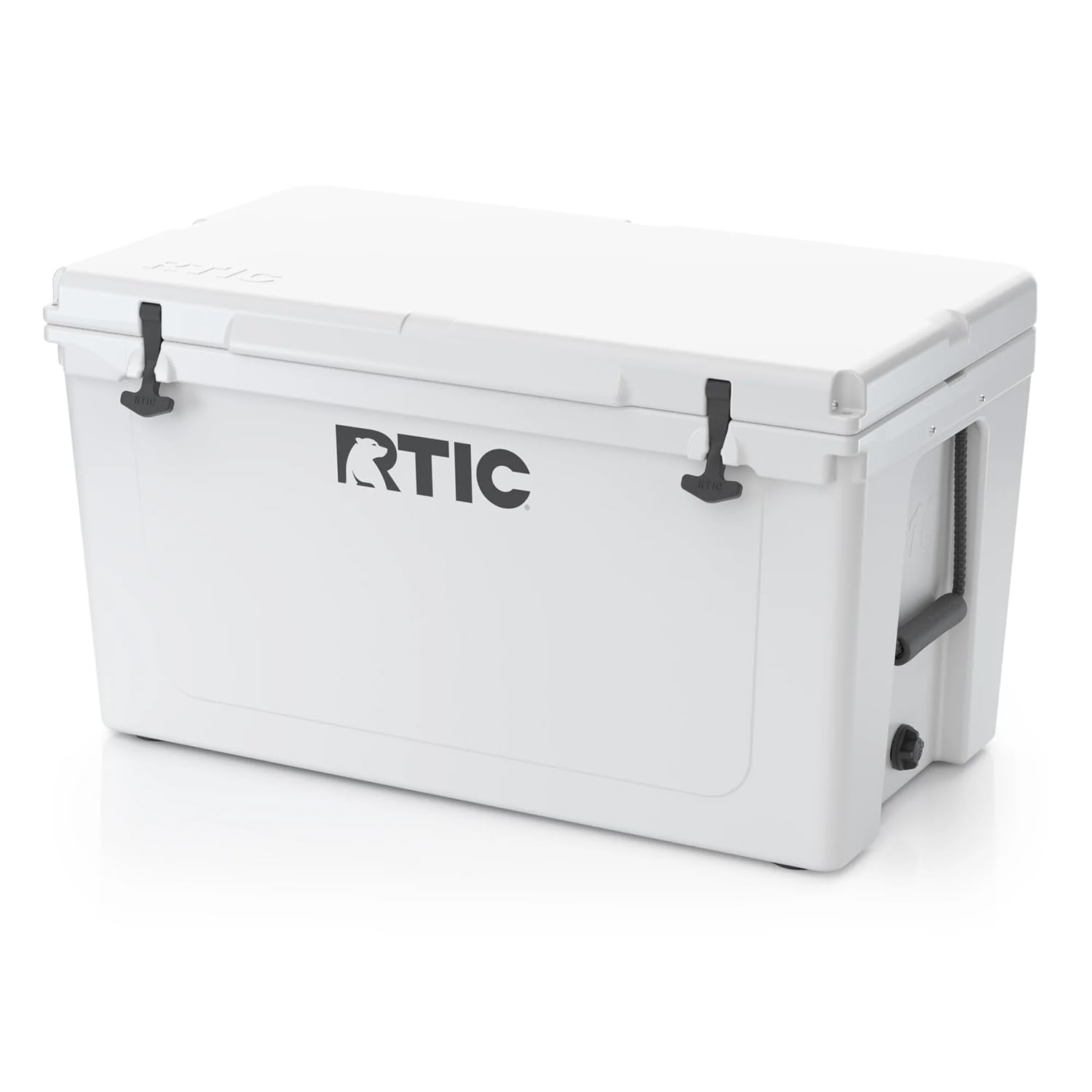
The RTIC Ultra-Tough is a rotomolded cooler built with 2.6 inches of closed-cell polyurethane foam — thicker than most competitors in this class. That extra foam translates to impressive ice retention that can stretch past a week if you pre-chill the cooler and use block ice. The 110-quart version holds up to 130 cans and weighs 47.8 pounds dry, making it a permanent fixture on job sites, boat decks, or truck beds.
Heavy-duty rope handles are the primary carry mechanism, and there are no wheels on this model. That’s a deliberate trade-off: the rotomolded shell is essentially indestructible, but you will not want to drag it across sand or gravel. The freezer-style rubber gasket is far superior to the foam strips found on mid-range coolers, creating a near-airtight seal that blocks external heat transfer.
The downside is weight and maneuverability. At nearly 50 pounds empty, this cooler demands two people to load when fully packed. But if your priority is keeping meat cold for a week-long hunting trip or storing drinks on a hot construction site, the RTIC’s insulation thickness and rotomolded toughness make it a serious contender for anyone looking at a value cooler with performance-heavy specs.
Why it’s great
- 2.6 inches of closed-cell foam outperforms most coolers at any price
- Rotomolded construction is nearly indestructible
- Rubber gasket seals better than foam alternatives
Good to know
- No wheels; at 47.8 pounds it is a heavy hauler
- Rope handles can be hard on hands when fully loaded
- Limited color options compared to other premium brands
3. Grizzly 100 Cooler
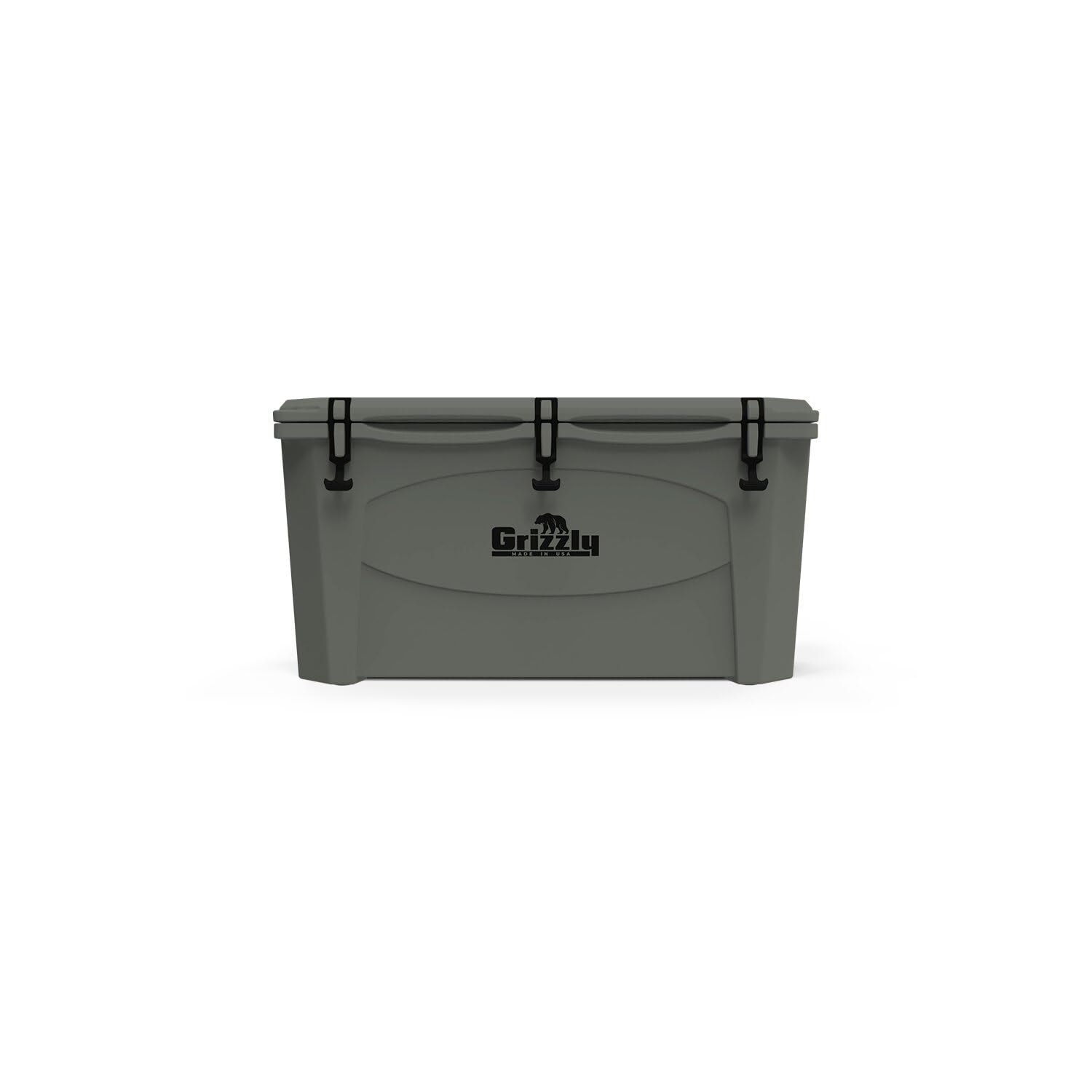
The Grizzly 100 is rotomolded in the USA from LLDPE plastic and pressure-injected with two inches of Ecomate polyurethane foam — an insulation with zero ozone depletion potential and no VOCs. The 100-quart capacity holds 95 cans with 30 pounds of ice, and the rubber lid gasket creates a compression seal that keeps cold air trapped inside. This cooler is for the buyer who wants a single purchase that lasts decades.
The dry weight of 38 pounds is lighter than the RTIC 110, which makes it slightly more manageable for two-person loading. Non-skid feet keep it from sliding around in a truck bed, and the integrated tie-down loops are molded into the shell rather than bolted on. Grizzly backs this cooler with a lifetime warranty — if it breaks, they replace it, no questions asked.
The catch is price: the Grizzly 100 sits in the premium tier and doesn’t include accessories like a dry goods tray (sold separately). The external dimensions are also slightly bulkier than equivalent Igloo or Coleman models, so measure your vehicle’s cargo space before buying. Still, for anyone who wants American-made rotomolded construction with a no-hassle lifetime warranty, this is a value cooler in the truest sense — you pay once and it outlasts everything else you own.
Why it’s great
- Made in the USA with a lifetime warranty
- Ecomate foam is environmentally friendly and thermally efficient
- Rubber gasket provides a superior compression seal
Good to know
- No wheels and relatively heavy at 38 pounds
- Dry goods tray is an extra-cost accessory
- External dimensions are larger than some 100-quart competitors
4. Blue Coolers Ark Series 110Qt (Wheeled)
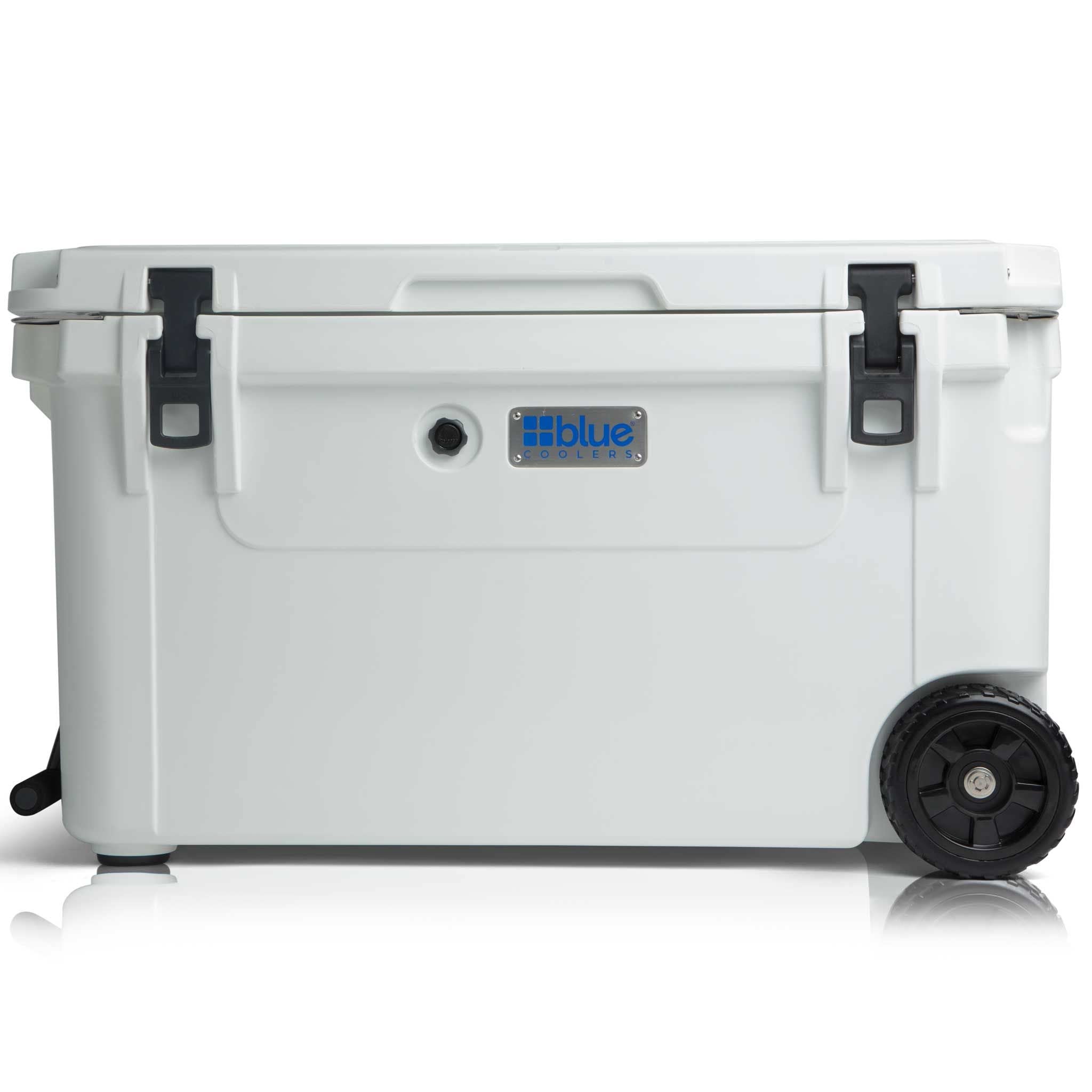
The Blue Coolers Ark Series claims up to 10 days of ice retention thanks to two inches of polyurethane foam inside a rotomolded HDPE shell. This is the only cooler in this lineup that explicitly markets a double-digit day count in ideal conditions, and the wheeled version makes the 46-pound dry weight far more practical for beach or campground use compared to a non-wheeled rotomolded cooler.
Features include a freezer-style gasket, lockable lid, non-skid feet, sure-grip rope handles, and a rapid drain system. The utility port allows you to run a hose or cable through the wall without breaking the seal, which is a thoughtful detail for anglers who want to keep bait cold while running a pump. The 110-quart capacity holds roughly 130 cans with ice.
The trade-off is that this cooler is massive — 34 inches long and 22 inches tall. Blue Coolers explicitly states the Ark Series is “intended to be filled up and stay in place.” You will not want to move it daily. For destination camping or as a base-camp cooler for a week-long trip, the Ark Series offers the longest ice life in this comparison. If you need a cooler that moves in and out of a vehicle frequently, the weight and size may be a dealbreaker.
Why it’s great
- Industry-leading 10-day ice retention with proper pre-chilling
- Wheeled version makes the 46-pound weight manageable
- Lockable lid and utility port add serious utility for remote trips
Good to know
- Massive dimensions make it difficult for daily transport
- Rope handles are tough on hands when fully loaded
- Premium pricing positions it as a specialty tool rather than an everyday cooler
5. Igloo Polar 120Qt Hard Cooler

The Igloo Polar 120Qt is the largest-capacity cooler in this roundup, offering 120 quarts of storage for up to 168 cans. Despite the size, it weighs only 12 pounds — a remarkably low number that comes from its injection-molded construction. UV inhibitors in the lid prevent sun damage during extended outdoor exposure, and the stain- and odor-resistant liner simplifies cleanup after a weekend of raw meat and fish.
The threaded drain plug accepts a standard garden hose for convenient draining, and the reinforced swing-up handles include tie-down loops for securing the cooler in a truck bed. Dual snap-fit latches close the lid firmly, though the gasket is a foam strip rather than a rubber seal, which means ice life is shorter than rotomolded options.
This cooler is best for large gatherings where you need to pack drinks for 20 people, or for campsite use where weight matters because you’re hauling the cooler a short distance. It will hold ice for roughly 3 days in 90°F conditions. The 12-pound dry weight is a huge advantage — one person can easily lift and position it — but the thin walls mean it won’t keep ice through a multi-day expedition. For the price, you get an enormous volume of cold storage with surprisingly easy portability.
Why it’s great
- Huge 120-quart capacity at a very accessible price point
- Weighs only 12 pounds — easy for one person to handle
- UV inhibitors and stain-resistant liner add durability
Good to know
- Foam gasket and thin walls limit ice retention to ~3 days
- Injection-molded seams are potential failure points over time
- No wheels; carry handles only
6. Coleman Classic Series 100-Quart Rolling Cooler
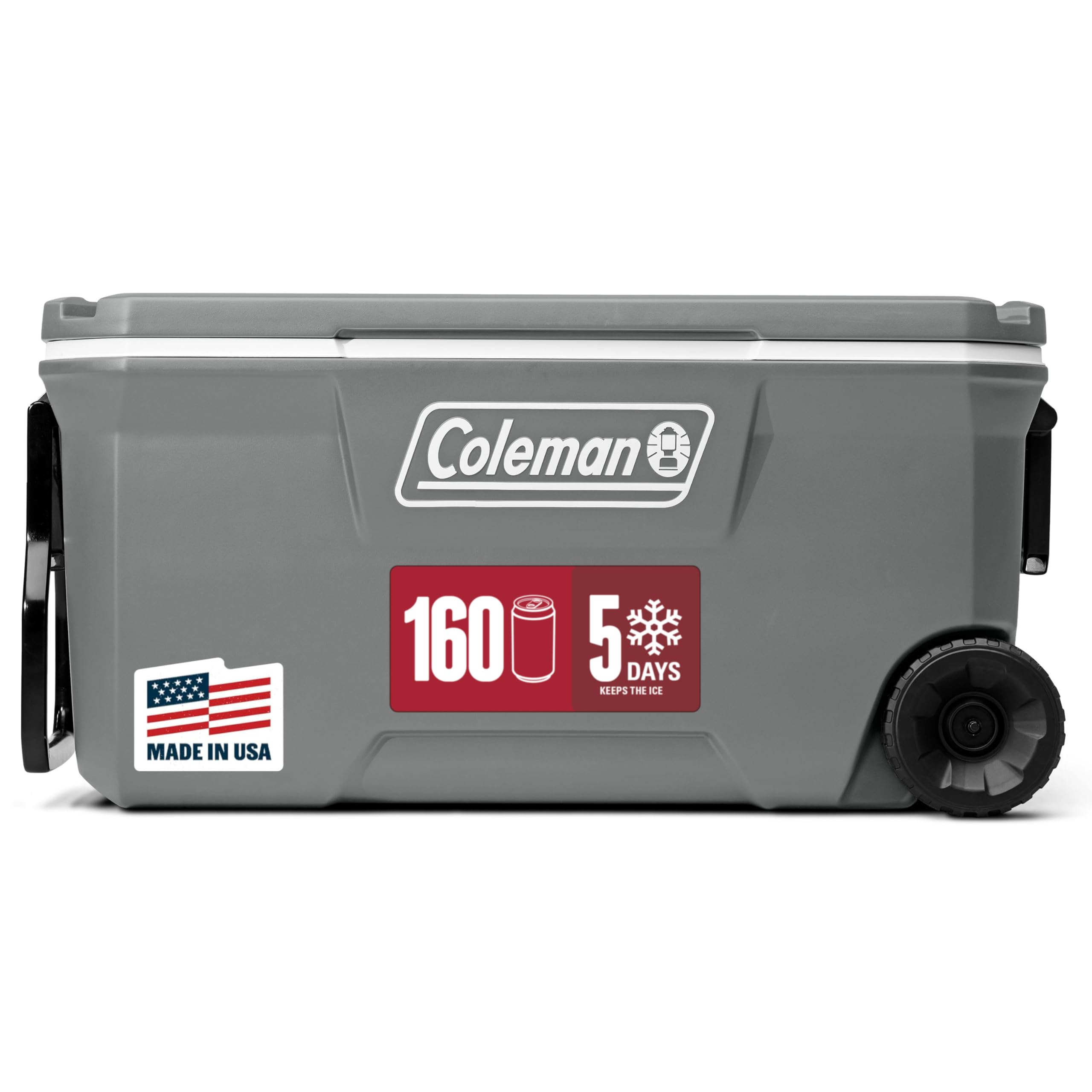
The Coleman Classic 100-Quart is the most budget-friendly rolling cooler in this comparison, offering a 100-quart capacity (160 cans), heavy-duty 6-inch wheels, and a lid that supports up to 250 pounds as a seat. The polyurethane foam insulation is rated for 5 days of ice retention at 90°F, and the stain-resistant liner with a leakproof channel drain plug simplifies cleaning. Molded cup holders in the lid fit 30-ounce tumblers.
The injection-molded construction keeps the weight at 20 pounds — manageable for one person — and the recessed lip on the lid improves access to contents when the cooler is fully packed. The tow handle and swing-up handle are sturdy enough for loading into a car trunk, though they feel less robust than the Igloo Maxcold’s telescoping mechanism.
Ice retention is the main compromise here. Five days is the optimistic claim; in real-world use with frequent opening, expect ice to last 2–3 days. The foam gasket is a simple strip, and the lid seal is not as tight as a rubber gasket. This cooler is a solid choice for afternoon barbecues, day trips to the lake, or as a backup cooler for overflow drinks. It represents the entry point where you get wheels and decent capacity without a premium investment.
Why it’s great
- Affordable rolling cooler with 6-inch wheels and seat lid
- Light at 20 pounds for a 100-quart cooler
- Molded cup holders fit large tumblers
Good to know
- Real-world ice life is closer to 3 days than 5
- Injection-molded construction is less durable than rotomolded
- Lid seal is a basic foam strip, not a freezer gasket
7. Coleman Marine 100-Quart Cooler
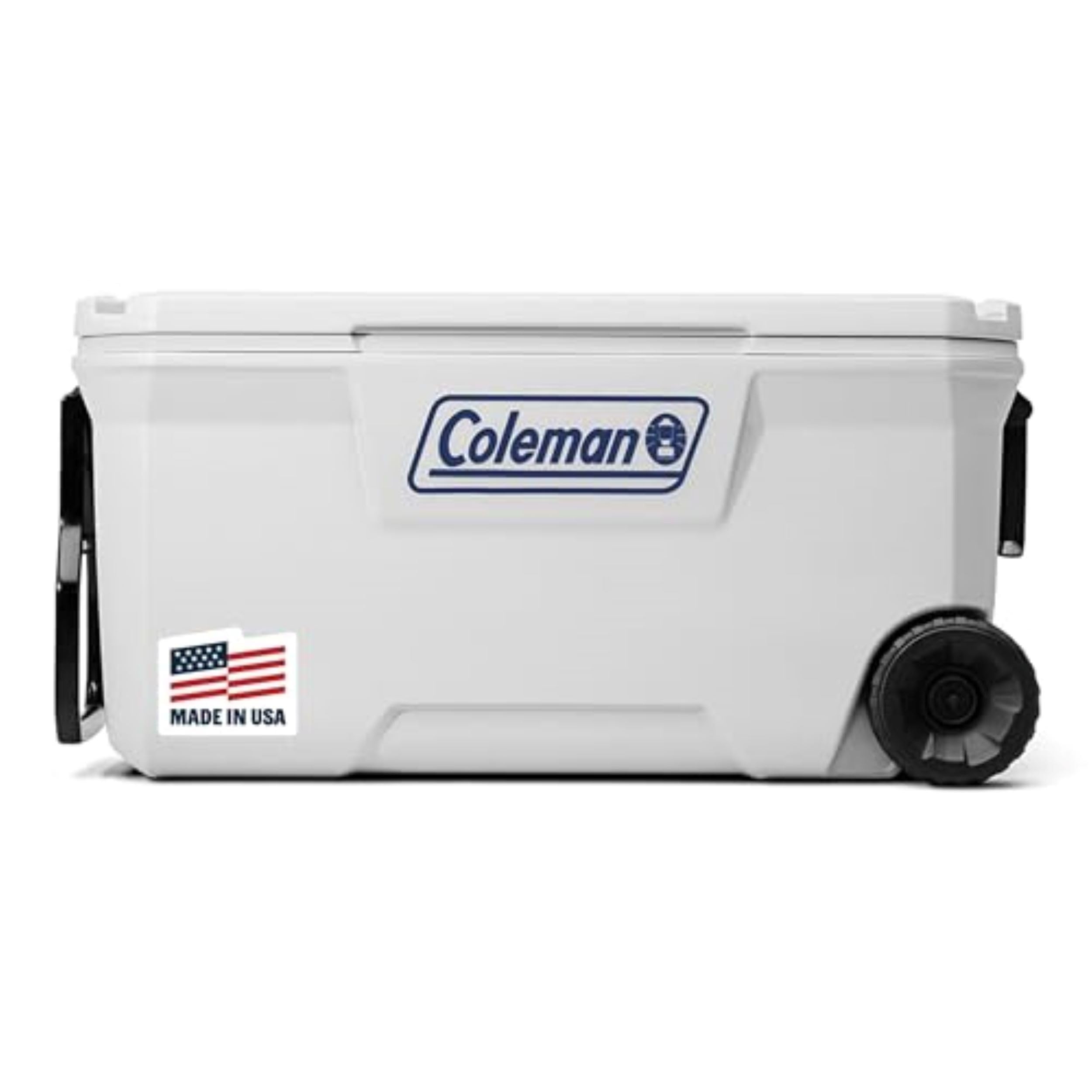
The Coleman Marine 100-Quart is built specifically for wet, sunny environments. It shares the same 100-quart shell as the Classic series but adds a UV Guard coating on the lid and body to protect against sun damage, plus rust-resistant stainless steel hardware that won’t corrode in saltwater air. The antimicrobial and stain-resistant liner actively resists odor, mold, and mildew — a crucial feature for a cooler that stays on a boat deck.
Ice retention is rated at up to 5 days in 90°F conditions, and the 100-quart capacity holds 160 cans. The leakproof channel drain plug works reliably, and the lid doubles as a 250-pound capacity seat. Cup holders fit 30-ounce tumblers, and a built-in ruler on the lid gives anglers a way to measure fish. The 17.7-pound dry weight is remarkably light for a 100-quart cooler.
The trade-off is similar to the Classic series: injection-molded construction with a foam gasket means you should not expect 5-day ice retention with frequent lid opening. The Marine cooler is best for day trips on the water, beach outings, or any environment where UV exposure and corrosion are primary concerns. For the buyer who needs a value cooler that survives the marine environment without rotomolded weight or cost, this is the right pick.
Why it’s great
- UV Guard coating and stainless steel hardware resist marine corrosion
- Antimicrobial liner prevents mold and mildew buildup
- Light weight (17.7 pounds) makes boat loading easy
Good to know
- Same ice retention limitations as the Classic series
- No wheels despite the 100-quart size
- Lid seal is foam, not rubber
FAQ
How do I calculate the real usable capacity of a value cooler?
Does a rubber gasket really make that much difference in ice retention?
Should I get a wheeled cooler or a non-wheeled rotomolded cooler?
What is the practical difference between 100-quart and 120-quart capacity?
Final Thoughts: The Verdict
For most users, the value cooler winner is the Igloo Maxcold Glide 110Qt because it delivers six-day ice retention, a smooth-rolling wheeled design, and a mid-range investment that undercuts rotomolded prices by hundreds while still keeping your drinks cold through a long weekend. If you want maximum ice life for a week-long expedition, grab the Blue Coolers Ark Series 110Qt. And for a budget-friendly wheeled hauler for day trips and tailgates, nothing beats the Coleman Classic 100-Quart.