Choosing a gyuto knife means understanding that steel type, blade geometry, and handle balance define performance far more than brand logos or flashy damascus patterns. Whether you are breaking down proteins or precision-slicing vegetables, the gyuto’s versatility demands a blade that holds its edge through repetitive tasks without compromising control. The wrong choice leads to frequent sharpening, fatiguing grip, or chipped edges.
I’m Mohammad Maruf — the founder and writer behind AirfryerBite. I have spent years analyzing kitchen steel metallurgy, blade construction methods, and handle ergonomics to identify the concrete specs that separate enthusiast-grade gyuto knives from ordinary chef’s knives.
This article breaks down seven gyuto knives across mid-range and premium tiers, focusing on core steel chemistry, heat treatment quality, edge angle precision, and handle materials that matter. Whether you need a daily workhorse or a high-end long-term investment, this guide to finding the best gyuto knife will help you decide based on real engineering, not marketing claims.
How To Choose The Best Gyuto Knife
A gyuto knife is a Japanese-style chef’s knife designed for all-purpose cutting, slicing, and chopping. Unlike a Western chef’s knife, the gyuto typically features a thinner blade, a flatter edge profile, and a sharper edge angle for cleaner cuts with less resistance. Understanding a few key parameters will prevent the most common disappointment: a knife that feels great out of the box but dulls within weeks.
Steel Core and Hardness Rating
The steel core determines how long the blade stays sharp and how easily it can be resharpened. Most gyuto knives use powdered or high-carbon stainless steels like VG10, which typically hits an HRC of 58-61. Higher HRC (60+) means longer edge retention but increases brittleness — avoid bones and frozen foods. Lower HRC (58-59) offers more toughness and easier sharpening. Cobalt alloy steel, like what Tojiro uses, provides a unique balance of hardness and corrosion resistance.
Edge Angle and Grind
Gyuto knives are typically sharpened to 12-15 degrees per side, significantly narrower than Western chef’s knives (20 degrees). This acute angle produces exceptional slicing performance but requires more care during use. A V-shaped edge that is hand-polished on both sides, as seen in HOSHANHO’s design, delivers consistent cutting geometry. Convex grinds offer better food release while hollow grinds reduce sticking — choose based on whether you cut more proteins or dense vegetables.
Handle Shape and Material
The standard gyuto handle shape is octagonal (hachikaku), which allows four different grip positions and reduces wrist fatigue during long prep sessions. Rosewood handles offer natural moisture resistance and aesthetic warmth, while Micarta and G10 handles provide superior durability against heat, moisture, and impact. A balanced knife should feel handle-heavy or neutral — never blade-heavy — for controlled rock-chopping and push-cutting.
Quick Comparison
On smaller screens, swipe sideways to see the full table.
| Model | Category | Best For | Key Spec | Amazon |
|---|---|---|---|---|
| Enso HD Series Gyuto | Premium | Daily high-volume prep | VG10 Hammered Damascus, 8″ | Amazon |
| Yaxell Mon Gyuto | Mid-Range | First premium Japanese knife | VG10 Steel, Micarta Handle | Amazon |
| KYOKU Shogun Series | Mid-Range | Budget-friendly damascus | 67-layer VG10, 8-12° edge | Amazon |
| KAWAHIRO VG10 Gyuto | Premium | Razor-edge enthusiasts | VG10, Octagonal Handle | Amazon |
| Shun Kanso Chef’s Knife | Premium | Lightweight all-purpose | 8″ Blade, Ergonomic Handle | Amazon |
| Tojiro Fujita Takako FU-809 | Mid-Range | Longer 9.4″ blade users | Cobalt Alloy, 240mm | Amazon |
| HOSHANHO 10Cr15CoMoV Gyuto | Mid-Range | Traditional forging budget pick | 9-Layer High Carbon Steel | Amazon |
In‑Depth Reviews
1. Enso HD Series Gyuto – 8″

The Enso HD Series gyuto uses VG10 stainless steel clad in 69 layers of hammered damascus, producing a blade that combines high hardness (HRC 60-61) with eye-catching aesthetics. The hammered finish reduces food sticking during slicing tasks — a practical advantage for high-volume prep. At 8 inches, the blade length hits the sweet spot between maneuverability and edge coverage for most home and professional kitchens.
The handle is constructed from a laminated reinforced material that withstands moisture and thermal cycling better than natural wood. The bolsterless design allows the full blade edge to be sharpened easily, extending the usable life of the knife. Many users report the factory edge lasts several months of regular use before needing a touch-up on a whetstone.
The overall balance sits just behind the pinch grip area, reducing wrist fatigue during extended cutting sessions. The included presentation box makes this a strong candidate for gifting, though the real value lies in the consistent edge geometry and corrosion resistance. This is a knife that rewards proper maintenance with years of reliable performance.
Why it’s great
- High HRC 60-61 VG10 core holds edge exceptionally well
- Hammered damascus cladding reduces food sticking
- Bolsterless design simplifies full-edge sharpening
Good to know
- Hand wash only — dishwasher will damage the handle
- Not suitable for cutting bones or frozen foods
2. Yaxell Mon 8″ Gyuto

The Yaxell Mon gyuto delivers the core performance of VG10 steel at a mid-range price point, making it a strong entry into Japanese knife ownership without breaking the budget. The blade is forged from VG10 stainless steel and ground to a sharp edge that performs well on vegetables, boneless proteins, and fish. The Micarta handle offers excellent grip even when hands are wet or greasy, and it is far more durable than standard Pakkawood handles found at similar price points.
Knife enthusiasts appreciate the full-tang construction and the balanced weight distribution that makes push-cutting through dense produce feel effortless. The blade measures 8 inches, which is ideal for cooks who want the agility of a shorter blade but still need enough length to slice through large squash or melons. The fit and finish are consistent, with no gaps between the handle and tang.
One notable detail is the heat treatment process that Yaxell applies to the VG10 core, which targets an HRC of 58-59. This slightly lower hardness improves toughness and reduces chipping risk compared to harder VG10 blades, making this a forgiving knife for cooks who are still developing their technique. The included sheath is basic but functional for storage.
Why it’s great
- Micarta handle is highly durable and moisture-resistant
- HRC 58-59 provides toughness with good edge retention
- Balanced weight ideal for push-cutting
Good to know
- Sheath is basic and may not fit securely over time
- Factory edge may need a quick hone before first use
3. KYOKU Shogun Series 8″ Gyuto

The KYOKU Shogun series gyuto packs a 67-layer damascus VG10 blade into a package that undercuts most competitors by a significant margin. The blade is sharpened to an 8-12 degree edge using the traditional Honbazuke method, resulting in a razor-sharp factory edge that slices through tomatoes and boneless chicken with minimal resistance. The 58-60 HRC rating places it in a sweet spot where edge retention is strong but the blade remains tough enough for general kitchen use.
The fiberglass handle with a mosaic pin provides solid grip and resists environmental damage from heat, moisture, and corrosion. The included sheath and case add genuine storage value that many knives in this price range skip entirely. The overall weight is 1.39 pounds, which gives the knife a reassuring heft without feeling blade-heavy during use.
Some users note that the Damascus pattern is more decorative than functional, but at this price point, the combination of VG10 steel, cryogenic treatment, and included accessories makes the KYOKU a compelling choice for budget-conscious cooks who still want the look and feel of a Japanese gyuto. The edge angle is extremely acute, so avoid hard chopping boards and never use this knife on bones.
Why it’s great
- Very sharp 8-12 degree edge from Honbazuke sharpening
- Includes sheath and storage case
- Cryogenically treated VG10 for improved edge stability
Good to know
- Damascus pattern is surface-level decorative
- Handle may feel slightly thick for smaller hands
4. KAWAHIRO VG10 Gyuto – 8″
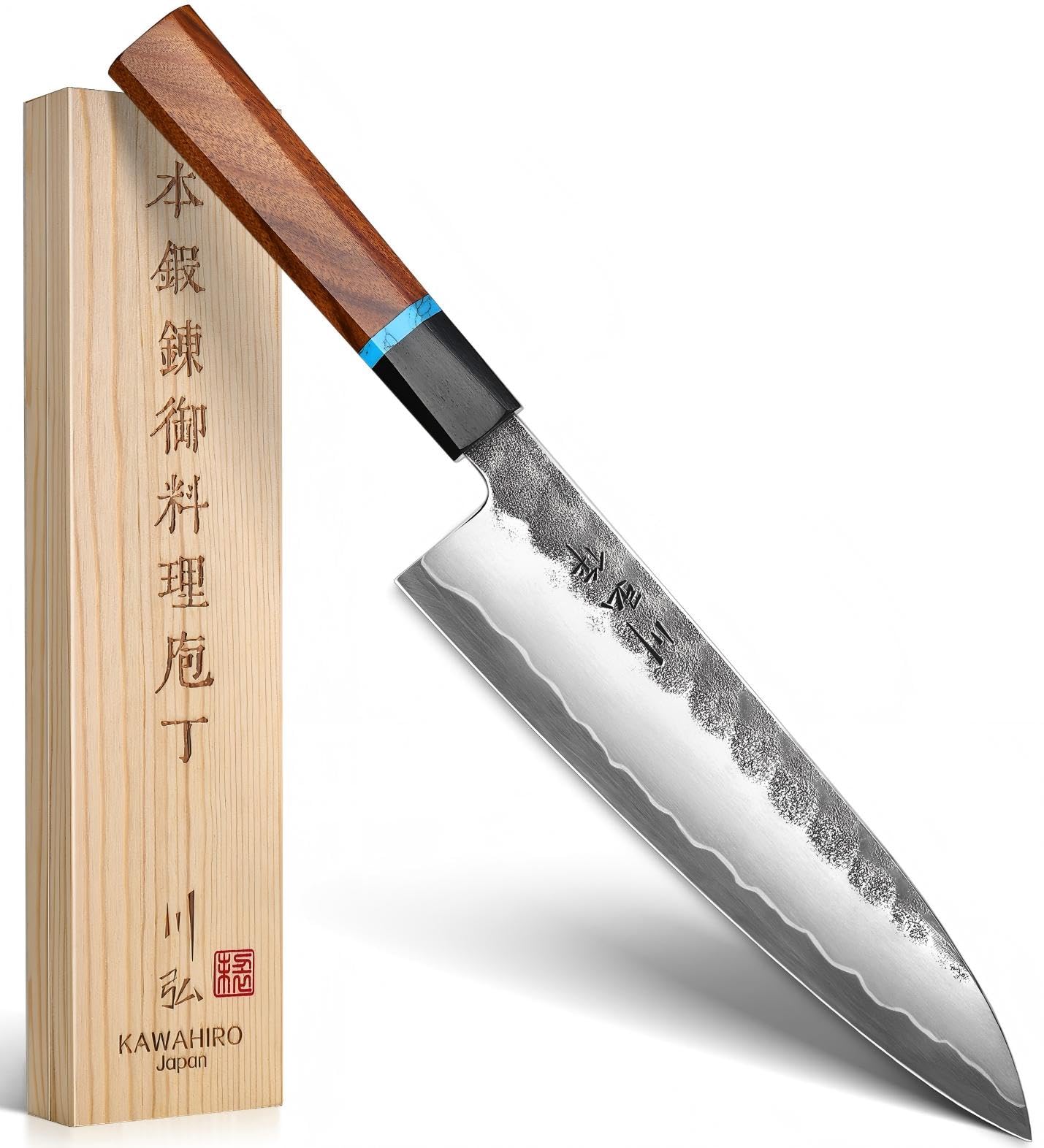
The KAWAHIRO gyuto features a VG10 core that is hand-forged and ground to a razor-sharp edge, designed for effortless slicing through meat and dense vegetables. The blade measures 8 inches and is clad in stainless steel for improved corrosion resistance while maintaining a hard cutting core. The octagonal handle shape follows traditional Japanese ergonomics, allowing four distinct grip positions that reduce fatigue during long prep sessions.
Each knife comes in a premium gift box, making it a suitable option for gifting to serious home cooks or culinary students. The blade is ground symmetrically on both sides (50/50), which makes it easy for right-handed and left-handed users alike to sharpen on a standard whetstone. The overall finish is clean with no visible glue lines or gaps at the handle junction.
Users familiar with heavier German-style chef knives will notice the lighter weight and thinner blade profile immediately, requiring a slight adjustment in cutting technique. The thinner blade means less wedging in dense ingredients like potatoes or carrots, but it also demands more careful handling to avoid bending the edge. The KAWAHIRO rewards precision cutting with cleaner results.
Why it’s great
- Octagonal handle provides excellent grip versatility
- Symmetrical 50/50 grind suits both hand orientations
- Premium gift box presentation
Good to know
- Thin blade requires careful use to avoid edge damage
- Not ideal for heavy chopping or root vegetable halving
5. Shun Kanso 8″ Chef’s Knife

The Shun Kanso series strips away the traditional damascus cladding in favor of a minimalist, lightweight design that prioritizes performance over ornamentation. The blade is made from high-carbon stainless steel and features a thin grind that excels at precise slicing and mincing. The handle is ergonomically shaped to reduce pressure points during prolonged use, making it a favorite among cooks who spend hours at the cutting board.
At 8 inches, the blade offers enough length for large slicing tasks while maintaining the nimble feel that Shun is known for. The edge is sharpened to a narrow angle that produces clean cuts through delicate ingredients like raw fish and ripe tomatoes without compressing the flesh. The knife is noticeably lighter than many similarly sized gyutos, which helps reduce arm fatigue.
The Kanso series is made in Japan and benefits from Shun’s established heat treatment processes that yield consistent hardness across the blade. Some users note that the handle material, while comfortable, is less durable than Micarta or G10 and may show wear faster with frequent washing. This knife is best suited for cooks who prioritize featherlight handling over rugged durability.
Why it’s great
- Very lightweight design reduces arm fatigue
- Thin grind excels at precise slicing
- Consistent heat treatment from established Japanese maker
Good to know
- Handle material is less durable than synthetic options
- Not as visually striking as damascus-pattern knives
6. Tojiro Fujita Takako FU-809

The Tojiro FU-809 is a 240mm (9.4-inch) gyuto that offers a longer blade than standard 8-inch models, making it ideal for cooks who need extra edge length for slicing large roasts, melons, or multiple ingredients at once. The core material is cobalt alloy steel, which delivers high wear resistance and maintains a sharp edge longer than many standard stainless steels. The sides are clad in 13-chrome stainless steel for corrosion protection.
The handle is constructed from a laminated reinforced material that provides a secure grip and resists moisture absorption. The blade is ground with a flat profile that excels at push-cutting and allows for clean, straight slices through dense ingredients. Tojiro’s reputation for consistent factory edges means most users can start cooking immediately without needing to sharpen first.
The longer blade requires a bit more wrist control during rock-chopping motions, but the extra length pays dividends when processing large quantities of vegetables or portioning proteins. The cobalt alloy core makes this knife a smart choice for cooks who prefer longer intervals between sharpening sessions. The overall build quality is reliable, typical of Tojiro’s mass-produced but well-engineered knives.
Why it’s great
- Cobalt alloy core offers excellent edge retention
- Longer 9.4-inch blade handles large tasks efficiently
- Reliable factory edge from a trusted Japanese brand
Good to know
- Rock-chopping requires more wrist control
- Handle material is functional but not premium-feeling
7. HOSHANHO 8″ Gyuto

The HOSHANHO gyuto uses a 10Cr15CoMoV high-carbon steel core surrounded by 8 layers of corrosion-resistant composite steel, creating a 9-layer sandwich construction that balances hardness with toughness. The blade is ground to a 12-15 degree edge using a wet V-shaped sharpening method, resulting in good out-of-box sharpness for a budget-friendly price. The hand-forged hammer pattern on the blade surface is unique to each knife.
The octagonal rosewood handle with copper wire accents provides a traditional Japanese aesthetic and a comfortable grip that fits naturally in the hand. The blade length is 8.11 inches and the handle length is 6.1 inches, creating a near-golden ratio that promotes balanced handling. The overall weight is notably light at just 221 grams, making it one of the lighter knives on this list.
While the 10Cr15CoMoV steel is capable of good edge retention, the heat treatment on this entry-level model may not be as refined as premium Japanese brands. Users should expect to hone the blade more frequently than with VG10 alternatives. The rosewood handle requires occasional oiling to prevent drying and cracking over time, especially in dry climates.
Why it’s great
- 9-layer construction improves toughness over mono-steel blades
- Lightweight design at 221 grams reduces fatigue
- Traditional rosewood handle with aesthetic copper accents
Good to know
- Edge retention is lower than VG10 alternatives
- Rosewood handle needs periodic oiling
FAQ
Should I avoid VG10 steel if I am new to Japanese knives?
Is a 240mm gyuto too long for home kitchens?
Can I use a gyuto knife on a glass cutting board?
Final Thoughts: The Verdict
For most users, the best gyuto knife winner is the Enso HD Series Gyuto because it combines VG10 performance, hammered damascus food release, and a bolsterless design at a premium yet justifiable price. If you want a tough, beginner-friendly VG10 blade with excellent handle durability, grab the Yaxell Mon Gyuto. And for cooks who need a longer edge for high-volume prep, nothing beats the cobalt alloy longevity of the Tojiro Fujita Takako FU-809.