Nothing ruins a French press or cold brew batch faster than a muddy, over-extracted cup caused by inconsistent grind particles that include too many fines. For coarse grinding, blade grinders produce a chaotic mix of dust and boulders, while proper burr grinders deliver a uniform particle size that unlocks clean, sweet extraction. Investing in the right tool for a coarse grind changes your morning ritual from a gamble into a reliable ritual.
I’m Mohammad Maruf — the founder and writer behind AirfryerBite. I’ve spent years dissecting the burr geometries, bearing tolerances, and adjustment mechanisms that separate high-performing coarse grinders from frustrating kitchen gadgets that produce more powder than chunks.
After analyzing 7 machines that range from compact manual grinders to feature-rich electric burr mills, I’m ready to guide you toward the best coarse coffee grinder for your specific brew style and counter space.
How To Choose The Best Coarse Coffee Grinder
A coarse grind is defined by large, even particles — think kosher salt or cracked peppercorns — that allow water to flow through quickly during French press or cold brew immersion. Getting this right demands a grinder that can hold a wide gap between the burrs without introducing wobble that creates fines. Here are the three specs that matter most.
Burr Type: Conical vs. Flat vs. Blade
Only conical burr grinders should be on your radar for coarse work. Flat burrs can produce excellent uniform grinds, but they are harder to service in manual form and often generate more fines at coarser settings. Blade grinders pulverize rather than shear, creating an unacceptable percentage of dust. A 40mm or larger stainless steel conical burr — like those found in the TIMEMORE C2S and SHARDOR CG018 — shears beans cleanly, preserving the large chunks you want for slow extraction.
Adjustment Resolution and Burr Stability
The step between clicks dictates how precisely you can tune the gap between burrs. A coarser adjustment like 30 to 60 microns per click is fine for French press, while a 16-micron-per-click system such as the KINGrinder K6 allows micro-tweaks between drip and press. At wide gaps, dual-bearing designs (seen in the TIMEMORE C2S and both top-tier hand grinders) prevent the inner burr from tilting, which causes one side to produce boulders and the other to create powder.
Motor and Speed Control in Electric Models
For electric grinders, low RPM motors preserve flavor oils by minimizing heat friction. The Tuni G1 runs at 450 RPM, which is ideal for coarse grinding because slow rotation reduces static cling that causes mess and retains more volatile aromatics. A digital timer with sub-second increments — like the 0.1-second precision on the SHARDOR — lets you dose by time rather than weight, which is a practical shortcut once you find the right setting for your batch size.
Quick Comparison
On smaller screens, swipe sideways to see the full table.
| Model | Category | Best For | Key Spec | Amazon |
|---|---|---|---|---|
| TIMEMORE C2S | Manual | Precision coarse at any setting | 38mm S2C burr, 36 settings | Amazon |
| KINGrinder K6 | Manual | Micro-adjustment on the go | 16 microns per click | Amazon |
| 1Zpresso J | Manual | Durable daily driver for all brews | 48mm burr, 30-click rotation | Amazon |
| Tuni G1 | Electric | Low-RPM quiet grinding at home | 40mm burr, 450 RPM | Amazon |
| SHARDOR CG018 | Electric | Touchscreen timer convenience | 40mm burr, 51 settings | Amazon |
| Vivaant Hand Grinder | Manual | Fast budget-friendly French press | 32g capacity, 6 settings | Amazon |
| Alpaca Ventures Manual | Manual | Entry-level travel companion | 420SS burr, dual bearing | Amazon |
In-Depth Reviews
1. TIMEMORE Chestnut C2S Manual Coffee Grinder

The TIMEMORE C2S is the C2 design iteration that fixes the original’s weak top cover by switching to a full metal unibody. Its 38mm S2C conical burr — CNC-machined to 55-58 HRC hardness — shears beans rather than crushing them, producing an even coarse particle distribution that works beautifully for French press and cold brew. The 36-step adjustment ring lets you fine-tune from near-espresso fines all the way to a very wide press grind, with each click producing a clear, repeatable gap change.
The double bearing central axis eliminates burr wobble even at the coarsest settings, which directly prevents the creation of boulders alongside dust — the classic failure of loosely toleranced hand grinders. At 700 grams, the C2S feels dense without being heavy, and the smooth handle rotation keeps spinning for a moment after you let go, confirming the bearing preload is well-calibrated. Disassembly for cleaning is straightforward, requiring no tools to separate the burr assembly.
What makes the C2S the best overall pick for coarse grinding is its ability to deliver repeatable results across the full range of coarse brew methods. Whether you are grinding 18 grams for a single French press or dialing in a wider setting for cold brew, the C2S responds predictably to the same number on the dial. That consistency — combined with a build that will outlast blade grinders by years — makes it the default recommendation for anyone serious about manual coarse grinding.
Why it’s great
- Full metal unibody eliminates plastic breakage at the lid.
- Double bearing keeps burr alignment steady at wide gaps.
- 36 settings cover every coarse brew method with repeatable clicks.
Good to know
- Capacity of 25g requires a second grind for larger batches.
- The numbered dial is not marked in microns — count clicks from zero.
2. KINGrinder K6 Manual Hand Coffee Grinder

If you want to dial in your coarse grind with the same precision as an espresso-focused barista, the KINGrinder K6 delivers 16 microns per click — meaning every step of the 60-click internal ring changes the particle size by a hair. That resolution allows you to find the exact gap where your French press stops producing silt, and it also means you can repeat that exact setting months later without guesswork. The interior adjustment design keeps the scale clean and protected inside the body, which is a smart touch for travel use.
The K6 is built around the same dual-bearing and stainless steel burr architecture as grinders costing more, but the full aluminum body and straight handle give it a premium feel that justifies its mid-range placement. The hopper holds between 25 and 35 grams, which is enough for a single press batch but not for entertaining four people at once. Disassembly is fully tool-free — you twist off the bottom cap, lift out the burr, and brush away retained ground coffee in under a minute.
The most practical benefit of the fine click resolution for coarse grinding is the ability to step between a V60 drip setting and a French press setting with only two or three clicks difference. That narrow dead zone means you never accidentally overshoot into dust territory. The K6 is the pick for the home grinder who obsesses over repeatability and wants the manual experience without losing control over particle size at the coarse end.
Why it’s great
- 16-micron step gives barista-level control for coarse settings.
- Full aluminum body is durable and easy to grip.
- Tool-free full disassembly for thorough cleaning.
Good to know
- Capacity of 25-35g limits it to single-batch grinding.
- The handle is straight, not foldable for storage.
3. 1Zpresso J Manual Coffee Grinder

The 1Zpresso J series has earned a cult following among coffee enthusiasts for a reason: its 48mm stainless steel conical burr is larger than almost any competitor in the manual space, and that extra diameter translates to faster grinding with less arm fatigue. For coarse grinding, the larger burr reduces the number of rotations needed to process a batch, and the factory-calibrated alignment ensures the gap stays uniform across the full 360-degree sweep. The internal adjustment ring provides 30 clicks per full rotation, which is coarser than the K6 but still fine enough to split the difference between drip and press cleanly.
The foldable handle is a standout feature — a push-and-twist mechanism tucks the crank flush against the body, which prevents the grinder from tipping over when stored and makes it genuinely compact for travel. The J series also includes a free cleaning brush, and the tool-free disassembly is identical in convenience to the K6 and C2S. The manufacturer rates the burr for 100 to 200 kg of grinding life, which translates to years of daily use before any replacement parts are needed.
Where the 1Zpresso J really shines is long-term mechanical durability. The precision-bored aluminum body, combined with the 48mm burr, gives it a stiffness that resists flexing even when you apply heavy torque during coarse grinding. If you want one manual grinder that will outlast your coffee maker and still produce uniform large particles for French press a decade from now, the 1Zpresso J is the investment that justifies its premium sticker.
Why it’s great
- 48mm burr grinds coarse batches faster than smaller burrs.
- Foldable handle eliminates tipping during storage.
- Factory calibrated alignment stays accurate for years.
Good to know
- Adjustment steps are coarser than the K6 — about 30 per rotation.
- Price places it at the high end of manual grinders.
4. Tuni G1 Conical Burr Coffee Grinder
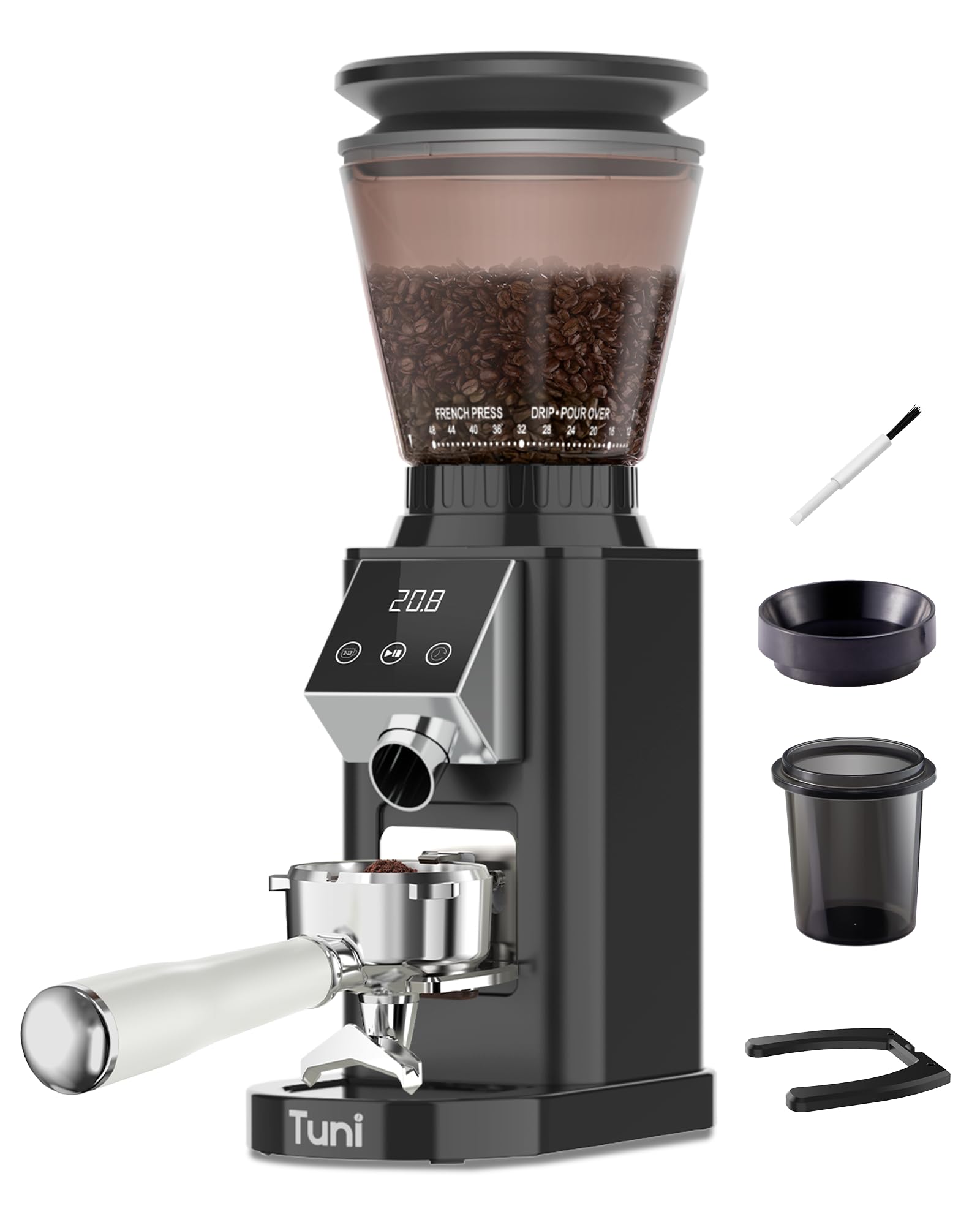
The Tuni G1 redefines what an entry-level premium electric grinder can do for coarse grinding. Its 40mm patented conical burr spins at just 450 RPM — substantially slower than most electric grinders that operate in the 1000+ RPM range — which keeps heat transfer to the beans to a minimum and preserves the aromatic oils that make coarse brews taste vibrant. The low speed also generates less static, meaning you are not fighting a cloud of clingy grounds every time you lift the dosing cup. The 48 setting steps are clearly marked on the dial, and the range from fine espresso to extremely coarse French press is wide enough to cover any manual brew method you own.
The integrated digital timer lets you set grind time in half-second increments up to 40 seconds, and the cup selector adjusts the dose for 2 to 12 cups designed for drip and pour-over. For coarse grinding, you typically run the timer a bit longer to push more beans through the wide gap — the G1 handles this without bogging because the low-RPM motor has enough torque to crush dense beans at a fast feed rate. The bean hopper holds 250 grams (about 8.8 ounces), which is generous for a machine this compact. The anti-fingerprint stainless steel finish resists smudges and wipes clean easily.
The included portafilter holder is compatible with 51 to 58mm baskets, so you can grind directly into your portafilter, and the 75-gram dosing cup is useful for larger dosing cycles. The suction-mounted hopper bellow blower clears retained grounds from the chute, reducing waste from the previous grind. The Tuni G1 is the best electric choice for the home barista who wants an automated, quiet, and thermally stable coarse grind without stepping up to commercial-tier pricing.
Why it’s great
- 450 RPM slow motor keeps beans cool and reduces static.
- 250g hopper allows grinding for multiple servings at once.
- Portafilter holder fits 51-58mm baskets for direct dosing.
Good to know
- Timer increments are 0.5 seconds — not as fine as the SHARDOR.
- Bean hopper is not removable for single-dosing.
5. SHARDOR Conical Burr Espresso Coffee Grinder Electric

The SHARDOR CG018 brings a premium touchscreen interface and a precision timer with 0.1-second increments to the mid-range electric category. Its 40mm stainless steel conical burr is designed to minimize grinding heat and preserve bean oils, and the 51 distinct grind settings offer enough granularity to dial in a perfect coarse French press grind without needing to guess between numbers. The anti-static technology in the grinding chamber significantly reduces coffee dust clinging to the bin walls, which is a common annoyance in cheaper electric burr grinders.
The portafilter cradle support is a real time-saver: you can place your portafilter directly under the chute, select the cup number (1 to 12), and let the timer control the dose. For coarse grinding, I found that setting the timer 1 to 2 seconds longer than the default yields a full dose for a 12-ounce press. The included coffee grounds residual cleaner — a small bellows-style pump — clears the chute of retained particles, which is especially helpful when switching between grind sizes to avoid cross-contamination from a fine espresso setting back to a coarse press setting.
The build is compact — 7.4 by 4.9 by 13.5 inches — and grinds directly into the portafilter or the included dosing cup. The touchscreen is responsive but does require a slightly more deliberate press than a mechanical switch. The SHARDOR is the best pick for the home user who wants a clean, programmable, low-mess electric burr grinder that handles coarse grinding without the noise and heat of a high-RPM motor.
Why it’s great
- 0.1-second timer increments allow repeatable dose control.
- 51 settings give ample range for coarse brew methods.
- Anti-static technology minimizes mess during grinding.
Good to know
- Touchscreen interface takes slightly more pressure than a button.
- Bean hopper capacity is smaller than the Tuni G1 at 1.4 ounces.
6. Vivaant Coffee Grinder Manual Capacity 32g

The Vivaant hand grinder is the fastest manual grinder in this lineup thanks to its proprietary Dragon Tooth stainless steel conical burr, which claims to grind twice as fast as ceramic burrs. For coarse grinding, the speed advantage is noticeable — you can process 32 grams of beans for a large French press in under a minute of steady cranking. The six adjustment settings are limited compared to the C2S and K6, but they cover the essential range: fine for Aeropress, medium for drip, and coarse for French press and cold brew. The settings click into place clearly, and you do not need to disassemble the grinder to change them.
The glass jar is marked with measurement lines, which is handy for portioning without a scale. The grinder disassembles in seconds — unscrew the jar, lift out the burr — and the included brush makes cleaning straightforward. The compact dimensions — 2.13 inches wide and 8 inches tall — make it genuinely portable, and the quiet operation is a bonus for early-morning grinding without waking the household.
The main trade-off for the lower price point is the burr tolerances. At the coarsest setting, you will notice slightly more particle size variation compared to the TIMEMORE or KINGrinder units. For a casual French press drinker who wants a quick, quiet, and affordable way to transition away from blade grinders, the Vivaant delivers exactly what it promises without overcomplicating the experience.
Why it’s great
- Fast grinding speed thanks to steel burr design.
- Glass jar with measurement lines simplifies portioning.
- Quiet operation and easy tool-free cleaning.
Good to know
- Only 6 settings limit granular control for fine-tuning.
- Particle consistency at coarsest setting is acceptable, not premium.
7. Alpaca Ventures Premium Manual Coffee Grinder

The Alpaca Ventures manual grinder is the most affordable entry point in this guide for anyone looking to move away from a blade grinder. Its 420 stainless steel conical burr and dual bearing center axis provide a stable platform for coarse grinding at a budget-friendly price point. The lengthened stainless steel handle offers good leverage, reducing the physical effort needed to produce a consistent coarse grind for French press or cold brew. The built-in bearing helps the handle keep spinning for a moment after you stop, which signals reasonable bearing preload despite the low cost.
The burr adjustment dial offers a decent range from espresso-fine to French press-coarse, though the click mechanism is slightly less defined than on premium models — you need to hold the handle in place while turning the dial, or the dial may spin without engaging. The grinder disassembles with a simple twist for cleaning, and the included brush reaches into the burr cavity to remove retained grounds. At 16 ounces, it is light enough to pack for camping or office use.
The biggest limitation is particle consistency at the coarsest settings, where the 420 steel burr and simpler machining tolerances produce slightly more fines than the higher-priced grinders. If your primary goal is making drinkable French press coffee on a tight budget without using a blade grinder, the Alpaca Ventures grinder gets the job done. It is not built for the obsessive dial-in crowd, but for entry-level convenience and portability, it is a legitimate option.
Why it’s great
- Dual bearing design improves burr alignment at this price point.
- Lightweight body (16 oz) is ideal for travel and camping.
- Easy twist disassembly for quick cleaning.
Good to know
- Adjustment dial can be finicky — requires holding the handle.
- Coarse particle consistency is not as uniform as premium grinders.
FAQ
Can I use a blade grinder to make coarse coffee grounds?
How many microns should a French press grind setting be?
Why do my coarse grounds contain fine powder?
Are electric or manual grinders better for coarse grinding?
Final Thoughts: The Verdict
For most users, the best coarse coffee grinder winner is the TIMEMORE Chestnut C2S because its metal unibody, double bearing system, and 36-step adjustment deliver repeatable coarse particles across every brew method without breaking the budget. If you want micro-precision to dial in your grind down to 16 microns per click, grab the KINGrinder K6. And for a quiet, automated electric experience with a large hopper and low-RPM burr, nothing beats the Tuni G1.