A dull blade is the most dangerous tool in your kitchen — it slips, it tears, and it turns prep work into a chore. Finding an affordable solution that actually restores a razor edge without a steep learning curve or expensive gear can feel impossible when every product promises professional results. The good news is that effective sharpening no longer requires a workshop budget or years of practice.
I’m Mohammad Maruf — the founder and writer behind AirfryerBite. I’ve spent countless hours cross-referencing grit ratings, angle guides, and abrasive materials to separate the sharpeners that actually remove steel efficiently from those that just burnish the edge for a few uses.
After comparing five distinctly different designs at various entry-level price points, I’ve assembled a focused guide to help you pick the right one. This is your definitive resource for finding the best inexpensive knife sharpener that matches your specific blade type and skill level without wasting a single dollar on marketing hype.
How To Choose The Best Inexpensive Knife Sharpener
Choosing a budget-friendly sharpener requires understanding which abrasive material and design suits your knife steel. A cheap tool that removes too little metal leaves you with a polished but blunt edge, while one that cuts too aggressively can ruin a blade’s profile. Here are the three most important factors to consider.
Grit Rating and Dual-Sided Stones
The grit number tells you how coarse the abrasive surface is. A coarse stone (100 to 400 grit) is for repairing nicks or setting a new bevel, while a medium grit (600 to 1000 grit) refines the edge, and a fine grit (3000 to 6000 grit) polishes it to a razor finish. For an inexpensive setup, a dual-sided stone that combines a 400 or 600 coarse side with a 1000 or 6000 fine side lets you both shape and finish the edge with one tool. Avoid single-grit pull-through models if your knives are very dull — they lack the coarse stage needed to actually reshape the cutting edge.
Sharpening Angle and Adjustability
Most Western kitchen knives use a 20° edge angle, while Japanese blades are often sharper at 15° or even 14°. A fixed-angle pull-through sharpener is fine if you only own standard German-style knives, but an adjustable system that lets you switch between 14°, 16°, 18°, 20°, 22°, and 24° gives you the flexibility to sharpen different blade types without guesswork. Whetstones require you to manually maintain the angle by feel, but an angle guide accessory can remove that uncertainty for beginners. Matching the sharpener’s angle to the knife’s existing bevel is the most direct path to a lasting edge.
Abrasive Material and Durability
Three materials dominate the budget market: corundum (aluminum oxide), silicon carbide, and diamond plating. Corundum stones like those found in most 1000/6000 kits wear slowly and cut well on standard stainless steel. Silicon carbide stones (often called Crystolon) are harder and cut faster, making them ideal for quick material removal on softer steels. Diamond-plated stones cut the fastest of all and work on any steel hardness, but cheap diamond plates can lose their grit after heavy use. For occasional home use, corundum or silicon carbide offers the best longevity per dollar. Tungsten carbide pull-through slots work for quick touch-ups but should not be used daily because they can chip the edge over time.
Quick Comparison
On smaller screens, swipe sideways to see the full table.
| Model | Category | Best For | Key Spec | Amazon |
|---|---|---|---|---|
| MAD SHARK Knife Sharpener | Pull-Through | Adjustable angle sharpening | 6 angles (14° to 24°) | Amazon |
| SHARPAL 191H | Pull-Through | Quick 3-stage kitchen use | Tungsten + ceramic + scissor slot | Amazon |
| Lifeholic Diamond Sharpening Stone | Diamond Plate | Fast hand-sharpening without soaking | 400/1000 grit with honeycomb | Amazon |
| ZGQOOFA Whetstone Kit | Whetstone | Controlled edge creation | 1000/6000 grit + angle guide | Amazon |
| Norton Crystolon Utility Stone | File Stone | Heavy material removal on tools | 100 grit coarse silicon carbide | Amazon |
In‑Depth Reviews
1. MAD SHARK Knife Sharpener

The MAD SHARK sharpener stands out because it solves the single biggest pain point of budget pull-through models: you no longer have to guess the angle. Its twist-dial mechanism offers six distinct settings from 14° to 24°, complete with a printed guide that recommends the right angle based on knife type. This means you can sharpen a delicate 15° Japanese blade and then switch to a 20° German chef knife without needing a second tool. The tungsten steel coarse slot and ceramic fine slot handle both edge setting and honing in separate passes, and the dedicated scissor slot is a genuinely useful addition.
The ergonomic handle and two silicone base pads keep the unit planted firmly on the counter during use, which addresses the slipping issue that plagues many lightweight pull-through sharpeners. Build quality feels solid for the price point, with precise alignment between the abrasive slots and the blade path. The instruction card provides clear guidance on how many passes to use for each stage, so even a first-time user can avoid over-sharpening. The compact, 10.4-inch length stores easily in a drawer.
One trade-off is the plastic housing, which, while durable enough for home use, lacks the heft of metal-framed pro sharpeners. The tungsten carbide slot cuts quickly, so you must use light pressure to avoid removing too much metal on softer blades. For home cooks who own a mix of knife types and want one tool that adapts to every edge, this is the most versatile budget-friendly option available right now.
Why it’s great
- Six sharpening angles (14° to 24°) match nearly any blade type
- Dual silicone pads anchor the unit firmly on the countertop
- Integrated scissor slot adds multi-tool functionality
Good to know
- Plastic construction may not survive heavy daily commercial use
- Tungsten slot cuts fast — requires light, even pressure
2. SHARPAL 191H Knife Scissors Sharpener
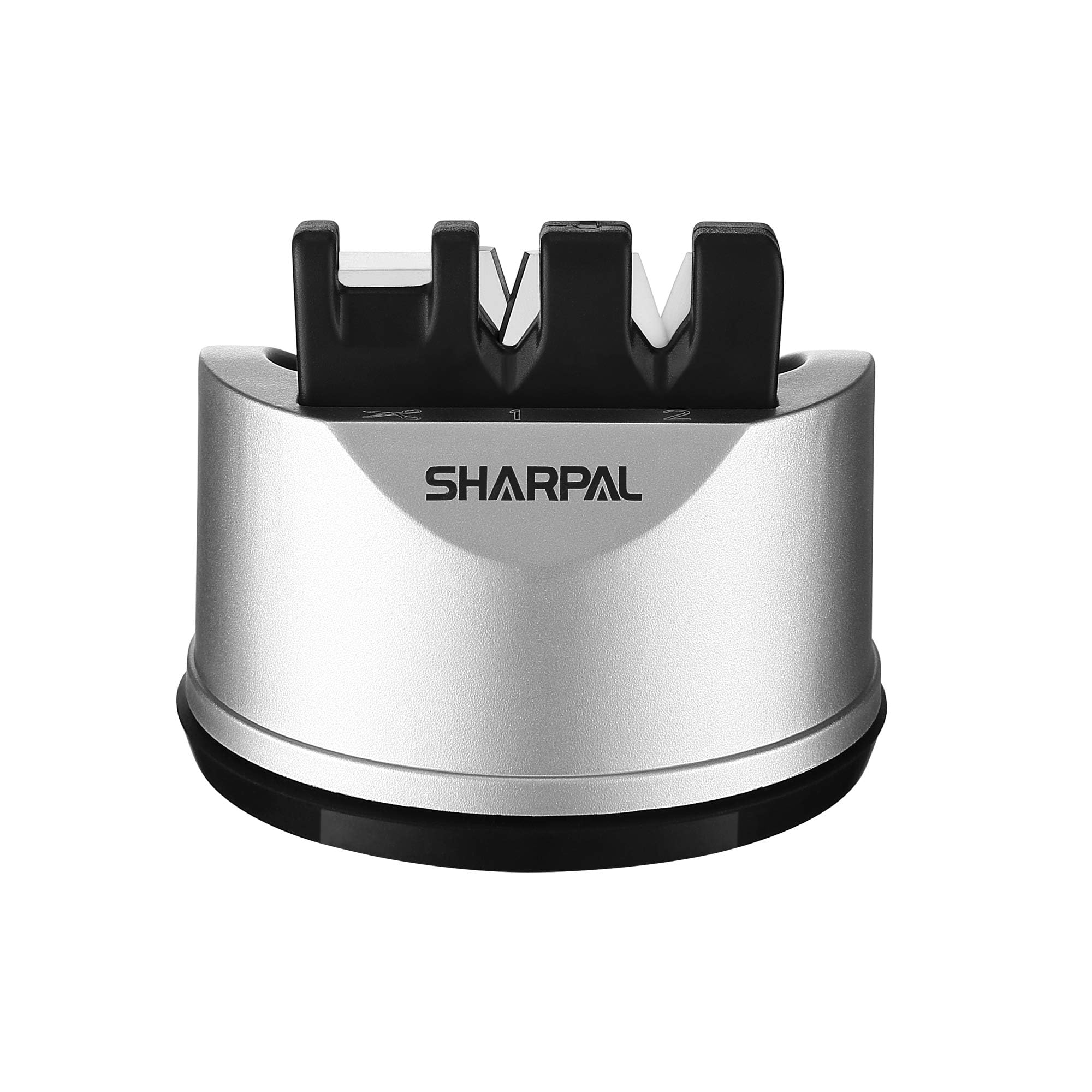
The SHARPAL 191H is a 3-stage sharpening tool that prioritizes convenience and safety above all else. Its stand-out feature is the enhanced suction base — simply press the black switch on a smooth, flat surface, and the unit locks down with enough grip to resist movement during aggressive pull-through passes. No hand-holding required, and it works equally well for left-handed and right-handed users. The three stages are clearly labeled: tungsten carbide blades for the initial edge setting, ceramic blades for the fine honing pass, and a dedicated slot for sharpening scissors without disassembling them.
At just 2.76 inches tall and weighing 0.19 pounds, this is one of the most compact sharpeners you can buy. The small footprint is ideal for tight kitchen drawers or counter edges. The tungsten carbide V-notch cuts quickly on dull blades, while the ceramic stage refines the burr into a smooth, functional edge. SHARPAL backs this unit with a 3-year warranty against material and workmanship defects, which is unusually long for a budget-priced sharpener and signals confidence in the build quality.
The fixed angle design means you cannot adjust the sharpening angle — it defaults to roughly 20°, which works well for standard Western chef knives but is too steep for Japanese blades. Also, the suction base requires a perfectly clean, dry, non-porous surface to hold reliably. For someone who wants a no-fuss, drop-in solution for everyday kitchen knives without any learning curve, the 191H delivers consistently.
Why it’s great
- Suction base provides exceptional stability without hand-holding
- Compact size (2.76 inches tall) stores in any drawer
- 3-year warranty is best-in-class for this budget tier
Good to know
- Fixed angle (about 20°) is not suitable for 15° Japanese knives
- Suction base requires a smooth, non-porous, dry surface
3. Lifeholic Diamond Sharpening Stone

Diamond-plated stones usually command a premium, but the Lifeholic 5-in-1 brings the benefits of diamond abrasives to a budget-friendly price point. The 400 grit coarse side rapidly removes metal to fix nicked or very dull edges, while the 1000 grit fine side refines the scratch pattern into a sharp, usable cutting surface. Unlike traditional whetstones, this one requires zero soaking — you can start sharpening immediately. For longer sessions, simply sprinkle water on the surface to cool the blade and flush away metal debris. The honeycomb surface pattern helps trap swarf so it doesn’t clog the diamond plating as quickly as a smooth plate would.
The 5-in-1 design goes beyond a simple two-sided stone. A lightning-shaped slot in the handle allows for scissor sharpening. The left waist of the handle houses a tungsten steel slot for quick edge setting, and the right waist features a ceramic slot for final honing and deburring. This combination of a full diamond plate plus built-in pull-through slots gives you the control of a hand stone and the speed of a pull-through system in one package. The 11.2-inch overall length and hanging hole make it easy to store on a pegboard or hook.
The main compromise is the diamond plate size — at roughly 5.5 x 2.1 inches, it is narrower than a full-size bench stone, which means you need to make longer strokes on longer blades. The diamond grit may also wear faster than silicon carbide if used frequently on very hard steels. For someone who wants the fast cutting action of a diamond stone without paying a premium, and who appreciates having backup sharpening slots built into the handle, this is a versatile pick.
Why it’s great
- Diamond-plated surface cuts fast on any steel hardness
- No soaking required — sharpen immediately out of the box
- Built-in tungsten and ceramic slots handle quick touch-ups and scissors
Good to know
- Diamond plate is narrower than standard bench stones
- Long, continuous sharpening sessions may accelerate grit wear
4. ZGQOOFA Whetstone Knife Sharpening Stone Kit

The ZGQOOFA whetstone kit is designed for the home cook who wants to learn proper stone sharpening without spending on a high-end Japanese water stone. The 1000 grit side establishes a clean, sharp bevel on dull knives, and the 6000 grit side polishes that edge to a near-mirror finish that slices through tomato skin without pressure. A non-slip bamboo base holds the stone securely in place during use, and a silicone holder further prevents the stone from sliding. The included angle guide clips onto the knife spine to help beginners maintain a consistent 15° to 20° angle, which dramatically reduces the guesswork that makes whetstones intimidating.
The setup ritual is simple: soak the stone in water for a few minutes until bubbles stop rising, then place it on the bamboo base and begin. No expensive honing oil is required, and cleanup is just a rinse under the tap. The corundum abrasive is durable enough for regular home use on common stainless and high-carbon steels, and the 8.46 x 3.67 inch surface provides enough room to sharpen full-size chef knives without running out of stone. At 861.83 grams (about 1.9 pounds), the stone has enough mass to stay put during the sharpening stroke.
The learning curve is slightly steeper than a pull-through model — maintaining a consistent angle without the guide takes practice, and the soaking requirement means you can’t do an instant touch-up. The 1000 grit side also takes longer to set a new edge on a very dull blade compared to a 400 grit stone. For someone who enjoys the process of hand-sharpening and wants the finest possible edge on their knives, this kit offers the best path to that result at a minimal investment.
Why it’s great
- 1000/6000 grit combo produces a polished, razor-sharp edge
- Non-slip bamboo base and angle guide help beginners build skill
- Corundum stone is durable and easy to clean with just water
Good to know
- Requires soaking before each use — not for instant touch-ups
- 1000 grit side is slower for heavy edge repair than coarser stones
5. Norton Crystolon Utility File Sharpening Stone
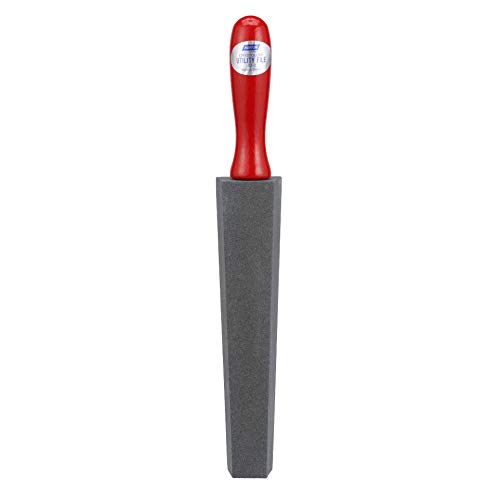
The Norton Crystolon Utility Stone occupies a specific niche: it is a 100 grit coarse stone designed for rapid material removal on tools and heavily damaged blades, not for fine kitchen edge finishing. The 14-inch length with a wooden handle keeps your fingers safely away from the cutting edge, which is critical when shaping large implements like lawn mower blades, shovels, axes, or mechanical insulation knives. The four-sided silicon carbide abrasive is exceptionally aggressive — it will quickly grind down a nicked edge to a fresh bevel in a fraction of the time a fine stone would take.
Silicon carbide has a unique advantage over corundum: it “self-sharpens” as it wears, exposing fresh abrasive particles so the cutting action remains consistent throughout the stone’s life. Norton recommends using sharpening oil with this stone to float away metal debris and prevent loading, which is the standard practice for silicon carbide bench stones. The 1.31 x 1.25 inch cross-section provides enough surface area to work on large cutting edges without losing control. At just 1 pound, the stone is portable enough to toss in a toolbox or carry to a job site.
This stone is not a primary kitchen sharpener for fine German or Japanese knives — the 100 grit surface will leave a very rough edge that requires subsequent honing with a finer stone. It also requires oil for best results, adding a consumable cost and cleanup step that a water stone does not. For anyone who maintains outdoor tools, gardening equipment, or very dull shop knives and needs a fast, aggressive sharpening stone that can handle serious abuse, the Norton Crystolon is the right tool for that specific job.
Why it’s great
- 14-inch handle keeps fingers safe during heavy material removal
- 100 grit silicon carbide cuts extremely fast on dull tools
- Self-sharpening stone maintains consistent abrasion over time
Good to know
- Too coarse for fine kitchen knife finishing — requires a follow-up stone
- Best results require sharpening oil, not water
FAQ
What is the best grit combination for a budget whetstone used on kitchen knives?
Can a pull-through sharpener damage my Japanese knife?
How do I clean a diamond sharpening stone after use?
Final Thoughts: The Verdict
For most users, the inexpensive knife sharpener winner is the MAD SHARK Knife Sharpener because its six adjustable angles and dual abrasive slots give you the control to sharpen both Western and Japanese blades without guesswork. If you want a no-learning-curve tool that locks to your counter and sharpens fast, grab the SHARPAL 191H. And for the traditionalist who wants the finest possible edge through hand control, the ZGQOOFA Whetstone Kit with the angle guide offers the best path to a true razor finish.