The line between a decent home espresso shot and a café-quality ristretto is drawn by precise temperature stability and a burr grinder that delivers uniform particle size. Settle for a machine that can’t hold a steady 200°F across a 30-second extraction, and you’re paying for sour or burnt flavors—not the velvety crema you actually want.
I’m Mohammad Maruf — the founder and writer behind AirfryerBite. I’ve spent months analyzing PID controllers, thermoblock vs. dual-boiler heat exchangers, and burr geometry across the to price band to find the machines that reward your ritual rather than fight it.
Whether you are a dedicated home barista or a busy professional who demands a reliable morning flat white, this guide to the best espresso machine under 2000 cuts through the boiler size myths and grinder hype to surface the hardware that actually delivers repeatable third-wave espresso without a commercial price tag.
How To Choose The Best Espresso Machine Under 2000
Crossing into the sub- bracket means you can dodge the starter-machine compromises: plastic group heads, pressurized baskets, and thermocoils that drift three degrees mid-pull. The right machine here should give you a PID controller, a commercial-standard 58mm portafilter, and a heat delivery system that doesn’t force you to wait for steam after brewing.
Heat System: Dual Boiler vs. Dual Thermoblock vs. Single Boiler
A dual boiler (like the Breville BES920XL) keeps the brew water and steam boiler at separate, stable temperatures so you can pull a shot and steam milk simultaneously. Dual thermoblocks (as in the Ascaso Steel DUO) heat water on demand through aluminum and stainless steel blocks, letting you switch from brew to steam in seconds without a dedicated steam boiler but with a slight trade-off in thermal mass during back-to-back shots. Single boilers are cheaper but force a temperature chase: you must wait for the boiler to heat from brew (200°F) to steam (280°F+) and back. At this budget, dual boiler or dual thermoblock should be your baseline.
Grinder Integration: Conical vs. Flat Burrs
Integrated grinders save counter space but the burr geometry matters. Conical burrs (found on the Breville Barista Express) produce a more rounded particle distribution, which can mute some bright acidity — forgiving for darker roasts but less ideal for light-roast Ethiopian beans. Flat burrs (found in the Philips 3200 and Terra Kaffe) produce a narrower particle spread, giving you cleaner extractions with delicate single-origin coffees. Also check the step size: grinders with fewer than 30 steps limit your ability to dial in the perfect resistance; the Breville machines offer over 40 steps, while super-automatics often settle for 10–15.
Pressure Control: OPV and Pre-Infusion
Standard espresso machines deliver a fixed 9–12 bar of pump pressure at the group head. An Over-Pressure Valve (OPV) regulates this to a nominal 9 bar — anything above 10 bars can cause channeling and bitter shots. The Breville Dual Boiler and Rancilio Silvia both feature adjustable OPVs, letting you fine-tune pressure for dense light roasts that benefit from slightly lower pressure (7–8 bar) during the first few seconds of extraction. Pre-infusion (low-pressure wetting of the puck before full pressure) helps guarantee even extraction; machines with programmable pre-infusion time (like the Breville Dual Boiler) let you ramp up from 2 bar to 9 bar over a user-set duration.
Quick Comparison
On smaller screens, swipe sideways to see the full table.
| Model | Category | Best For | Key Spec | Amazon |
|---|---|---|---|---|
| Breville Dual Boiler BES920XL | Dual Boiler | Simultaneous brew & steam | 1700W / 2 stainless steel boilers | Amazon |
| De’Longhi Eletta Explore | Super-Automatic | 50+ one-touch recipes | 13 grind settings / Cold Extraction | Amazon |
| Terra Kaffe TK-02 | Super-Automatic | App-controlled brewing profiles | Flat burr grinder / Wi-Fi | Amazon |
| Jura E6 Platinum | Super-Automatic | Premium build & high throughput | Aroma G3 grinder / 1 brew unit | Amazon |
| Ascaso Steel DUO | Dual Thermoblock | Compact prosumer form factor | PID / 58mm portafilter / Walnut handle | Amazon |
| Rancilio Silvia | Single Boiler | Modding & pressure profiling | 58mm portafilter / Iron frame | Amazon |
| Bosch TIU20307 | Super-Automatic | Double-cup at high volume | Large bean hopper / One-touch drinks | Amazon |
| Breville Barista Express BES870XL | Semi-Automatic | Best all-in-one on a $ mid-range | Conical burr / 1600W / PID | Amazon |
| Philips 3200 EP3241/54 | Super-Automatic | Low-maintenance daily driver | Ceramic grinder / 15-sec milk rinse | Amazon |
| De’Longhi La Specialista Arte Evo | Semi-Automatic | Cold brew + hot espresso combo | Integrated grinder / tamping station | Amazon |
| Ninja R-ES601 Luxe Café (Renewed) | Semi-Automatic | Entry-level with drip & cold brew | Built-in grinder / tamper / frother | Amazon |
In‑Depth Reviews
1. Breville Dual Boiler BES920XL

The Breville BES920XL is the gold standard for home baristas who refuse to compromise on simultaneous brewing and steaming. Its dual stainless steel boilers (one dedicated to brew, the other to steam) let you pull a 25-second ristretto while frothing milk for latte art without any temperature drop at the group head. The PID controller holds water temperature within a tight ±2°F window, and the OPV prevents over-pressure channeling that plagues cheaper single-boiler designs.
The 58mm portafilter accepts commercial accessories — a huge upgrade from 54mm machines that lock you into Breville-only baskets. The low-pressure pre-infusion ramps up over a gentle 12 seconds, which reduces the risk of channeling in freshly roasted, high-gas light roasts. The LCD shot timer and programmable single/double volumes give you repeatable dosing without a separate scale.
Consider this machine if you value temperature stability and steam power over a built-in grinder. The BES920XL expects you to pair it with a separate grinder — budget for something like a Eureka Mignon or a Baratza Sette 270 to fully unlock its potential.
Why it’s great
- True dual boilers for simultaneous brew and steam
- ±2°F PID temperature stability on the group head
- 58mm commercial portafilter with OPV adjustability
Good to know
- No integrated grinder — requires separate investment
- Internal plumbing can be difficult to reach for descaling
- Build quality feels heavier than the Barista Express but is still primarily plastic cladding
2. De’Longhi Eletta Explore

The Eletta Explore packs over 50 one-touch recipes into a super-automatic chassis that also delivers cold brew in under 3 minutes using dedicated Cold Extraction Technology. The 13-step conical burr grinder automatically adjusts dose based on bean freshness through Bean Adapt Technology, and the dual LatteCrema systems (hot and cold foam) let you switch between a cappuccino and an iced latte without manual cleanup of a steam wand.
The 3.5-inch TFT touch display guides you through recipe categories, and the included travel mug makes it easy to brew up to 16oz of iced or hot coffee for the commute. The 60-ounce water tank and removable, dishwasher-safe milk carafes reduce daily maintenance to a 30-second rinse under the tap.
If you want a true bean-to-cup experience that handles everything from ristretto to cold foam without any manual technique, this is the machine. But if you prefer to chase the perfect shot weight with a scale and a bottomless portafilter, a semi-automatic machine will give you more hands-on control.
Why it’s great
- Cold extraction in under 3 minutes without burnt flavors
- 50+ one-touch hot and iced recipes
- Dishwasher-safe milk system and included travel mug
Good to know
- Plastic body panels feel less premium than the price suggests
- Grinder steps are limited compared to dedicated grinders
- Without a bottomless portafilter, diagnosing channeling is harder
3. Terra Kaffe TK-02
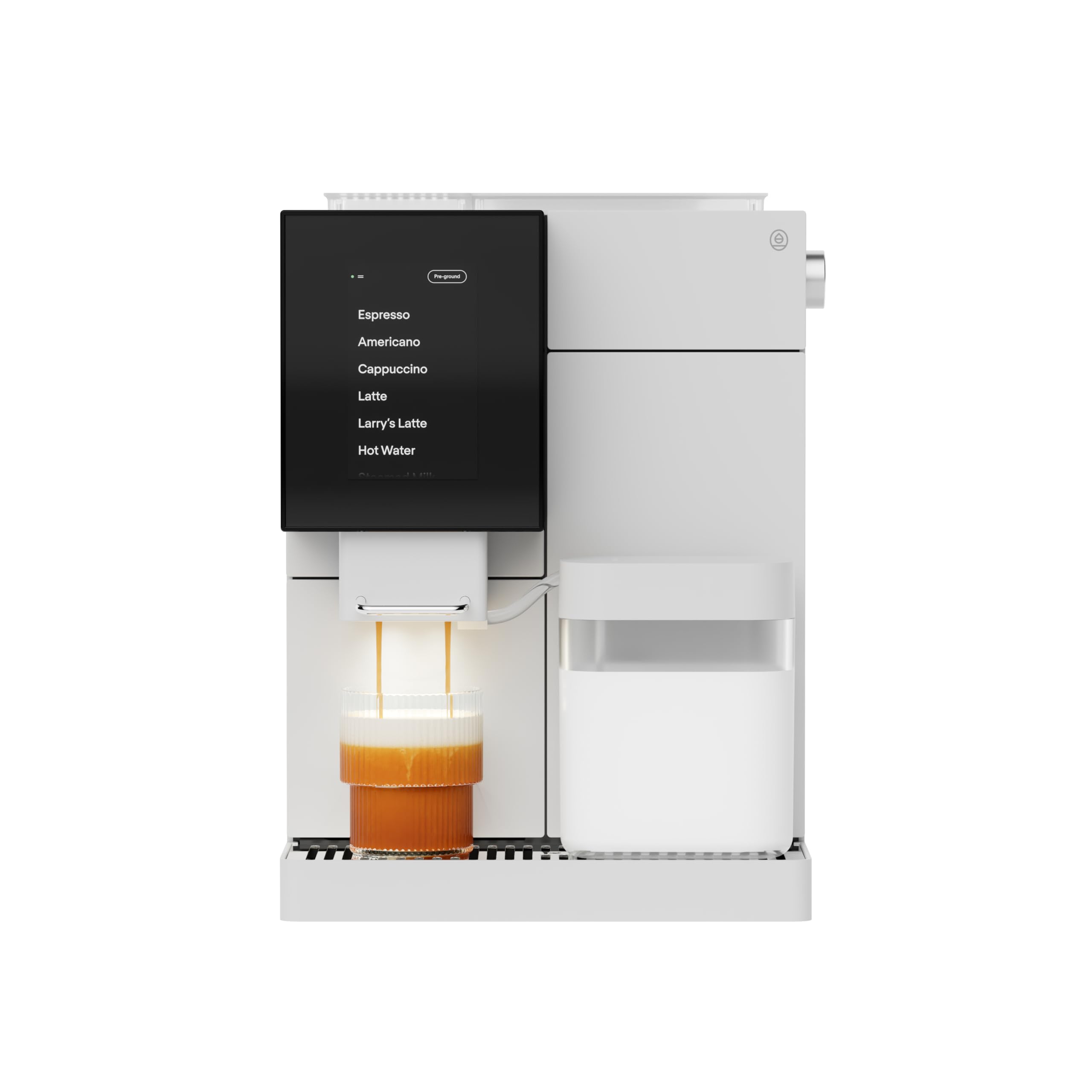
The Terra Kaffe TK-02 aims to bridge the gap between the convenience of a super-automatic and the customizability of an app-connected device. It uses a flat burr grinder — rare for machines in this tier — which gives a narrower particle distribution than conical burrs, meaning cleaner extractions on light-roast single-origin beans. The app lets you save custom profiles for different coffees and schedule auto-wake and sleep times.
The machine accepts all milk types (oat, almond, dairy) without scalding, and the PID ensures the brew water hits your target temperature within 1°F of the set point. At a premium entry price, it competes directly with the Jura E6 but adds Wi-Fi control and a more modern interface.
Where it stumbles slightly is the steam wand: the automatic milk texturing produces microfoam that is adequate for latte art but not as thick as what a prosumer semi-automatic like the Breville Dual Boiler can achieve with manual control.
Why it’s great
- Flat burr grinder for tight particle distribution
- Full Wi-Fi/app control for custom profiles and scheduling
- Accepts any type of milk without missing a beat
Good to know
- Steam wand is not as powerful as dedicated semi-automatics
- Some users report connectivity dropouts with the companion app
- Pre-infusion is not user-adjustable through the app
4. Jura E6 Platinum
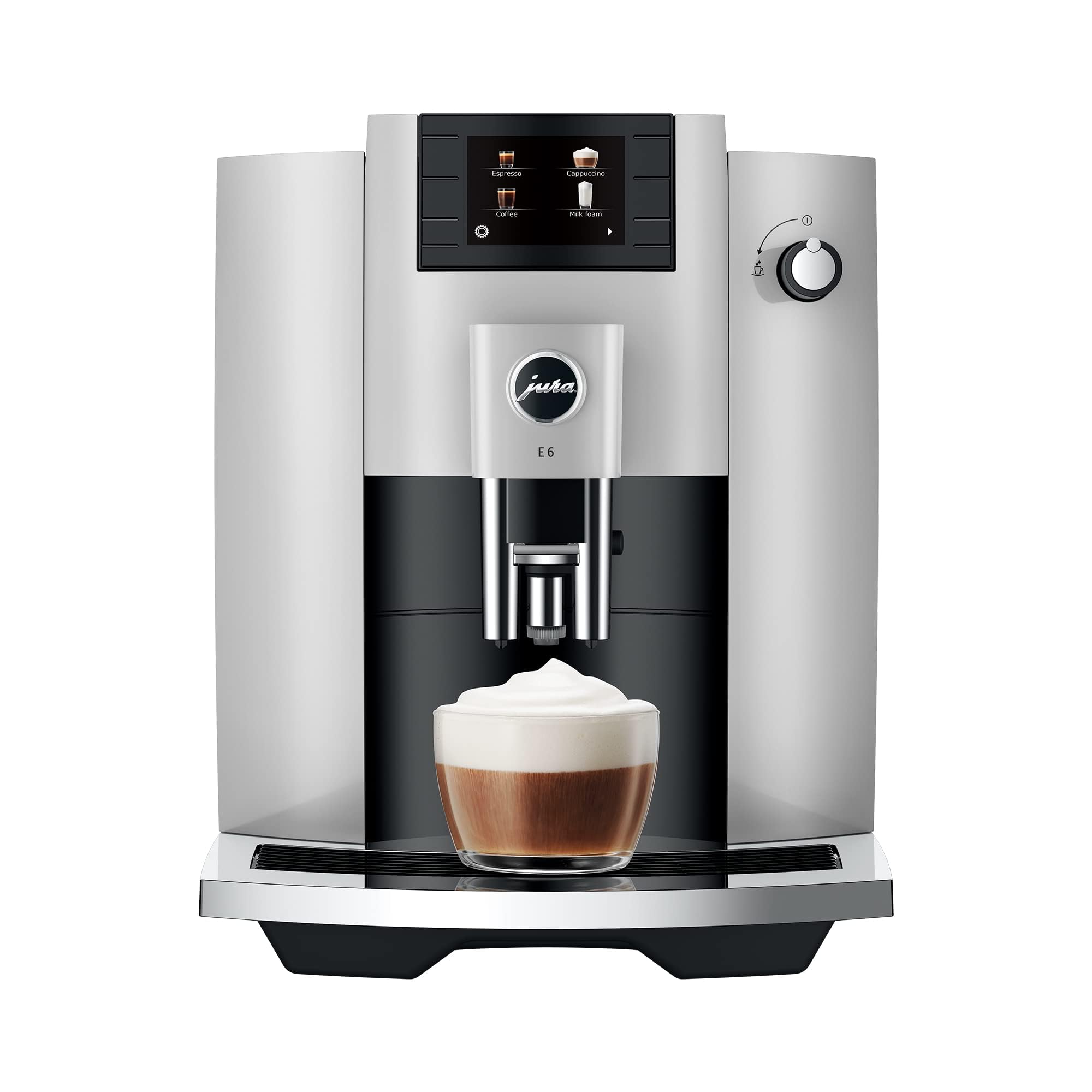
Jura’s E6 Platinum is the Swiss-engineered benchmark for zero-fuss super-automatic performance. It uses the proprietary Aroma G3 grinder (a conical burr with an optimized bean feed angle) to produce a consistent grind at 8 steps, and the single-brew-unit design extracts every shot through a pressurized pre-brew chamber that Jura claims improves crema volume.
The machine is built around the Pulse Extraction Process (P.E.P.), which introduces water in short bursts rather than a continuous stream. This yields noticeably richer body on darker roasts and cuts the extraction time for a ristretto to about 15 seconds. The water tank holds 60.8 ounces, and the waste container holds up to 15 pucks before you need to empty it — good for households that run 5–6 shots daily.
Be aware that the Jura E6 requires branded cleaning tablets and descaling cartridges — proprietary consumables that raise long-term cost. It also has a fixed brew temperature (no user-adjustable PID on the interface), so if you obsess over 203°F vs. 197°F for different beans, this machine may feel restrictive.
Why it’s great
- Pulse Extraction Process (P.E.P.) for richer, concentrated shots
- Aroma G3 grinder with optimized bean feed geometry
- High build quality and low long-term failure rate
Good to know
- Proprietary cleaning products are required and expensive
- No user-adjustable brew temperature
- Grinder only has 8 steps — less flexibility for bean variety
5. Ascaso Steel DUO PID

The Ascaso Steel DUO packs a prosumer-grade PID controller and two independent thermoblocks (one for brew, one for steam) into a footprint that is only 10.5 inches wide. The body is powder-coated carbon steel with polished stainless steel side panels, giving it a weight of 35 pounds that rivals heavy commercial machines. The 58mm portafilter comes with a real walnut wood handle and is compatible with standard commercial baskets and tampers.
The PID display lets you tweak temperature in single-degree increments, and the volumetric controls allow programming of pre-infusion time, single shot volume, and double shot volume independently. The steam thermoblock heats up to 300°F in seconds and produces continuous dry steam powerful enough to texture a 12-oz pitcher of milk in under 20 seconds.
Because the thermoblock heats water on demand rather than storing it in a boiler, the DUO consumes less standby energy than a dual boiler — a genuine advantage if you only pull 2–3 shots per day but still want instant steam readiness.
Why it’s great
- Compact 10.5-inch-wide footprint saves counter space
- Dual thermoblocks for independent brew/steam with instant-on
- Real walnut handle and metal body feel premium
Good to know
- Thermoblock water temp can fluctuate by ±2°F under back-to-back shots
- No integrated grinder — expect to spend extra on a separate grinder
- Drip tray is small; you will empty it after 2–3 shots
6. Rancilio Silvia

The Rancilio Silvia is the default machine for home baristas who plan to mod pressure profiles, install PID kits, or replace the OPV with a spring-based adjustable version. Its brass boiler (0.3 liters) and metal frame mean it will outlast plastic-heavy machines by a wide margin, and the 58mm commercial portafilter accepts any E61-compatible basket or bottomless portafilter on the market.
Out of the box, the temperature stability is not PID-controlled — you get a standard thermostat that cycles on and off, leading to swings of about 5°F during a shot unless you temperature surf. Adding a – aftermarket PID kit entirely transforms this machine, locking the brew temperature to within ±1°F of your target. The steam wand produces wet steam at first, but after a 2-second purge, it textures milk adequately for cappuccinos.
If you prefer to buy once and mod over time, the Silvia’s build quality and community support are unmatched at this price. But out-of-the-box, it requires more technique than a Breville Barista Express or a super-automatic.
Why it’s great
- Brass boiler and metal frame built to last a decade
- 58mm commercial portafilter with OPV adjustable for pressure profiling
- Massive aftermarket community for PID kits and other mods
Good to know
- No PID out of the box — temperature surfing is required
- Single boiler: wait time between brew and steam
- Small 0.3-liter boiler limits back-to-back shots
7. Bosch TIU20307
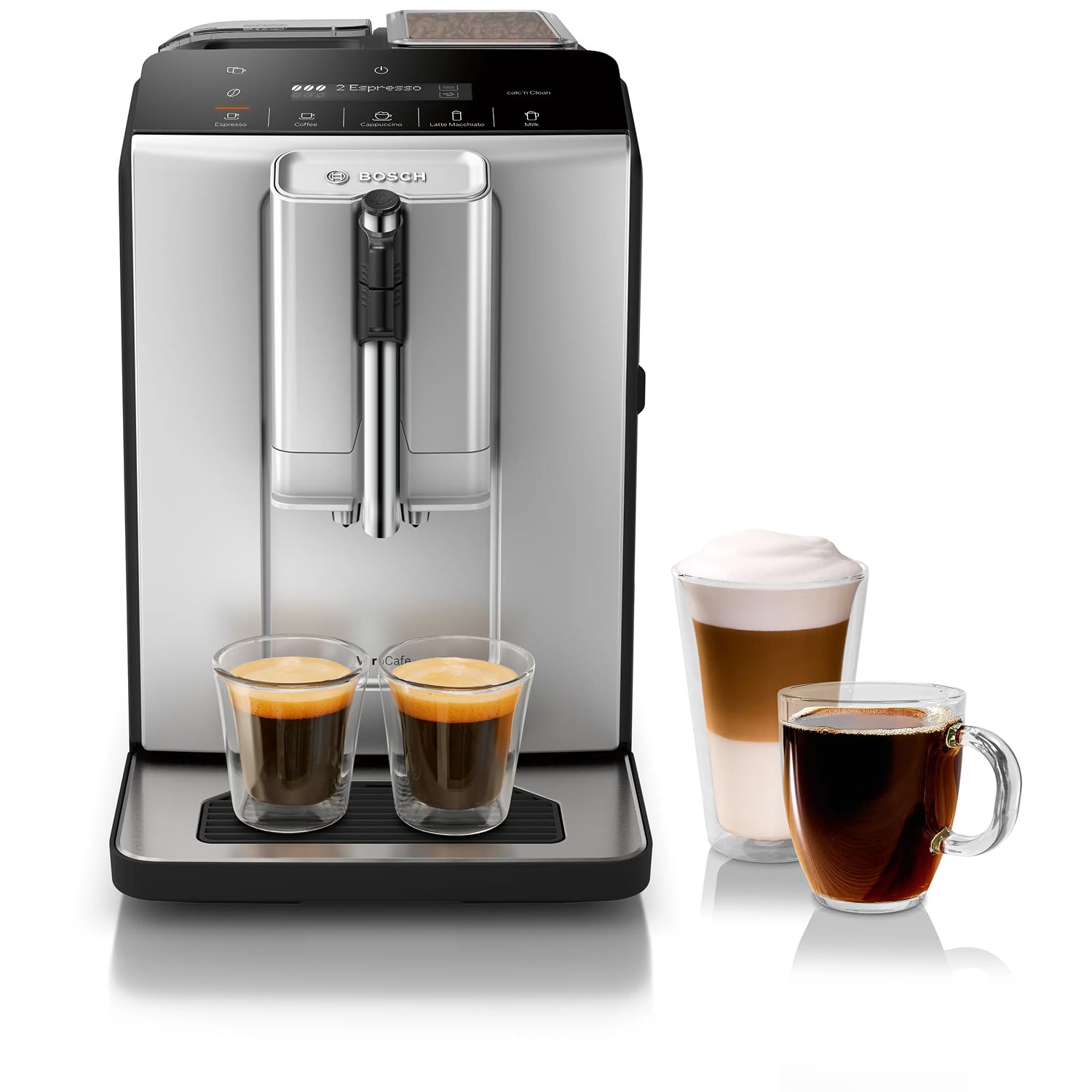
Bosch’s fully automatic TIU20307 emphasizes high-volume throughput: a large bean hopper and a dedicated double-cup brewing mode that pulls two separate spouts simultaneously. The one-touch drink menu includes espresso, lungo, cappuccino, and latte macchiato, and the steel conical burr grinder is designed to stay cool during extended use, reducing headspace clumping during back-to-back drinks.
The milk frother operates on a separate cleaning cycle that flushes steam through the wand automatically after each use, which cuts down on daily manual rinsing. The water tank is oversized at 60 ounces, and the integrated AquaClean filter reduces the need for descaling for up to 5,000 cups if replaced on schedule.
Where the Bosch falls short versus the Jura E6: the foam quality is thinner and the grinder steps (only 10) limit grind adjustment resolution. It is best suited for households that prioritize speed and capacity over tweaking the perfect extraction curve for rare beans.
Why it’s great
- Double-cup brewing for simultaneous serving
- Large bean hopper reduces refill frequency
- Automatic steam wand cleaning cycle
Good to know
- Grinder has only 10 steps — limited recipe flexibility
- Steam wand texture is thin for latte art
- Plastic touch buttons can feel stiff over time
8. Breville Barista Express BES870XL

The Breville Barista Express has been the most recommended all-in-one semi-automatic for years, and for good reason: the integrated conical burr grinder delivers 40+ grind settings directly into the 54mm portafilter, eliminating the need for a separate grinder. The digital PID controller keeps the water temperature locked within a narrow window, while the low-pressure pre-infusion ramps up over 8 seconds to reduce channeling.
The 67-ounce water tank and 1/2-pound bean hopper are large enough for a household that pulls 4–6 shots daily. The Razor Dose Trimming tool helps you level the puck consistently, and the built-in tamper is forgiving for beginners who may not have a consistent tamping force. The steam wand produces microfoam that is thick enough for latte art once you master the angle and purge technique.
The primary trade-off is the 54mm portafilter: aftermarket accessories (precision baskets, bottomless portafilters) are less common than for the 58mm standard. If you plan to upgrade to a separate grinder later, the BES870XL loses value; the grinder is good but not great for exacting light-roast single-origin shots.
Why it’s great
- Integrated conical burr grinder with 40+ settings
- PID-controlled temperature for stable extractions
- Included Razor tool and tamper for beginner-friendly puck prep
Good to know
- 54mm portafilter limits aftermarket accessories
- Integrated grinder is not as precise as a dedicated flat burr unit
- Steam wand can be finicky; needs practice for microfoam
9. Philips 3200 EP3241/54
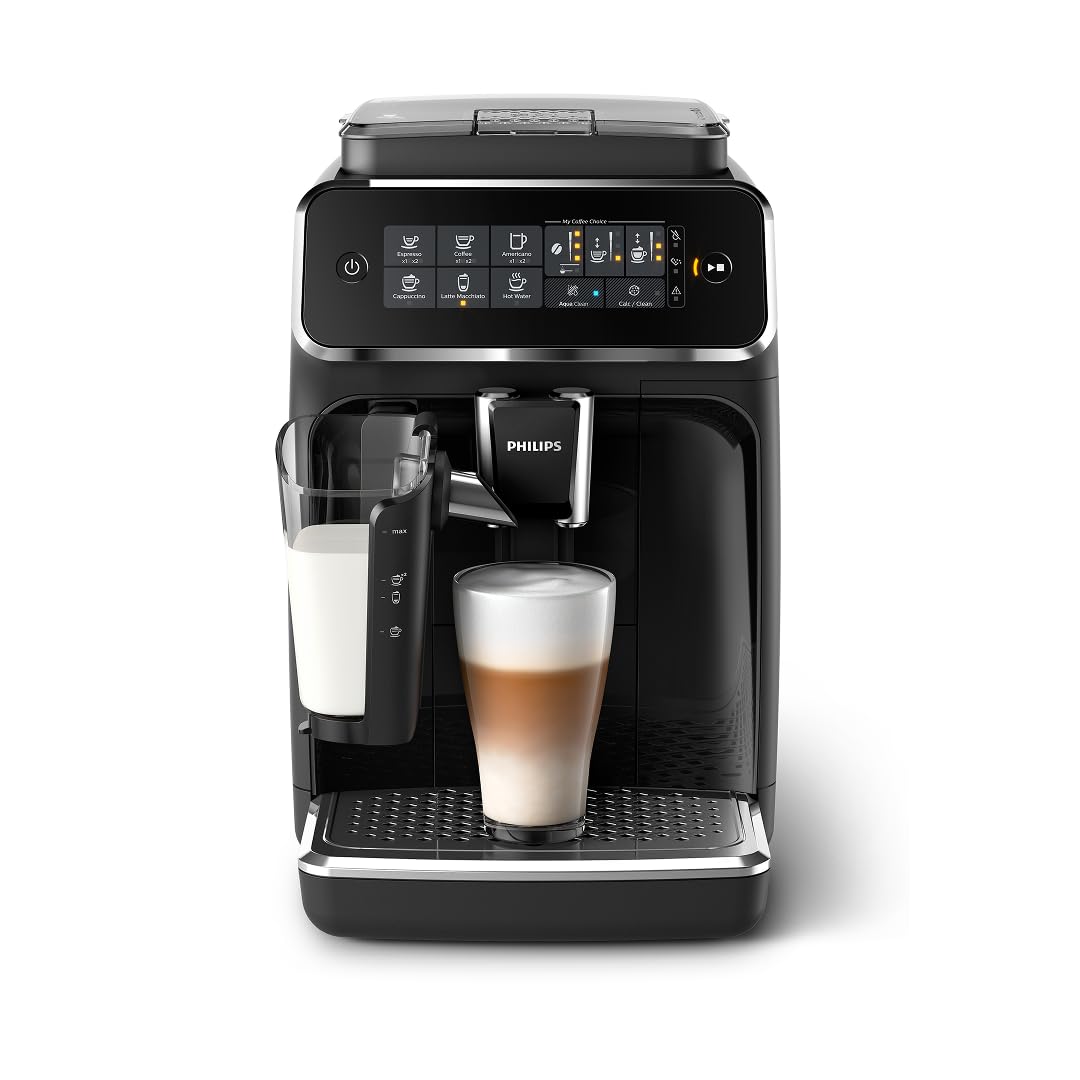
The Philips 3200 Series is engineered for the person who wants good espresso without becoming a technician. The 100% ceramic grinder is much quieter than metal grinders and resists heat absorption, so the grounds stay cool even after consecutive doses. The LatteGo milk system uses just 2 parts (no tubes) that rinse clean in 15 seconds under tap water, making it the easiest milk system to maintain in the super-automatic category.
The intuitive touch display walks you through 5 coffee varieties (espresso, coffee, americano, cappuccino, latte macchiato) and the Aroma Extract system optimizes the brew temperature and flow rate automatically depending on the selected drink. The AquaClean filter prompts you for replacement, and Philips claims you can go up to 5,000 cups without descaling if you change the filter on time.
For the price, the step count on the grinder is limited (12 settings) compared to semi-automatic grinders, and the steam/texture from the LatteGo system is less dense than what a dedicated steam wand produces. It is a machine for convenience, not for precision shot chasing.
Why it’s great
- Ceramic grinder is quiet and cool-running
- 2-part LatteGo milk system cleans in 15 seconds
- AquaClean filter reduces descaling frequency dramatically
Good to know
- Grinder has only 12 steps, limiting bean selection
- Milk foam is airy, not microfoam-thick
- Plastic build feels less robust than the De’Longhi Eletta Explore
10. De’Longhi La Specialista Arte Evo

The La Specialista Arte Evo is a compact semi-automatic that includes a dedicated cold brew setting — a rarity in this category. It uses a 15-bar pump and a built-in conical burr grinder that doses directly into the portafilter. The tamping station has a lever that assists you in applying consistent pressure, helpful for beginners who struggle with tamping angle and force.
The stainless steel steam wand is fully articulating and produces wet steam that is hot enough to texture milk for lattes, though microfoam takes a bit of practice because the wand does not have the same pressure as a larger boiler system. The included portafilter is 54mm — same as the Breville Barista Express — so aftermarket accessories are limited, but the cold brew function genuinely works, brewing a full-strength concentrate in about 20 minutes compared to the traditional 12-hour steep.
This machine is best for those who alternate between hot espresso and cold brew on a regular basis but do not want two separate appliances. The grinder steps are not as fine as a dedicated unit, so dialing in light roasts can be frustrating; darker roasts produce consistent, balanced shots without much effort.
Why it’s great
- Integrated cold brew function in a semi-automatic chassis
- Assisted tamping station reduces user error
- Compact footprint and integrated grinder save counter space
Good to know
- 54mm portafilter limits accessory compatibility
- Steam wand power is moderate, not commercial-grade
- Internal pipeless water path can be hard to descale
11. Ninja R-ES601 Luxe Café (Renewed)

The Ninja Luxe Café Premier Series — available as a renewed unit in the sub- range — is a multi-function machine that pulls espresso, drip coffee, and cold brew from a single base. The integrated grinder uses a 54mm conical burr set and includes a built-in tamper and frother that are adequate for casual users who are not picky about precise grind distribution or steam texture.
The machine has an espresso-specific setting that uses 19 bars of pressure, though without a PID controller the temperature can swing by about ±4°F during a shot. The free-pouring steam wand produces decent microfoam after a 3–4 second purge, but it does not compare to the dual-boiler or thermoblock machines in terms of steam pressure or consistency.
This is the right machine for someone new to espresso who also wants a drip coffee maker and a cold brewer in one appliance. If your priority is espresso-only with accuracy, the budget stretch to a Breville Barista Express is worth it.
Why it’s great
- Triple function (espresso, drip, cold brew) from one machine
- Renewed price point opens espresso to a wider audience
- Integrated tamper and frother for basic convenience
Good to know
- No PID — temperature swings of ±4°F affect shot consistency
- Brew pressure feels aggressive at 19 bars, may channel
- Renewed unit may show cosmetic wear and shorter warranty
FAQ
Can I use a Breville Dual Boiler without a separate grinder?
Which machine in this price range is best for light-roast espresso?
Do I really need a 58mm portafilter for good espresso?
How often should I descale a super-automatic espresso machine?
Is a separate grinder always better than an integrated one?
Final Thoughts: The Verdict
For most users, the best espresso machine under 2000 winner is the Breville Dual Boiler BES920XL because it delivers genuine dual-boiler temperature stability and a 58mm commercial portafilter without any integrated-grinder compromise. If you want the convenience of 50+ one-touch recipes and cold brew in under 3 minutes, grab the De’Longhi Eletta Explore. And for those who value compact size, instant steam on demand, and the ability to fine-tune temperature in single-degree increments, nothing beats the Ascaso Steel DUO PID.