A burr grinder that claims “coarse” but delivers a mix of boulders and dust is the fastest way to ruin a French press morning or a cold brew batch. The floating fines clog your filter, over-extract the smaller particles, and leave your cup tasting muddy instead of clean and bold. Finding a machine that produces a truly uniform coarse grind without breaking the bank is the real challenge.
I’m Mohammad Maruf — the founder and writer behind AirfryerBite. I spend my days analyzing burr geometry, step count, and RPM data to separate the grinders that deliver consistent particle size from those that just look the part on a spec sheet.
After sorting through dozens of models and dozens of user reports on grind retention and static cling, I’ve narrowed the field down to seven machines that actually deliver a clean, repeatable coarse grind for French press and cold brew. This is my focused take on the best coffee grinder for coarse grind, built for buyers who want results, not marketing fluff.
How To Choose The Best Coffee Grinder For Coarse Grind
Not every burr grinder can produce a clean coarse grind. The geometry of the burrs, the speed of the motor, and the number of adjustment steps all play a role in determining whether your French press grounds look like even sea salt or like a crushed gravel mix. Here are the three factors that matter most.
The Burr Type: Conical vs. Flat
For coarse grinding, conical burrs have a clear advantage. Their shape naturally allows larger particles to fall through without being re-ground, which reduces the creation of fine dust. Flat burrs, while excellent for espresso, often produce a wider particle distribution at coarser settings, leading to more sludge in your brew.
Grind Settings Count and Step Size
A grinder with only 10 to 15 settings might lump several coarse levels into one click, leaving you with no way to fine-tune between a perfect French press grind and one that’s too chunky. Look for at least 20 to 25 settings — more is better. The ability to make small, repeatable adjustments is what separates a dialed-in grinder from a one-trick pony.
Motor Speed and Anti-Static Design
Low-speed grinding, typically around 400 to 500 RPM, generates less heat and produces fewer fines than high-speed burrs. This is critical for coarse grinding because heat can degrade the beans’ oils before they even hit the water. Anti-static technology, whether through ionizing elements or special coatings, prevents grounds from clinging to the chute and bin, ensuring every gram of your coarse grind ends up in the brew basket, not on the counter.
Quick Comparison
On smaller screens, swipe sideways to see the full table.
| Model | Category | Best For | Key Spec | Amazon |
|---|---|---|---|---|
| IAGREEA 48-Setting | Premium | Precision coarse control | 450 RPM low-speed motor | Amazon |
| Tuni G1 | Premium | Digital precision & touchscreen | 48 grind settings | Amazon |
| SHARDOR 64mm | Pro Grade | Maximum coarse range | 100 grind settings | Amazon |
| OXO Brew Compact | Mid-Range | Consistent home use | Compact conical burr | Amazon |
| Aromaster 25-Setting | Mid-Range | Versatile home grinding | 25 grind settings | Amazon |
| KIDISLE 35-Setting | Value | Budget-friendly precision | 35 grind settings | Amazon |
| Cuisinart DBM-8P1 | Entry-Level | Simple one-touch burr | 18 grind positions | Amazon |
In‑Depth Reviews
1. IAGREEA Conical Burr Coffee Grinder
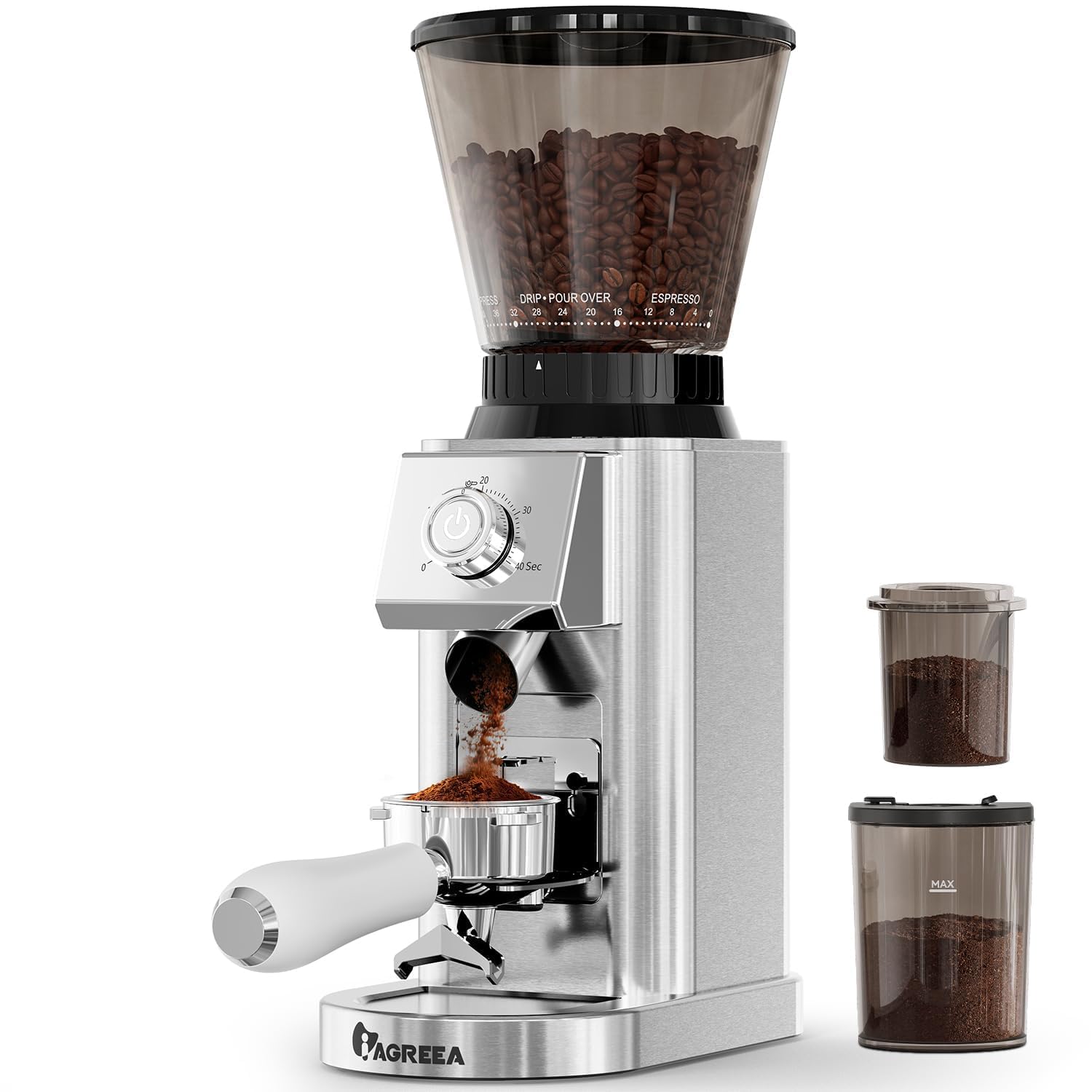
The IAGREEA nails the core requirement for coarse grinding: a low-speed 450 RPM motor that produces minimal heat and fewer fines. With 48 grind settings, you get ample room to fine-tune the particle size for French press or cold brew without jumping from too fine to too chunky in a single click.
Its anti-static design is not a gimmick — it noticeably reduces the cling of grounds to the collection bin and chute, meaning your yield actually makes it into the brew. The portafilter holder is a nice bonus for espresso users, but the real star here is the consistency of the coarse particles at settings above 30. The burrs maintain a tight tolerance, producing a mostly uniform size with very few boulders or dust.
The stainless steel build feels solid for its price tier, and the precision timer lets you dial in exact batch sizes. If you want one machine that handles everything from drip to a true coarse grind without compromise, this is the most balanced pick in the list.
Why it’s great
- Low 450 RPM motor produces fewer fines at coarse settings
- 48 grind settings offer very fine control for coarse adjustments
- Effective anti-static tech reduces counter mess
Good to know
- Hopper capacity is moderate, not suited for massive batches
- Some users find the touch controls less intuitive than knobs
2. Tuni G1 Conical Burr Coffee Grinder

The Tuni G1 brings a digital edge to the coarse grinding game with an LED touchscreen and a precision electronic timer. The 48 grind settings mirror the IAGREEA’s range, but the interface makes it easier to recall your exact coarse setting for a specific bean or roast level without guessing.
Its anti-static design is paired with a stainless steel build that reduces static buildup effectively. At coarse settings, the particle distribution is impressively tight — you get clean, even grounds that look like coarse sea salt rather than a mix of fines and chunks. The touchscreen adds a modern feel, but it is responsive and doesn’t lag during operation.
The portafilter holder is included for espresso dosing, but the primary strength remains the repeatable coarse grind quality. The motor runs quietly, and the overall footprint is compact enough for most countertops. For those who want a digital workflow with visual confirmation of their grind setting, the Tuni G1 delivers a premium experience.
Why it’s great
- LED touchscreen makes setting recall easy and precise
- 48 grind settings allow fine coarse-tuning
- Anti-static build minimizes mess and waste
Good to know
- Digital interface may be less durable than mechanical knobs long-term
- Higher price point for essentially the same setting range as IAGREEA
3. SHARDOR Professional 64mm Burr Coffee Grinder
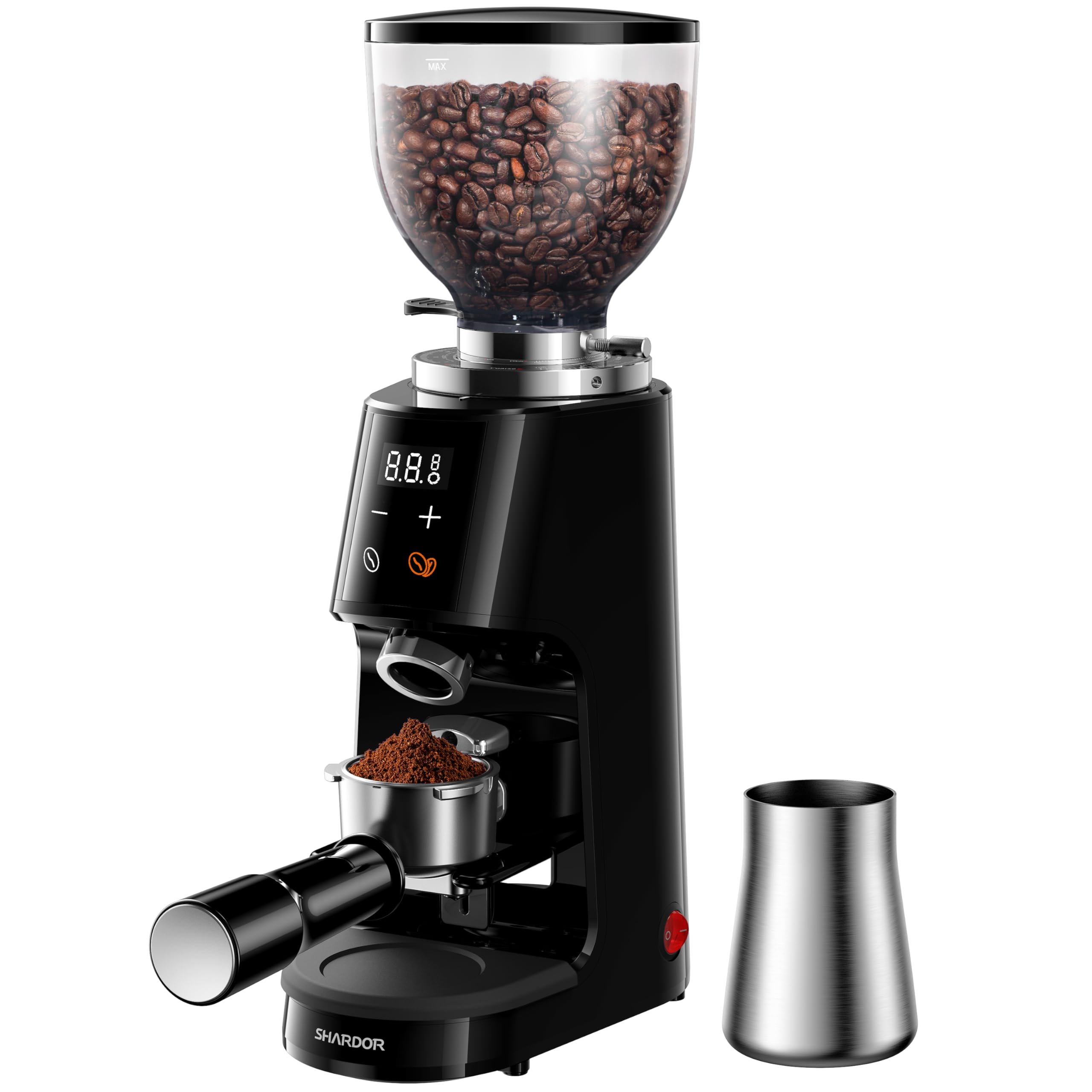
The SHARDOR is the most serious contender for those who demand the absolute widest range of adjustment. With 100 grind settings and a 64mm flat burr set, it offers an unprecedented level of granularity for coarse grinding. The ability to move in tiny increments means you can dial in a specific coarse particle size for a particular French press immersion time with surgical precision.
The all-metal chamber is a durability statement — this grinder feels built to last years of daily use. The adjustable electronic timer and LED display let you program dose sizes accurately, and the anti-static design is effective at keeping grounds from scattering. The flat burr design at coarse settings produces a slightly different particle shape than conical burrs, but the high number of settings compensates by allowing you to land exactly on the right coarseness.
It runs on 120V only, so verify your outlet. The larger burr set demands more counter space and the motor is slightly louder than the low-speed conical models, but for the enthusiast who wants to control every variable, the SHARDOR is the most capable coarse grinder on this list.
Why it’s great
- 100 grind settings offer unmatched granularity for coarse dialing
- All-metal chamber provides exceptional durability
- Large 64mm burrs for high throughput
Good to know
- Flat burr design may produce slightly more fines at very coarse settings
- Larger footprint and louder motor than conical alternatives
4. OXO Brew Compact Conical Burr Coffee Grinder

OXO is known for practical, well-thought-out kitchen gear, and this compact conical burr grinder lives up to that reputation. It does not offer the high setting count of some competitors, but the step size between the available coarse settings is well-judged — you can find a consistent coarse grind for a standard French press without having to guess or waste beans.
The compact footprint is a real advantage for smaller kitchens. It fits neatly under cabinets without taking up valuable counter real estate. The grinding consistency at coarse settings is solid, producing a uniform particle size with fewer fines than many budget blade grinders. It is also relatively quiet during operation.
It lacks the anti-static features of the higher-end models, so some grounds may cling to the bin on dry days. But for the home user who wants a reliable, consistent coarse grind from a trusted brand without paying for advanced features they do not need, the OXO Brew is a smart, clean pick.
Why it’s great
- Compact size fits easily into small kitchens
- Consistent coarse grind for French press
- Reliable brand with good build quality
Good to know
- Limited number of grind settings
- No anti-static technology, some cling in dry conditions
5. Aromaster Conical Burr Coffee Grinder

The Aromaster offers a strong mid-range package with 25 grind settings, covering the typical spectrum from fine espresso to coarse French press. The conical burrs are made from stainless steel and deliver a cleaner coarse particle distribution than blade grinders at this price tier. The DC motor is notably quieter than older AC-driven models.
It includes a 3-ear portafilter holder for 51-53mm baskets, which is a thoughtful addition for espresso users. The anti-static design and removable upper burr make cleaning straightforward — the included brush is a welcome extra. The 2-12 cup timer adjustment lets you grind for the exact batch size needed without weighing every time.
At coarse settings, the grind consistency is good but not perfect — you may find slightly more variation than in the premium options. However, for the price, the Aromaster represents a solid investment for anyone who wants a conical burr grinder capable of a decent coarse grind without jumping to the top-tier price bracket.
Why it’s great
- 25 grind settings provide solid range for coarse dialing
- Quiet DC motor
- Includes portafilter holder and cleaning brush
Good to know
- Coarse consistency may vary slightly between batches
- Smaller 5.6 oz capacity limits batch size
6. KIDISLE Conical Burr Coffee Grinder
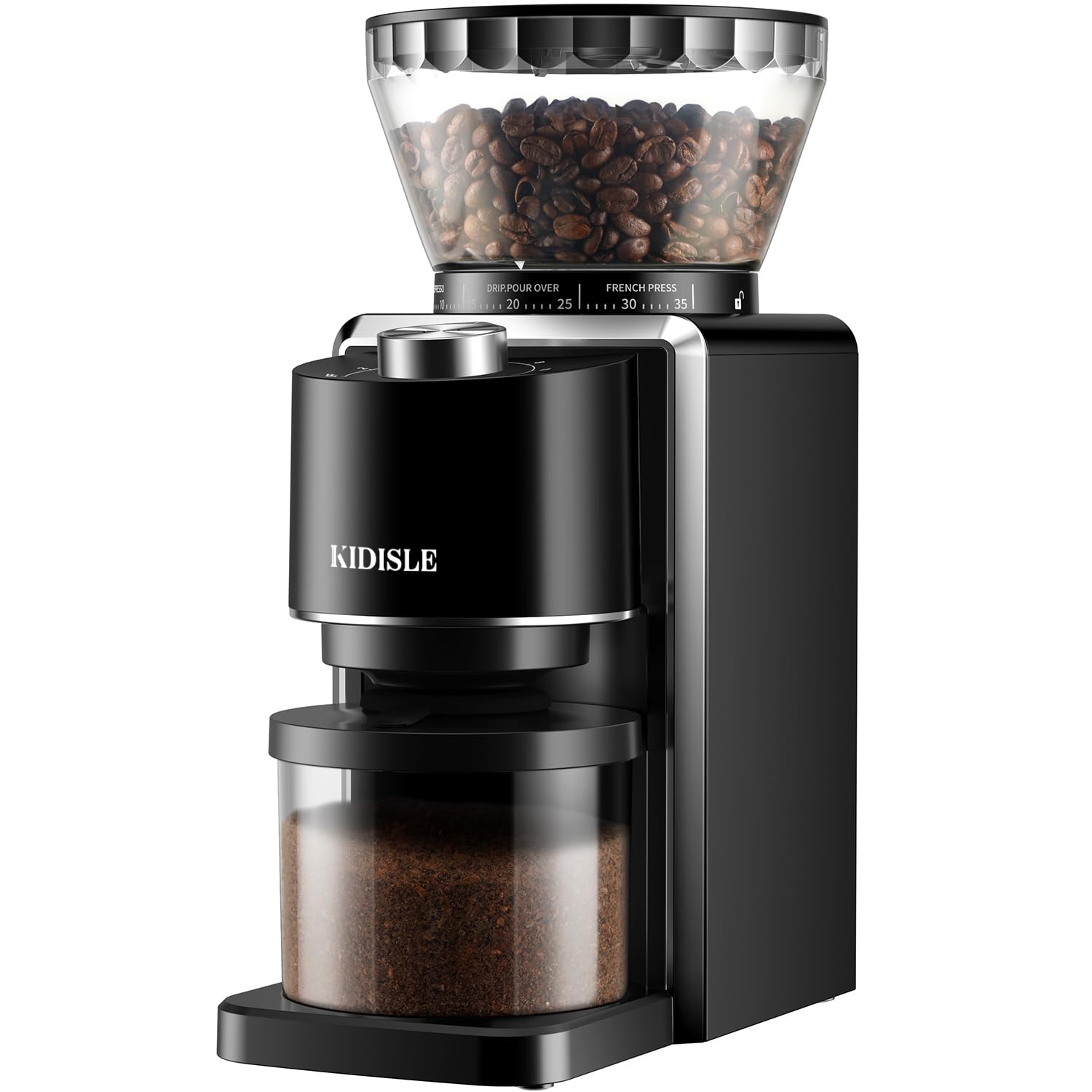
The KIDISLE punches above its weight class with 35 grind settings — more than many mid-range models. This higher setting count gives you the ability to fine-tune your coarse grind for different French press brew times or cold brew concentrates without settling for a one-size-fits-all coarse option. The anti-static design is a welcome feature at this price tier, reducing mess during transfer.
Grind consistency at coarse settings is decent, with fewer large boulders than you would expect from a budget conical burr. The 2-12 cup selector is useful for portion control, though the timer mechanism is less precise than digital options. The build uses more plastic than metal, but it feels sturdy enough for regular home use.
For the price, it is hard to argue with the value proposition. It offers a genuine conical burr with a wide setting range and anti-static tech without the premium price tag. If you are on a tight budget but refuse to use a blade grinder for your French press, the KIDISLE is the entry point that makes the most sense.
Why it’s great
- 35 grind settings for a budget-friendly burr grinder
- Anti-static design at an affordable price
- Conical burrs for better particle uniformity than blades
Good to know
- Build quality favors plastic over metal
- Timer is mechanical and less accurate than digital
7. Cuisinart DBM-8P1 One-Touch Automatic Burr Grinder
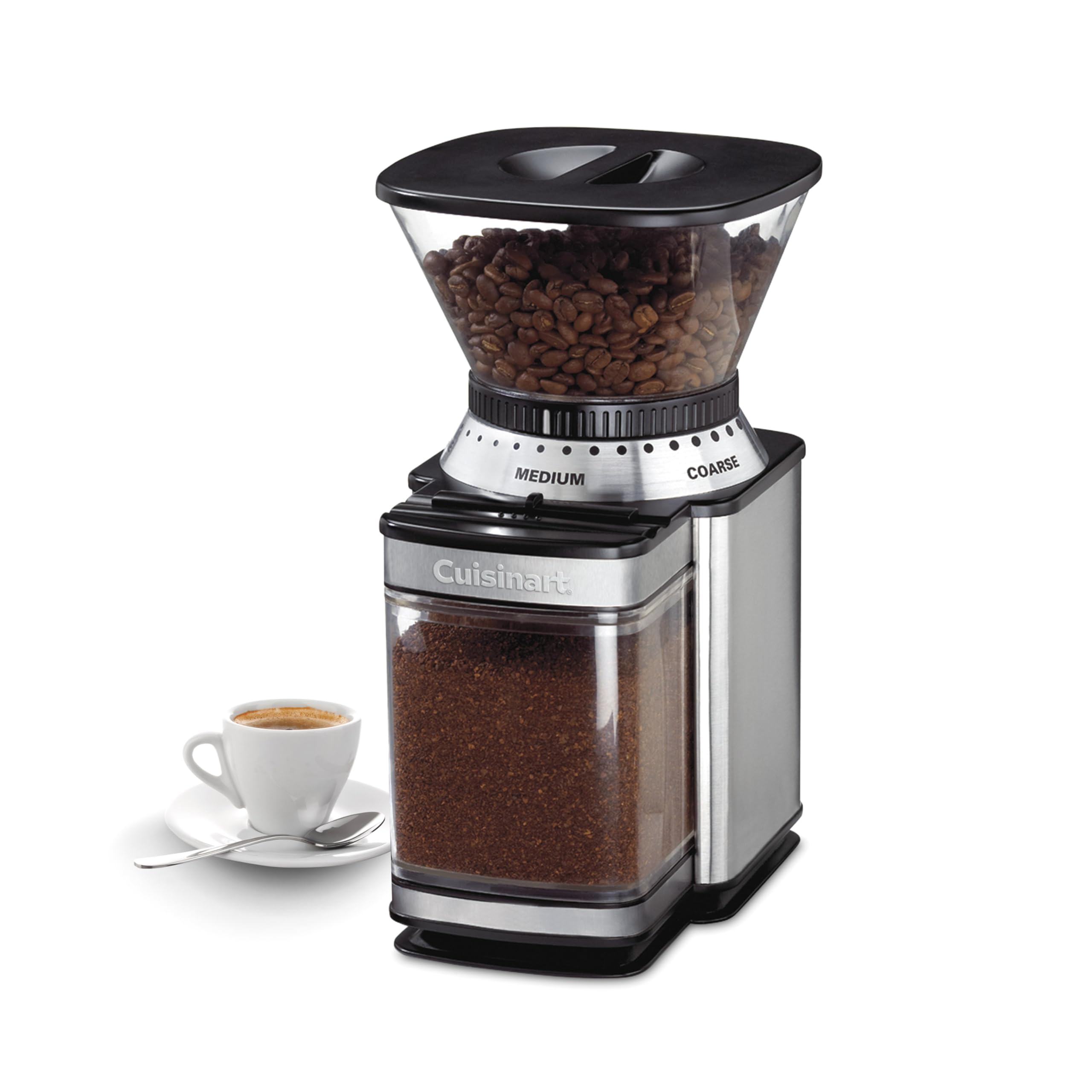
The Cuisinart DBM-8P1 is the classic entry-level burr grinder, and it remains a popular choice for good reason. Its 18 grind positions cover the basic range, and the coarse setting is suitable for a standard French press, though it lacks the fine granularity of grinders with more steps. The one-touch automatic operation with a cup selector for 4 to 18 cups makes it very easy to use.
The grind consistency at coarse settings is acceptable for a burr grinder at this price tier, but you will notice more variation and fines than with the higher-setting models. It is a blade-grinder upgrade rather than a precision tool. The black stainless finish looks decent on the counter, and the hopper capacity is generous enough for large batches.
The main limitation for coarse grinding is the fixed steps — you cannot dial in a specific coarse size as precisely as with a 35- or 48-setting grinder. But for casual French press users who want to move away from pre-ground coffee without a big investment, the Cuisinart delivers a functional and reliable coarse grind.
Why it’s great
- Easy one-touch operation with cup selector
- Reliable burr grinder at an entry-level price
- Large hopper for batch grinding
Good to know
- Only 18 positions limit coarse fine-tuning
- More fines at coarse settings compared to higher-step models
FAQ
What grind setting number is best for French press coarse grind?
Can I use a blade grinder for coarse grind?
Why do my coarse grounds have so much dust or fines?
Is 48 grind settings overkill for just coarse grinding?
Final Thoughts: The Verdict
For most users, the coffee grinder for coarse grind winner is the IAGREEA Conical Burr Coffee Grinder because its 48 settings, low 450 RPM motor, and effective anti-static design deliver the best balance of coarse consistency and value. If you want a digital interface with precise setting recall, grab the Tuni G1. And for maximum granularity and pro-grade build, nothing beats the SHARDOR 64mm.