Slicing a rustic, crusty sourdough loaf by hand is a fast track to uneven slabs, crushed crumbs, and a dulled chef’s knife. The hard crust fights back against standard blades, and a wobbly freehand cut can ruin the open crumb structure you spent days developing. A dedicated bread slicer solves this by locking the loaf in place and guiding a serrated blade through a consistent, straight plane.
I’m Mohammad Maruf — the founder and writer behind AirfryerBite. I’ve spent years analyzing kitchen hardware specifications, comparing blade geometries, guide rail systems, and base stability across dozens of manual slicer models to separate the genuine performers from the gimmicks.
This guide breaks down the top-rated manual slicers for home bakers, comparing key specs like adjustable thickness range, blade material, and base suction. After reviewing the data, I’ve built a short list of the best bread slicer for sourdough to help you get bakery-consistent slices every time.
How To Choose The Best Bread Slicer For Sourdough
The right slicer for sourdough hinges on three core factors: blade aggression, thickness adjustment range, and base stability. An uneven slice or a crushed crust is a sign that one of these elements is mismatched to your loaf style. Let’s look at what matters most.
Blade Material and Serration Pattern
Sourdough crust is dense and sharp. A standard straight-edge blade will compress the loaf before it cuts, collapsing the airy interior. Look for a slicer with a stainless steel serrated blade — the teeth grab the crust and saw through without pressure. Food-grade 403 stainless steel is common in this category; it resists rust and holds a sharp edge through dozens of loaves. Avoid carbon steel blades that can discolor or corrode from moisture.
Adjustable Thickness Range
The best slicers let you dial in slice width from paper-thin (around 0.2 inches) for delicate open-faced toppings up to 0.9 inches for thick toast or French toast. A rotary knob or slider with clear engraved markings is essential for repeatability. If you bake both light sandwich loaves and dense rye, a wider range gives you more versatility. Look for a maximum thickness of at least 0.8 inches.
Base Stability and Suction Cups
Slicing requires two hands — one to crank and one to guide the loaf. If the slicer slides across the counter, the cut will be crooked or unsafe. Four strong suction cups are the standard for keeping the unit locked in place. Models with a wider, heavier wooden base also dampen vibration during the cut, which improves slice consistency. Check that the suction cups are replaceable if they lose grip over time.
Quick Comparison
On smaller screens, swipe sideways to see the full table.
| Model | Category | Best For | Key Spec | Amazon |
|---|---|---|---|---|
| Brvclon Manual Bread Slicer | Premium | Gift-ready packaging & stability | Solid wood base, metal guide | Amazon |
| vanerepok Upgrade Manual Slicer | Premium | Continuous conveyor slicing | Steel wire guide rail | Amazon |
| SOWKIPE Hand Crank Slicer | Premium | Thick slices up to 0.9 inches | 0.9-inch max thickness | Amazon |
| Voltironix Upgrade Manual Slicer | Mid-Range | Versatile slicing beyond bread | 403 stainless steel blade | Amazon |
| vanerepok Hand Crank Slicer | Mid-Range | Commercial & home dual use | Adjustable stainless steel | Amazon |
| Manual Bread Slicer with Suction Cups | Budget | Simple, stable home slicing | Solid wood base, scale marks | Amazon |
| SYOKAMI Bow-Design Slicer | Budget | Unique bow-blade for crusty loaves | Bow design, 4 thickness marks | Amazon |
In‑Depth Reviews
1. Brvclon Manual Bread Slicer
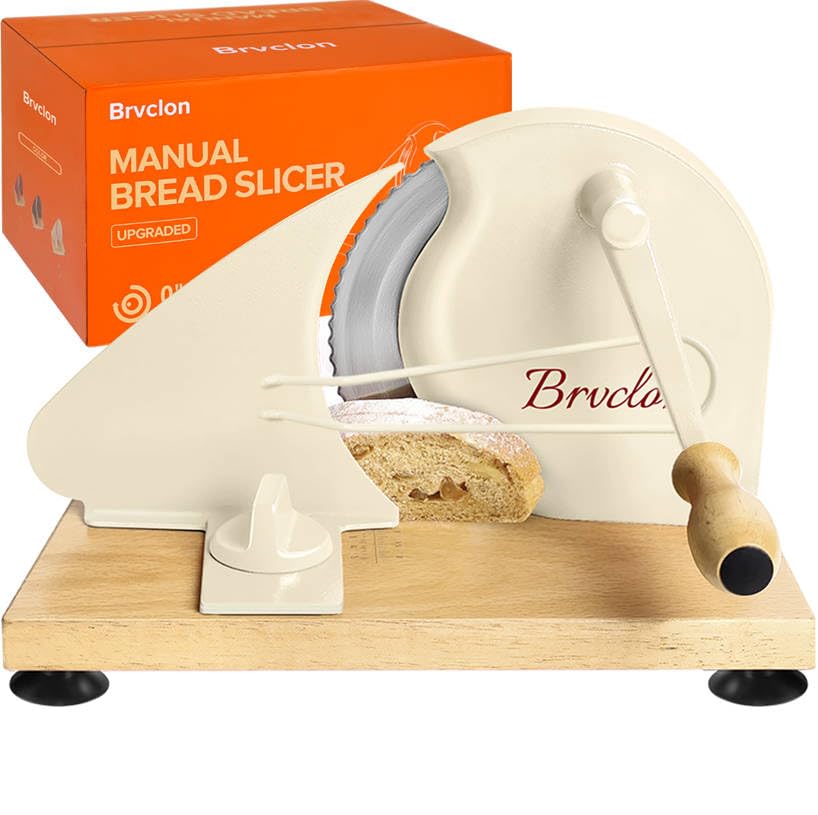
The Brvclon slicer sits at the top of the premium tier for good reason. Its solid wood base provides enough mass to stay planted during heavy cranking, and the metal wire guide prevents the sliced bread from collapsing onto the handle. This guide rail is a standout feature — it keeps each slice upright and aligned, so you never have to fish a crushed piece out of the mechanism mid-cut.
The adjustable thickness knob is marked with clear scale lines, letting you dial in anything from a thin 0.2-inch slice for tartines up to a hearty 0.8-inch cut for toasting. The stainless steel serrated blade cuts through a dense sourdough boule without tearing the crumb, and the four suction cups lock the slicer firmly to granite or butcher block surfaces. The packaging is gift-level quality, which is a bonus if you intend to give this to a fellow baker.
One thing to note: the blade is not removable for sharpening, so you’ll need to treat it gently and hand wash it only. The wooden base shouldn’t be soaked — a quick wipe after each use will keep it stain-free. For the stability and consistent output it delivers, this is a strong contender for the top spot.
Why it’s great
- Heavy wood base prevents counter shift during slicing.
- Metal guide rail keeps slices upright and handle clear.
- Gift-level packaging adds value.
Good to know
- Blade is non-removable for sharpening.
- Wood base requires careful hand washing only.
2. vanerepok Upgrade Manual Bread Slicer (White)
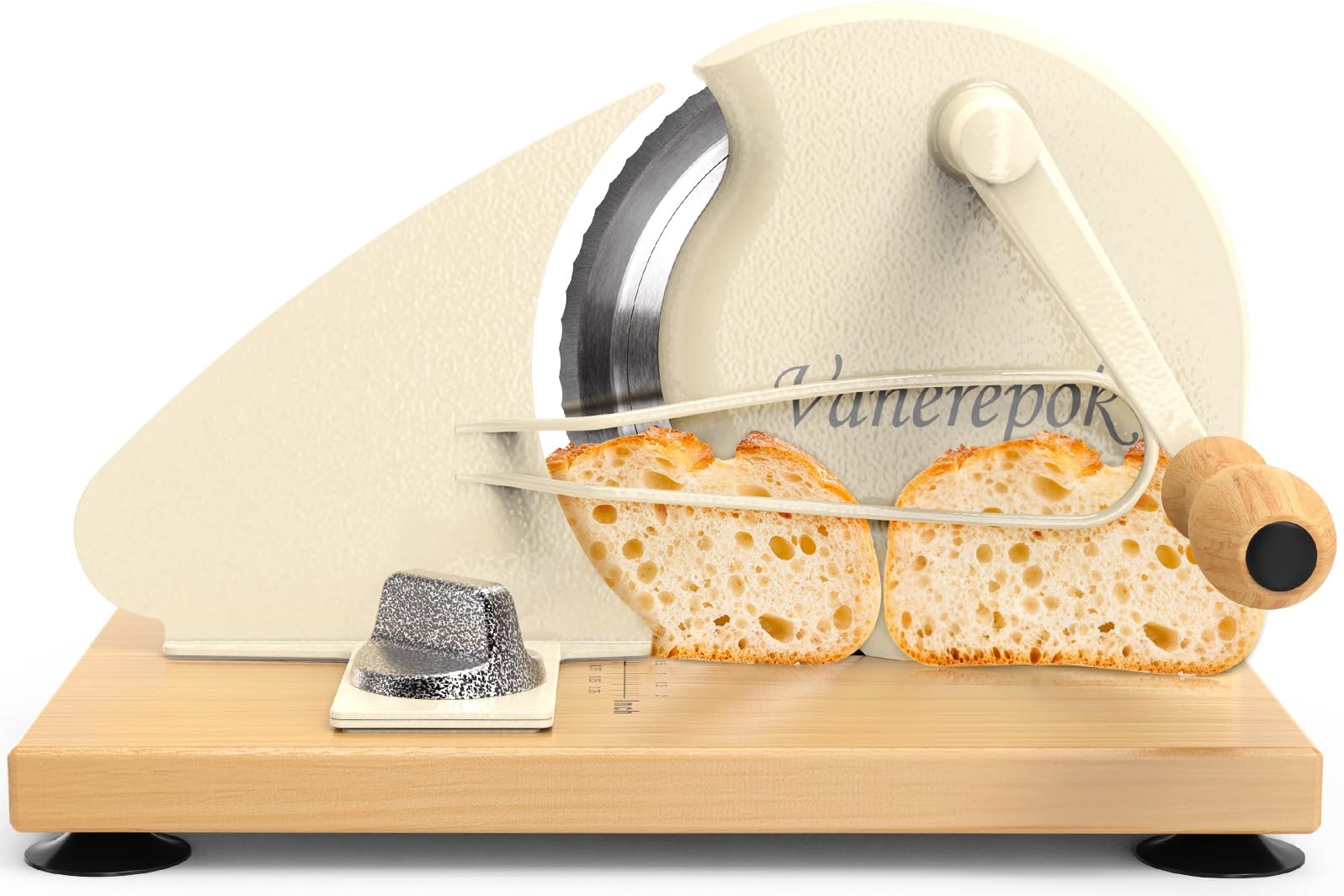
This vanerepok model introduces a steel wire conveyor-belt guide rail that changes how the slicer handles continuous operation. Instead of slices falling onto the handle and blocking the crank, each piece rides the wire rail forward, keeping the path clear for the next cut. For home bakers who slice multiple loaves in one session — say, for a bake sale or weekly meal prep — this feature alone saves significant frustration.
The gear drive adds a mechanical advantage that makes cutting through a thick, cold sourdough crust noticeably easier. You won’t need to muscle the crank; the gearing does the work. Thickness adjusts up to 0.8 inches via a simple rotary knob, and the 4 suction cup feet grip the counter reliably even on smooth tile. The vintage white aesthetic blends well with both modern and retro kitchens without looking out of place.
The blade is stainless steel and serrated, but at 6.6 inches it’s slightly shorter than some competing models. Very large boules over 7 inches in diameter may require repositioning mid-cut. Also, the wooden base, while attractive, requires hand drying to prevent warping. For efficient multi-loaf slicing with minimal effort, this is the most thoughtful design in the list.
Why it’s great
- Steel wire guide rail prevents slice pile-up on handle.
- Gear drive reduces effort cutting dense crust.
- Adjustable thickness up to 0.8 inches.
Good to know
- 6.6-inch blade may not fit extra-large boules.
- Wood base must be hand-dried to avoid warping.
3. SOWKIPE Manual Bread Slicer with Hand Crank

The SOWKIPE offers the widest adjustable thickness range in this roundup — up to 0.9 inches. If you prefer your sourdough toast with a dense, chewy center and a thick crust, this slicer delivers that exact cut without having to freehand a second pass. The rotary knob is easy to turn even with floured hands, and the engraved scale lines are visible at a glance.
The frame uses a combination of food-grade aluminum and stainless steel, which keeps the unit lightweight at 5.5 pounds but still stable thanks to four powerful suction cups. The ergonomic handle is contoured for a natural grip, reducing wrist fatigue when working through a batch of three or four loaves. The metal wire guide is another thoughtful inclusion — it holds slices upright so they don’t tumble into the crank path.
One trade-off: the aluminum components are lighter than a solid wood base, so on very slick countertops the suction cups do most of the stabilization work. Make sure the surface is clean and dry before locking it down. The blade is not designed for user replacement, but with regular hand washing it holds its edge well for dozens of loaves before noticeable dulling.
Why it’s great
- Widest thickness range — up to 0.9 inches.
- Lightweight aluminum frame with strong suction cups.
- Metal wire guide keeps slices upright.
Good to know
- Aluminum base less stable than wood on slick surfaces.
- Blade is non-replaceable for home users.
4. Voltironix Upgrade Manual Bread Slicer
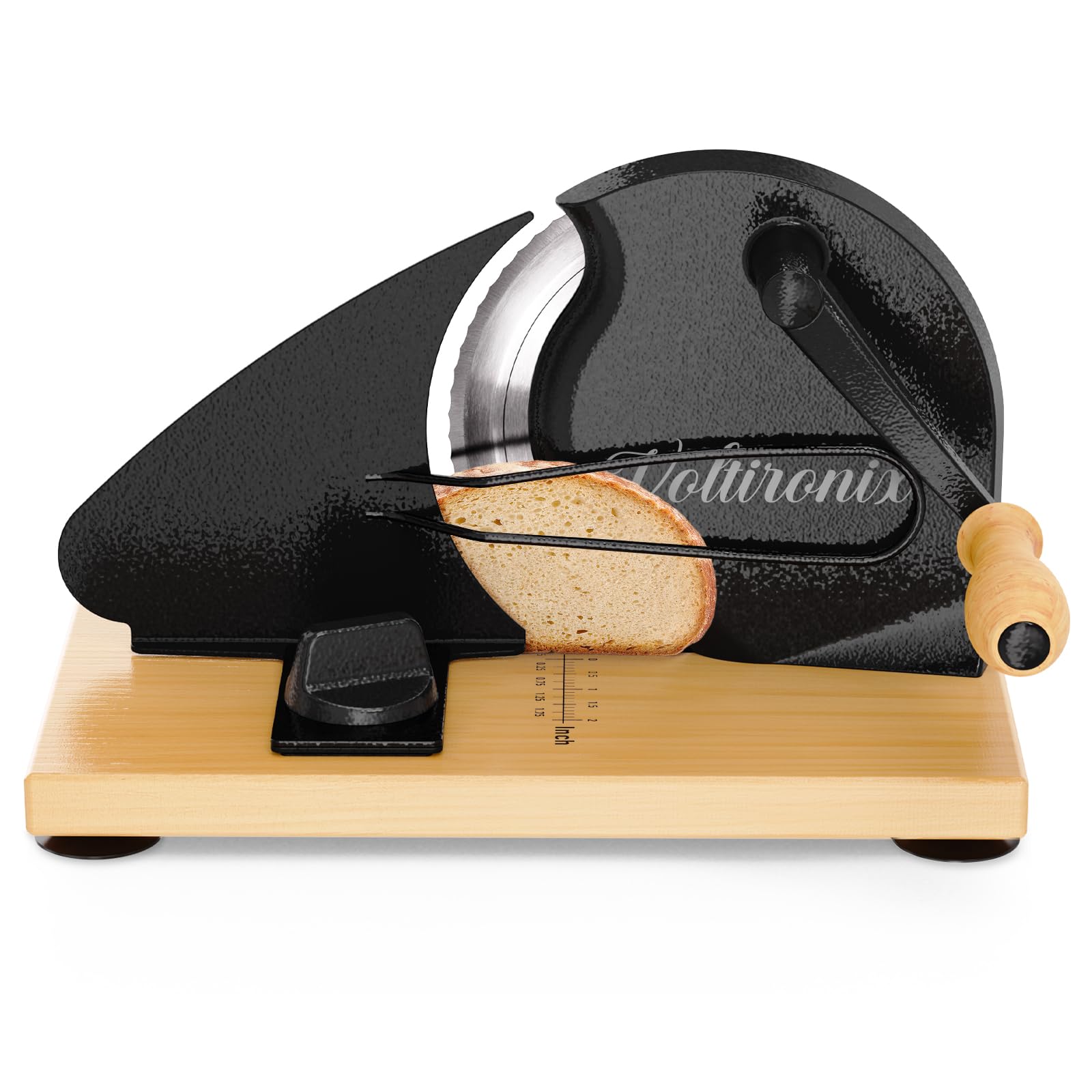
Voltironix packs a lot of practical engineering into its mid-range price bracket. The star of the show is the food-grade 403 stainless steel serrated blade — a material choice that delivers sharp, clean cuts through sourdough crust without microscopic chipping. The blade length of 6.6 inches is sufficient for standard boules and batards, and the serration pattern is aggressive enough to grab the crust without forcing.
The guide rail system is designed to prevent the handle from crushing soft bread, which is especially useful for sourdough that has a delicate, open crumb. Thickness adjustment spans 0 to 0.8 inches, controlled by a rotary knob with clear engraved markings. The solid wood base is paired with four strong suction cups that keep the unit planted even during rapid cranking. This model also cuts vegetables, cheeses, and bagels, adding versatility for non-bread tasks.
At 2.52 kilograms, it’s one of the heavier slicers, which contributes to stability. The downside is the weight can make it awkward to store in a cabinet — you’ll likely want to keep it on the counter. The included beechwood handle looks nice but requires occasional oiling to prevent drying. For home bakers who want one slicer to handle bread and more, this is a strong value.
Why it’s great
- 403 stainless steel blade stays sharp longer.
- Heavy wood base and suction cups for stability.
- Can slice vegetables, cheese, and bagels too.
Good to know
- Heavy weight is less convenient for storage.
- Wooden handle requires periodic oiling.
5. vanerepok Hand Crank Bread Slicer

This vanerepok model targets the baker who needs a slicer that can handle both home and light commercial use. The stainless steel construction and adjustable width mechanism allow for consistent slices from thin sandwich bread to thick artisan cuts. The hand crank is smooth and well-balanced, with a gear ratio that doesn’t require excessive torque on crusty loaves.
The unit includes suction cup feet for countertop stability, and the overall build feels durable enough for daily use in a small bakery or cafe setting. The blade is serrated and replaceable, which is a significant advantage for commercial users who will run through hundreds of loaves. The thickness adjustment is straightforward, with a knob that clicks into discrete positions for repeatable settings from one loaf to the next.
The biggest consideration is that replacement blades are not widely available through standard retail channels — you may need to contact the manufacturer directly. Also, the suction cups are smaller than on some premium models, so on porous or uneven countertops you might need to re-seat them occasionally. For the baker experimenting with higher volume, this is a reliable mid-range workhorse.
Why it’s great
- Stainless steel construction built for volume.
- Replaceable serrated blade for long-term use.
- Click-stop thickness adjustment for repeatability.
Good to know
- Replacement blades limited to direct purchase.
- Suction cups smaller than premium-tier models.
6. Manual Bread Slicer with Suction Cups (Wood Base)
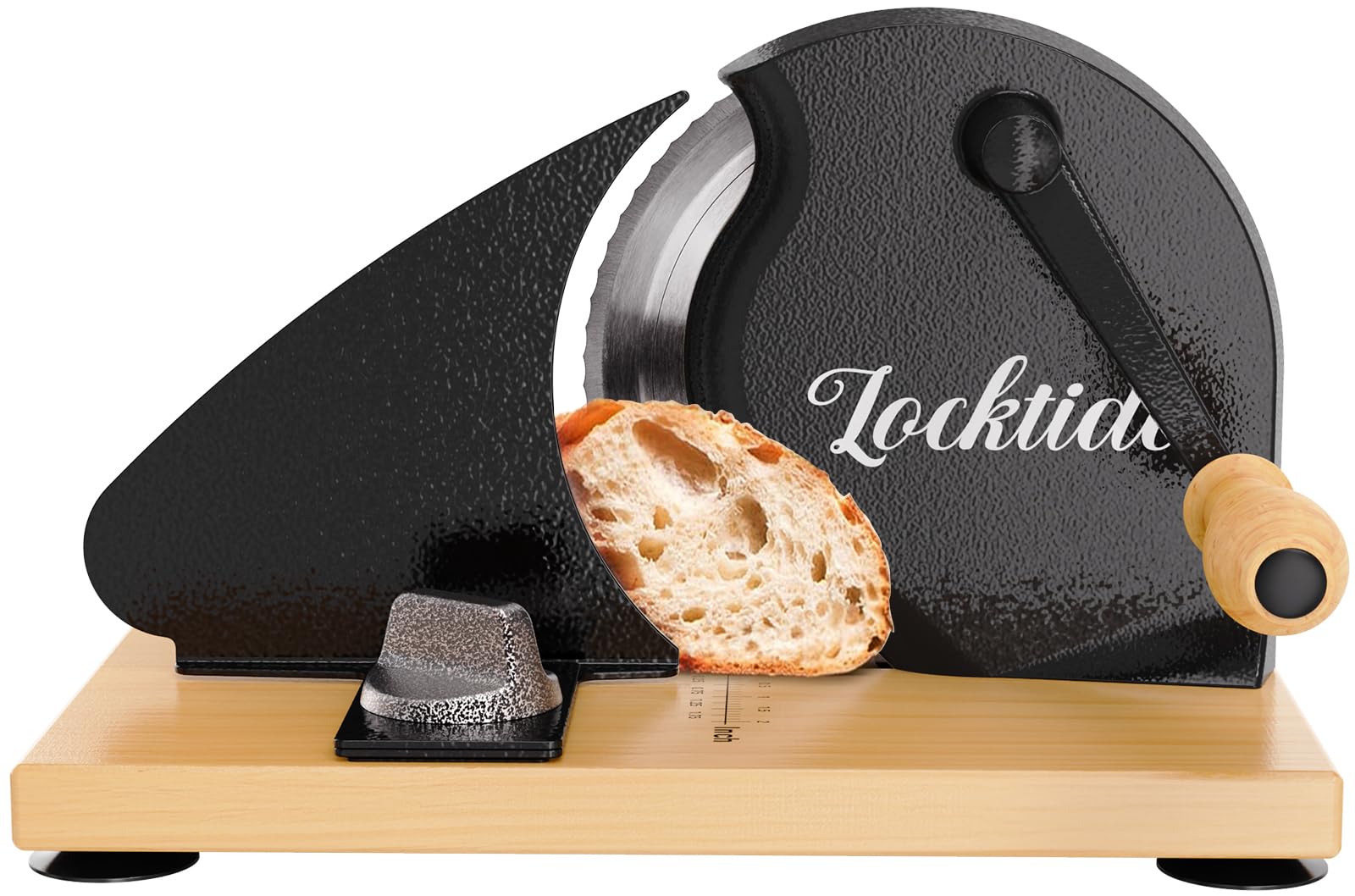
This entry-level slicer keeps things simple with a solid wood base, suction cups, and engraved scale lines — no motors, no gears, just the classic manual crank mechanism. For the home baker who only slices one or two loaves a week, this is a perfectly functional tool that doesn’t overcomplicate the process. The wood base provides enough heft to stay put, and the suction cups grip well on smooth countertops.
The adjustable thickness is manual and relies on a slide mechanism rather than a rotary knob. It works fine but lacks the fine granularity of a knob-based system — you get a few discrete settings rather than infinite adjustment. The blade is stainless steel and serrated, though it’s not marked with a specific grade. For soft to medium-crust sourdough, it cuts cleanly; very dense rye may require a bit more cranking force.
One thing to watch: the scale lines are printed rather than engraved, which means they may fade with repeated cleaning. The suction cups are replaceable, which extends the life of the unit. For the budget-conscious baker who prioritizes simplicity over precision engineering, this slicer delivers the core function without unnecessary frills.
Why it’s great
- Simple, intuitive manual crank operation.
- Replaceable suction cups extend unit life.
- Solid wood base provides adequate stability.
Good to know
- Slide mechanism limits fine thickness adjustment.
- Printed scale lines may fade over time.
7. SYOKAMI Bow-Design Sourdough Bread Slicer
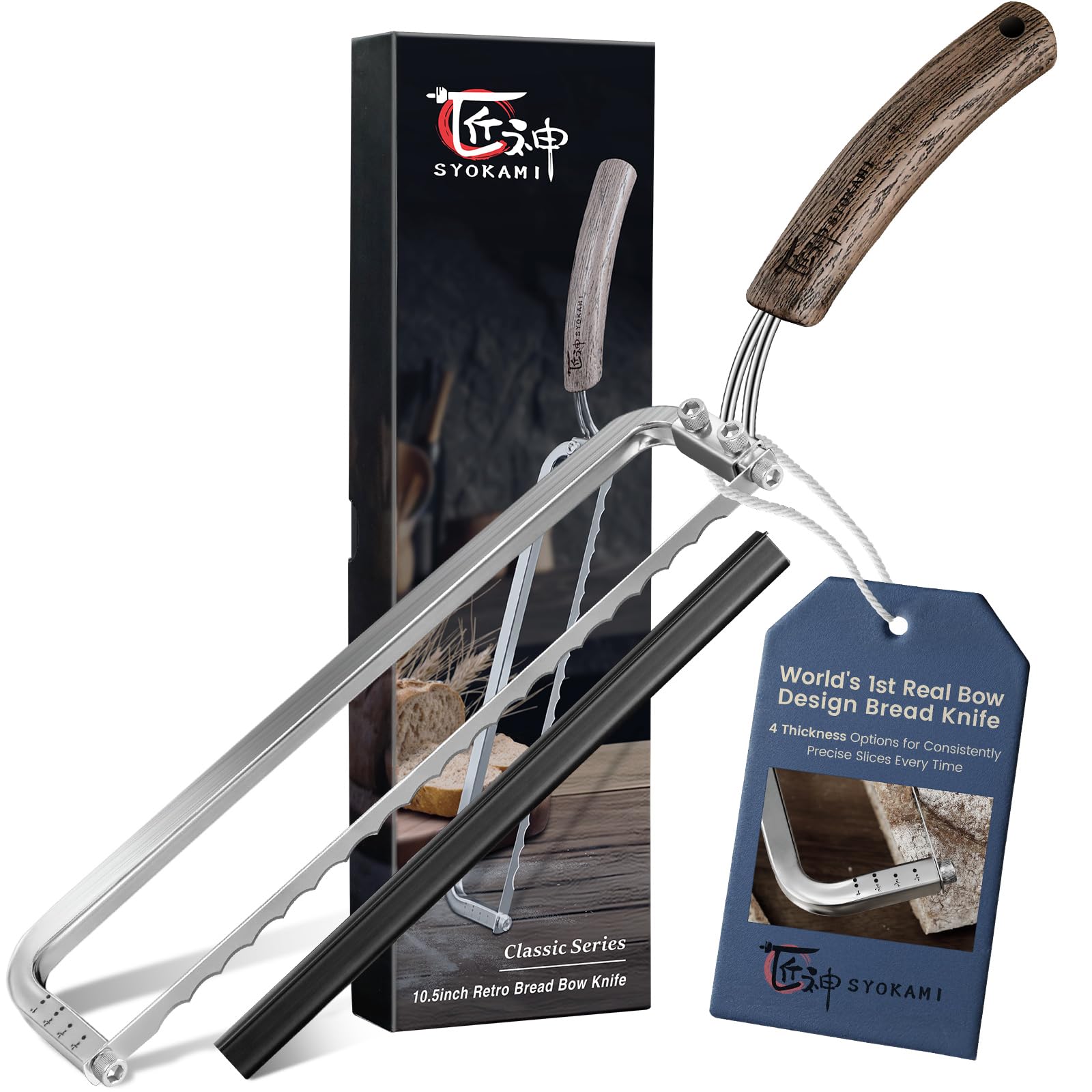
The SYOKAMI takes a different approach with its bow-shaped blade design. Instead of a traditional hand crank that rotates the blade through a fixed arc, this slicer uses a curved blade that mimics the motion of a pulling saw. The geometry is intended to reduce the compression force on the loaf, which can help preserve the open crumb structure of a high-hydration sourdough.
It includes four thickness scale marks printed on the frame, giving you a few preset options rather than continuous adjustment. The blade is marketed as razor-sharp straight from the package, and early users report clean cuts through crusty loaves with minimal tearing. The unit is compact and lightweight, making it easy to store in a drawer or small cabinet.
The bow design is unconventional, and it takes a few uses to get comfortable with the pulling motion — it’s not a simple crank-and-guide system. The suction cups are smaller than on the crank-style slicers, so the unit can shift if you apply too much downward force. If you’re willing to adapt your slicing technique, this is an interesting and compact option for occasional use.
Why it’s great
- Bow-blade design reduces crumb compression.
- Compact and easy to store.
- Razor-sharp blade cuts crusty loaves cleanly.
Good to know
- Unconventional motion requires practice.
- Smaller suction cups may shift during use.
FAQ
Can a bread slicer handle very crusty sourdough without crushing the crumb?
How do I clean a manual bread slicer with a wood base?
What is the ideal maximum thickness for sourdough toast?
Final Thoughts: The Verdict
For most users, the best bread slicer for sourdough winner is the vanerepok Upgrade Manual Bread Slicer because its steel wire guide rail and gear drive make continuous slicing effortless and precise. If you want the widest thickness range for thick toast, grab the SOWKIPE Hand Crank Slicer. And for a premium gift-ready package with rock-solid stability, nothing beats the Brvclon Manual Slicer.