A kitchen compost bin should sit quietly on your counter, collecting scraps without announcing its presence through unpleasant smells or an eyesore design. The wrong bin leaks odors, attracts fruit flies, and turns an eco-friendly habit into a daily frustration. The right one locks in smells, blends with your decor, and makes diverting food waste from the landfill nearly effortless.
I’m Mohammad Maruf — the founder and writer behind AirfryerBite. I’ve spent countless hours analyzing kitchen waste solutions, from countertop composters to under-sink collectors, focusing on the interplay between carbon filtration, material durability, and airtight seals that actually work in a home kitchen.
This guide breaks down the five best options on the market, helping you find the best kitchen compost bin for your countertop, your family size, and your tolerance for smelling yesterday’s onion peels.
How To Choose The Best Kitchen Compost Bin
Picking a kitchen compost bin comes down to balancing three factors: how often you want to empty it (capacity), how much you want to smell the contents (filtration), and how well it survives daily scrubbing (materials). Beginners often over-prioritize capacity and end up with a bin that stinks, while others buy a tiny bin and run to the outdoor pile three times a day.
Capacity vs. Counter Space: The 1.3-Gallon Sweet Spot
Most households produce between 1 and 1.5 gallons of food scraps per week. A 1.3-gallon bin holds roughly four to five days of peels, coffee grounds, and eggshells before needing a trip to the outdoor bin. A larger 2-gallon bin stays on the counter longer but takes up more real estate and gets heavy enough to strain the lid latch. A smaller 1-gallon bin requires near-daily emptying—fine for singles, annoying for a family of four. Measure the clear counter space near your prep zone: a bin that exceeds 8.7 inches in diameter starts to crowd a standard 24-inch countertop.
Carbon Filtration: Passive vs. Active Systems
Not all charcoal filters work the same. The best bins embed a thick, replaceable carbon filter pad inside the lid, which passively absorbs volatile organic compounds as air passes through. Some cheaper designs simply drill holes in the lid and stick a thin adhesive pad on top—these saturate within two weeks and start letting odors escape. Look for bins whose filter compartment holds a dedicated, replaceable carbon cartridge (usually 1–2 inches thick) rather than a flimsy foam disc. Premium bins like the EPICA and D’Lifeful include multiple spare filters, doubling the effective life of the system before you need to reorder.
Material: Stainless vs. Powder-Coated Steel
Bare stainless steel (like the Utopia and EPICA bins) resists rust well and wipes clean easily, but it shows every fingerprint and develops a mild metallic scent if you don’t wash it weekly. Powder-coated steel or carbon steel (like the Beautiful and D’Lifeful bins) adds a layer of color and texture that hides smudges, but the coating can chip if knocked against a sink edge, exposing raw metal underneath. For long-term durability in a humid kitchen, look for powder-coated bins that specify rust-proof treatment on the base—that’s where moisture seeps in first. Avoid bins with plastic bodies entirely; they stain and absorb odors over time.
Lid Design: Airtight vs. Ventilated
A completely airtight lid keeps smells locked inside but slows the aerobic breakdown process, potentially creating anaerobic pockets that smell worse when you open the bin. The best engineering compromise is a bin with a rubber gasket around the rim and a small, filtered vent in the lid. The gasket prevents major leaks while the carbon filter allows enough airflow to keep the contents breathing. Bins with no gasket at all (common in budget models) let odors escape around the lid seam, especially when the bin is more than half full.
Quick Comparison
On smaller screens, swipe sideways to see the full table.
| Model | Category | Best For | Key Spec | Amazon |
|---|---|---|---|---|
| EPICA | Stainless Steel | Best Overall build quality | 1.3 gal / 2 carbon filters / brushed finish | Amazon |
| Beautiful by KIBAGA | Powder-Coated Steel | Aesthetic countertop appeal | 1.1 gal / wood handle / sage finish | Amazon |
| D’Lifeful | Galvanized Steel | Longest filter life (3 years supply) | 1.3 gal / 6 filters / cream powder coat | Amazon |
| Utopia Kitchen | Stainless Steel | Budget-friendly entry-level bin | 1.3 gal / charcoal filter / mirror polish | Amazon |
| Perfnique | Plastic Liner | Mess-free emptying with inner bucket | 1.3 gal / includes liner & carbon filter | Amazon |
In‑Depth Reviews
1. EPICA Countertop Compost Bin

The EPICA has been a staple in the kitchen compost category for years, and for good reason. Its 1.3-gallon brushed stainless steel body hits the balance between weekly emptying and counter-top footprint without feeling oversized. The lid houses a dedicated compartment for two included carbon filters, which absorb odors far more effectively than the single-filter designs found on cheaper bins.
Unlike bare metal bins that show every fingerprint, the EPICA uses a brushed finish that hides smudges well and resists the mild rust spots that sometimes appear around the rim of mirror-polish bins. The handle is solid stainless steel with a comfortable grip, making carrying a nearly full bin to the outdoor pile a one-handed task.
The lid seals with a silicone gasket that stays flexible over months of use, preventing the odor leakage that happens when hard plastic gaskets wear down. The bin is fully dishwasher-safe, though the lid should be hand-washed to preserve the filter’s longevity.
Why it’s great
- Brushed finish hides smudges and resists corrosion
- Two thick carbon filters provide superior odor trapping
- Silicone gasket maintains an airtight seal over years
- Comfortable stainless steel handle for easy transport
Good to know
- Filters must be replaced every 3–4 months for best performance
- Stainless body can dent if knocked against hard counter edges
2. Beautiful Kitchen Compost Bin by KIBAGA
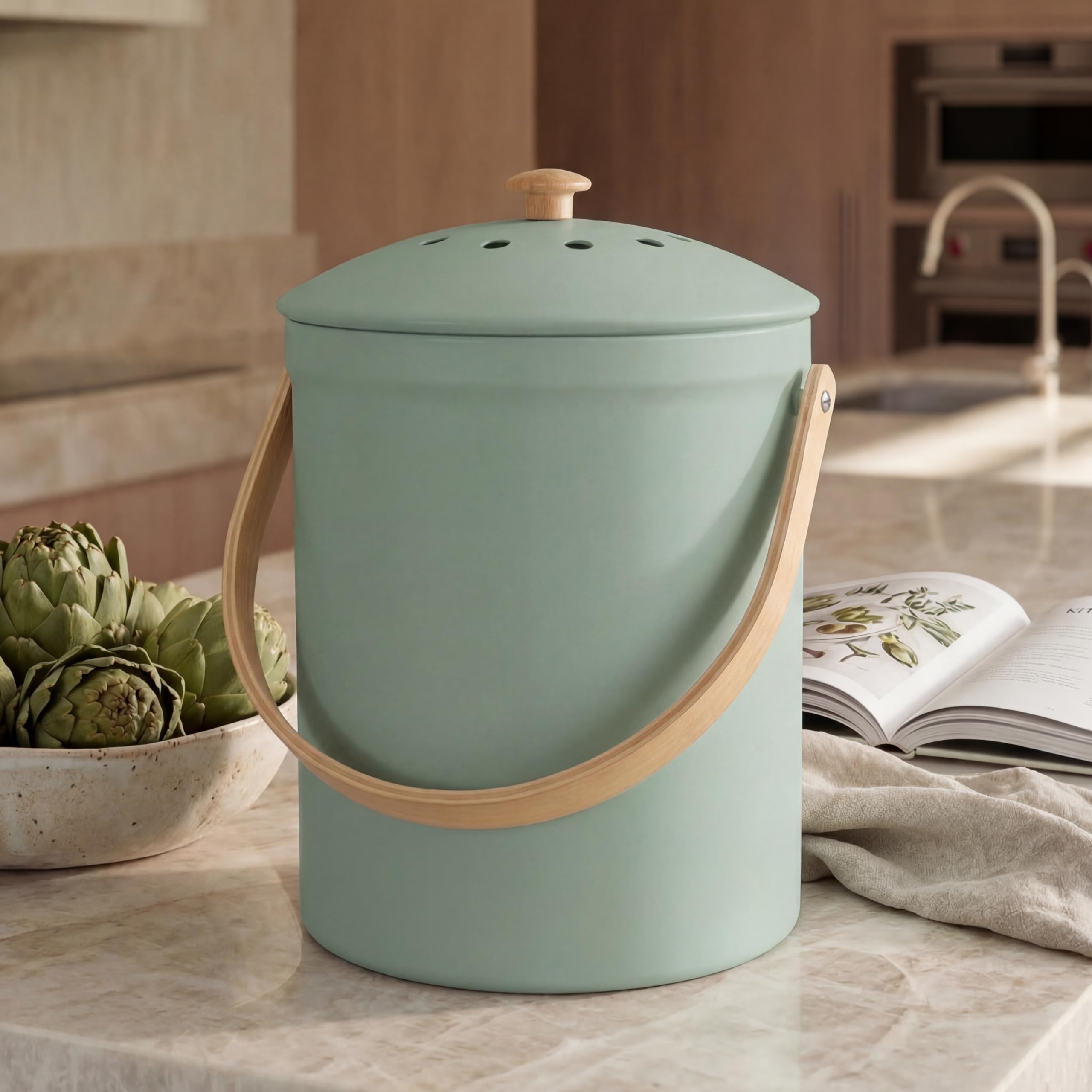
The KIBAGA Beautiful bin proves a compost collector doesn’t have to look utilitarian. Finished in a matte sage powder coat with a contrasting wooden knob and handle, it sits on the counter like a piece of farmhouse decor rather than a waste receptacle. The 1.1-gallon capacity is slightly smaller than the standard 1.3, which makes it ideal for a couple or a single person who empties the bin every two to three days.
The powder-coated carbon steel body resists rust effectively, though the coating can chip if the bin is dropped or scraped against a metal sink. The lid features a built-in charcoal filter compartment with ventilation holes that allow the compost to breathe without releasing odors. Two replacement filters are included, extending the seal life to roughly six months before a reorder is needed.
The wooden handle adds a warm tactile feel but should be dried after washing to prevent swelling.
Why it’s great
- Sage powder coat and wood handle elevate counter aesthetics
- Compact 1.1-gallon shape fits tight counter spots
- Charcoal filter compartment with vents prevents anaerobic smells
- Rust-resistant powder coat over carbon steel
Good to know
- Smaller capacity means more frequent emptying for families
- Powder coat can chip if struck against a hard surface
3. D’Lifeful Kitchen Compost Bin
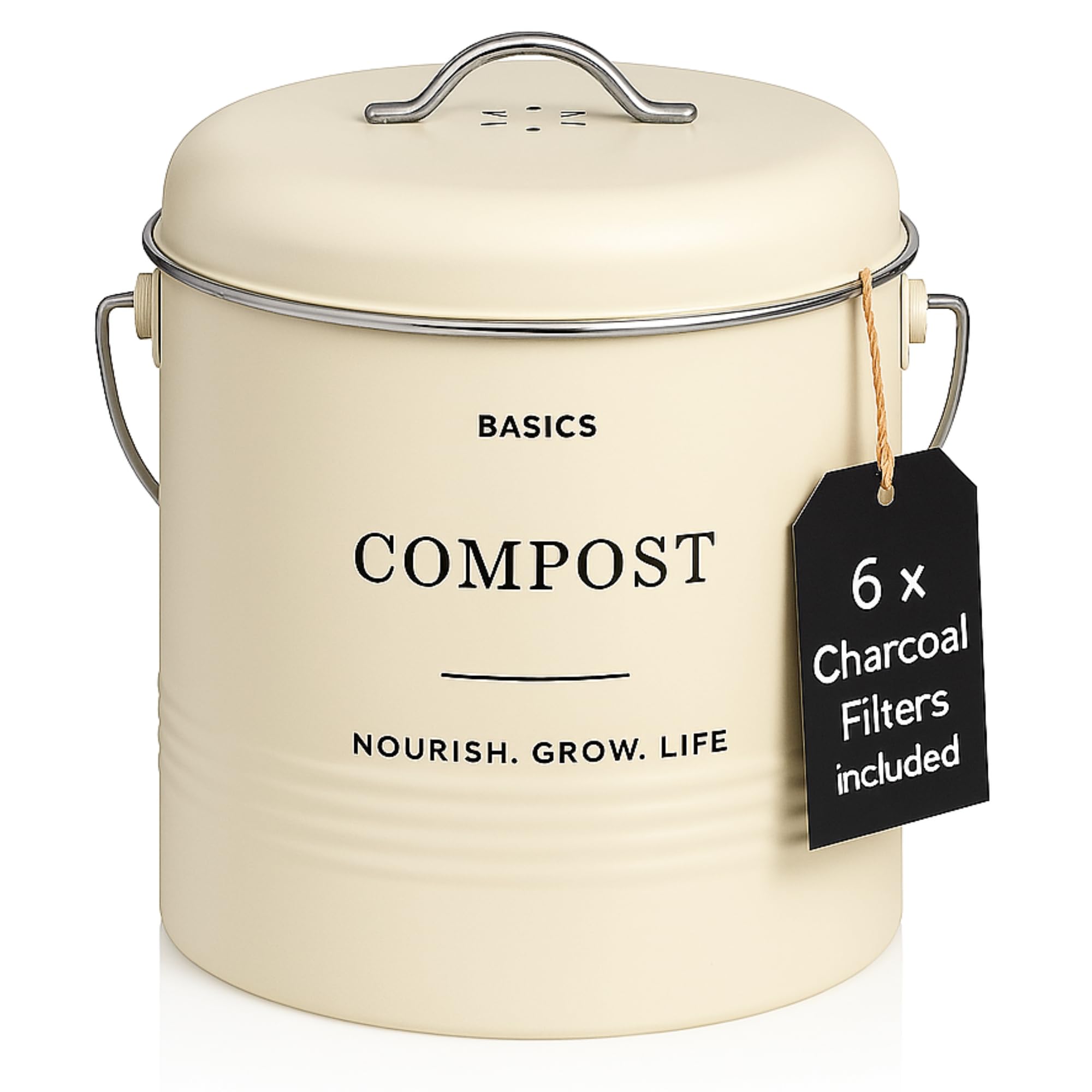
The D’Lifeful bin takes the worry out of filter replacements by bundling six activated charcoal filters with the purchase—enough to last roughly three years if each filter is swapped every six months. That alone saves you from frantically searching for replacement packs when the smell creeps back. The cream-colored powder coat over galvanized steel gives it a neutral look that fits both modern and traditional kitchens.
The 1.3-gallon capacity matches the EPICA and Utopia bins, so it holds about four to five days of scraps for a family of four. The lid closes with a snug, silicone-gasketed seal that keeps odors contained, and the compact 8.7-inch square footprint fits neatly beside a coffee maker or toaster without crowding the work triangle.
One subtle design advantage is the rounded interior corners, which prevent food scraps from getting trapped in hard-to-clean crevices. The bin rinses easily, though the powder-coated exterior should be wiped rather than scrubbed with abrasive pads to avoid scratching the finish.
Why it’s great
- Six carbon filters included—3-year supply out of the box
- Cream powder coat hides fingerprints and smudges
- Silicone gasket lid creates a reliable odor seal
- Rounded interior corners simplify cleaning
Good to know
- Powder coat may chip if handled roughly over time
- No handle on the side—must grip the body to carry
4. Utopia Kitchen Countertop Compost Bin

The Utopia Kitchen bin offers the most affordable entry point into the 1.3-gallon stainless steel category without sacrificing the core features that make composting manageable. Its mirror-polish stainless body is easy to wipe clean and resists rust when dried promptly after washing. The handle is integrated into the lid, which simplifies lifting but means you can’t carry the full bin by the handle alone without the lid potentially coming off.
The included charcoal filter sits in a small compartment on the underside of the lid. It’s a single, thinner filter compared to the dual filters in the EPICA, so it saturates faster—expect noticeable odor breakthrough after about two to three months of daily use. The lid snaps onto the rim without a rubber gasket, relying on the metal-on-metal contact for the seal, which works well when the bin is less than half full but lets occasional smells escape when it’s packed.
The bin is dishwasher-safe top rack, which is convenient for deep cleaning. The 7.8-inch diameter makes it one of the narrower options in the category, fitting easily under a cabinet overhang or on a crowded counter with limited horizontal space.
Why it’s great
- Mirror-finish stainless wipes clean with minimal effort
- Narrow diameter fits in tight counter and under-sink spaces
- Dishwasher-safe for easy deep cleaning
- Most accessible price point for first-time buyers
Good to know
- No rubber gasket—seal is metal-on-metal, less odor-proof
- Single thin filter saturates faster than dual-filter bins
- Lid handle makes carrying awkward when full
5. Perfnique Kitchen Compost Bin

The Perfnique bin differentiates itself with an inner bucket liner system—a removable plastic insert that lifts out completely, allowing you to empty the compost without scraping or rinsing the main container every time. The 1.3-gallon cream-colored body has a clean, minimalist look that blends well with light-colored kitchen palettes. The lid includes a carbon filter compartment for odor control, and the filter is pre-installed so it’s ready to use out of the box.
The inner liner sits snugly inside the main bucket and can be emptied directly into an outdoor composter or a garden pile, then rinsed and returned. This is a practical advantage for users who dislike scrubbing sticky food residue from the base of a traditional bin. The liner is made of BPA-free plastic, though it can stain over time if not cleaned promptly after use.
One trade-off of the double-wall design is that the 1.3-gallon bin occupies a slightly larger footprint than single-wall bins of the same capacity—9.5 inches tall by 7.5 inches wide—so check your counter clearance before buying. The cream finish shows stains if deeply colored scraps (berry juice, turmeric) spill onto the exterior, but a quick wipe with a bleach-free cleaner restores the surface.
Why it’s great
- Removable inner liner eliminates scraping and scrubbing
- BPA-free plastic liner is lightweight and easy to rinse
- Carbon filter pre-installed and ready for immediate use
- Clean cream aesthetic fits neutral kitchen decor
Good to know
- Double-wall design takes up slightly more counter space
- Cream exterior can stain if berry juices sit on the surface
- Plastic liner may absorb odors if not washed weekly
FAQ
How often should I change the carbon filter in my kitchen compost bin?
Can I put citrus peels and onion scraps in the bin without ruining the seal?
Is a powder-coated bin better than bare stainless steel for a humid kitchen?
Final Thoughts: The Verdict
For most users, the best kitchen compost bin winner is the EPICA Countertop Compost Bin because it combines the ideal 1.3-gallon capacity with a proven dual-filter system and a brushed stainless body that outlasts powder-coated alternatives. If you want a bin that complements your counter decor with a farmhouse aesthetic, grab the Beautiful by KIBAGA. And for the best long-term filter value with zero reorder stress, nothing beats the D’Lifeful and its six included filters.