The gap between a flat, sour shot of espresso and a syrupy, crema-topped ristretto is often measured not in technique but in microns of grind particle size. For home baristas, that delta usually funnels through a single bottleneck: the grinder. A quality burr set capable of espresso-fine adjustment without pulverizing the coffee into a heat-tainted sludge has historically demanded a serious investment, leaving most budget-conscious coffee lovers trapped behind a machine that simply cannot keep up with their palate.
I’m Mohammad Maruf — the founder and writer behind AirfryerBite. I research coffee equipment by cross-referencing burr geometry, torque consistency, and micron adjustment tolerances with long-term user performance data to separate real value from marketing watts.
Dropping a few hundred dollars is not the only path to repeatable extraction; the market now delivers conical and flat burr grinders with stepless adjustment, low-RPM motors, anti-static chambers, and precision timers that sit firmly in the value tier. The results of this analysis define what a real best inexpensive espresso grinder must deliver: consistent particle distribution, minimal retention, and the build quality to survive daily double shots without drifting off the dial.
How To Choose The Best Inexpensive Espresso Grinder
Choosing a grinder for espresso on a budget requires looking past wattage or bean hopper size and focusing on the mechanical chain that creates the grind. A grinder that excels for drip coffee can be terrible for espresso, and vice versa. These four checkpoints will save you from buying an overpriced spice mill that looks like a coffee grinder.
Burr Geometry: Conical vs. Flat
Conical burrs are the dominant geometry in the value tier because they are cheaper to manufacture, run at lower RPM (typically 400-500 RPM), and produce a broad particle distribution that can taste forgivingly sweet in espresso. Flat burrs, especially 54 mm or 64 mm models, offer a tighter particle distribution, clearer flavor separation, and less fines production, but often cost more. For an inexpensive espresso grinder, a quality conical burr is safer; a flat burr at the same price point may indicate corners cut in burr finishing.
Adjustment Increment: Microns per Click
Espresso lives in a grind range of roughly 200 to 400 microns. A grinder that jumps 50 microns per click may skip over the exact point where your machine and beans produce a balanced shot. Look for step sizes of 20 microns or less. Stepless external adjustment rings, common on premium manual grinders like the 1Zpresso K-Ultra, provide infinite fine-tuning. On electric models, 48 settings (like on the AMZCHEF and Tuni G1) is a bare minimum; 100 settings (SHARDOR, MOKKOM) give granular control for dialing in different roast levels.
Retention and Single Dosing
Retention is the enemy of freshness. A grinder that holds back 2-3 grams of old grounds inside the chute means your first shot of the day is stale. Look for designs with minimal grind path length, bellows or blow-out funnels, and anti-static features (plasma generators or ionizers) that prevent grounds from clinging to the exit chute. True zero retention (under 0.1 grams) is a sign of thoughtful engineering, even at an inexpensive price point.
Motor Speed and Heat Management
High RPM generates heat, which drives off volatile coffee oils before they reach your portafilter. A low-speed motor (around 450-500 RPM) runs cooler, reduces static, and preserves flavor. Also verify that the motor is rated for intermittent home use — some very inexpensive electric grinders use underpowered universal motors that overheat during a 30-second espresso grind. A 165-watt motor (as in the Breville Smart Grinder Pro) is a solid benchmark for durability.
Quick Comparison
On smaller screens, swipe sideways to see the full table.
| Model | Category | Best For | Key Spec | Amazon |
|---|---|---|---|---|
| Breville Smart Grinder Pro | Electric Conical | Consistency & Brand Trust | 60 Grind Settings, 0.2s Timer | Amazon |
| MiiCoffee DF54 | Electric Flat Burr | Zero Retention Single Dosing | 54mm Flat Burrs, Plasma Gen | Amazon |
| SHARDOR 64mm Burr | Electric Flat Burr | Versatile Brew Methods | 100 Settings, 64mm Flat Burr | Amazon |
| MOKKOM 64mm Flat Burr | Electric Flat Burr | Full-Metal Pro Build | 100 Settings, Plasma Gen | Amazon |
| Viesimple Gen 4 | Electric Conical | Quiet, Anti-Clog Motor | 48mm Conical, < 50dB Noise | Amazon |
| 1Zpresso K-Ultra Manual | Manual Conical | Infinite Stepless Dial-In | 20 Microns/Click, 40g Cap | Amazon |
| KINGrinder K6 Manual | Manual Conical | Portable Full-Metal Build | 16 Microns/Click, 30g Cap | Amazon |
| AMZCHEF 48-Setting | Electric Conical | Entry-Level Espresso Grind | 48 Settings, 40mm Conical | Amazon |
| Tuni G1 | Electric Conical | Compact, Value Mise en Place | 48 Settings, 450 RPM | Amazon |
In‑Depth Reviews
1. Breville BCG820BSS Smart Grinder Pro

The Breville Smart Grinder Pro is the benchmark that every inexpensive espresso grinder is measured against — and for good reason. Its 40 mm conical burr runs at a moderate speed that keeps heat out of the grind, and the 60 unique settings cover the full espresso-to-French-press spectrum. The Dosing IQ timer, adjustable in 0.2-second increments, lets you dial in dose weight by time rather than relying on a scale every single pull. The LCD screen showing grind setting, time, and shot count removes the guesswork from repeatable dosing.
The build quality here is a step above most competitors in its range. The brushed stainless steel housing feels substantial, and the dual portafilter cradles (small 50-54 mm and large 58 mm) mean it fits directly into your workflow without an extra dosing cup step. The 18-ounce bean hopper is generous for a home grinder, yet the footprint is manageable at under 9 inches wide. At 165 watts, the motor has proven its longevity over years of market presence — replacement burrs and parts are widely available, which matters for a multi-year purchase.
No grinder at this price point is flawless. Retention sits around 1-2 grams, which means the first grind of the day should be discarded or used for purging. The plastic grind bin and the somewhat fiddly top burr carrier are reminders that corners were pinched to hit the price tier. Still, for sheer versatility, ease of use, and the largest community of user recipes and troubleshooting, the Smart Grinder Pro remains the default recommendation.
Why it’s great
- Precise 0.2-second timer for consistent dose-by-weight control
- Dual portafilter cradles fit 50-54 mm and 58 mm baskets
- 60 grind settings cover espresso through French press
Good to know
- Retains about 1-2 grams of grounds between grinds
- Grinds bin and top burr carrier are plastic
- No plasma anti-static system — some popcorning and static cling
2. MiiCoffee DF54 Single Dose Grinder

The MiiCoffee DF54 disrupts the idea that you need to spend over for a flat burr grinder with sub-gram retention. Its 54 mm stainless steel flat burrs produce the kind of tight particle distribution typically reserved for professional cafe grinders, which means your espresso shots extract evenly and taste cleaner. The stepless adjustment ring lets you dial in at infinite increments — no click stops, no guessing between settings. This is critical for pulling a 35-second shot from a light-roast Ethiopian bean that requires a grind change of just a few microns.
Version 1.4 introduces an enlarged chute and an upgraded metal declumper, solving the clumping issue that plagued earlier single-dose grinders. The integrated plasma generator wraps around the exit chute and neutralizes static charge, so grounds fall cleanly into the dosing cup instead of clinging to the walls. The included bellows and blow-out funnel let you purge the entire grind chamber, achieving true near-zero retention (under 0.1 grams). The anti-popcorn disc sits on top of the burrs and prevents beans from bouncing during grinding, which also speeds up the grind cycle.
The DF54 has a compact 7 by 4.5 inch footprint and a 12-inch height, making it one of the most counter-space-efficient espresso grinders available. However, it is a single-dosing machine only; there is no large hopper for bulk grinding, and the plastic dosing cup feels less premium than the rest of the build. The power cord is non-detachable and relatively short. For the home barista committed to single-dosing with a flat burr flavor profile, the DF54 delivers performance that punches far above its price bracket.
Why it’s great
- Stepless adjustment for micro-dialing espresso grind size
- Plasma generator effectively eliminates static and mess
- Upgraded metal declumper and chute in v1.4 reduce clumping
Good to know
- Single-dose only — no large-capacity bean hopper
- Plastic dosing cup feels less durable than metal alternatives
- Short fixed power cord may limit placement flexibility
3. SHARDOR Professional 64mm Burr Grinder
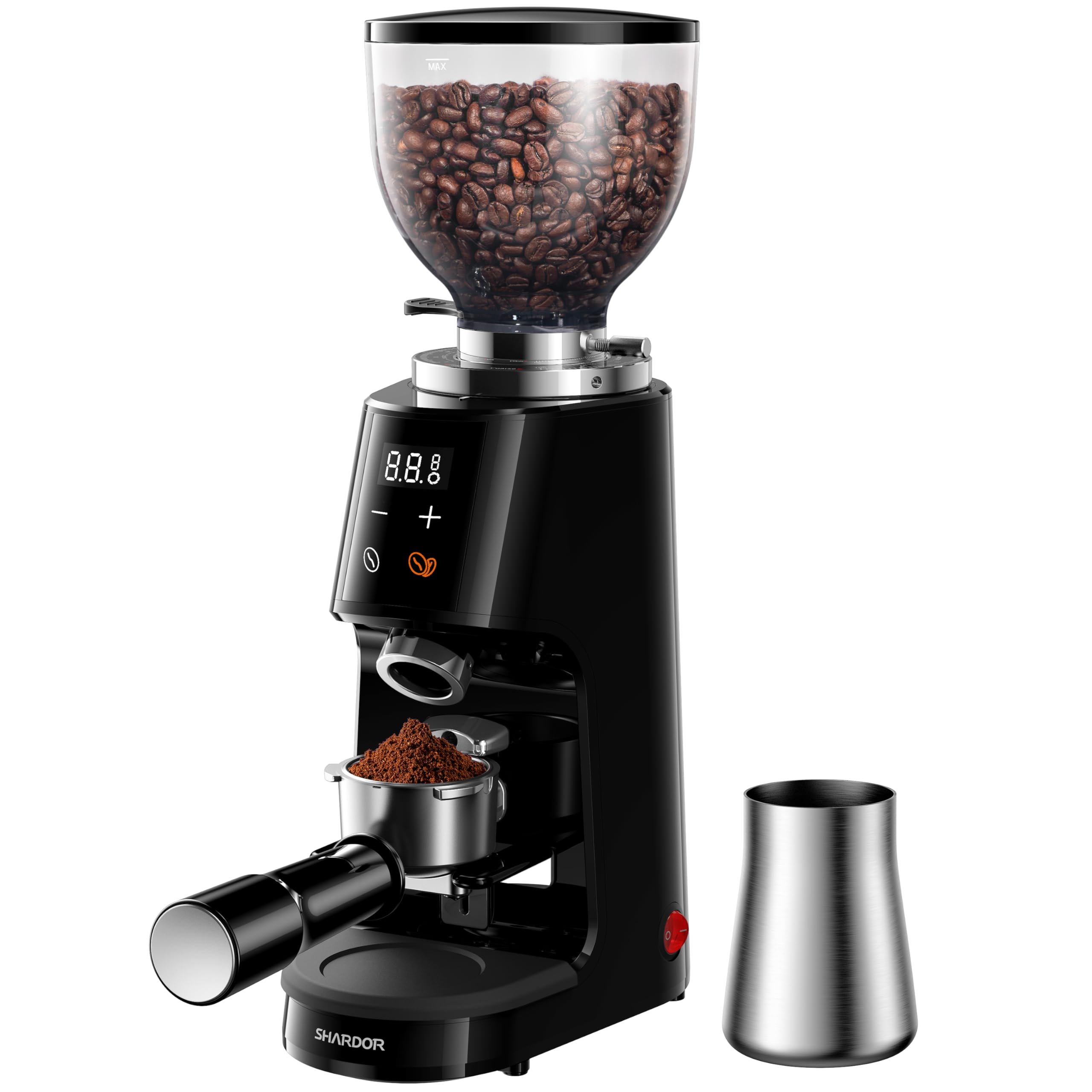
The SHARDOR Professional grinder brings 64 mm flat burrs and 100 grind settings into a price bracket that previously could only offer conical burrs. The larger flat burr diameter means the coffee spends less time being ground per dose — faster throughput and less heat transfer. The 100 settings give you the granularity to dial in everything from Turkish coffee powder to coarse cold brew, with espresso sitting in a wide sweet spot in the middle. The all-metal grinding chamber adds thermal stability and durability; plastic chambers can flex under torque, leading to inconsistent gap uniformity over time.
Anti-static features include a stainless steel catch cup and a built-in system that reduces mess. The LED display allows you to program grind times in 0.1-second increments for single, double, and continuous brews, which is useful for replicating your preferred dose weight. The removable magnetic discharge pipe, upper burr, and hopper make routine cleaning straightforward. A portafilter holder is included, and the grinder works with most standard machines.
A few caveats apply. The unit is explicitly rated for 120V only — connecting it to a 220V supply will permanently damage the electronics. The plastic outer housing, while attractive, does not match the all-metal feel of pricier competitors. Some users report that the default zero point calibration requires adjustment out of the box to reach true espresso fineness. For the home user who wants flat burr clarity without jumping to the tier, the SHARDOR is a strong mid-range contender.
Why it’s great
- 64 mm flat burrs produce uniform grind with minimal heat
- 100 grind settings give fine control across all brew methods
- All-metal grinding chamber resists flex and thermal expansion
Good to know
- 120V only — use on 220V will destroy the machine
- Zero-point adjustment may be needed out of the box
- Plastic exterior contrasts with the metal chamber
4. MOKKOM Professional 64mm Flat Burr Grinder
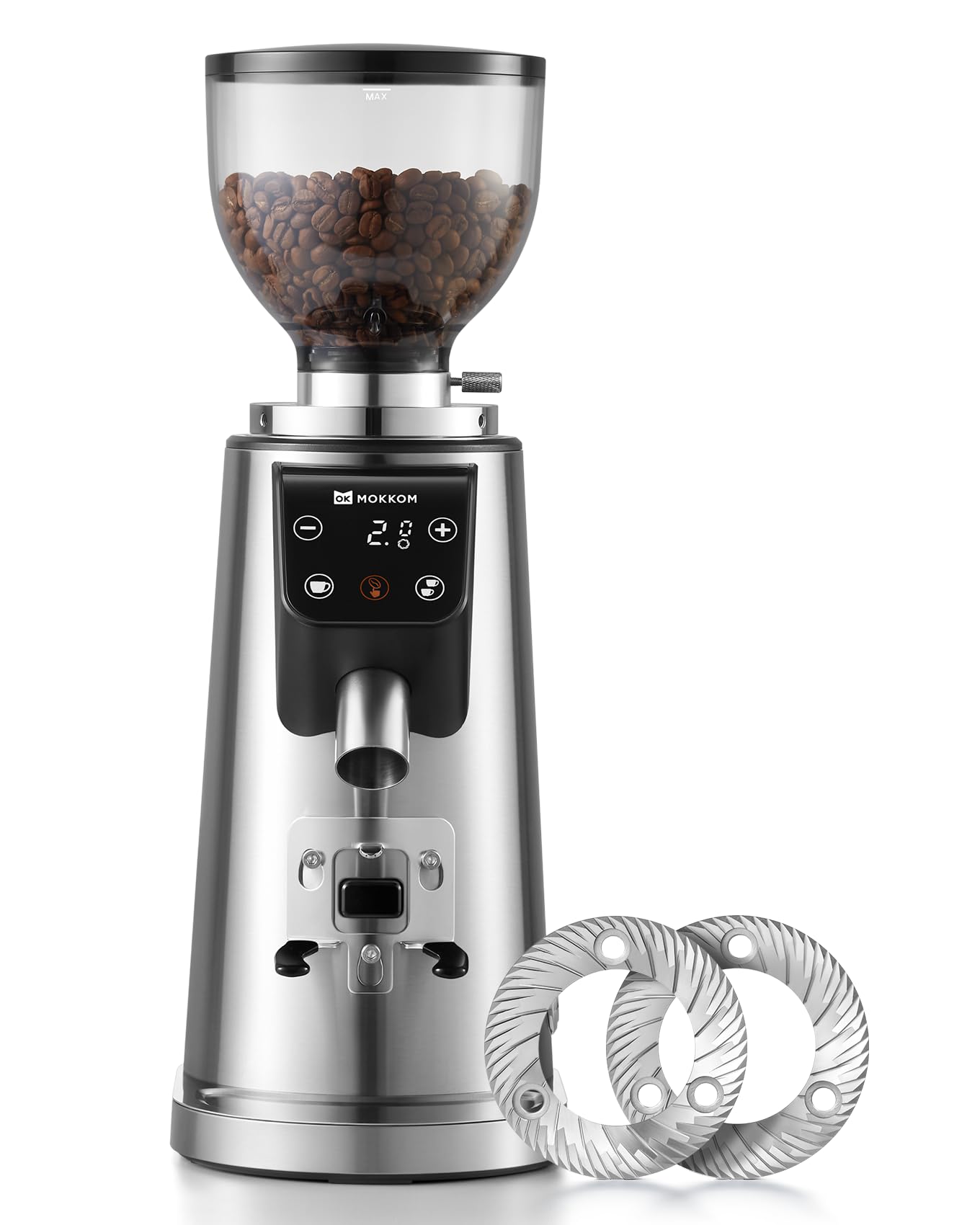
The MOKKOM Professional grinder refines the 64 mm flat burr platform with a full-metal stainless steel body and an aluminum alloy grinding chamber base. The premium 7 mm brass grind adjustment ring provides the mechanical rigidity needed to maintain burr alignment at espresso-fine settings; plastic adjustment rings can drift over time as they wear, causing inconsistent grind size. The 100 grind settings are accessible via a smooth external dial, and the 0.1-second precision timer on the LED display lets you dose by time with repeatability.
A plasma generator (ionizer) wraps around the exit chute to neutralize static electricity, a common problem with flat burrs that generate more fines. The unit includes two bean hoppers: a large 350-gram hopper for bulk grinding and a silicone bellows single-dose hopper for purging and zero-retention workflow. The ability to switch between bulk and single-dosing without tools makes this a flexible option for households where one person drinks drip and another wants espresso. The anti-popcorn disc is integrated, and the burrs are removable for cleaning with a grounds press.
The trade-off for the full-metal construction is weight — the grinder is heavy and occupies a permanent spot on the counter rather than being easily stored. The 12.35-ounce capacity of the large hopper is generous, but the single-dose hopper is relatively small. Some users note that the plasma generator is effective but not 100 percent eliminatory; a few fines still escape into the dosing cup. For baristas who value build quality and the option to switch between dosing styles, the MOKKOM offers professional-grade hardware at a price that still falls within the inexpensive umbrella.
Why it’s great
- Full stainless steel body with 7 mm brass adjustment ring
- Dual hopper system: 350g bulk and silicone single-dose bellow
- Plasma generator reduces static for a cleaner workspace
Good to know
- Heavy build — not ideal for frequent counter storage
- Plasma generator reduces but does not eliminate all static fines
- Single-dose bellow is small relative to the bulk hopper
5. Viesimple Gen 4 Single Dose Grinder
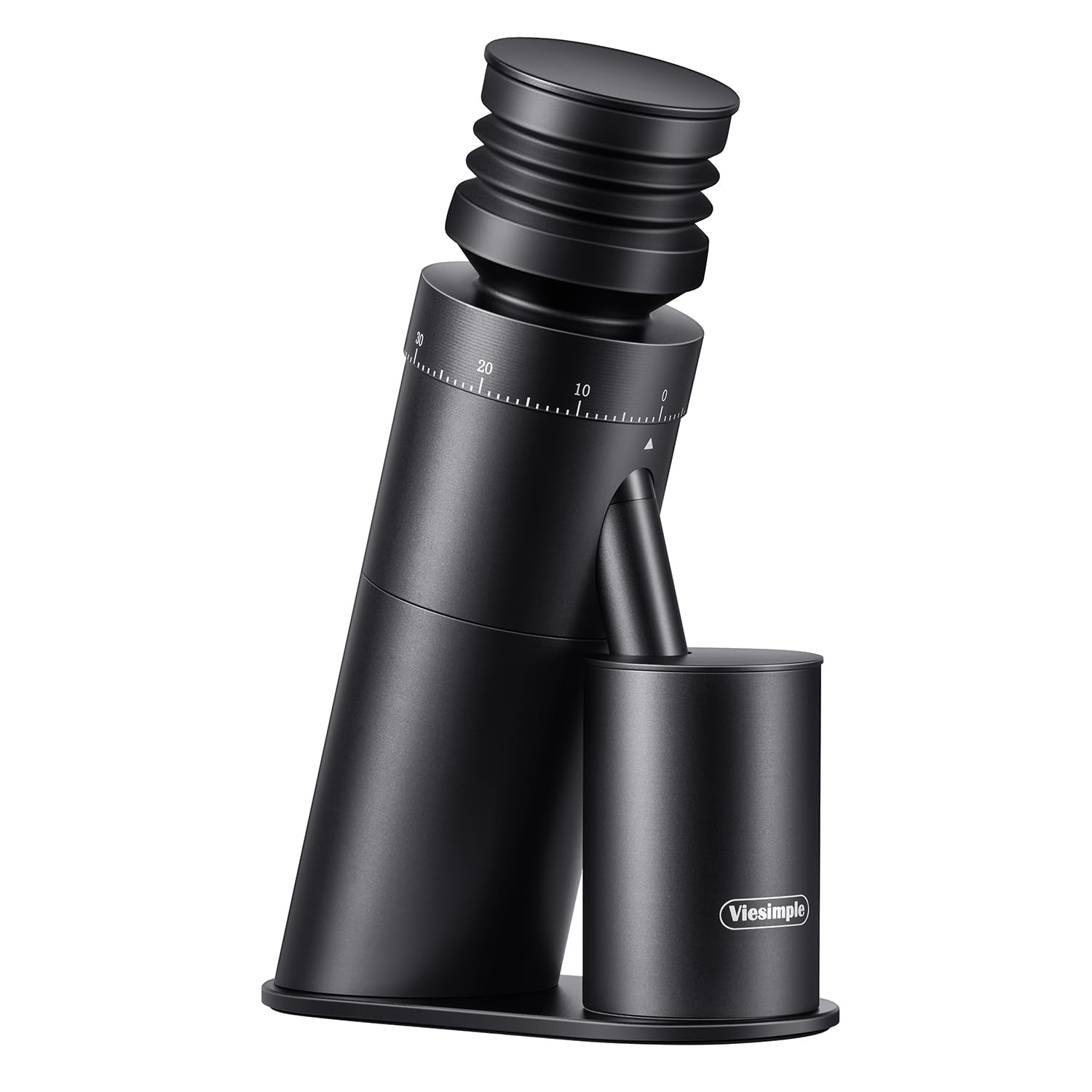
The Viesimple Gen 4 prioritizes two often-overlooked specs: noise level and anti-clog reliability. Its 48 mm conical burr is driven by a motor rated at under 50 decibels, which makes it one of the quietest electric grinders in this review. If you pull espresso before sunrise or share a thin-walled apartment, the reduced noise is genuinely quality-of-life improving. The motor design includes a patent for anti-clogging that optimizes the powder channel geometry — the third-generation version of this grinder had retention issues, but Gen 4 claims 100 percent powder discharge with less than 0.2 percent debris residue.
The grinding chamber and body are all-aluminum, providing good thermal management without the weight of stainless steel. The magnetic dosing cup seats automatically into place, and the blow-out funnel design uses a sealed lid to prevent powder from flying out during the purge. The 5-blade burr set (a 48 mm conical) is a bit of an oddity — traditional conical burrs have a single continuous spiral, while the Viesimple uses a segmented geometry that supposedly adapts to different brew methods. In practice, it produces a consistent enough grind for espresso, pour-over, and French press.
The 9-inch height makes this one of the most compact electric grinders available, but the 30-gram capacity is strictly single-dose. There is no bean hopper — you weigh beans, pour them in, grind, and purge. The included accessories are minimal: just the grinder itself, no portafilter holder or cleaning kit beyond a brush. The voltage range of 100-240V is a genuine plus for international use. For espresso-focused users who value a quiet morning workflow, the Viesimple Gen 4 delivers.
Why it’s great
- Under 50 dB operation — among the quietest espresso grinders
- Anti-clog patent optimizes powder channel for full discharge
- All-aluminum build with magnetic dosing cup and sealed lid
Good to know
- Strictly single-dose — no bulk hopper included
- No portafilter holder or cleaning accessories
- Segmented burr geometry is unconventional and less documented
6. 1Zpresso K-Ultra Manual Grinder

The 1Zpresso K-Ultra is the manual grinder that sets the benchmark for adjustment precision in the sub- category. The external adjustment dial offers over 100 clicks with each click representing exactly 20 microns of burr gap change. At the espresso range (typically 1.5 to 3.0 full rotations from zero), you can make a meaningful grind change with a single click — no guesswork. The specialized K burr geometry is engineered for faster grinding and better particle uniformity than older 1Zpresso models, producing shots with higher clarity and less astringency.
The build is all metal: the body is machined aluminum, the burr carrier is stainless steel, and the dual-bearing system ensures the burrs stay concentric even at fine settings where wobble would ruin a shot. The foldable handle stores flush against the body and the magnetic catch cup snaps into place, holding 35-40 grams of grounds. The included travel case makes this genuinely portable for camping, travel, or office use — you get caf-quality espresso grind without electricity. The tool-free dismantling for cleaning is fast, and both a brush and air blower are included.
Manual grinding takes effort and time. At espresso fineness, grinding 18 grams takes roughly 45-60 seconds of steady cranking. The 20-micron clicks are excellent for dialing in, but the absolute range of adjustment (from Turkish to cold brew) means that the number wheel can be hard to read in low light. The K-Ultra is not a purchase for someone who wants push-button convenience; it is for the home barista who values precision, portability, and the tactile control of hand grinding.
Why it’s great
- 20-micron click adjustment for precise espresso dialing
- Dual-bearing stabilization prevents burr wobble
- Inclusive travel case and tools for extreme portability
Good to know
- Manual grinding at espresso fineness requires effort and time
- Number wheel can be difficult to read in dim lighting
- Higher upfront cost than entry-level electric grinders
7. KINGrinder K6 Manual Grinder

The KINGrinder K6 brings an even finer incremental adjustment than its peers at 16 microns per click. This means within a single rotation there are 60 discrete positions, giving you more resolution for espresso dialing. The full metal design (aluminum body, stainless steel burr set, dual bearings) resists the flex and wear that plastic components introduce. The interior adjustment mechanism is protected from accidental bumps, which is important for a grinder that is designed for camping, hiking, and outdoor use.
The 25-35 gram capacity is suited for single or double espresso doses. The straight handle is comfortable for a full grind cycle, and the tool-free disassembly allows for quick cleaning in the field. The grinder has been reviewed by a major coffee YouTuber with a sizable following, which has contributed to its community-tested reputation. The burr alignment is factory-calibrated, and the company offers a one-year warranty with replacement parts available.
At 0.63 ounces (the listed specification appears to be a data error; the unit weighs significantly more in practice — approximately 1.2 pounds), the K6 is solid but not burdensome for travel. The capacity is smaller than the 1Zpresso K-Ultra’s, meaning you cannot grind for a group without multiple batches. The included accessories are limited to a lid and straight handle. For the budget-conscious traveler who wants a manual grinder capable of espresso, the K6 offers the finest click resolution in its class.
Why it’s great
- 16-micron per click adjustment — highest resolution in class
- Full metal construction with dual-bearing stabilization
- Tool-free disassembly makes cleaning and travel simple
Good to know
- 25-35g capacity limits batch grinding for multiple people
- Minimal accessories included — no travel case
- Manual grinding requires physical effort for espresso fineness
8. AMZCHEF Coffee Grinder 48-Setting
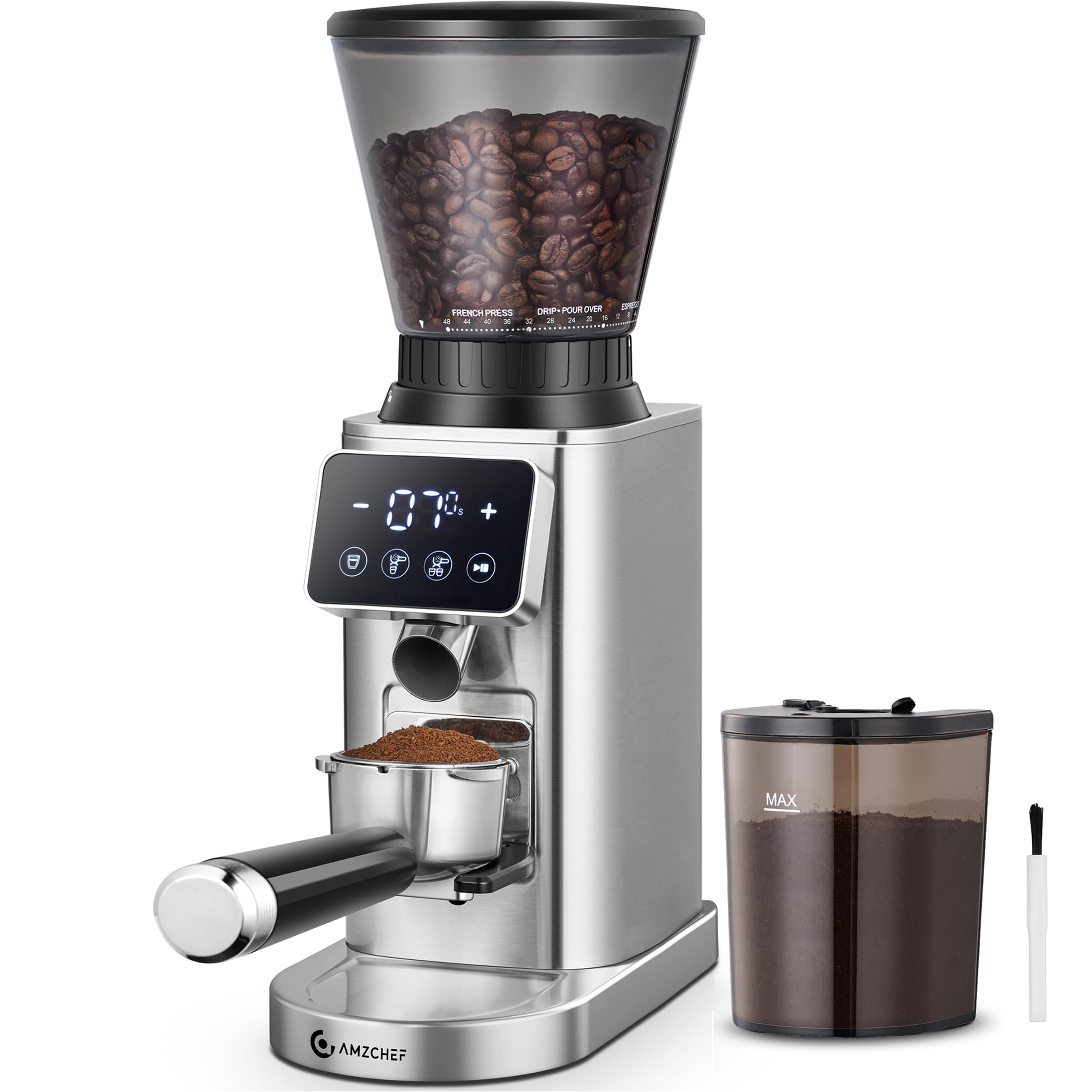
The AMZCHEF grinder is a remarkable entry point for anyone building their first espresso station on a strict budget. Its 40 mm stainless steel conical burr runs at a low 450 RPM, which keeps heat transfer minimal and preserves the aromatic oils in your beans. The 48 grind settings provide enough granularity to move from pressurized basket territory into a genuine espresso grind that can choke a machine or flow freely depending on the setting. The included portafilter holder is compatible with 50 mm portafilters, allowing direct grinding into the basket.
The LED touch control panel is surprisingly sophisticated for the price tier. You can select grind by cup count, time, or pre-programmed espresso single/double modes. The timer adjusts in 0.5-second increments, which is coarser than the 0.2-second increments on the Breville but still functional for dosing consistency. The anti-static design and 100-gram photophobic (light-blocking) coffee ground container help preserve freshness during storage. The detachable funnel stand and cleaning brush make maintenance straightforward.
The trade-offs are clear: the build quality is mixed, with plastic components in the main housing and the burr carrier. Some users report that the first use produces coffee powder residue inside the chamber that must be cleaned before dialing in. The 48 settings, while adequate, have larger jumps at the espresso end than a 100-setting grinder would. The motor is not designed for heavy commercial use — it is a home grinder for 2-4 shots per day. For the price, the AMZCHEF delivers espresso-capable grinding with modern features that would have been unthinkable at this level five years ago.
Why it’s great
- Low 450 RPM motor minimizes heat transfer and oil damage
- Touch LED panel with espresso presets and 0.5s timer
- Portafilter holder included for 50 mm baskets
Good to know
- First use requires cleaning of internal residue
- Plastic construction in housing reduces long-term durability
- 0.5s timer is less precise than 0.2s alternatives
9. Tuni G1 Conical Burr Grinder

The Tuni G1 is a compact conical burr grinder that prioritizes workflow flexibility at a low entry price. Its 40 mm burr operates at 450 RPM with a patented anti-static system, and the 48 grind settings span from espresso fine to French press coarse. The adjustable cup size settings (2 to 12 cups based on Americano serving size) let you dose by volume, and the timer increments in 0.5 seconds up to 40 seconds total. The LED touchscreen mirrors the interface found on more expensive grinders, with modes for grind by cup, time, or espresso singles and doubles.
The standout feature here is the portafilter holder compatibility: it comes with an adapter that works with both 54 mm and 58 mm portafilters. That means if you upgrade your espresso machine from a Breville (54 mm) to a Gaggia (58 mm), you can keep using the same grinder. The dosing cup holds 75 grams, and the bean hopper holds 250 grams (8.8 ounces). The anti-fingerprint stainless steel finish keeps the exterior clean, and the soft brush attached to the hopper lid makes quick cleaning a habit rather than a chore.
At 4.8 pounds and 7 inches deep, the G1 is one of the more compact electric grinders for espresso, which matters for tight counter spaces. The build quality is acceptable for the price, though the housing is mostly plastic with a metallic coating. Some users note that the 48 settings are not enough for extremely finicky light-roast espresso, and the 0.5-second timer is less repeatable than a 0.1-second system. For the espresso drinker who values compatibility with multiple machine basket sizes and needs a small footprint, the Tuni G1 is a sensible entry-level choice.
Why it’s great
- Portafilter holder works with both 54 mm and 58 mm baskets
- Compact 7-inch depth fits small kitchen layouts
- Anti-static patented burr system with 450 RPM low heat
Good to know
- Larger jump between settings at the espresso end
- Plastic housing with metallic coating, not solid metal
- 0.5-second timer less precise than competition
FAQ
Can a budget conical burr grinder actually produce a decent espresso shot?
Why does static matter in an espresso grinder?
How many grind settings do I really need for espresso?
Is a manual hand grinder better than an electric for budget espresso?
Final Thoughts: The Verdict
For most users, the best inexpensive espresso grinder winner is the Breville Smart Grinder Pro because it balances 60 grind settings, precise 0.2-second timer control, and the widest accessory ecosystem at a price that still qualifies as inexpensive. If you want the particle uniformity of flat burrs and near-zero retention, grab the MiiCoffee DF54. And for manual precision at a cost that rivals entry-level electrics, nothing beats the 1Zpresso K-Ultra.