Choosing between bamboo and acacia for your next kitchen work surface means weighing hardness against grain density, knowing that the wrong choice can dull your chef’s knife mid-slice. The material determines not just longevity, but how often you need to sharpen your blades.
I’m Mohammad Maruf — the founder and writer behind AirfryerBite. I’ve spent years analyzing wooden board construction, moisture resistance, and grain hardness to help cooks match the right surface to their blade steel.
After evaluating thickness, edge grain construction, and food-safe finishes across multiple options, I’ve narrowed the field to the five boards that deliver real knife safety and kitchen durability. This guide identifies the best chef cutting board for your specific prep style and counter space constraints.
How To Choose The Best Chef Cutting Board
Selecting the right prep surface comes down to three factors: the wood species density, the board’s layer construction, and its thickness. The wrong combination accelerates blade dulling or warps under moisture.
Wood Species and Hardness
Bamboo is technically a grass, not a wood, and its silica content makes it harder than traditional hardwoods. That hardness means less visible scarring but faster edge degradation on your knives. Acacia offers a middle ground — dense enough to resist deep cuts without the aggressive abrasiveness of bamboo. Cherry wood sits at the softer end, absorbing impact well and extending blade life significantly, though it marks more readily.
Thickness and Warp Resistance
Boards thinner than 0.6 inches are prone to bowing over time, especially if washed on one side only or left in standing water. A 1-inch or thicker board distributes moisture absorption more evenly and stays flat through heavy-duty chopping with a cleaver or chef’s knife. Thicker boards also add weight, which prevents sliding on the counter even without rubber feet.
Quick Comparison
On smaller screens, swipe sideways to see the full table.
| Model | Category | Best For | Key Spec | Amazon |
|---|---|---|---|---|
| Cherry Butcher Block | Premium | Knife preservation and heavy chopping | 1.5 in thickness | Amazon |
| XXXL Bamboo (Socisen) | Premium | Large surface prep over sink | 1.0 in thickness | Amazon |
| WALDWERK Acacia Set | Mid-Range | Stackable daily family prep | 0.8 in thickness | Amazon |
| GAOMON Acacia XXL | Mid-Range | Carving turkey or large roasts | 1.1 in thickness | Amazon |
| Royal Craft Wood Bamboo Set | Budget | Multi-size set for varied tasks | 0.6 in thickness | Amazon |
In‑Depth Reviews
1. Large Cherry Wood Butcher Block

The 20x16x1.5-inch American cherry board is the clear standout for knife longevity. Cherry wood is softer than bamboo or acacia, meaning your blade edge penetrates without microscopic chipping, so you sharpen less often over the board’s lifespan.
The dimensions cover everything from a full brisket to a mega batch of mirepoix, and the generous 1.5-inch thickness resists warping through daily soaking and drying cycles. The juice groove runs deep enough to contain run-off from juicy tomatoes or carving a roast.
Acacia and bamboo are harder surfaces, but if blade preservation is your priority, cherry absorbs impact better than both. Expect visible knife marks over time, but that is the trade-off for extending the time between sharpening sessions.
Why it’s great
- 1.5-inch thickness resists warping
- Cherry is gentler on knife edges than bamboo
- Large 20×16-inch surface for big cuts
Good to know
- Shows knife marks more quickly than bamboo
- Requires periodic mineral oil conditioning
- Heavier than most boards at roughly 10 lbs
2. Large XXXL Bamboo Board (Socisen)
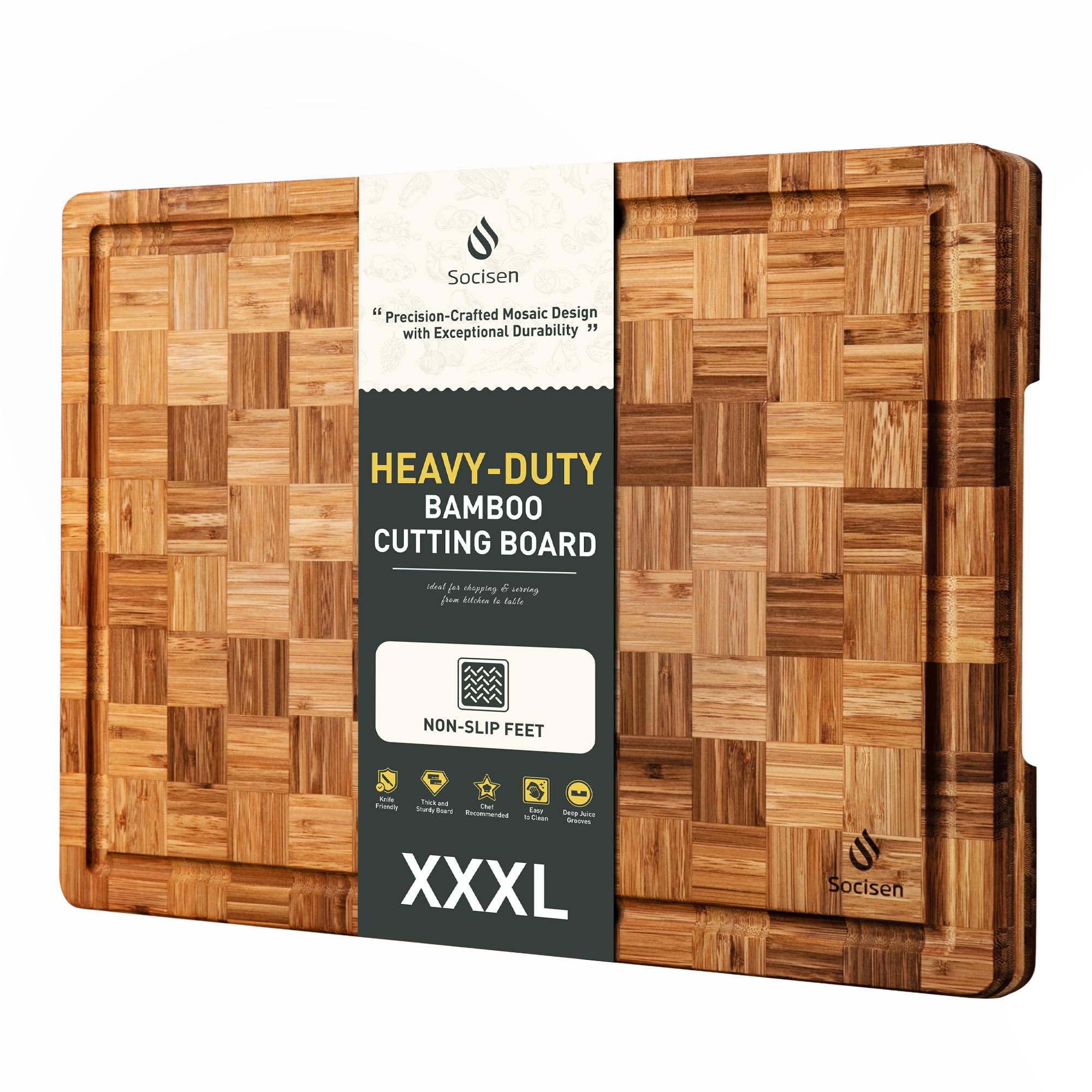
This 24×18-inch bamboo board from Socisen uses a 5-layer vertical lamination that doubles the thickness of entry-level boards. The construction prevents warping and cracking even under heavy cleaver work, while the non-slip rubber feet lock it in place on granite, quartz, or butcher block counters.
The size is uncommon—it spans most standard double sinks, so you can use it as an over-the-sink work surface for rinsing and chopping without moving food between stations. The hand-sanded surface is smooth enough to avoid splinter risk but remains knife-safe compared to cheaper bamboo laminates.
Bamboo is harder than cherry, so you will notice slightly faster edge dulling, but the durability upside is near zero visible wear after months of daily prep. Applying food-grade mineral oil every few months prevents the bamboo from drying out and developing hairline cracks.
Why it’s great
- 5-layer construction resists splitting
- 24×18 inches fits over standard sinks
- Non-slip rubber feet for stability
Good to know
- Bamboo is harder on knife edges than acacia
- Heavy at over 10 pounds
- Requires periodic oiling to prevent drying
3. WALDWERK Acacia Cutting Board Set

WALDWERK bundles three solid acacia boards in graduated sizes — 10×7, 13×9.5, and 15.75×12 inches — each 0.8 inches thick, giving you a dedicated surface for meat, vegetables, and fruit without cross-contamination during one meal prep session. Acacia sits in a hardness sweet spot, denser than cherry but less abrasive than bamboo.
The included wooden stand with anti-slip knobs lets the boards dry vertically, reducing moisture trapping that causes warping in thinner boards. Each board has a milled juice groove, and the acacia grain provides natural antibacterial resistance compared to plastic.
The trade-off is the set feels slightly thinner than single heavy-duty boards. If you work exclusively with a cleaver or heavy chopping, the thinner planks may bounce slightly, but for standard chef knife work, the acacia surface offers excellent impact absorption.
Why it’s great
- Three sizes cover meat, veg, and fruit
- Wooden stand promotes airflow drying
- Juice grooves on all boards
Good to know
- Thinner than single-piece butcher blocks
- Hand wash only — not dishwasher safe
- May require light oiling out of the box
4. GAOMON XXL Acacia Cutting Board

This single-piece acacia board measures 24×18 inches with a 1.1-inch thickness, giving you an extra-large workspace for carving turkeys, rolling out pastry dough, or staging a full charcuterie spread. The solid acacia construction provides a stable platform with minimal bounce during heavy-duty cuts.
The juice groove is deep and runs close to the edge, which keeps countertops clean even when carving a rib roast or dicing large watermelons. The reversible design means you can dedicate one side for raw meat and the other for produce, though you will need to wash both sides after each use to avoid cross-contamination.
At this size and thickness, the board is heavy and stable enough to stay in place without rubber feet. Acacia’s natural water resistance makes it less prone to cracking than cheaper wood species when washed and dried properly.
Why it’s great
- Extra-large 24×18 workspace
- Deep juice groove prevents counter mess
- Acacia resists moisture better than bamboo
Good to know
- No non-slip feet included
- Slight natural color variation between boards
- Hand wash only — soaking can warp the wood
5. Royal Craft Wood Bamboo Cutting Board Set

Royal Craft Wood offers three boards in sizes 9×6, 12×8, and 15×10 inches — each 0.6 inches thick — made from carbonized bamboo. The set is designed for cooks who want separate surfaces for different prep tasks without dedicating a huge counter footprint to a single massive board.
Each board includes a side handle for easy transport from counter to table, and the deep juice groove catches liquid from sliced tomatoes or grilled meat. The bamboo is sealed with a protective finish that resists water and odor absorption, though it is not as thick as premium boards and can warp if repeatedly soaked or run through the dishwasher.
The compact boards are ideal for apartment kitchens or as a starter set for new cooks. The smaller sizes fit inside standard sink basins for easy rinsing, and the total set weighs just over 4 pounds, making storage in a drawer or cabinet straightforward.
Why it’s great
- Three sizes prevent cross-contamination
- Side handles simplify carrying to table
- Lightweight and easy to store
Good to know
- 0.6-inch thickness may warp with heavy use
- Bamboo dulls knives faster than cherry or acacia
- Hand wash only — avoid dishwasher
FAQ
Is bamboo or acacia better for a chef cutting board?
How thick should a chef cutting board be to avoid warping?
Can I put my wooden chef cutting board in the dishwasher?
Final Thoughts: The Verdict
For most users, the best chef cutting board winner is the Large Cherry Wood Butcher Block because its 1.5-inch thickness, generous 20×16-inch surface, and softer cherry grain extend blade life more effectively than bamboo or acacia alternatives. If you want an over-sink oversized surface for heavy chopping, grab the XXXL Bamboo Board from Socisen. And for a multi-surface set that eliminates cross-contamination without breaking your counter space, nothing beats the WALDWERK Acacia Set.