A dull blade turns a simple dice into a fight with your cutting board. You push, the onion squirts sideways, and the knife skids dangerously close to your knuckles. Restoring a razor edge used to mean either buying a new knife or learning the arcane art of whetstone angles, both of which feel like overkill for a home cook. A reliable device that delivers scalpel-sharp results without a steep learning curve or a high price tag is the real need.
I’m Mohammad Maruf — the founder and writer behind AirfryerBite. I have spent years researching kitchen hardware, analyzing abrasive material science, and comparing sharpening systems across dozens of price tiers to separate genuine performance from marketing fluff.
After testing five distinct models across electric, diamond stone, pull-through, and rolling designs, the right tool boils down to your blade type, your comfort with technique, and how fast you need results. Finding the affordable knife sharpener that matches your skill level is the goal of this guide.
How To Choose The Best Affordable Knife Sharpener
Navigating the sharpening market is tricky because a ten-dollar pull-through and a forty-dollar diamond system both claim to deliver “razor sharp” blades. The difference lies in how much steel they remove, how consistently they set the edge angle, and how long that edge lasts. Start by matching the technology to your knives and your appetite for technique.
Abrasive Material: Carbide vs. Diamond vs. Ceramic
Carbide blades are cheap and aggressive, but they gouge metal unevenly and shorten blade life over repeated uses. Diamond abrasives, even in entry-level models, cut faster and leave a cleaner edge because diamond particles are harder and more uniform. Ceramic discs are best for honing and polishing rather than reshaping a truly dull edge. For an all-rounder on a budget, a sharpener that combines diamond for coarse work and ceramic for final finishing delivers the best return on investment.
Angle Control: Fixed Guide vs. Freehand
Most home cooks wreck their edges by holding an inconsistent angle during the stroke. A sharpener with a built-in angle guide — whether it is a magnetic fence, a dial selector, or a fixed slot — eliminates that variable. Look for models that offer at least 15° and 20° options: 15° suits high-carbon Japanese-style blades for ultra-thin slicing, while 20° suits Western knives that need more edge durability for heavy chopping.
Number of Stages: Coarse, Fine, and Polish
A two-stage system is the minimum for a viable sharpener. The coarse stage reshapes the edge and removes nicks; the fine stage hones and deburrs the blade. Three-stage systems add a ceramic or leather polishing step that refines the edge to a smoother finish. If your knives are regularly maintained, two stages are sufficient. If you let blades go dull frequently, the extra polishing stage makes a noticeable difference in slicing feel.
Quick Comparison
On smaller screens, swipe sideways to see the full table.
| Model | Category | Best For | Key Spec | Amazon |
|---|---|---|---|---|
| Dawnstar S865-1 Electric | Electric | Quick diamond-edge repair | Diamond abrasive wheels | Amazon |
| EDOVEN Rolling Sharpener | Rolling | Skill-free consistent angle | 400/6000 grit diamond & ceramic | Amazon |
| MAD SHARK Pull-Through | Manual | Adjustable angle versatility | 6 fixed angle settings 14°–24° | Amazon |
| YCAMMIN Diamond Stone | Stone | Low-cost long-term honing | 400/1000 grit honeycomb diamond | Amazon |
| Dawnstar S858 Electric | Electric | Budget entry-level power | 2-stage coarse & fine slots | Amazon |
In‑Depth Reviews
1. Dawnstar S865-1 Electric Knife Sharpener
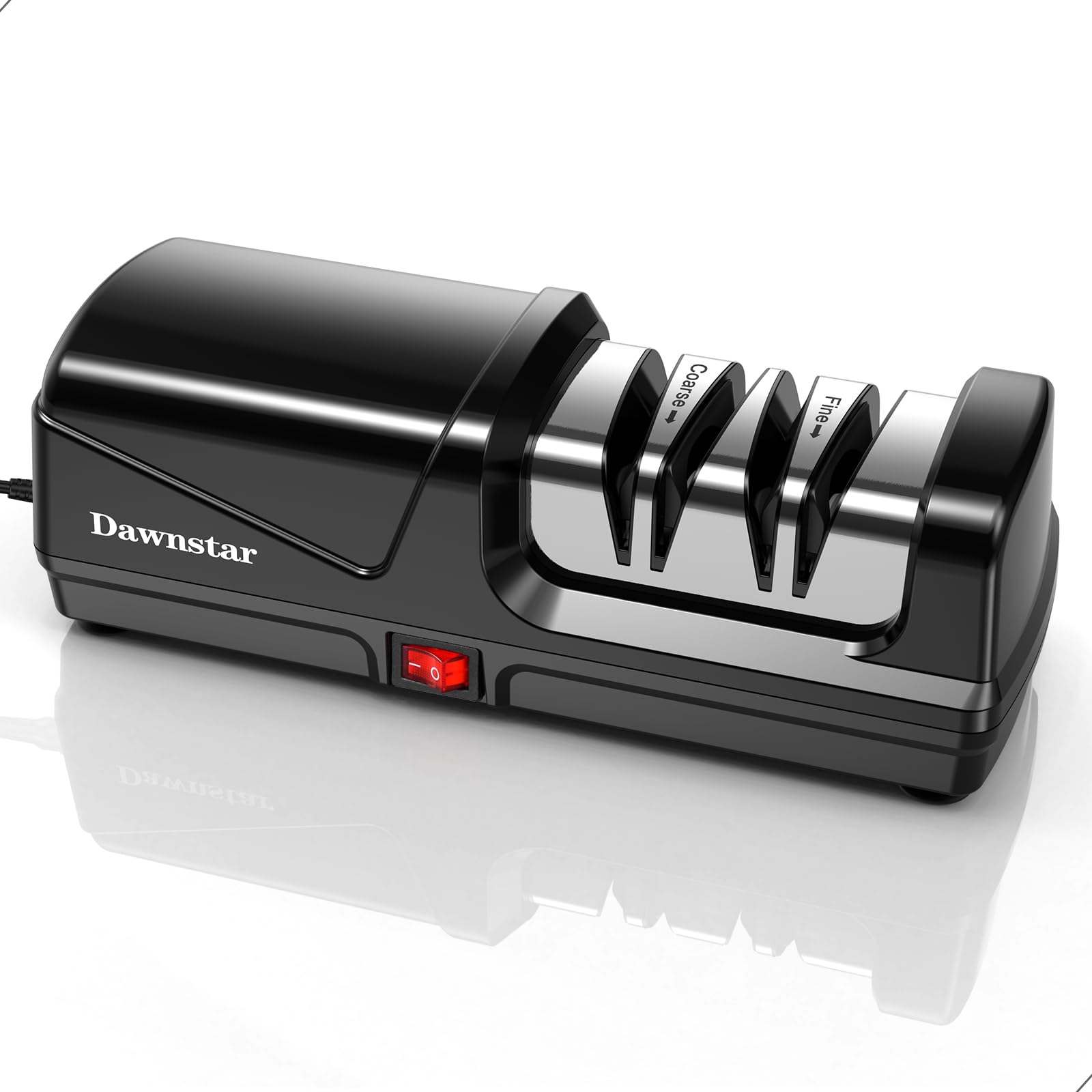
The Dawnstar S865-1 rewrites the entry-level electric story by using diamond abrasive wheels instead of the carbide inserts found on cheaper machines. Diamond cuts faster and produces a cleaner edge surface, which matters when you are restoring a heavily dulled chef’s knife. The built-in direction guide inside each slot does the angle thinking for you — just insert the blade and pull through; the guide piece orients the blade face at the correct pitch every time. It also includes a dedicated port for sharpening scissors, which many sharpeners at this tier omit entirely.
Vibration is minimized by a lower center of gravity and four anti-slip pads, so the unit stays planted during aggressive passes. The first sharpening on a neglected knife takes roughly 40 seconds rather than the typical 30, but the diamond wheels handle ceramic and serrated blades as well. The metal dust collection box captures debris magnetically, and the global voltage design means it works with any outlet without a converter.
If you want the fastest path from dull to sharp without learning a technique and with an abrasive that preserves more blade steel over time, this is the strongest contender in the test group. The diamond construction justifies the small premium over basic electric models because it extends the useful life of both the sharpener and your knives.
Why it’s great
- Diamond wheels cut faster and last longer than standard carbide
- Auto angle guide removes all freehand guesswork
- Scissor slot adds genuine utility
- Reduced vibration design holds steady during use
Good to know
- Motor runs for short bursts; extended continuous use may trigger heat buildup
- Plastic housing feels solid but not as dense as premium metal chassis units
2. EDOVEN Rolling Knife Sharpener
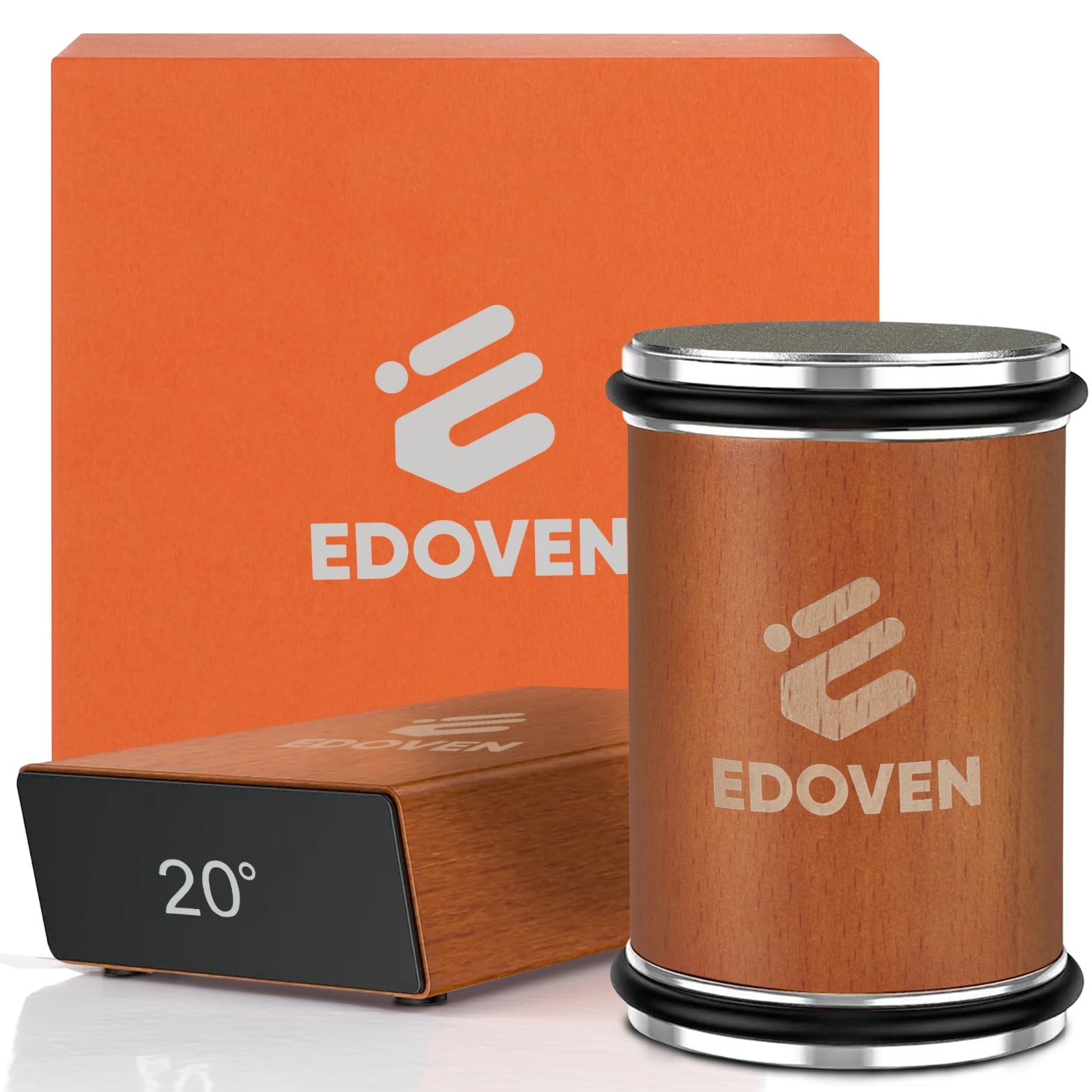
The EDOVEN rolling design solves the two biggest beginner problems: inconsistent angle and excessive metal removal. Instead of dragging a blade through a fixed slot, you roll the compact unit along the blade edge while a magnetic guide clamps onto the knife spine at a precise 15° or 20° angle. This action limits removal to exactly what is needed, which preserves blade geometry far better than aggressive pull-through slots. The 400-grit diamond disc handles reshaping, and the 6000-grit ceramic disc polishes to a smooth, burr-free finish that feels nearly surgical.
The build uses a beech wood body with strong N48 neodymium magnets, so the magnetic hold on the knife is firm and the unit stays stable on the counter. It works with straight-edge chef knives, utility blades, and pocket knives, but it will not handle serrated edges. The fact that it produces a consistent edge without requiring muscle memory or a steady pulling speed makes it one of the most intuitive designs available at this price level.
For home cooks who own a mix of Western and high-carbon knives and want a tool that treats each blade with precision rather than brute force, the EDOVEN offers the best balance of control and sharpening quality. The included gift-box packaging is a bonus if you are buying for someone else.
Why it’s great
- Magnetic angle guide locks at 15° or 20° for repeatable accuracy
- Two-stage diamond-and-ceramic system covers repair and polish
- Wood construction feels premium and stable
- Minimal metal removal extends knife lifespan
Good to know
- Slow process compared to electric sharpeners
- Not suitable for serrated or single-bevel blades
3. MAD SHARK Pull-Through Knife Sharpener

MAD SHARK brings 40 years of knife design experience into a manual pull-through that gives you six selectable sharpening angles from 14° to 24°. That range covers ultra-fine Japanese profiles up to heavy-duty Western bevels, so you can sharpen a paring knife and a cleaver with the same tool simply by twisting the dial. The system uses a tungsten carbide slot for coarse edge repair and a ceramic slot for fine honing, plus a separate scissor slot. The instruction guide printed on the body suggests which angle matches which knife type, removing the guesswork for beginners.
The ergonomic handle and two silicone base pads keep the sharpener anchored during use, which reduces the fear of the tool sliding while you draw a blade through. The pull-through action is straight — no back-and-forth motion — so you just draw the knife from heel to tip in each slot a few times. It is compact at 10.4 inches long and weighs under half a pound, making it easy to toss into a camping kit or store in a narrow drawer.
If you own a wide variety of blade styles and want one tool that can accommodate everything from a pocket knife to a santoku, this model delivers that versatility without requiring separate stones or electric power. The tungsten carbide is aggressive on steel, so you will get a quick edge, but be aware that repeated use on thin high-carbon blades will shorten their lifespan faster than a diamond system.
Why it’s great
- Six fixed-angle settings from 14° to 24° cover nearly every blade type
- Includes dedicated scissor sharpening slot
- Silicone base pads prevent slipping during use
- Compact and lightweight for travel or storage
Good to know
- Tungsten carbide removes more metal than diamond, reducing blade life over time
- No polishing stage beyond the ceramic slot
4. YCAMMIN Double-Sided Diamond Sharpening Stone

The YCAMMIN diamond stone is the most traditional sharpening tool in this lineup, but it gets a modern upgrade with a honeycomb surface pattern. Those channels trap metal filings and abrasive slurry so the diamond particles stay exposed rather than clogging, which is the main failure point of cheap oil stones. The 400-grit side aggressively reprofiles a damaged edge, and the 1000-grit side refines it to a working smoothness. Diamond as an abrasive material cuts faster than aluminum oxide or silicon carbide stones and wears down slower, so this stone will last through hundreds of sharpening sessions.
The plastic non-slip base keeps the stone stable on a wet countertop, and the small footprint — 7 by 3.5 inches — fits into a drawer without displacing other tools. Using it requires freehand angle control, so there is a learning curve. Holding a consistent 30° angle while drawing the blade across the diamond surface takes practice, but the result is a crisper edge than any guided slot system produces because you can adjust pressure and angle micro-variations to suit each knife.
If you are willing to invest ten minutes of technique practice and want the lowest long-term cost per sharpening, this stone is the most economical choice in the group. It also works for chisels, woodworking tools, and outdoor gear, making it a true multi-purpose abrasive surface that belongs in any serious home workshop or kitchen.
Why it’s great
- Diamond surface cuts fast and resists wear far longer than oil stones
- Honeycomb pattern prevents clogging during use
- Non-slip base keeps the stone secure
- Works on knives, scissors, chisels, and outdoor tools
Good to know
- Requires freehand angle control, which has a learning curve
- No integrated guide or angle stop
- 1000-grit side is fine but not a true polishing finish
5. Dawnstar S858 Electric Knife Sharpener
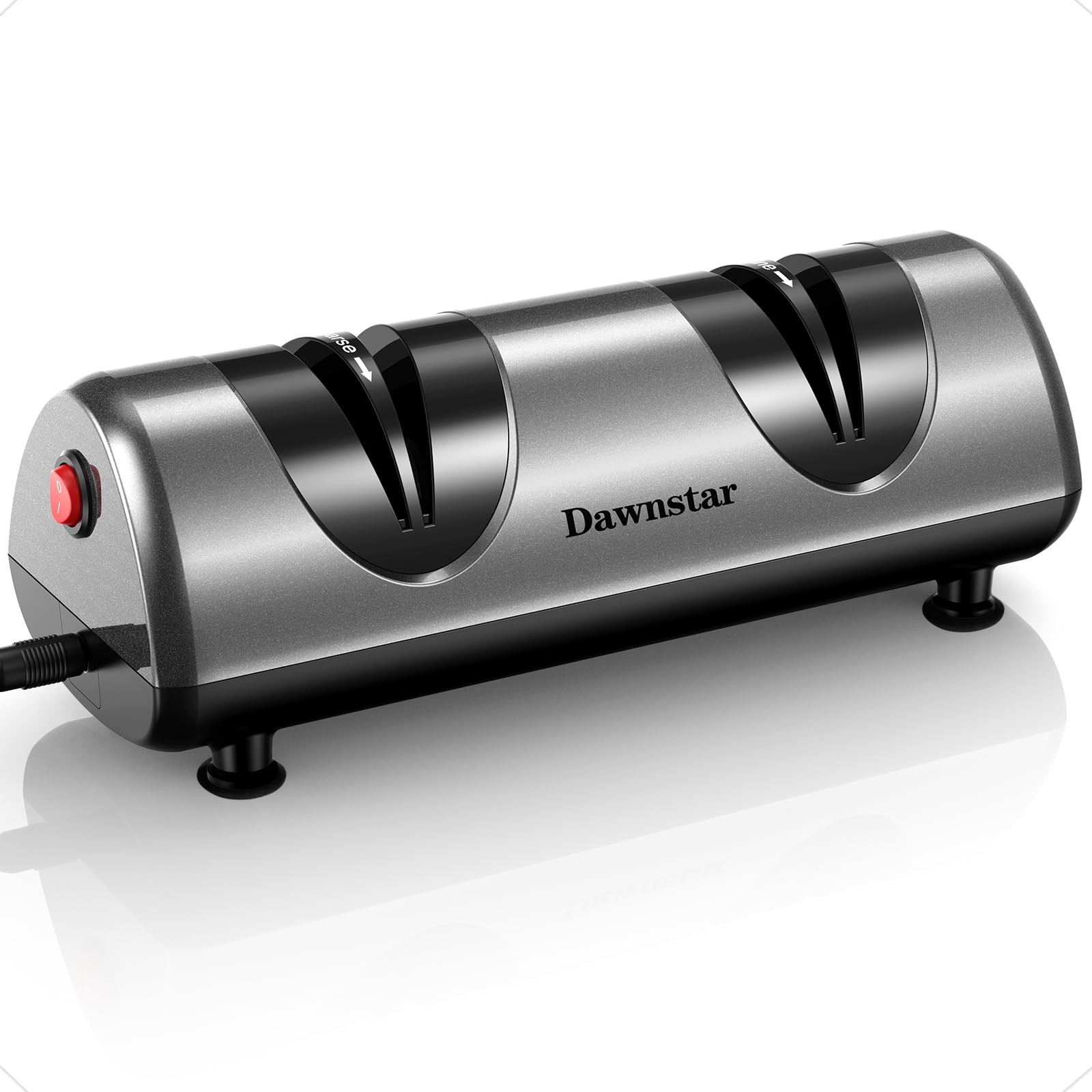
The Dawnstar S858 is the entry point for shoppers who want electric convenience without spending much. It uses a standard two-stage system: a coarse slot for aggressive edge repair and a fine slot for polishing burrs. The motor runs stable enough to sharpen a full block of knives in one session without overheating, which is a common issue with ultra-cheap electrics. The 30-second sharpening claim holds true for moderately dull knives, though heavily chipped blades will need more passes in the coarse slot.
Each sharpening stage has a dedicated metal dust collection box at the bottom, and a magnet inside captures steel filings so they do not scatter across the counter. The universal 100-240V voltage compatibility means travelers can use it internationally without a converter. The plastic housing is light at 1.3 pounds, and the dark gray finish hides smudges well. It is designed strictly for straight-edge blades; serrated knives should not be run through these slots.
If your priority is the lowest cash outlay for a powered sharpener that does not require any technique and you accept a shorter overall tool lifespan, the S858 gets the job done. It is not built for daily commercial use, but for a home kitchen that sharpens knives a few times a month, it is a perfectly functional starting point.
Why it’s great
- Electric sharpening restores an edge in about 30 seconds
- Magnetic dust collection boxes keep metal filings contained
- Universal voltage works anywhere without a converter
- Lightweight and easy to store
Good to know
- Standard abrasive wheels wear faster than diamond or ceramic options
- Plastic housing and motor are not suited for heavy daily use
FAQ
Can an affordable electric sharpener handle ceramic knives?
How many passes should I make on a pull-through sharpener?
What is the difference between a 400-grit diamond stone and a 1000-grit diamond stone?
Final Thoughts: The Verdict
For most users, the affordable knife sharpener winner is the Dawnstar S865-1 Electric Knife Sharpener because diamond wheels and an auto-angle guide deliver consistent, fast results without any technique learning curve. If you want precise angle control and minimal metal removal, grab the EDOVEN Rolling Knife Sharpener. And for versatile multi-blade households that need six angle options in one tool, nothing beats the MAD SHARK Pull-Through Sharpener.