A dull knife is a dangerous tool. It forces you to apply extra pressure, increasing the risk of slips and uneven cuts, and it robs the joy from prep work. The goal of any sharpening routine is to restore a precise, durable edge that cuts with minimal effort, turning a frustrating chore into a fluid, controlled motion.
I’m Mohammad Maruf — the founder and writer behind AirfryerBite. I’ve spent years analyzing the mechanical properties and abrasive technologies behind edge-geometry systems, from diamond-coated plates to ceramic whetstones, to understand what separates a good edge from a great one.
Whether you maintain high-carbon chef’s knives or super-steel pocket blades, the best at home knife sharpener must balance abrasive aggressiveness, angle consistency, and ease of use to match your specific blade material and sharpening skill level.
How To Choose The Best At Home Knife Sharpener
Selecting a home sharpener is not just about removing metal; it is about controlling the removal to create a consistent edge geometry. Three core factors — abrasive type, angle control, and grit progression — define how well a sharpener can restore a factory edge or improve upon it.
Abrasive Material: Diamond vs. Corundum vs. Ceramic
Diamond abrasives are the hardest option, cutting through super-steels like CPM-S90V and Elmax without losing flatness. Corundum (aluminum oxide) water stones, like the 1000/6000 grit combination, offer a finer polishing finish on standard stainless and carbon steels but require soaking and flattening maintenance. Ceramic whetstones, such as Shapton’s glass-hard stones, provide a consistent grit breakdown with minimal dishing but are brittle if dropped. For most home users dealing with modern high-hardness kitchen knives, a diamond plate delivers the best combination of speed, flatness, and longevity.
Angle Guides: Consistency Over Guesswork
A manual freehand sharpening angle varies with every stroke, creating a convex or uneven edge. Integrated angle guides — whether a fixed wedge system like on the Work Sharp or adjustable rods like the Warthog A4 — lock the blade-to-stone angle at a precise degree (typically 15°, 17°, or 20°). This consistency ensures that the entire edge bevel is ground uniformly, preventing micro-chipping and extending edge retention between sharpenings.
Grit Progression: From Restoration to Polish
Sharpening is a subtractive process that must transition from coarse abrasion to fine honing. A dual-grit or three-stage system starts at 300-400 grit to reshape a dull or chipped edge, moves to 600-1000 grit for sharpening, and finishes at 5000-6000 grit for a polished, razor edge. Skipping grits leaves deep scratches that weaken the edge and cause premature dulling. The best home sharpeners offer at least two distinct grit levels to complete this progression without requiring separate stones.
Quick Comparison
On smaller screens, swipe sideways to see the full table.
| Model | Category | Best For | Key Spec | Amazon |
|---|---|---|---|---|
| Chef’sChoice 15XV | Electric | High-volume kitchen sharpening | 3-stage diamond / 15° edge | Amazon |
| SHAPTON Ha No Kuromaku | Whetstone | Precision polishing of Japanese steel | #1000 / #5000 ceramic stone set | Amazon |
| Warthog V-Sharp A4 | Manual System | Multi-angle precision for hunting & kitchen | Adjustable 15-30° diamond rods | Amazon |
| Homly Professional Electric | Electric | Budget electric for everyday steel knives | 3-stage / diamond abrasives | Amazon |
| Mercer Culinary Double Diamond | Manual Pull-Through | Foolproof quick touch-ups | Diamond sharpening / honing stages | Amazon |
| SHARPAL 168H | Diamond Plate | Super-steel knives & woodworking tools | 8×3″ 325 / 1000 grit diamond stone | Amazon |
| Work Sharp Benchtop Whetstone | Water Stone | Traditional sharpening with angle guides | 1000 / 6000 corundum water stone | Amazon |
In‑Depth Reviews
1. Chef’sChoice 15XV Professional Electric Knife Sharpener

The Chef’sChoice 15XV is a heavy-duty electric sharpener built around a brushed metal housing and a three-stage EdgeSelect system. Stages 1 and 2 use 100% diamond abrasives to sharpen and hone, while Stage 3 employs a patented flexible abrasive stropping system to polish and refine the edge. The key differentiator is its ability to convert standard 20-degree factory edges into a 15-degree XV Trizor edge, which delivers noticeably sharper cuts on straight and serrated blades alike.
The flexible spring guides automatically adjust to the blade contour, removing the guesswork from angle selection. First-time sharpening takes about one minute, and subsequent touch-ups run roughly ten seconds. The unit weighs 5 pounds and sits securely on the counter without sliding. Noise output ranges between 65 and 75 dB — comparable to a quiet conversation — making it acceptable for daily kitchen use.
It handles standard stainless steel, German steel, and high-carbon blades without issue, but the aggressive diamond removal rate means you must avoid oversharpening thin Japanese knives that require a gentler touch. The 15-degree edge geometry produces extreme sharpness, though some users may find the edge less durable on very hard steels under heavy commercial use.
Why it’s great
- Three-stage diamond system with stropping stage for a polished final edge
- Converts standard edges to a sharper 15-degree bevel
- Fast cycle time at roughly one minute for first-time sharpening
Good to know
- Over-aggressive for ultra-thin Japanese blades
- Higher price point than manual or pull-through options
- Requires periodic diamond stage replacement after heavy use
2. SHAPTON Ha No Kuromaku Ceramic Whetstone Set (#1000 / #5000)

Shapton’s Ha No Kuromaku series is widely respected among knife enthusiasts for its glass-hard ceramic binder that breaks down slowly, maintaining a consistent cutting surface far longer than traditional water stones. This set pairs a #1000 medium grit stone for initial sharpening with a #5000 fine grit stone for final honing and polishing. Each stone measures 8.25 x 2.75 x 0.5 inches and comes housed in a ventilated plastic case that doubles as a non-slip stone holder.
The ceramic material does not require soaking — a quick splash of water is sufficient to create a slurry that lifts swarf and prevents glazing. The #1000 stone cuts efficiently on stainless and carbon steels, while the #5000 stone refines the edge to a mirror-like polish that excels on Japanese high-carbon and powdered metallurgy blades. The stones produce minimal dishing over time compared to corundum water stones, extending the interval between flattening sessions.
This set is ideal for the user who values edge quality over sharpening speed and is comfortable developing freehand angle control. The lack of built-in angle guides means you must either sharpen by feel or use a separate angle aid. The #1000 stone is too coarse for quick touch-ups on already-sharp knives, so you will need to maintain a consistent two-stone progression for best results. The set weighs 3.11 pounds and fits neatly into a drawer or toolbox.
Why it’s great
- Glass-hard ceramic binder resists dishing and maintains flatness
- #1000 / #5000 progression covers sharpening and polishing
- No soaking required — works with a splash of water
Good to know
- No angle guides — requires freehand skill or an external guide
- Brittle ceramic can crack if dropped on a hard surface
- #5000 stone is slow for removing deep scratches from coarser grits
3. Warthog V-Sharp A4 Knife Sharpener

The Warthog A4 uses a patented V-Sharp mechanism with spring-loaded diamond hones that sharpen both sides of the blade simultaneously. The metal frame carries a solid rubber base that prevents movement during use, and the powder-coat finish resists rust and corrosion. Four angle settings — 15°, 20°, 25°, and 30° — allow you to match the edge geometry to your specific blade type, from delicate fillet knives to thick bushcraft blades.
The included 325 grit natural diamond hone handles heavy metal removal on dull or damaged edges, while the hardened steel hone refines the edge for a working finish. The simultaneous dual-side sharpening reduces the time required to restore an edge compared to a single-sided stone, but it also means that any error in centering the blade is mirrored on both bevels. The spring-loaded rods maintain consistent tension across the blade length, producing a uniform edge even on slightly curved blades.
This system excels for users who own a mix of kitchen and outdoor knives and need one tool that can handle both without changing stones. The angle adjustment is mechanical and locks positively, so you can switch between a 20° kitchen edge and a 25° hunting edge in seconds. The 325 grit diamond hone is too aggressive for a finishing polish — you will need to follow with the steel hone or a separate fine stone for a razor-sharp result. The overall build is robust, and the metal frame adds enough weight to keep the unit planted during aggressive sharpening.
Why it’s great
- Adjustable 15-30° angles cover kitchen, hunting, and tactical blades
- Simultaneous dual-sided sharpening saves time
- Metal frame and rubber base provide stable, non-slip operation
Good to know
- 325 grit diamond hone is too coarse for final polishing
- Simultaneous sharpening amplifies any centering error
- Bulky footprint on the counter compared to whetstones
4. Homly Professional Electric Knife Sharpener

The Homly Professional Electric Sharpener brings a three-stage diamond abrasive system into a more accessible price bracket. Stages 1 and 2 use 100% diamond-coated wheels to sharpen and hone straight edges, while Stage 3 polishes the blade with a flexible abrasive system. A spring-loaded guide rod maintains the blade at an ideal angle throughout the stroke, reducing the risk of uneven bevels that can occur with manual electric pull-throughs.
The unit is designed for standard metal steel knives including chef, Santoku, butcher, and fillet knives. The motor runs at a moderate noise level below most budget electric sharpeners, and the double-layer shell coating resists wear from repeated use. The 120-volt motor draws enough power to handle heavy re-sharpening without stalling, and the 2-year warranty provides some assurance of long-term reliability.
The Homly is a solid entry-level electric option for users who want the speed of a powered system without the premium price of the Chef’sChoice. The diamond wheels are effective on common German and stainless steels, but they struggle with ultra-hard powdered metallurgy blades and ceramic knives despite the listing suggesting ceramic compatibility. The plastic housing feels less durable than metal-clad alternatives, and the sharpening angle is fixed rather than adjustable, so you cannot tune the edge geometry to your preference.
Why it’s great
- Three-stage diamond system at an accessible entry-level price
- Spring-loaded guide rod maintains consistent angle
- Motor operates at manageable noise level for a budget electric unit
Good to know
- Fixed angle limits edge geometry customization
- Not effective on super-steels or true ceramic blades
- Plastic housing feels less substantial than metal alternatives
5. Mercer Culinary Double Diamond Manual Knife Sharpener

The Mercer Culinary Double Diamond sharpener is a compact pull-through manual tool that integrates 100% diamond abrasives in two stages: a sharpening slot for edge restoration and a honing slot for refining the bevel. The polycarbonate body is lightweight at 0.25 kilograms and features a textured handle that provides a secure grip, even with wet hands. Precision guides inside each slot control the sharpening angle, making the process nearly foolproof for users unfamiliar with freehand sharpening.
The diamond-coated surfaces create an arch-shaped edge that Mercer claims is both strong and durable. The sharpener works on both straight-edge and serrated blades, and the two-pass process — sharpening followed by honing — is sufficient for maintaining a kitchen knife that sees regular use. The sharpener measures 8 x 3 x 4 inches, making it small enough to store in a drawer or hang on a magnetic strip.
This sharpener is best suited for quick maintenance touch-ups rather than heavy restoration of a severely dull or chipped edge. The pull-through design removes a minimal amount of metal per pass, which is ideal for extending the life of good-quality knives but frustrating if you need to reprofile a damaged blade. The diamond abrasives will eventually wear down with heavy use, and the non-replaceable sharpening elements mean the entire unit must be replaced once they dull.
Why it’s great
- Two-stage diamond sharpening and honing in a compact package
- Foolproof angle guides suitable for beginners
- Works on both straight and serrated edges
Good to know
- Not effective for heavy edge restoration or reprofiling
- Diamond elements are non-replaceable
- Lightweight body may lift off the counter if not held firmly
6. SHARPAL 168H Large Dual-Grit Diamond Sharpening Stone
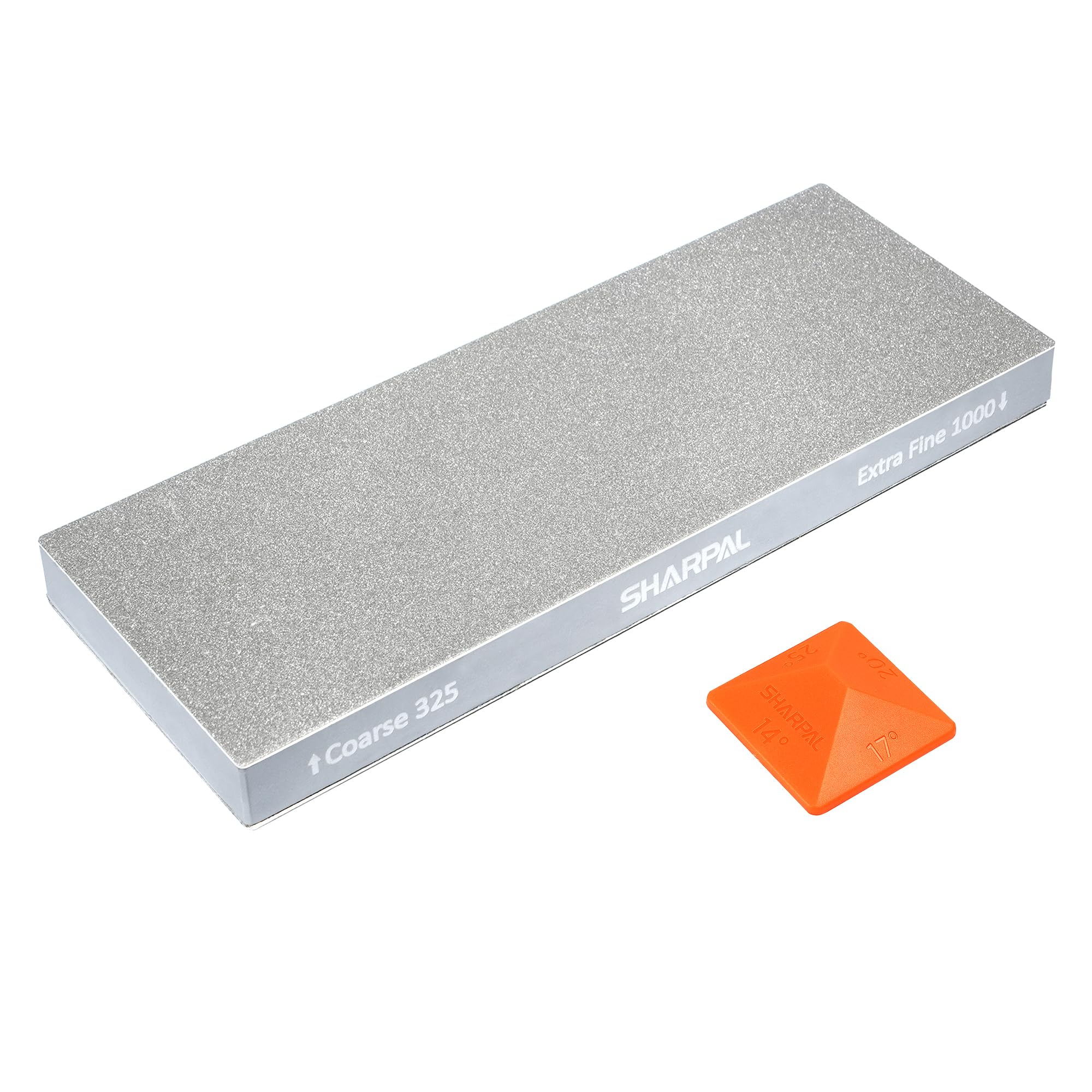
The SHARPAL 168H is an 8 x 3 inch monocrystalline diamond sharpening plate with a coarse 325 grit side for edge restoration and an extra-fine 1000 grit side for honing. Unlike bonded whetstones, this diamond plate uses an electroplating process that anchors monocrystalline diamond particles to a steel substrate, producing a surface that stays flat and does not require soaking or lapping. The MirrorFlat technology holds flatness to ±0.002 inches, ensuring even blade contact across the entire stone.
The included angle guide provides four settings (14°, 17°, 20°, and 25°) and a non-slip pad protects the work surface while keeping the plate stable. The diamond coating handles the hardest commercial steels including CPM-series, M390, and Elmax without loading or glazing. The 8 x 3 inch surface offers more than double the sharpening area of standard pocket-sized diamond stones, allowing full-length strokes on chef’s knives without resetting the blade position.
This plate is ideal for users who maintain a mix of kitchen knives and woodworking tools like chisels and plane blades. The coarse 325 grit side cuts aggressively enough to repair a rolled edge or chip quickly, while the 1000 grit side refines the bevel to a working sharpness suitable for most cutting tasks. The diamond plate will not produce the mirror polish of a 6000 grit water stone, so users who want a true razor-sharp finish will need to follow with a strop or finer diamond emulsion. The electroplated diamond layer has a finite lifespan under heavy pressure, but the 3-year warranty provides a reasonable safety net against premature wear.
Why it’s great
- Cuts super-steels like M390 and CPM-series without loading
- 8 x 3 inch provides ample surface for full-length chef’s knife strokes
- MirrorFlat technology ensures precise, even blade contact
Good to know
- 1000 grit side is too coarse for a true mirror finish
- Diamond layer will eventually wear out under heavy pressure
- No water or oil required, but lubricant helps reduce heat buildup
7. Work Sharp Benchtop Whetstone Knife Sharpener

The Work Sharp Benchtop Whetstone pairs a 1000/6000 grit corundum water stone with an integrated water control base that reduces mess and provides a stable sharpening platform. The 1000 grit side is suitable for sharpening moderately dull knives, while the 6000 grit side delivers a polished, razor-sharp finish that competes with much more expensive stones. Removable sharpening guides set at 15° and 17° offer angle support for users who are still developing freehand consistency, and the guides can be detached entirely for freehand work.
The water control base includes a reservoir that keeps the stone lubricated during use, minimizing the need for constant rewetting. The included anti-skid mat prevents the base from sliding across the counter, and the stone storage slot in the base keeps the whetstone contained when not in use. The stone measures 4 x 2.25 x 9.5 inches and weighs 2.3 pounds, making it compact enough to store in a cabinet or leave on the counter without dominating the workspace.
This system is well-suited for the home cook who wants the edge quality of a water stone without the mess of traditional soaking methods. The 1000 grit side cuts efficiently on standard stainless and carbon steels but will struggle on super-hard powdered metallurgy blades. The 6000 grit side, while excellent for polishing, creates a slurry that can accumulate on the stone surface if not rinsed regularly. The corundum material is softer than diamond or ceramic, so it will dish over time and require flattening with a separate flattening stone or sandpaper.
Why it’s great
- 1000/6000 grit progression delivers a true razor-sharp final edge
- Water control base reduces mess and keeps the stone lubricated
- Removable 15° and 17° angle guides support beginners
Good to know
- Corundum stone dishes faster than diamond or ceramic alternatives
- Not effective on super-hard powdered metallurgy steels
- Requires flattening maintenance to maintain even sharpening surface
FAQ
Can a home sharpener damage a high-end Japanese knife?
What is the difference between a 1000/6000 water stone and a 325/1000 diamond plate?
How often should I flatten a corundum water stone?
Final Thoughts: The Verdict
For most users, the best at home knife sharpener winner is the Chef’sChoice 15XV because it combines speed, angle precision, and a three-stage diamond system that delivers consistent results on a wide range of kitchen knives. If you want a precision edge on Japanese or hard super-steels, grab the SHAPTON Ha No Kuromaku stone set. And for a versatile system that handles both kitchen and outdoor blades at adjustable angles, nothing beats the Warthog V-Sharp A4.