A freezer that loses power or has its door left slightly ajar can silently destroy hundreds of dollars in meat, vegetables, and prepared meals before you ever notice the temperature change. The difference between perfectly frozen inventory and a soggy, bacteria-laden mess often comes down to a single, inexpensive piece of hardware that tells you the moment things go wrong. A dedicated monitor bridges that gap, converting a passive appliance into an actively guarded cold storage system.
I’m Mohammad Maruf — the founder and writer behind AirfryerBite. I have spent years analyzing the hardware specifications, wireless protocols, and sensor accuracy metrics of small kitchen electronics, including the temperature-monitoring tools that serious home cooks rely on to protect their stored food.
Whether you are managing a chest freezer full of game meat, a refrigerator with a finicky defrost cycle, or a garage freezer exposed to wild temperature swings, the right device acts as your remote eyes and ears. This guide breaks down the top contenders for the best freezer alarm based on connectivity, range, sensor accuracy, and alert reliability.
How To Choose The Best Freezer Alarm
A freezer alarm is a small electronic sentry, but not every model communicates equally well. The right choice balances your physical setup with your tolerance for false alarms and your preferred alert method. Ignoring the wireless environment between your freezer and your router is the most common mistake buyers make.
Wireless Protocol: WiFi vs. LoRa vs. Proprietary
Standard WiFi thermometers rely on your home network, which means they struggle inside metal freezers placed in garages or basements far from the router. LoRa-based systems like YoLink use a low-power, long-range radio that punches through walls and insulated freezer doors far better than WiFi. If your freezer sits in an outbuilding, a detached garage, or a basement corner, LoRa is the more reliable path.
Sensor Accuracy and Temperature Range
A freezer alarm should read accurately below 0°F. Look for industrial-grade temperature chips offering ±0.9°F or better. Units that only claim ±2°F at freezing may trigger false high-temperature alarms during normal defrost cycles, eroding your trust in the alerts. The sensor’s reporting interval also matters — a reading every ten minutes can miss a door that was left open for five.
Alert Escalation and Redundancy
The best alarms do not stop at an app notification. They should also sound a local audible siren, send email alerts, and optionally push SMS messages. A multi-layered alert system ensures that if your phone is on silent or you are out of cellular range, you still hear the hub screaming from the kitchen. False alarm prevention settings that tolerate normal compressor cycle fluctuations are equally important.
Quick Comparison
On smaller screens, swipe sideways to see the full table.
| Model | Category | Best For | Key Spec | Amazon |
|---|---|---|---|---|
| MOCREO WiFi Freezer Thermometer | WiFi Hub | Home freezers with reliable WiFi | ±0.9°F accuracy, 2-year data export | Amazon |
| MOCREO WiFi Long Range | WiFi Hub | Remote mute and 1/3 mile range | IP66 sensor, 95dB hub siren | Amazon |
| GoveeLife 2.0 WiFi Dual Probes | WiFi Probe | Dual-zone fridge and freezer monitoring | 1840ft range, large LCD display | Amazon |
| GoveeLife WiFi Thermometer 2 Pack | WiFi Pack | Two freezer locations on one account | 2-year free data export, LCD display | Amazon |
| YoLink Smart Thermometer 3-Pack | LoRa Hub | Garages and outbuildings beyond WiFi | ±0.36°F accuracy, 5-year battery | Amazon |
| YoLink X3 Data Logger 2-Pack | LoRa Pro | Remote data logging and SMS alerts | 5+ year battery, text/email alerts | Amazon |
| SensorPush HTP.xw | Bluetooth Pro | Premium accuracy and barometric data | Barometer + temp/humidity, app monitoring | Amazon |
In‑Depth Reviews
1. YoLink Smart Wireless Thermometer Hygrometer 3-Pack

The YoLink system sidesteps WiFi congestion entirely by using LoRa wireless technology, which transmits data over a quarter mile in open air and penetrates metal freezer walls and concrete basement floors that kill standard WiFi sensors. Each sensor delivers commercial-grade accuracy of ±0.36°F from 32°F to 129°F, meaning you can trust the reading even during a compressor defrost cycle that briefly raises internal temperature. The hub connects to your router via Ethernet or 2.4 GHz WiFi, collecting data from up to 100 sensors without slowing your home network.
Battery life is quoted at up to five years on two AA batteries, a claim backed by the low-power LoRa radio that only wakes to transmit when temperature or humidity crosses a threshold. The package includes the hub and three sensors, allowing you to monitor a garage freezer, a kitchen refrigerator, and a basement chest unit simultaneously. Alerts arrive via push notification, email, and SMS — though SMS is limited to 15 free messages per month across the system.
Critical Alert support on iOS bypasses silent mode, ensuring you get pinged even if your phone is face-down. The lack of an on-sensor display is a trade-off the app compensates for with clear historical graph charts and configurable threshold warnings. For anyone with a freezer that lives outside the router’s airy comfort zone, this is the most reliable option.
Why it’s great
- LoRa range penetrates freezers and concrete walls easily
- ±0.36°F accuracy rivals professional data loggers
- Three sensors cover multiple locations from one hub
Good to know
- SMS alerts are capped at 15 per month
- Sensors lack an onboard LCD display
- Hub requires Ethernet or 2.4 GHz WiFi connection
2. YoLink 2-Pack X3 Version Temperature Humidity Data Logger

The X3 version of YoLink’s sensor builds on the same LoRa foundation but adds a focus on data logging for users who need to prove temperature compliance over time. Each sensor records temperature and humidity at configurable intervals and stores history that can be exported via the app for analysis or insurance claims. The two-sensor pack, paired with the included hub, lets you cover a freezer and a refrigerator with a single system.
YoLink claims a battery life of over five years, and the X3’s low-power design means you can place a sensor in a deep chest freezer and forget about it for half a decade. The wireless range remains the standout feature — LoRa signals travel up to a quarter mile, making this the go-to choice for outbuildings, barns, or detached garages where a WiFi thermometer would drop signal immediately. Alerts come through email, text, and push notifications, with the hub also sounding an audible alarm.
The lack of an integrated display on the sensor means you depend entirely on the app or web dashboard for readings, but the data charts are comprehensive and the alert customization is granular. For a serious homesteader or anyone managing multiple freezer units in separate buildings, the X3’s combination of range, battery life, and logging capability justifies its position as a top-tier investment.
Why it’s great
- Ultra-long LoRa range for detached structures
- 5+ year battery life eliminates frequent swaps
- Data export useful for temperature history records
Good to know
- Two-sensor pack limits coverage to two zones
- No sensor display requires app for any reading
- Hub setup needs Ethernet or 2.4 GHz WiFi
3. MOCREO WiFi Freezer Thermometer Alarm
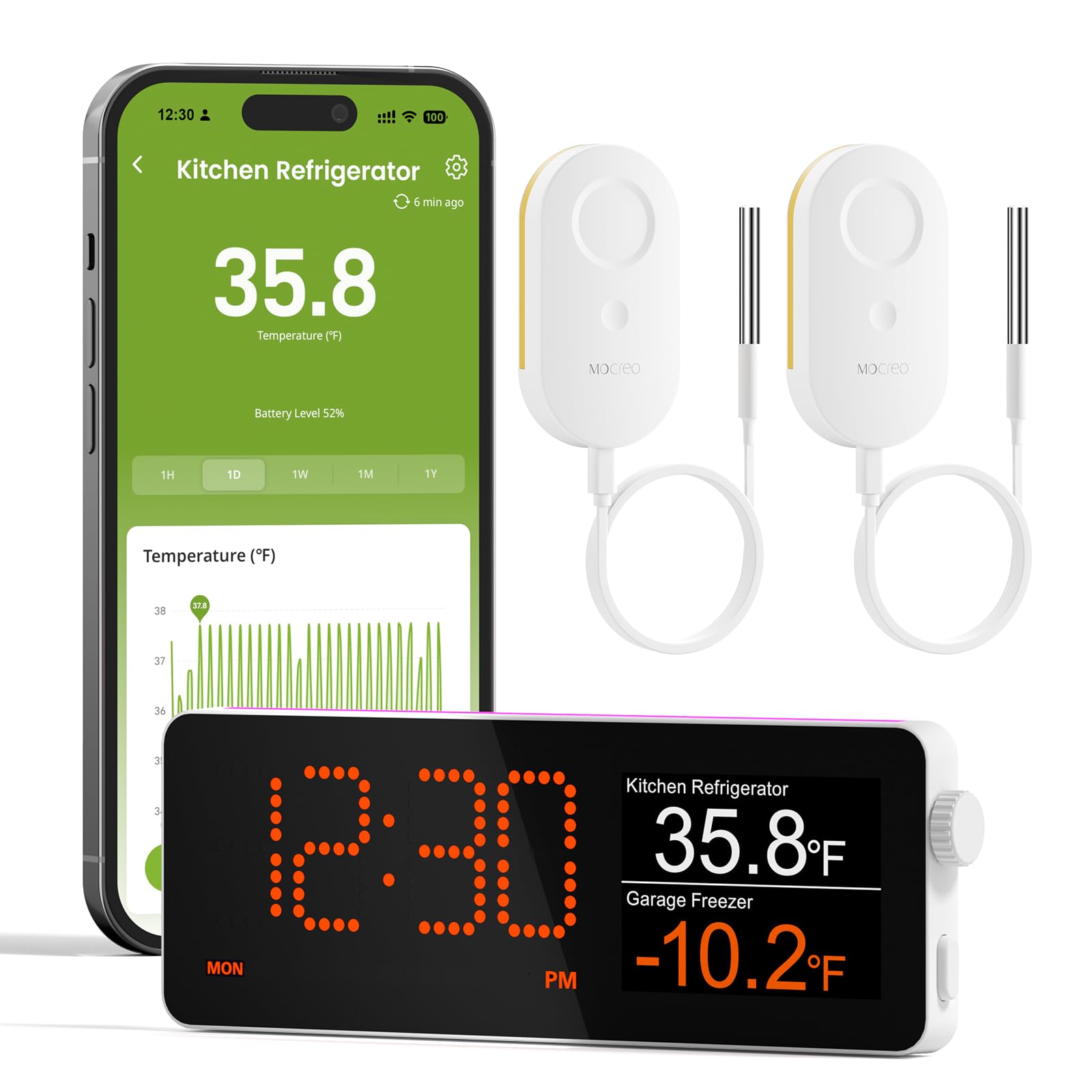
MOCREO’s entry-level WiFi kit includes a digital monitor hub and two remote sensors, giving you immediate two-zone coverage for a freezer and a fridge without any recurring fee. The system logs temperature data for two years and allows CSV export, which is useful if you need to track performance trends or prove a power outage occurred. Accuracy is rated at ±0.9°F, which is sufficient for home use and sensitive enough to catch gradual warming before food thaws.
The hub communicates over standard 2.4 GHz WiFi, so its effective range depends on your home network’s reach. If your freezer is in a basement with a thick concrete wall between it and the router, you may experience dropouts that the LoRa-based YoLink would not. The sensors themselves are compact and battery-powered, with a claimed two-year battery life under typical conditions above 32°F.
Alerts arrive through the app and email, and the hub emits a local beep when thresholds are crossed. The lack of SMS alerting means you need data connectivity on your phone to receive notifications away from home. For a straightforward home setup with decent WiFi coverage, this kit offers strong value and a clean, no-subscription data model.
Why it’s great
- No subscription for data logging or cloud access
- Two-year data export in CSV format
- Two sensors cover fridge and freezer together
Good to know
- Range depends on your home WiFi strength
- No SMS or text message alert option
- Sensor battery life drops in sub-freezing temps
4. MOCREO WiFi Remote Thermometer Freezer Alarm

MOCREO’s H5Pro iteration improves on the base model by adding a long-range wireless protocol that reaches up to 1640 feet in open air, plus IP66 splash-proof sensors rated for humid environments like refrigerator interiors or outdoor enclosures. The sensor measures from -4°F to 131°F with ±0.9°F accuracy, and the hub’s LCD display provides real-time temperature, historical charts, and even calendar and weather updates for a fuller dashboard view.
A notable feature is the remote mute function, which lets you silence the hub’s 95dB beep directly from the app instead of walking to the device. The system supports up to 100 sensors on one hub, making it scalable if you want to monitor multiple freezers, refrigerators, and a greenhouse all from a single interface. Alerts include app push, email, and the local siren, with smart settings for power outage, WiFi disconnect, and low battery warnings.
The sensors run on three AAA batteries and claim a two-year lifespan when used above 32°F. Placing the sensor inside a fully enclosed metal walk-in cooler or thick freezer door may interfere with the long-range signal, so positioning near the door hinge is recommended. For a WiFi-based system that balances range, weatherproof sensors, and convenient app control, this is a well-rounded mid-range pick.
Why it’s great
- 1640-foot open-air range covers large properties
- IP66 splash-proof ideal for humid fridge interiors
- Remote mute saves a trip to the basement
Good to know
- Signal may struggle inside metal walk-in coolers
- Battery life quoted as 2 years above 32°F only
- Hub requires Ethernet or 2.4 GHz WiFi
5. GoveeLife 2.0 WiFi Refrigerator Thermometer with Dual Probes
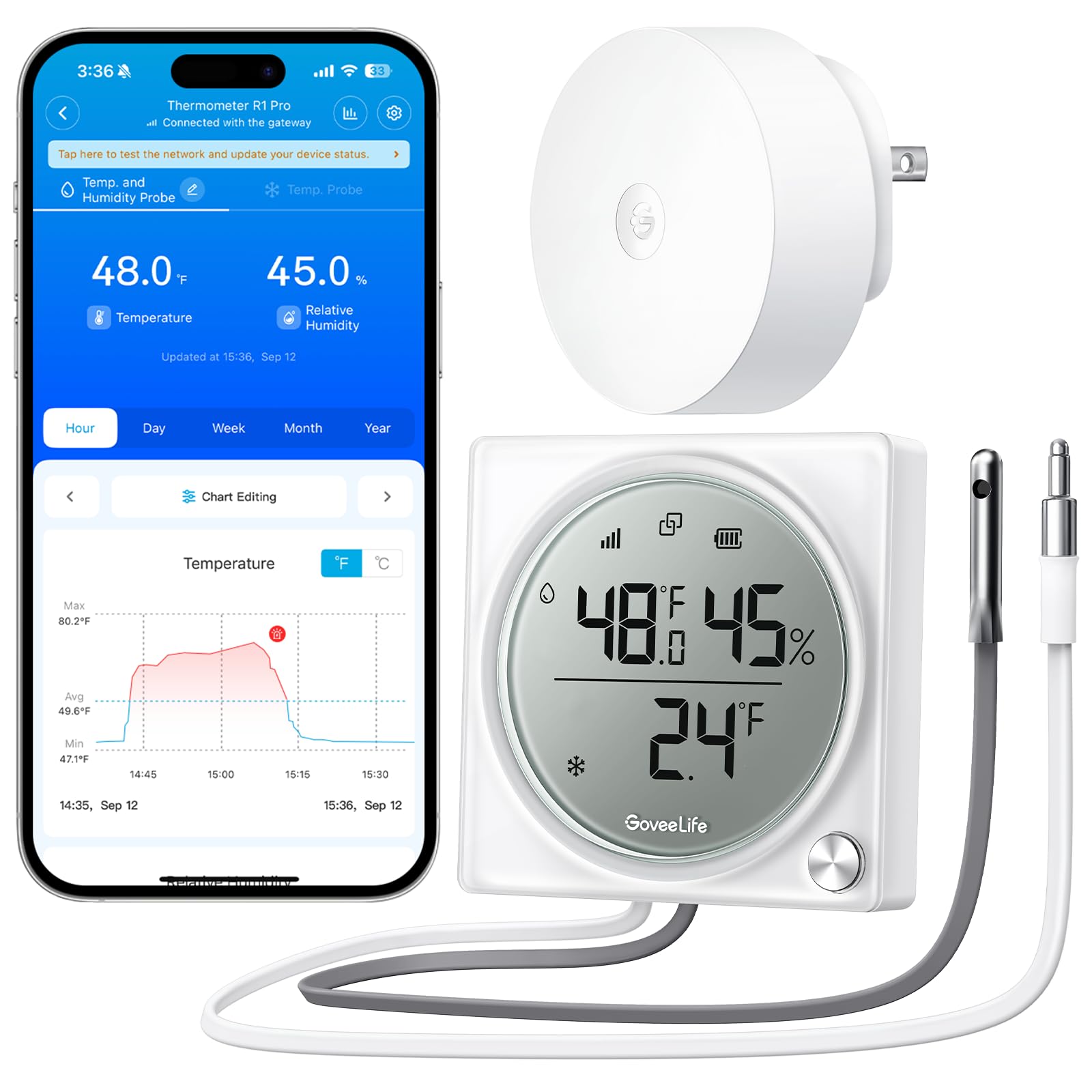
The GoveeLife 2.0 model uses two wired probes rather than wireless sensors, which eliminates connectivity concerns inside the freezer — the probe wire runs through the door seal to the display unit placed outside. This design guarantees consistent readings from the probe tip regardless of WiFi interference, making it a reliable choice if your freezer sits in a location where wireless signals struggle. The large LCD display shows both probe temperatures and humidity simultaneously in a format readable from across the kitchen.
Govee claims an 1840-foot wireless range between the display and your phone via Bluetooth and WiFi bridge, though real-world performance depends on obstacles between the display and your router. The app provides notification alerts, temperature history charts, and configurable high/low thresholds. The dual-probe setup means you can place one probe in the freezer and one in the refrigerator section, tracking both zones from a single display.
The wired probe approach has the advantage of zero battery changes inside the cold zone, but it does require routing the thin probe cable through the door gasket. Over time, repeated compression of the gasket can reduce seal effectiveness if the cable is not positioned carefully. For users who prioritize direct temperature measurement over wireless convenience, this system delivers dependable data with fewer variables.
Why it’s great
- Wired probes eliminate wireless dropouts inside freezer
- Large LCD shows both zones at a glance
- 1840-foot Bluetooth range flexible for large homes
Good to know
- Probe cable may compress door gasket over time
- Display must sit outside the freezer compartment
- Bluetooth range reduced by walls and appliances
6. GoveeLife WiFi Refrigerator Thermometer 2 Pack

This two-pack from GoveeLife gives you two standalone WiFi thermometers, each with its own LCD display, allowing independent monitoring of two separate freezers or one freezer and one refrigerator without needing a central hub. Each unit connects directly to your 2.4 GHz WiFi network and pushes alerts to the Govee Home app. The two-year free data export feature is useful for tracking long-term temperature patterns or providing proof of a failure event.
The LCD on each sensor shows current temperature and humidity, a convenient feature for quick visual checks without opening the app. Accuracy is typical for the mid-range WiFi category, adequate for catching warming trends but not as precise as the YoLink or SensorPush units. Alerts are app-based, so your phone must have data connectivity to receive them when you are away from home.
Because each unit operates independently, you manage two separate device entries in the app rather than one consolidated dashboard. For a basic dual-freezer household or a rental property where simplicity and low cost are the priorities, this pack provides functional coverage with minimal setup friction.
Why it’s great
- Two independent displays for separate locations
- No hub required, each sensor connects directly to WiFi
- Two years of free data export included
Good to know
- App-based alerts only, no local siren or SMS
- Each unit managed separately in the app
- WiFi range limited to your home network coverage
7. SensorPush HTP.xw Smart Temperature & Humidity Sensor

The SensorPush HTP.xw stands apart by offering not just temperature and humidity monitoring, but barometric pressure tracking as well, which matters for scientific hobbies like wine aging, cigar storage, or mycology cultivation. Its sensor accuracy is among the highest in the consumer market, with tightly calibrated components that deliver reliable readings for sensitive environments. The device communicates via Bluetooth to the app, which logs data continuously and supports customizable alert thresholds.
The lack of WiFi or a hub means the SensorPush only reports data when your phone is within Bluetooth range — typically 100 to 200 feet through walls. This makes it a poor choice for remote monitoring of a garage freezer unless you leave an old phone or tablet nearby as a bridge. The app offers excellent data visualization and CSV export, and the device runs on a single coin cell battery that lasts about a year.
If you need to monitor a freezer that is within Bluetooth reach of where you spend most of your day, the SensorPush delivers reference-grade accuracy. But for anyone who needs alerts while traveling or during a power outage away from home, the lack of WiFi, SMS, or email alerting is a dealbreaker. It is a niche tool for precision-focused users who stay close to their gear.
Why it’s great
- Premium accuracy with barometric pressure monitoring
- Excellent data logging and graphing in app
- Compact and reliable for short-range use
Good to know
- Bluetooth only — no remote alerts away from home
- No WiFi hub or gateway for cloud upload
- Coin cell battery may need annual replacement
FAQ
Can a LoRa-based freezer alarm penetrate a metal chest freezer?
What temperature threshold should I set for a freezer alarm?
Final Thoughts: The Verdict
For most users, the best freezer alarm winner is the YoLink Smart Wireless Thermometer 3-Pack because its LoRa protocol penetrates freezers, concrete walls, and garage structures where WiFi fails, while delivering ±0.36°F accuracy and five-year battery life across three sensors. If you want a straightforward WiFi system with no subscription and two-zone coverage out of the box, grab the MOCREO WiFi Freezer Thermometer. And for remote data logging with text alerts and extreme battery life, nothing beats the YoLink X3 Data Logger 2-Pack.