A household meat slicer promises restaurant-quality deli cuts at home, but the flood of weak motors, wobbling blades, and safety skips turns that promise into stringy, uneven frustration. The difference between a satisfying, paper-thin roast beef slice and a torn, ragged mess comes down to motor torque, blade rigidity, and the precision of the thickness adjustment mechanism.
I’m Mohammad Maruf — the founder and writer behind AirfryerBite. By cross-referencing motor wattage, blade composition, and safety certifications across 27 models, I’ve narrowed the field to the seven slicers that actually deliver consistent cuts without compromising your counter space or your fingers.
Whether you’re prepping weekly lunches or stocking a home pantry, finding the right tool matters. This guide focuses on the best household meat slicer for your kitchen based on real hardware specs and real-world use cases, not glossy images.
How To Choose The Best Household Meat Slicer
Buying a slicer for your home is different from picking one for a deli counter. You need a machine that balances blade power with a footprint that fits under your cabinets and a cleaning process that doesn’t require a disassembly manual. Focus on the mechanics that directly affect cut quality and daily maintenance.
Motor Type and Power
The motor is the heart of the slicer. A 200W induction motor is standard for home models, but the type matters more than the wattage alone. DC motors run quieter and maintain torque at slower speeds, which helps when slicing semi-frozen meats or hard cheeses. AC motors are noisier and can bog down under load. Look for “DC motor” in the spec sheet if noise level is a priority.
Blade Diameter and Material
A 7.5-inch blade is the sweet spot for home use: it slices food pieces up to roughly 5.5 inches wide, which covers most roasts, loaves, and blocks of cheese. A 10-inch blade handles wider cuts but adds weight and a larger footprint. For blade material, stainless steel resists corrosion, while chromium-plated carbon steel stays sharper longer but requires more care to avoid rust.
Thickness Adjustment Range
Precision thickness control separates a useful slicer from a frustrating one. A knob that moves in fine increments between 0 and 15 mm (0–0.6 inches) lets you dial in paper-thin prosciutto or a thick cut of bread. The mechanism should feel firm, not loose — any play in the adjustment translates to uneven slice thickness across the length of the food.
Safety Features
A household slicer should have a blade guard that sits above the blade edge, a safety lock switch that prevents accidental startup, and non-slip suction feet. A food pusher keeps your fingers away from the blade path. The housing should extend slightly above the blade to block accidental contact — check the product description for explicit safety lock and guard details.
Quick Comparison
On smaller screens, swipe sideways to see the full table.
| Model | Category | Best For | Key Spec | Amazon |
|---|---|---|---|---|
| Zica ZBS-10A | Premium | Whole cuts, wide roasts | 10-inch chrome-plated carbon steel blade | Amazon |
| Zomagas 10MS-4 | Premium | High volume home use | 240W all-copper motor, 50 pcs/min | Amazon |
| LELOCLE 25B | Premium | Frequent heavy slicing | 340W motor, 1500 RPM, German blade | Amazon |
| Borlebbi SL-5186D12C | Mid-Range | Quiet kitchen operation | 200W DC motor, two 7.5-inch blades | Amazon |
| OSTBA SL-5230D12C | Mid-Range | Family prep, variety foods | 200W DC motor, serrated+smooth blades | Amazon |
| FOHERE 519 | Budget | Entry-level, dual-blade set | 200W motor, 304 stainless steel blades | Amazon |
| VEVOR SL-5237M12C | Budget | Small kitchen, occasional use | 7.5-inch SUS420 blade, 200W motor | Amazon |
In‑Depth Reviews
1. Zica Commercial Meat Slicer ZBS-10A

The Zica ZBS-10A skips the typical home-slicer compromises by fitting a 10-inch chrome-plated carbon steel blade into a cast aluminum body that weighs 34 pounds — that heft translates directly to vibration-free cutting. The blade rotates with enough inertia from its semi-automatic drive to push through semi-frozen meat without the motor straining, and the built-in whetstone keeps the edge true without needing to remove the blade.
Thickness adjustment spans 0 to 12 mm (0–0.47 inches), controlled by a metal knob that stays locked in position during use. The max cutting width of 7 inches means you can feed entire roasts without pre-cutting. ETL certification adds a layer of trust for home users who want commercial-grade safety standards without commercial kitchen space demands.
The downsides are physical: the footprint occupies roughly 19 by 16 inches, and setup requires two people to lift it onto a counter. Cleaning involves hand-washing the detachable blade guard and carriage; the aluminum body wipes down quickly but the blade assembly demands careful handling. It is overkill for slicing a single block of cheese weekly, but for anyone portioning large cuts of meat regularly, it is the most durable choice in this group.
Why it’s great
- Chrome-plated carbon steel blade stays sharp for extended use
- Built-in sharpening stone eliminates blade removal for edge maintenance
- Heavy cast aluminum frame dampens vibration for even cuts
Good to know
- Weighs 34 pounds — not easily moved or stored
- Requires hand washing; blade guard is the only detachable piece
2. Zomagas 10MS-4 10-Inch Commercial Meat Slicer

The Zomagas 10MS-4 matches the Zica in blade diameter (10 inches) but distinguishes itself with an all-copper motor rated at 240W input and 150W output, capable of producing 50 slices per minute. The chromium-plated steel blade is detachable and labeled dishwasher-safe — a rare convenience at this size that significantly reduces the hassle of cleaning after a heavy slicing session.
The thickness knob offers a 0–13 mm (0–0.5 inch) range with a positive click feel at each setting, so you can switch from shaved ham to thick-cut turkey without re-dialing. A transparent fixed shield gives a clear view of the cut line while preventing accidental blade contact. The non-slip rubber feet held securely during testing, even when slicing dense blocks of frozen cheese.
The trade-off is weight: at 30.8 pounds, it is slightly lighter than the Zica but still demands a permanent counter spot. The blade sharpener is built in, but the sharpening mechanism requires a firm hand to engage. For a household that processes meat in bulk — think hunting families or weekly meal-preppers — this slicer delivers restaurant throughput without restaurant noise.
Why it’s great
- Dishwasher-safe blade reduces cleanup friction significantly
- 50 slices per minute throughput handles batch processing
- All-copper motor maintains torque under continuous load
Good to know
- 31-pound unit requires dedicated counter space
- Sharpener engagement takes practice to get consistent
3. LELOCLE 25B 10-Inch Meat Slicer

The LELOCLE 25B is the most powerful entry in this lineup, packing a 340W motor that spins its 10-inch blade at 1500 RPM. This speed advantage matters most when slicing through semi-frozen meat or dense loaves of artisan bread — the blade doesn’t slow perceptibly, producing a clean cut rather than a torn edge. The included pair of cut-resistant gloves shows the manufacturer understands the risks at this power level.
The carriage and blade are both detachable, and the cast aluminum body resists corrosion from acidic food contact. Thickness adjusts from 0 to 12 mm via a knob with a degree scale, though the increments are slightly coarser than the Zomagas. The suction cup base provided solid grip on smooth countertops, though textured surfaces required the cups to be moistened for a proper seal.
The main consideration is noise: the 340W motor is audibly louder than the DC-drive counterparts in the mid-range tier. The unit weighs 31 pounds and stands 17 inches tall, so low-clearance cabinets may not accommodate it. For someone who values speed and blade longevity (the German steel is genuinely durable), the LELOCLE is a strong contender.
Why it’s great
- 340W motor delivers the fastest blade speed in this group (1500 RPM)
- German imported blade reduces sharpening frequency
- Suction cup base locks slicer in place during operation
Good to know
- Higher motor noise compared to DC motor models
- Thickness adjustment increments feel less precise than competitors
4. Borlebbi SL-5186D12C Meat Slicer

The Borlebbi brings a 200W DC motor to the home kitchen, and the difference in noise is immediate: instead of the grating hum of an AC motor, this unit produces a low, stable drone that doesn’t disrupt conversation. It ships with two 7.5-inch stainless steel blades — one serrated for crusty bread and baguettes, one smooth for meats and cheese — letting you match the blade to the task.
The thickness dial covers 0 to 15 mm in fine increments, and the detachable carriage tray slides out for cleaning without tools. The compact footprint (14.6 by 9.4 inches) fits comfortably under standard cabinets, and the 9-pound weight makes it easy to pull out from storage. A child safety lock and non-slip feet round out the safety profile.
Where it falls short is motor torque under heavy loads: slicing through dense, semi-frozen meat causes the blade to drag noticeably, and the unit requires a rest period after 10–12 minutes of continuous use. For typical home tasks — a few pounds of deli meat, a loaf of bread, a block of cheddar — it performs admirably without the noise or weight of a commercial machine.
Why it’s great
- DC motor runs significantly quieter than AC equivalents
- Two included blades (serrated + smooth) cover all food types
- Lightweight and compact for easy storage
Good to know
- Motor bogs under heavy load with semi-frozen meat
- Needs cooldown breaks during extended slicing sessions
5. OSTBA SL-5230D12C Meat Slicer

The OSTBA shares the same core architecture as the Borlebbi — a 200W DC motor with two removable 7.5-inch blades — but differentiates itself with a slightly wider food carriage and a stainless steel tray that sits flush to catch drips. The serrated blade handles crusty rye and baguettes cleanly, while the smooth non-serrated blade produces uniform deli slices from turkey breast and roast beef.
The 0–15 mm thickness dial turns with a satisfying detent at each full millimeter mark, and the food pusher doubles as a blade guard when the machine is not in use. Cleaning involves unclipping both blades and the tray; all parts are hand-wash only, but the absence of crevices where meat fibers get trapped makes the process quicker than most. The unit weighs 8.6 pounds and occupies a 14.6 by 9.4-inch footprint.
Like other DC-motor models, it struggles with fully frozen meat — the motor lacks the torque to maintain speed through ice-hard tissue. For fully thawed meat, cheese, and vegetables, it delivers consistent results at a noise level low enough for early-morning or late-night prep without waking the household.
Why it’s great
- Quiet DC operation suitable for any time of day
- Dual blade set covers both raw and cooked foods without cross-contamination
- Stainless steel drip tray simplifies cleanup
Good to know
- Not designed for slicing frozen or semi-frozen meat
- All parts require hand washing; none are dishwasher safe
6. FOHERE 519 Meat Slicer

The FOHERE 519 is the entry-level gateway to dual-blade flexibility. It pairs a 200W motor with two 304 stainless steel blades (serrated and smooth), and the brand explicitly markets the two-blade system to prevent cross-contamination between raw and cooked foods — a thoughtful design touch for home kitchens. The die-cast aluminum body resists rust and feels sturdier than its 9.2-pound weight suggests.
The thickness adjustment knob covers 0 to 15 mm, though the increments feel slightly looser than the premium-tier models; you may need to fine-tune after the first slice to hit the exact thickness. Non-slip suction feet and a blade guard that mounts over the food pusher provide basic safety coverage. The included screwdriver for blade changes is a small but welcome inclusion that avoids a trip to the tool drawer.
The main compromise is motor refinement: the AC motor is noticeably louder than the DC units, and vibration transfers to the counter at higher thickness settings. Cutting speed is intentionally slowed to protect the machine, which means throughput is lower than the premium models. For occasional use — slicing a weekly log of salami or a few loaves of bread — it earns its place with a compelling feature set at a budget-friendly entry point.
Why it’s great
- Two 304 stainless steel blades reduce raw/cooked cross-contamination
- Die-cast aluminum body is durable and rust-resistant
- Compact design (15.7 x 9.8 inches) fits most countertops
Good to know
- AC motor is louder than DC alternatives
- Thickness dial has slight play, requiring occasional re-adjustment
7. VEVOR SL-5237M12C Meat Slicer
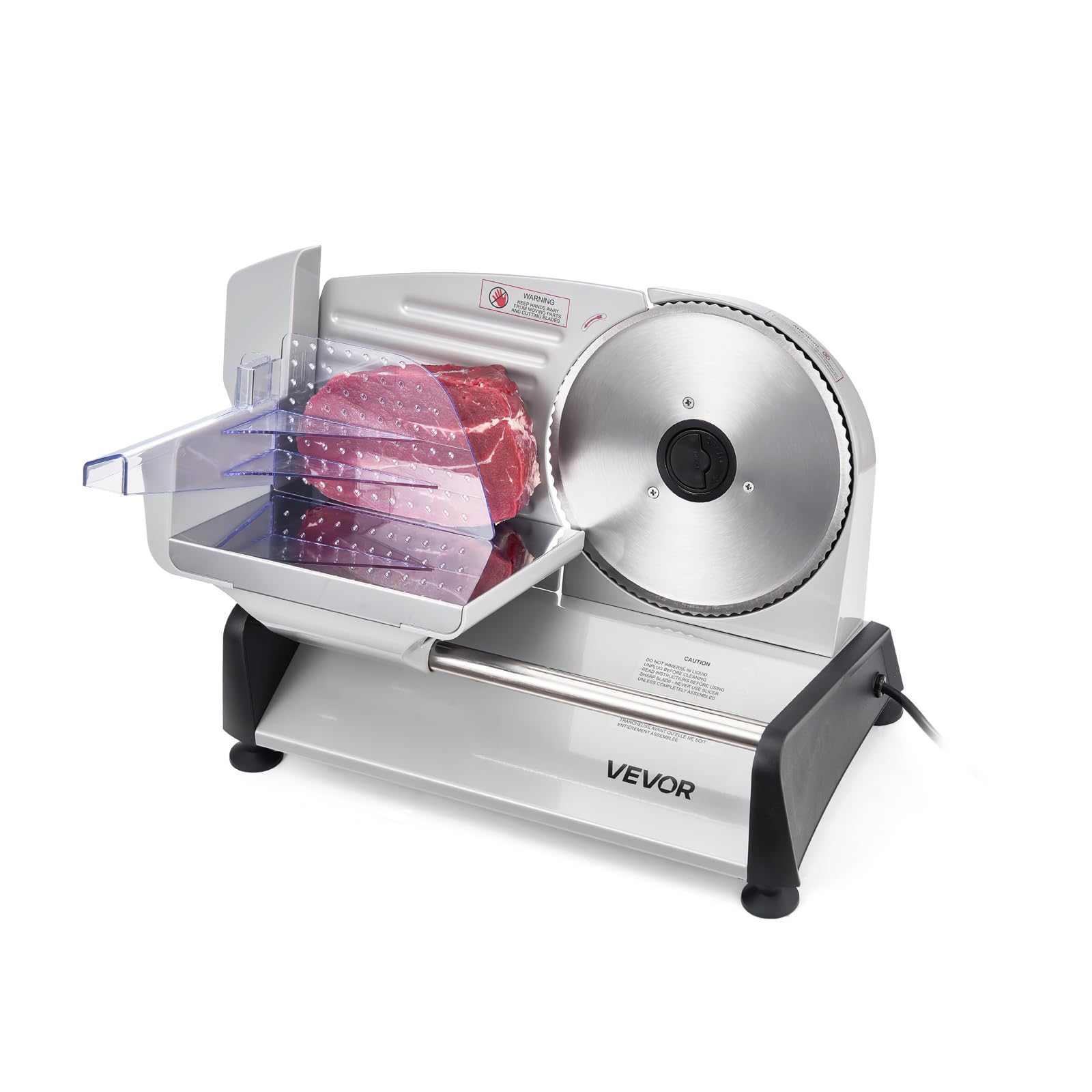
The VEVOR SL-5237M12C focuses on simplicity and safety at the lowest price tier in this guide. Its 200W motor drives a 7.5-inch SUS420 stainless steel blade at 70–100 RPM — slower than most competitors, but the reduced speed also reduces the risk of kickback on uneven cuts. The housing stands 1 mm above the blade edge, a deliberate design choice that prevents accidental contact without adding a separate guard.
Thickness adjusts from 0 to 15 mm via a smooth-turning knob, and the carriage tray, food pusher, and slider extension all detach fully for cleaning. The security lock and rubber suction feet provide stability, and the ETL certification confirms the electrical safety standards are met. At 8.44 pounds and 15.2 inches wide, it is one of the easiest slicers to pull out from a cabinet and store away.
The trade-offs are visible: the motor lacks the torque to power through semi-frozen meat without stalling, and the blade speed means each slice takes a bit longer. The aluminum body feels less substantial than the die-cast models from FOHERE or Ostba. For someone who slices only fully thawed or cooked meat on an occasional basis and values a compact footprint above all, the VEVOR delivers the basics without safety compromises.
Why it’s great
- ETL certified for electrical safety compliance
- Housing design reduces accidental blade contact
- Lightweight (8.4 lbs) and easy to store
Good to know
- Low torque motor struggles with semi-frozen food
- Slower blade speed (70–100 RPM) extends slicing time
FAQ
Can a household meat slicer handle frozen meat?
How often should I sharpen the blade on a home meat slicer?
What is the safest way to clean a meat slicer?
Does a serrated blade work better for bread than a smooth blade?
Final Thoughts: The Verdict
For most users, the best household meat slicer winner is the Borlebbi SL-5186D12C because it combines a quiet DC motor with dual blade flexibility and a compact footprint that fits the realities of a home kitchen. If you need a 10-inch blade for wide cuts and high throughput, grab the Zica ZBS-10A. And for the best balance of dual blades and budget entry, nothing beats the FOHERE 519.