The gap between a decent morning cup and a truly great one often comes down to a single variable: the grind. Relying on pre-ground coffee or a whirring blade grinder introduces inconsistency that no brewing technique can fix. A dedicated burr grinder at home changes that equation, delivering uniform particle sizes that unlock the full potential of your beans.
I’m Mohammad Maruf — the founder and writer behind AirfryerBite. I’ve spent countless hours analyzing consumer reports and cross-referencing burr geometry, motor torque, and grind retention data to understand what separates a mid-range workhorse from a frustrating countertop ornament.
After evaluating dozens of models across different price tiers, I’ve narrowed the field to the seven most compelling options available today. This guide breaks down each contender to help you find the best coffee grinder under $200 for your specific brew method and counter space.
How To Choose The Best Coffee Grinder Under $200
Not every burr grinder under two hundred dollars delivers the same quality. The burr geometry, motor speed, grind retention, and step resolution vary widely. Knowing which specs matter most for your brew method — espresso, pour-over, drip, or French press — prevents an expensive mistake.
Conical vs. Flat Burrs: Which Belongs on Your Counter?
Conical burrs dominate this price segment because they are cheaper to manufacture and produce a wide particle distribution that suits medium to coarse grinds well. Flat burrs offer tighter particle distribution for espresso but typically cost more. For most home users grinding for multiple methods, a quality conical burr set from a reputable brand is the safer bet.
Grind Settings: How Many Steps Do You Really Need?
A grinder with 15 to 30 stepped settings covers drip, pour-over, and French press adequately. Espresso drinkers should look for 40-plus settings or micro-adjustments to dial in shot timing. Stepless adjustment is rare under $200 but appears on some models — it offers infinite resolution but requires a bit more technique to lock in consistently.
Dose Capacity and Retention: Feeding Your Habit
A hopper that holds 50 grams (roughly six cups of brewed coffee) is fine for a single household. Larger 100-gram hoppers suit multiple drinkers or high-volume mornings. More critical is grind retention — the grounds stuck inside the chute after grinding. Look for models with retention under two grams to avoid stale grounds mixing into tomorrow’s fresh dose.
Anti-Static and Cleanability: The Hidden Daily Friction
Static electricity causes fine coffee particles to fly everywhere when you remove the grounds bin. An anti-static design, either through ionizing technology or coated chutes, keeps your counter clean. Removable upper and lower burrs make deep cleaning possible without tools — essential for switching bean types or avoiding oil buildup.
Quick Comparison
On smaller screens, swipe sideways to see the full table.
| Model | Category | Best For | Key Spec | Amazon |
|---|---|---|---|---|
| AMZCHEF Coffee Grinder | Premium | Espresso & precision dosing | 48 settings, 100g hopper, LED touchscreen | Amazon |
| Aromaster 48-Setting | Premium | Versatile home grinding | 48 grind settings, 3.9 oz capacity | Amazon |
| SHARDOR Conical Burr | Premium | Touchscreen convenience | 51 precise settings, precision timer | Amazon |
| OXO Brew Compact | Mid-Range | Tight counter spaces | 15 settings + 29 micro-adjustments | Amazon |
| Aromaster 25-Setting | Mid-Range | Entry-level burr grinding | 25 grind settings, anti-static design | Amazon |
| AYCHIRO Conical Burr | Mid-Range | Budget-friendly versatility | 30 grind settings, 2-12 cups | Amazon |
| Cuisinart DBM-8P1 | Budget | Simple automatic operation | 18-position selector, 4-18 cups | Amazon |
In‑Depth Reviews
1. AMZCHEF Coffee Grinder
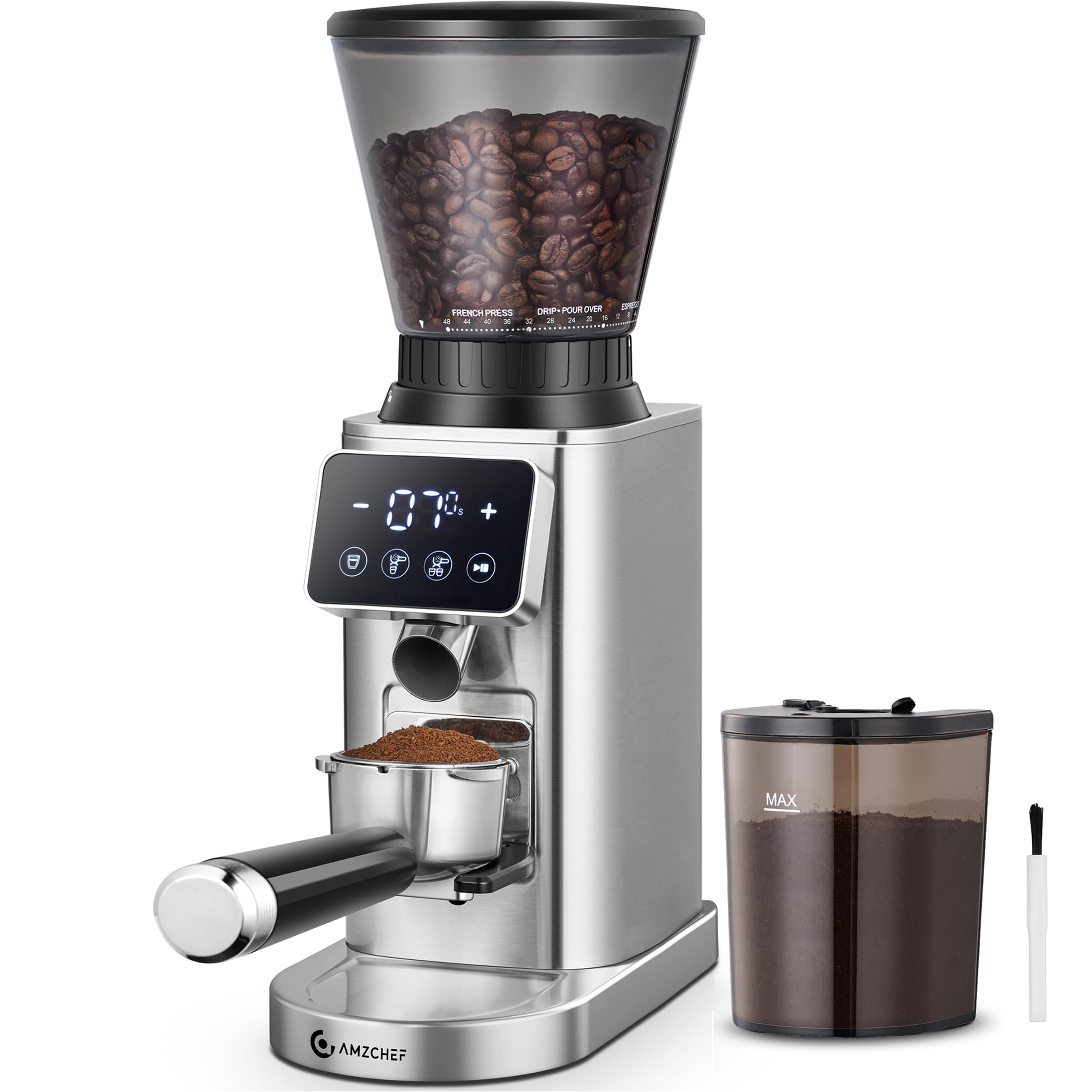
The AMZCHEF stands out with its dedicated espresso portafilter holder and a 100-gram photophobic grounds container that blocks UV degradation of your ground coffee. The 40-millimeter stainless steel conical burrs spin at a low 450 RPM, reducing heat transfer and static buildup during grinding. The patented grinding system delivers consistent particle size from the second use onward, after a brief break-in period clears residual powder from manufacturing.
The LED touchscreen offers three grind modes — by cups, by time, or single/double espresso dosing — with 0.5-second timing increments for precise dose control. The detachable funnel stand accommodates 50-millimeter portafilters directly, eliminating the need to transfer grounds. The anti-static design and removable ring burr simplify cleaning, though the plastic hopper feels less substantial than the all-metal construction of pricier competitors.
At roughly 5.4 pounds, this unit has a solid, non-skid footprint that stays planted during grinding. The 48-setting range covers Turkish-fine through French press coarse, making it a true multi-method workhorse. If you brew espresso and pour-over interchangeably, this is the most versatile pick in the sub-$200 space.
Why it’s great
- Portafilter holder compatible with 50mm baskets for direct espresso grinding.
- Ultra-low 450 RPM burr speed minimizes heat and static.
- LED touchscreen with 0.5-second timer increments for repeatable dosing.
Good to know
- Plastic hopper and housing may not satisfy users seeking all-metal build.
- First use generates some residual powder that should be discarded.
2. Aromaster Burr Coffee Grinder (48 Settings)
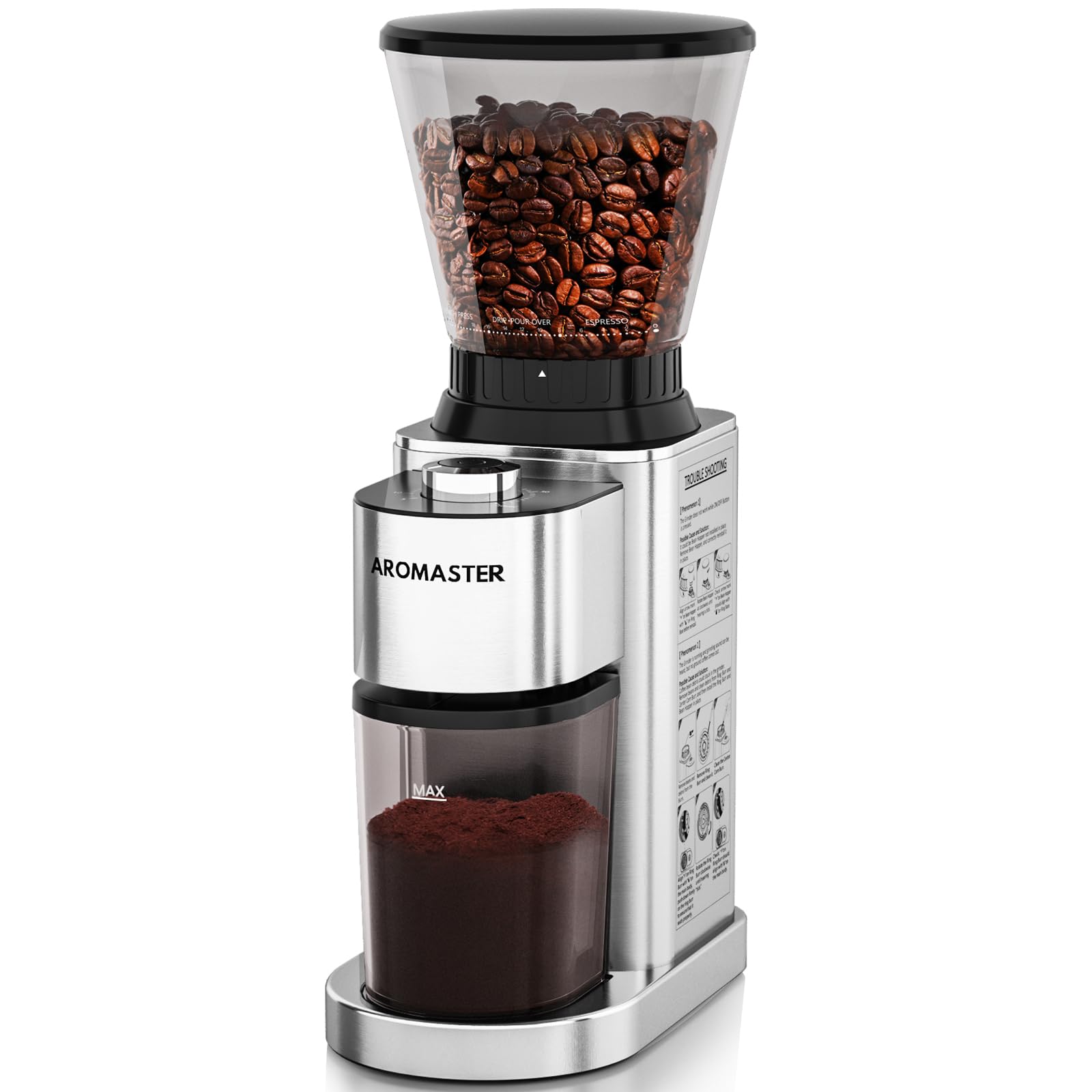
The Aromaster 48-setting model packs a 3.9-ounce bean hopper, enough for multiple pots or a larger household’s morning routine. Its stainless steel conical burrs grind slowly to preserve volatile aromatic oils, and the upgraded anti-static technology prevents fine particles from clinging to the chute or flying out when you remove the bin. The tawny-colored grounds bin also reduces UV light exposure, slowing staling after grinding.
A 40-second adjustable timer lets you dial in dose size by duration, and the removable ring burr enables tool-free cleaning. A small cleaning brush is stored on the back of the bean hopper lid — a thoughtful detail that keeps the tool accessible. The machine requires a 120V, 60Hz supply, and the instruction manual explicitly warns to keep the conical burr dry before reassembly to avoid short-circuiting.
This unit has earned strong customer feedback with a 4.6-star rating across nearly a thousand reviews. The grind range covers espresso to French press, though the stepped adjustment may not offer the micro-fine resolution that dedicated espresso enthusiasts want for dialing in specific shots. For general home use with occasional method switching, it delivers reliable consistency and generous capacity.
Why it’s great
- Large 3.9-ounce capacity suits families or multiple brew sessions.
- Integrated anti-static system keeps the counter clean.
- Convenient built-in brush storage on the hopper lid.
Good to know
- Stepped adjustment may feel coarse for espresso fine-tuning.
- Conical burr must be completely dry before reassembly to prevent electrical issues.
3. SHARDOR Conical Burr Espresso Coffee Grinder

SHARDOR’s entry in the premium tier packs 51 distinct grind settings — more than most competitors at this price — giving espresso drinkers the granularity needed to dial in extraction times precisely. The Precision Timer 2.0 system lets you program dose duration in small increments, so each morning’s grind matches the previous day’s output within a fraction of a gram. The touchscreen interface is responsive and easy to navigate, even when half-awake.
Conical burrs made from stainless steel deliver a consistent particle distribution with minimal fines, and the anti-static chute reduces mess significantly. The grounds bin holds enough for a double shot plus a bit extra, though the hopper capacity is modest compared to the Aromaster. The unit’s compact footprint fits under low cabinets, making it a solid option for kitchens with limited vertical clearance.
The brushed stainless steel finish looks clean on the counter, but the plastic dosing cup feels slightly light for the price point. Some users note that the first few grinds produce uneven particle size until the burrs season. Once broken in, the SHARDOR delivers espresso-grade consistency that rivals grinders costing twice as much.
Why it’s great
- 51 grind settings provide excellent resolution for espresso dial-in.
- Precision Timer 2.0 ensures repeatable dosing session to session.
- Touchscreen interface is intuitive and responsive.
Good to know
- Seasoning period required before consistent particle size is achieved.
- Plastic dosing cup feels less premium than the rest of the build.
4. OXO Brew Compact Conical Burr Coffee Grinder

The OXO Brew Compact is exactly what its name promises — a slim, powerful grinder that stands only 10.75 inches tall and 3.75 inches wide. Despite its small stature, it offers 15 primary grind settings plus 29 micro-adjustments within those steps, giving you 44 effective positions for fine-tuning. The stainless steel conical burrs are removable for thorough cleaning, and both the hopper and grounds container are made from Tritan Renew — a material derived from recycled plastics.
With a 50-gram hopper capacity (enough for about six cups of brewed coffee), this grinder is optimized for single-household use. The grounds bin slides out easily, and the anti-static coating on the chute reduces clinging particles. The build quality is typical OXO — soft-touch plastic that feels durable without being heavy — and the footprint is narrow enough to slide into a crowded corner.
The micro-adjustment system is a genuine differentiator at this price. Most grinders in the mid-range offer stepped settings without fine-tuning capability. Here, you can dial in between major steps, which helps bridge the gap between pour-over and drip consistency. The trade-off is a smaller dose capacity and a slightly slower grind speed compared to larger models.
Why it’s great
- Ultra-compact dimensions — only 3.75 inches wide.
- 44 effective grind positions via micro-adjustments within 15 steps.
- Upper and lower burrs are fully removable for easy cleaning.
Good to know
- 50-gram capacity is limited to roughly six cups per fill.
- Slower grind speed than larger conical burr models.
5. Aromaster Conical Burr Coffee Grinder (25 Settings)

The Aromaster 25-setting model serves as a capable entry point into burr grinding without stretching the budget. It shares the same anti-static design and cleaning brush integration as its 48-setting sibling but offers fewer step positions, which limits fine-tuning for espresso. The adjustable 2-12 cup timer allows basic portion control, and the included 3-ear portafilter holder adds convenience for espresso machine owners.
Build quality mirrors the larger Aromaster — mostly plastic with stainless steel burrs — but the reduced setting count makes operation simpler for beginners who might be overwhelmed by dozens of options. The grind range still covers espresso through French press, though the coarser steps between settings mean you may not hit the exact particle size for a specific drip method on the first try.
Cleanup is straightforward thanks to the removable ring burr and included brush. The anti-static feature works well enough to keep stray grounds contained. For someone moving from a blade grinder to their first burr unit, this is a low-risk step up that delivers noticeably more consistent results without a steep learning curve.
Why it’s great
- Beginner-friendly interface with 25 settings that cover most methods.
- Includes 3-ear portafilter holder for espresso use.
- Anti-static chute reduces mess compared to blade grinders.
Good to know
- Step resolution may be too coarse for serious espresso tuning.
- Plastic construction feels less durable than premium alternatives.
6. AYCHIRO Conical Burr Coffee Grinder Electric
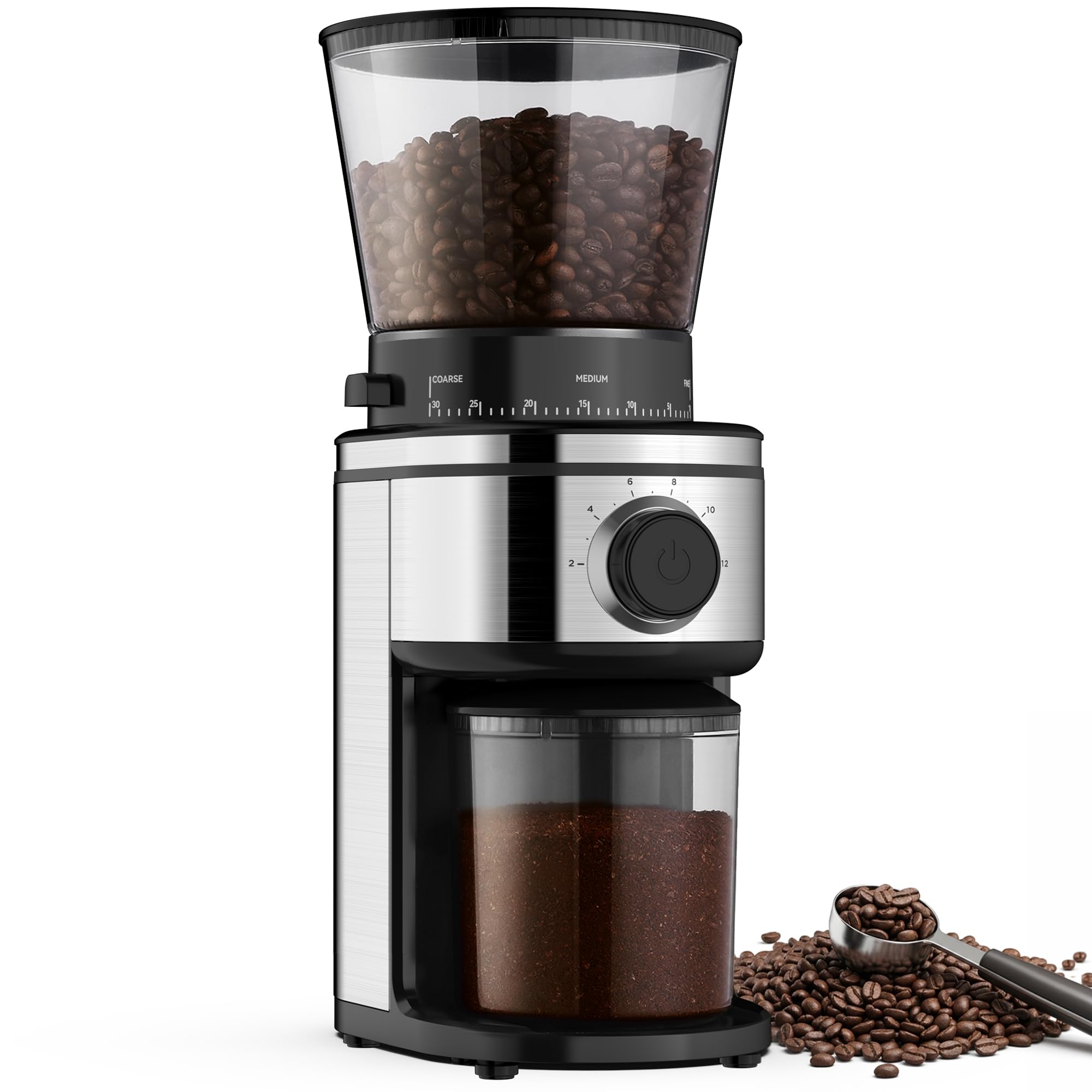
The AYCHIRO conical burr grinder offers 30 grind settings and a 2-12 cup capacity selector, making it a flexible choice for households that brew varying amounts day to day. The adjustable burr mill is designed for home use and covers espresso, pour-over, and French press grind sizes. The stainless steel burrs produce fewer fines than a blade grinder, and the motor operates quietly relative to other entry-level models.
The dosing timer lets you set the grind duration based on your brew method, which helps maintain consistency once you find your ideal setting. The grounds bin is translucent with measurement markings, so you can see the volume accumulating without opening the chamber. The hopper capacity is adequate for a single brewing session, but larger households may need to refill mid-grind.
Build quality is functional rather than luxurious — the housing is plastic, and the burr alignment sometimes shifts slightly during heavy use, requiring occasional re-seating. For the price, it delivers respectable grind consistency and a broad enough setting range to explore different brewing methods. It is a solid option for budget-conscious buyers who still want burr-ground quality.
Why it’s great
- 30 grind settings offer good flexibility for multiple brew methods.
- Quieter operation than many blade grinders at this price tier.
- Measurements on the grounds bin simplify dosing.
Good to know
- Burr alignment can drift slightly during extended grinding.
- Plastic build feels less durable than mid-range competitors.
7. Cuisinart Coffee Grinder DBM-8P1
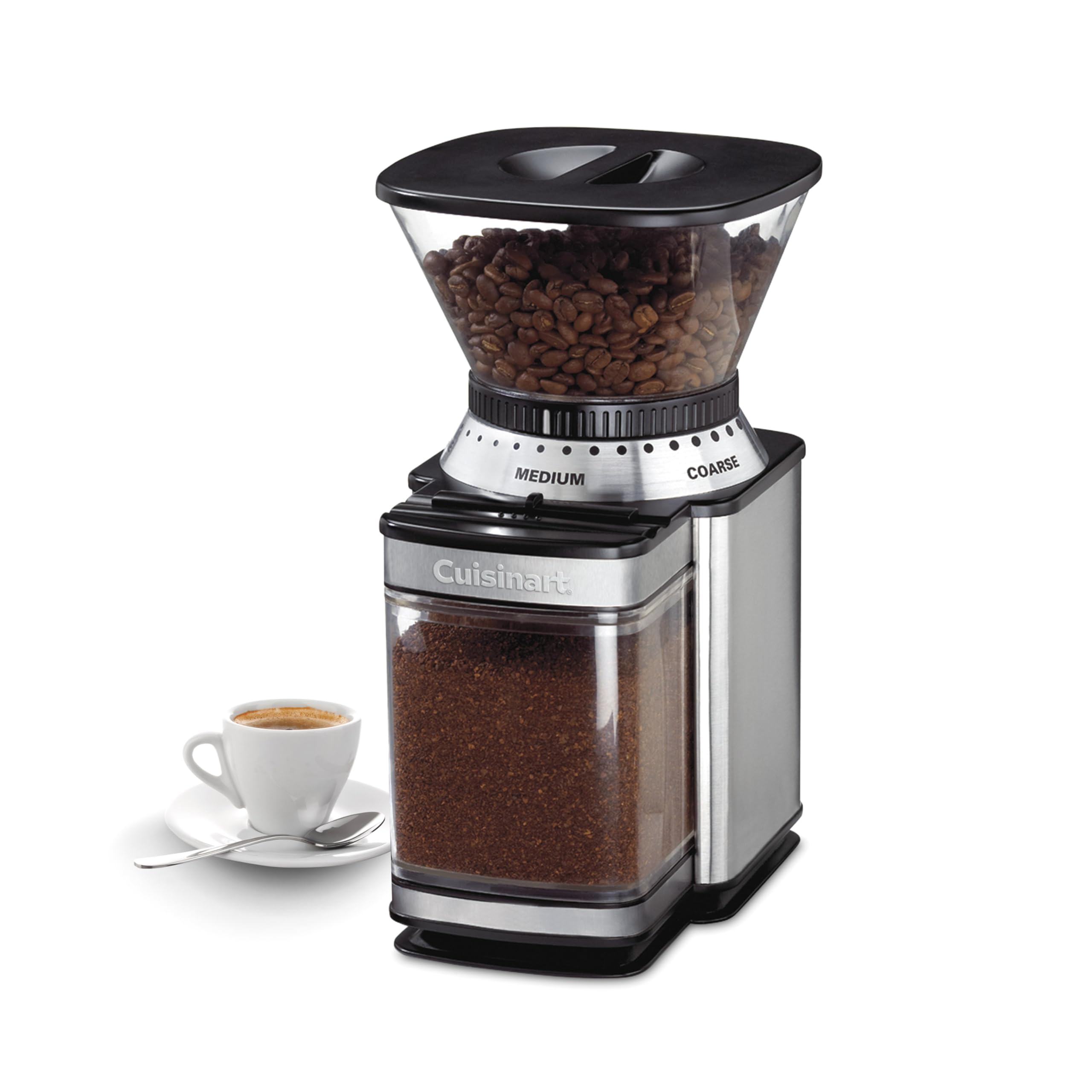
The Cuisinart DBM-8P1 is a long-standing entry in the automatic burr grinder segment, with an 18-position grind selector and a cup-size selector that ranges from 4 to 18 cups. Its one-touch operation is about as simple as it gets — load beans, select your settings, press start. The auto-stop feature turns the grinder off when the hopper is empty, preventing wear from running dry.
The grind quality is consistent for drip coffee and French press, but the 18-step resolution is limited for espresso. Fine settings produce a decent particle size, but the step increments are wide enough that dialing in a perfect shot can be frustrating. The plastic burr holder and housing feel dated compared to newer all-metal competitors, but the unit is reliable and has a well-earned reputation for longevity.
Cleaning requires disassembling the upper burr, which is straightforward but not as tool-free as some modern designs. The grounds bin is large enough for a full pot, and the removable hopper makes bean switching easy. For drip coffee drinkers who value simplicity and don’t need espresso-grade precision, this is a dependable workhorse that has stood the test of time.
Why it’s great
- Simple one-touch operation with auto-shutoff when hopper is empty.
- Large 18-cup capacity suits high-volume brewing.
- Proven durability with years of positive consumer feedback.
Good to know
- 18 grind settings are insufficient for espresso precision.
- Plastic burr holder feels less robust than newer models.
FAQ
Can I use a coffee grinder under $200 for espresso?
How often should I clean a burr grinder?
What is grind retention and why does it matter?
Should I buy a blade grinder or a burr grinder?
Final Thoughts: The Verdict
For most users, the best coffee grinder under $200 is the AMZCHEF Coffee Grinder because it combines 48 grind settings with an espresso portafilter holder and precise digital timer control. If you need maximum capacity for multiple drinkers, grab the Aromaster 48-Setting model. And for tight counter spaces where every inch counts, nothing beats the OXO Brew Compact with its micro-adjustment system and slim footprint.