The moment green coffee beans hit the roasting chamber, a complex chemical reaction called the Maillard process begins, transforming raw, grassy seeds into the aromatic, oil-rich brown beans you grind every morning. The difference between a stale bag from a grocery shelf and a batch you just pulled from the roaster is measurable — volatile aromatic compounds degrade within days of commercial roasting, while green beans maintain peak freshness for up to two years. A dedicated coffee roaster lets you control the rate of that transformation with precision, dictating whether you stop at the first audible crack for a light, acidic cup or push through to the second crack for a dark, smoky espresso profile.
I’m Mohammad Maruf — the founder and writer behind AirfryerBite. I’ve spent hundreds of hours analyzing the thermal dynamics, batch-size consistency, and chaff-management systems of home coffee roasters across the to range, comparing drum type, fluid-bed convection, and heat source to help you match a machine to your skill level and daily consumption.
This guide breaks down the essential specs — wattage, capacity in grams, temperature range, and airflow control — that separate a forgiving first machine from a frustrating one, so you can confidently choose the best coffee roaster for your counter.
How To Choose The Best Coffee Roaster
Selecting a home coffee roaster means balancing batch capacity against the precision of temperature and airflow controls. The right machine depends on how many cups you drink per week and how much hands-on profiling you want to do.
Batch Size: Match Grams to Your Daily Consumption
The most important spec is the roaster’s recommended batch weight, listed in grams. A 200-gram batch yields roughly fourteen to sixteen cups of brewed coffee, depending on your dose. If you drink two cups a day, that batch covers about a week. Roasters with capacities between 300 and 500 grams suit households that consume more or like to store a few days’ worth. Overloading the chamber — especially in fluid-bed models — leads to uneven heat distribution and a baked, flat-tasting roast. Under-loading by too much can cause beans to tumble erratically or scorch because the airflow has too much room.
Heat Source and Control: Drum vs Fluid-Bed
Drum roasters, like the DYVEE KAKA-G400, use a rotating metal or glass cylinder heated by a gas burner or electric element, transferring heat through conduction as beans tumble against the hot surface. This method delivers a classic, full-bodied flavor profile and is forgiving of slightly larger batch sizes. Fluid-bed roasters, like the Fresh Roast SR800, suspend beans in a column of hot air, using convection for even, fast roasts — often under ten minutes. Fluid-bed models produce brighter, cleaner cups but require more careful attention to fan speed and heat settings to avoid unevenness or tipping (scorching the bean edge). Beginners often find drum machines more intuitive, while tinkerers prefer the control that fluid-bed systems offer.
Temperature Range and Programmability
Look for a roaster with an adjustable temperature range of at least 200°F to 460°F (roughly 95°C to 240°C). This span covers the full spectrum from a very light City roast to a dark French or Italian roast. Machines with a digital display and real-time temperature readout, like the Roma Pro, let you track the rate of rise (RoR), a key metric for repeatable results. Some roasters offer automatic modes that follow a pre-set profile, which is helpful for consistency, while manual fan and heat control allow you to tweak the curve for specific bean origins or density levels.
Quick Comparison
On smaller screens, swipe sideways to see the full table.
| Model | Category | Best For | Key Spec | Amazon |
|---|---|---|---|---|
| Fresh Roast SR800 | Fluid-Bed | Precision profiling | 170–226g per batch | Amazon |
| MAGO MAGA Roma Pro | Fluid-Bed | Smart control, low smoke | 300g capacity | Amazon |
| DYVEE KAKA-G400 | Drum / Gas | Traditional drum feel | 200–300g per batch | Amazon |
| Precision PKF-500 | Drum / Electric | Fully automatic plus manual | 1 lb capacity | Amazon |
| ANGELLOONG Upgrade | Stir-Crazy Style | Large 750g batches | 1200W / 0–240°C | Amazon |
| ANGELLOONG 750g | Stir-Crazy Style | Bang for the buck | 1200W / 0–240°C | Amazon |
| JIAWANSHUN 800g (Timer) | Stir-Crazy Style | Easy entry with timer | 1200W / 0–240°C | Amazon |
| GIVEROO 500g | Stir-Crazy Style | Simple budget-friendly model | 800W / 0–240°C | Amazon |
| JIAWANSHUN 800g (Basic) | Stir-Crazy Style | Lowest-cost entry point | 1200W / 0–240°C | Amazon |
In‑Depth Reviews
1. Fresh Roast SR800 Coffee Roaster
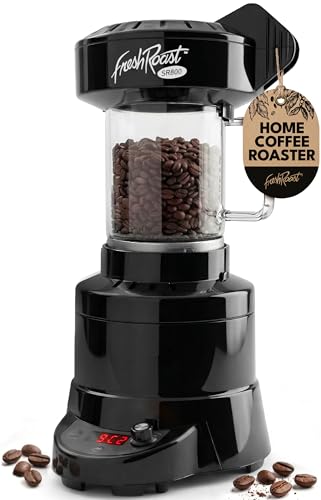
The Fresh Roast SR800 is a fluid-bed convection roaster built for the coffee enthusiast who wants granular control over every roast variable. Its speed-roast system uses a powerful fan to suspend beans in a hot air column, completing batches of 170 to 226 grams in under ten minutes. The digital display shows real-time temperature, and you adjust heat and fan speed across nine levels each by pushing and turning the central knob — a tactile interface that rewards practice and note-taking. Because you can change the default start settings, repeatable profiles for specific bean origins are achievable once you dial in the curve.
The small batch size is intentional: limiting the load to roughly six to eight ounces ensures that every bean receives the same convective heat exposure, eliminating the baked spots common in overloaded stir-crazy machines. The SR800 handles any green bean — wet-processed, decaf, organic, or fair-trade — and the fluid motion keeps chaff separated and caught in a top collector. You hear first crack clearly through the glass chamber, and you can drop the batch seconds after second crack if you prefer a dark roast without scorched oils.
This machine is listed at under , which places it in the premium tier for home roasters, but the level of repeatability and the speed of roasting justify the investment for someone roasting two to three times per week. It is a USA-based company with responsive customer service, and the SR800 has a strong community of users sharing roast logs online, which shortens the learning curve significantly.
Why it’s great
- Nine-level independent heat and fan control for precise profiling
- Fast roast times under ten minutes per batch
- Strong online community with shared roast profiles
Good to know
- Maximum batch size of 226g may be too small for heavy daily consumption
- Fluid-bed roasts produce brighter cups; not the best for traditional dark Italian profiles
2. MAGO MAGA Roma Pro Coffee Bean Roaster
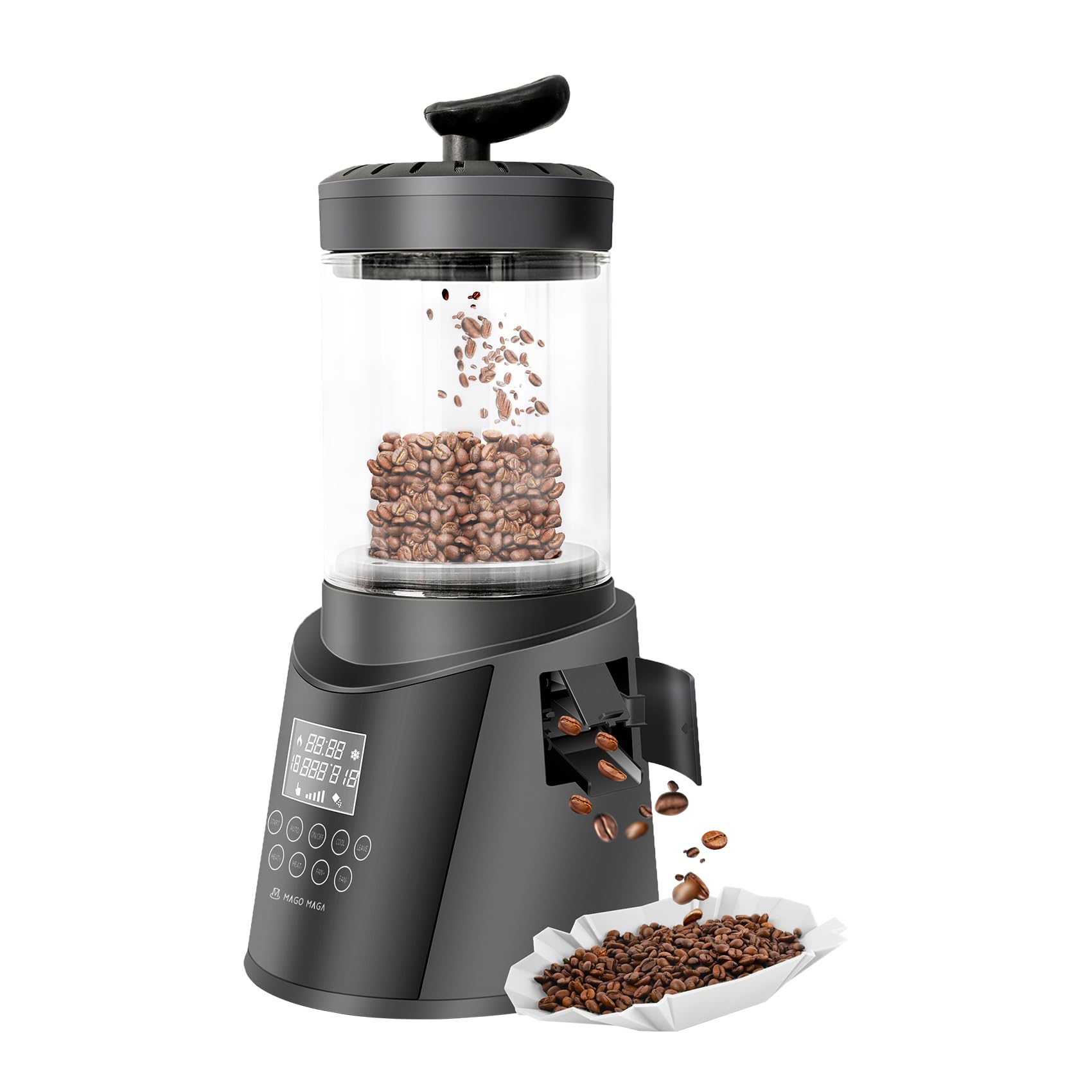
The Roma Pro is a smart fluid-bed roaster that bridges the gap between push-button automation and hands-on manual profiling. It handles up to 300 grams of green beans per batch — a meaningful step up from the Fresh Roast SR800 — and features a clear digital display that toggles between Celsius and Fahrenheit with a switch. The unit earned a 2025 SCA Best New Product Award, and the version 1.5 upgrade improved the bean bin door switch reliability for smoother operation. In auto mode, the machine follows a pre-set roast curve that works well for most standard green beans, while manual mode unlocks full control over temperature and airflow for experienced roasters wanting to build custom profiles for dense or decaf beans.
The double-layer glass viewing window gives you a real-time look at bean color changes, and the auto-cooling cycle kicks in immediately after the roast ends, dropping bean temperature rapidly to lock in flavor and aroma. The ultra-low smoke claim holds up well due to the efficient hot air circulation and the included chaff collector, which separates most of the silverskin before it can burn. Because the smoke output is minimal, this roaster is more forgiving for indoor use without needing a vent pipe.
At roughly , the Roma Pro sits in the premium tier, but the 300-gram capacity and dual-mode operation make it a strong contender for the home roaster who wants to grow from automatic to manual without buying a second machine. It only roasts green coffee beans — it is not a coffee maker — and the glass components are not dishwasher safe, but the chamber wipes clean easily with a damp cloth.
Why it’s great
- Auto mode for consistent beginner results and manual mode for advanced profiling
- 300g batch size fits most weekly consumption patterns
- Very low smoke output compared to drum roasters
Good to know
- Higher price point may feel steep for casual users
- Not recommended for roasting decaf in auto mode
3. DYVEE KAKA-G400 Coffee Roaster

The KAKA-G400 is a gas-fired drum roaster that appeals to purists who want the classic conductive roasting method. The drum is made of transparent quartz glass, so you watch the beans tumble and change color from green to yellow to brown under direct burner heat. The stainless steel frame and base combined with a wooden handle give it a professional look, and the recommended batch size of 200 to 300 grams aligns with what most home users roast in a single session. A 12-volt motor turns the drum, keeping the beans in constant motion to avoid scorching, and the gas burner allows you to adjust the flame intensity visually.
The process is simple: load the beans, light the burner, and monitor the color while listening for first and second crack. The quartz drum conducts heat differently than a metal drum, producing a slightly more even roast profile because the glass does not have hot spots as pronounced as thin steel. The machine comes with a funnel, power adapter, and manual, and the complete package weighs 17 pounds, meaning it sits solidly on a counter without walking during operation. Because it uses a gas burner, smoke output is higher than fluid-bed models, so you should use this roaster near a range hood or in a well-ventilated area.
Priced at approximately , the KAKA-G400 sits in the mid-range tier. It is not the machine for someone who wants a digital display or programmable profiles, but it is a durable, repairable option for the roaster who enjoys the hands-on ritual of gas flame control. The chaff collects at the bottom of the drum and can be brushed out after each batch.
Why it’s great
- Transparent quartz drum provides clear visual of the entire roast cycle
- Gas burner offers immediate, visible heat adjustment
- Solid stainless steel construction adds counter stability
Good to know
- Requires a gas source and good ventilation for smoke
- No digital temperature display; relies on visual and auditory cues
4. Precision PKF-500 Coffee Roaster
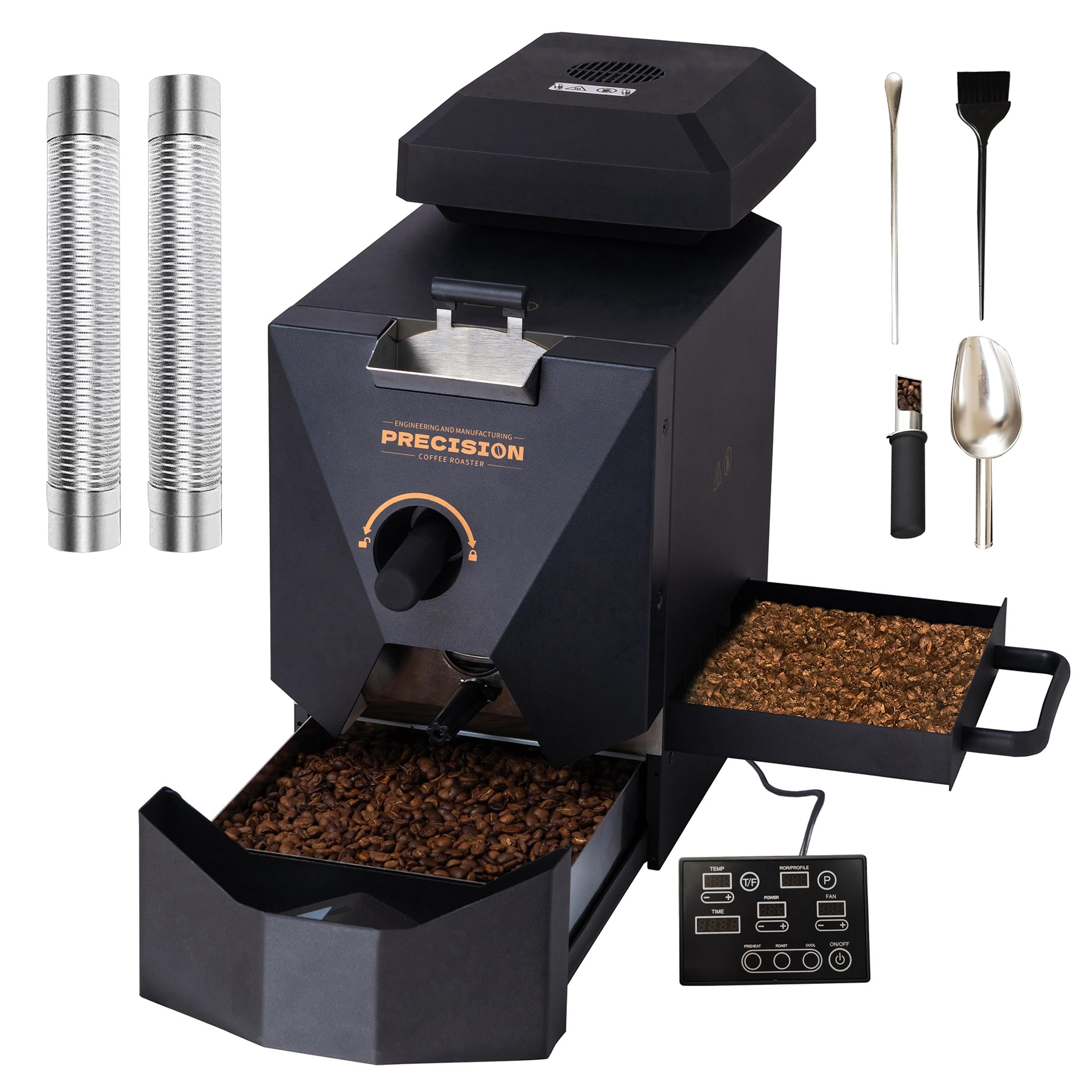
The Precision PKF-500 is a fully automatic electric drum roaster with a 1-pound (454-gram) capacity, built for users who want a mix of convenience and environmental control. It offers three operation modes: automatic, assisted, and manual, allowing you to progress from hands-off consistency to full control over the roast curve as your skills develop. The integrated smoke filter and dual chimney tube system route exhaust outside or through the filter, which significantly reduces indoor smoke compared to an open gas drum. A touchscreen interface handles the programming, and the observation window plus sample spoon let you check bean progress without interrupting the cycle.
The 1-pound capacity makes it the largest batch size among the products on this list, suitable for households that go through several cups daily or for small-scale gifting. The stainless steel construction and microfilter system are designed for durability and easy cleaning, though the filter needs periodic replacement. The machine is not recommended for commercial use, but it handles most green bean types, including dense varietals that require a longer development time.
At roughly , the PKF-500 sits at the top of the price range, making it a premium investment. The automatic mode is forgiving enough for a first-time roaster, while the manual mode offers the granularity needed for serious profiling. The overall footprint of 19 by 10 by 15 inches requires dedicated counter space, and the machine weighs enough that you will not want to move it frequently.
Why it’s great
- Three operating modes let you grow from beginner to expert on one machine
- Smoke filter and vent pipes keep indoor air clean
- Full-pound batch capacity for heavy coffee drinkers
Good to know
- Large footprint and heavy build require dedicated counter space
- Filter replacement adds ongoing maintenance cost
5. ANGELLOONG Upgrade Coffee Roaster 750g

The ANGELLOONG Upgrade model is a stir-crazy style roaster that uses a motorized agitator rod to tumble beans inside a heated chamber with a honeycomb non-stick bottom. The 1200-watt heating element can reach temperatures up to 240°C (464°F), and the 0-to-60-minute timer lets you set a duration and walk away. The recommended roasting load is 300 to 500 grams, though the chamber can hold up to 750 grams of green beans. A transparent lid with venting holes allows you to watch the color change and smell the aromas as the beans progress through the roast stages.
The wide temperature adjustability means you can dial in a profile from a very light cinnamon roast at around 180°C to a dark French roast near the max temperature. The non-stick base makes cleanup manageable with a damp cloth, though the agitator rod occasionally catches very small or broken beans, so pre-sorting green beans is recommended. This machine also handles peanuts, barley, popcorn, and dried fruit, making it a multi-purpose tool if you want to experiment beyond coffee.
At about , this roaster lands in the mid-range tier and delivers high capacity for the price. The lack of fan control means you rely entirely on temperature setting and batch size to manage heat transfer, which is less precise than a fluid-bed system but perfectly workable once you learn the machine’s thermal behavior. It is a solid choice for the home roaster who wants to roast larger batches without spending into the premium tier.
Why it’s great
- High 750g maximum capacity for big-batch roasting
- Timer and wide temperature range give useful control
- Multi-purpose for nuts, grains, and popcorn
Good to know
- Agitator rod can bind on small or irregular beans
- No fan control limits profiling precision
6. ANGELLOONG Coffee Roaster 750g

This ANGELLOONG model shares the same 1200-watt base platform and 750-gram maximum capacity as its Upgrade sibling but comes at a slightly lower entry price. The controls are straightforward: a thermostat dial from 100 to 240°C and a 0-to-60-minute timer. The honeycomb non-stick chassis and black food-grade Teflon layer promote even heating, and the heat-resistant transparent cover with a four-hole ventilation system lets you monitor progress without lifting the lid. The handles are thickened and widened on both sides to stay cool during operation.
The agitator rotates the beans continuously, and the professional thermostat maintains the set temperature automatically. For a beginner, the simplicity is an advantage — set the dial, start the timer, and listen for first crack around the 12-to-18-minute mark depending on bean density. The machine can also roast peanuts, chestnuts, barley, and dried fruit, adding versatility for someone who wants to try roasting other ingredients. Cleaning the honeycomb bottom with a damp cloth is straightforward as long as you do not let oils build up over many batches.
Priced around , this is one of the most accessible electric roasters with a 750-gram capacity. The biggest trade-off is the lack of fan speed adjustment and the reliance on a single agitator speed, which can lead to less even results when you push above the recommended 500-gram sweet spot. For small to medium batches, it performs reliably well for the cost.
Why it’s great
- Very affordable for the 750g capacity
- Simple dual-dial operation works well for beginners
- Honeycomb bottom heats evenly and is easy to wipe clean
Good to know
- Single agitator speed cannot compensate for uneven bean sizes
- No viewing window; you must lift the lid to check color closely
7. JIAWANSHUN 800g Coffee Roaster (with Timer)

The JIAWANSHUN upgraded model adds a timer to the same basic platform as the 800-gram stir-crazy design. The temperature range covers 100 to 240°C, and the 1200-watt element brings the chamber up to temperature quickly. The transparent glass lid with four ventilation holes lets you observe the beans and smell the evolving aroma, and the honeycomb non-stick interior cleans with a damp cloth. The automatic mixing stirrer rotates the beans constantly, and the manufacturer recommends a 300-to-500-gram load for the most even results.
The inclusion of a separate timer is a meaningful upgrade over simpler models because it lets you set a target duration and focus on listening for first and second crack without watching a clock. The machine also handles peanuts, sunflower seeds, almonds, and popcorn, making it a versatile countertop appliance. The external dimensions are compact enough at 13 by 13 by 7 inches that it fits under most upper cabinets.
At roughly , this roaster sits at the very top of the budget-friendly tier. It cannot match the profiling precision of a fluid-bed machine, but for less than one hundred dollars, it provides a functional path into home roasting. The agitator rod can still jam on very small beans, so pre-sorting remains important, but for the price, the value is strong for an entry-level machine.
Why it’s great
- Timer adds convenience for hands-off roasting
- Compact footprint fits small kitchens
- Multi-purpose roasting for nuts and seeds
Good to know
- Batches under 300g may roast unevenly
- Plastic and glass build does not feel as durable as metal alternatives
8. GIVEROO 500g Coffee Bean Roaster

The temperature range still covers 0 to 240°C, and the stir-crazy agitator mechanism rotates the beans inside the honeycomb chamber. With a recommended maximum batch size of around 500 grams, this machine is best suited for a single person or a couple who roasts once a week. The smaller wattage means the chamber takes slightly longer to reach target temperature and recover heat after loading cold beans, so you may need to preheat for a few minutes before adding the green coffee.
The manufacturer markets this as suitable for both home and commercial-grade use, though the 800-watt element and plastic base suggest it is better suited for light home duty. The glass lid provides a clear view of the bean color, and the honeycomb bottom makes cleaning easy. Because the wattage is lower, you need to be more patient during the drying phase — the first few minutes when beans shed moisture before yellowing — but the result is still drinkable, fresh coffee.
Priced at about , the GIVEROO competes directly with the basic JIAWANSHUN model. The lower wattage is a real limitation if you want to roast back-to-back batches because thermal recovery is slow, but for occasional use, it gets the job done affordably.
Why it’s great
- Very low price point for entry into home roasting
- Clear glass lid simplifies visual monitoring
- Compact dimensions fit small countertops
Good to know
- 800W element results in slower heat-up and recovery between batches
- Lower build quality compared to metal-frame alternatives
9. JIAWANSHUN Electric Coffee Roaster 800g (Basic)

The basic JIAWANSHUN model is the least expensive option in the lineup, offering the same 1200-watt heating element and 0-to-240°C temperature range as its upgraded sibling but without a built-in timer. The white plastic body holds a honeycomb non-stick pan, and the transparent glass cover with four ventilation holes lets you watch the beans as they roast. The automatic mixing rod rotates the beans continuously, and the manufacturer recommends loading 300 to 500 grams for even results. Smaller loads than 300 grams risk uneven roasting because the agitator cannot distribute heat uniformly across a sparse bed of beans.
The lack of a timer means you need to track roasting duration manually, which is fine for an attentive beginner but makes it harder to repeat a specific profile consistently. The machine also handles nuts, peanuts, melon seeds, and popcorn, adding some utility. Cleaning the honeycomb bottom with a damp cloth is simple, and the overall operation is straightforward plug-in-and-go.
At about , this is the absolute entry point for home coffee roasting. The build quality is basic — plastic and glass — but the 1200-watt heating element provides enough power to reach roasting temperatures quickly. If you are on a tight budget and simply want to taste a fresh roast without any frills, this machine will get you there, though you will likely outgrow it once you want to dial in specific profiles.
Why it’s great
- Lowest price for an electric coffee roaster with 1200W power
- Honeycomb non-stick bottom is simple to wipe clean
- Transparent cover lets you watch the roast cycle
Good to know
- No timer requires you to manually track roast duration
- Plastic and glass construction feels less durable than metal options
- Inconsistent results with batches under 300g
FAQ
Can I use a coffee roaster for other types of beans or grains?
How long does a typical home roasting session take from start to cool-down?
What is the difference between first crack and second crack in terms of flavor?
Final Thoughts: The Verdict
For most users seeking a coffee roaster, the winner is the Fresh Roast SR800 because its nine-level fan and heat controls deliver repeatable, fast fluid-bed roasts that unlock bright, clean flavor profiles while keeping the learning curve manageable through a strong online community. If you want a smart machine that handles auto and manual modes with ultra-low smoke, grab the MAGO MAGA Roma Pro. And for the traditionalist who prefers a gas-heated quartz drum and the hands-on ritual of flame adjustment, nothing beats the DYVEE KAKA-G400.