A chef knife under $200 is the sweet spot where performant blade geometry and quality fitment meet a realistic budget. Too far below that threshold, and you risk a stamped blade with poor edge retention and an unbalanced handle. Above it, you start paying for branding, exotic handle materials, and diminishing returns on cutting performance. This buying guide cuts through the noise to find the eight-inch blades that deliver genuine professional-level cutting, lasting sharpness, and ergonomic comfort without breaking the bank.
I’m Mohammad Maruf — the founder and writer behind AirfryerBite. I’ve spent years analyzing kitchen steel specifications, studying blade metallurgy reports, and cross-referencing thousands of user experiences to understand exactly what separates a solid mid-range chef knife from a regrettable purchase.
Whether you’re a home cook upgrading from a starter block or a line cook building a personal kit, finding a reliable chef knife under $200 requires focusing on the steel type, the blade construction method, the handle ergonomics, and the overall balance of the finished tool.
How To Choose The Best Chef Knife Under $200
Selecting an eight-inch chef knife in this price range means balancing material quality, construction method, and handle ergonomics against value. Focus on the three criteria that differentiate a long-lasting workhorse from a blade that will need replacing within a year.
Blade Steel And Rockwell Hardness
The steel type determines how often you need to sharpen and how easily the edge can be restored. In this bracket, you will encounter VG10 stainless steel, high-carbon German steel like X50CrMoV15, and Damascus super steels with a high-carbon core. Look for a Rockwell hardness rating between 58 and 64 HRC. Harder steel (60+ HRC) holds an edge longer but is more brittle and harder to sharpen without proper stones. Softer steel (56-58 HRC) is tougher, less prone to chipping, and easier to sharpen on a steel rod. Choose based on whether you prefer less frequent sharpening or more forgiving maintenance.
Blade Construction: Forged vs. Stamped
Fully forged blades are shaped from a single rod of steel under heat and pressure, creating a denser grain structure and a thicker bolster area that improves balance. Stamped blades are cut from a sheet of steel, which reduces cost but often results in a lighter, less balanced tool. At this price point, most quality options are fully forged. Check for a full tang — the steel runs the entire length of the handle — as this provides better weight distribution and durability.
Handle Material And Ergonomics
The handle is your primary point of contact during hours of prep. Wood handles like pakkawood, olive wood, and rosewood offer a warm, secure grip that molds to your hand over time. Synthetic handles like G10 provide excellent chemical resistance, durability in wet environments, and a textured grip that does not swell. Avoid handles that feel too thick or too thin in your palm. The handle shape — rounded, D-shaped, or octagonal — affects how naturally the knife sits in a pinch grip or a full grip.
Quick Comparison
On smaller screens, swipe sideways to see the full table.
| Model | Category | Best For | Key Spec | Amazon |
|---|---|---|---|---|
| Shun Classic 8″ Kiritsuke | Premium | Razor-sharp precision cutting | VG-MAX steel with 68-layer Damascus cladding | Amazon |
| Made In 8″ Chef Knife | Premium | Versatile daily workhorse | X50CrMoV15 stainless steel, full tang, 2 mm blade thickness | Amazon |
| KAWAHIRO VG10 Gyuto | Premium | Japanese craftsmanship and aesthetic | VG10 core with 3-layer composite steel | Amazon |
| Dalstrong Gladiator Elite Kiritsuke | Mid-Range | High-carbon German steel with heft | Forged High Carbon German Steel, 56+ HRC | Amazon |
| HOSHANHO Damascus Chef Knife | Mid-Range | Damascus pattern with high hardness | 67-layer Damascus super steel, 62-64 HRC | Amazon |
| KYOKU Shogun Series | Budget | Japanese-style entry under budget | VG10 steel core, hammered Damascus finish | Amazon |
| Victorinox Wood 8″ Chef’s Knife | Budget | Affordable swiss-made entry point | Stainless steel blade, maple wood handle | Amazon |
In‑Depth Reviews
1. Shun Classic 8″ Kiritsuke Knife

The Shun Classic 8-inch Kiritsuke sits at the ceiling of this price bracket, and for good reason. Its VG-MAX steel core and 68 layers of Damascus cladding produce a blade that glides through dense squash, ripe tomatoes, and raw protein with minimal resistance. The 16-degree edge angle is ground symmetrically, which means left-handed users get the same performance as right-handed cooks. The blade height offers excellent knuckle clearance, making rock-chopping comfortable even during long prep sessions.
The D-shaped Pakkawood handle is a defining feature — it fills the palm naturally and provides a secure grip whether you use a pinch grip or a full handle grip. Shun includes a lifetime warranty and free sharpening service, which adds significant long-term value. The blade is handcrafted in Japan, and the attention to detail in the Damascus finish is visually striking without feeling gaudy. It is a knife that performs as well as it looks on a magnetic strip.
At roughly 8 ounces, the knife feels nimble but not flimsy. The full-tang construction delivers balanced weight distribution that reduces hand fatigue. The only real consideration is that the harder steel (approximately 61 HRC) requires a ceramic or diamond sharpening rod rather than a standard steel — but the edge lasts noticeably longer between sharpening sessions than softer German blades.
Why it’s great
- Razor-sharp 16-degree edge from the factory with exceptional edge retention.
- 68-layer Damascus cladding provides both visual appeal and added corrosion resistance.
- Comfortable D-shaped Pakkawood handle fits left and right hands equally well.
Good to know
- Harder steel requires a ceramic or diamond sharpener — standard steel rods will not work effectively.
- Not dishwasher safe; hand washing and drying is required to maintain the Pakkawood handle.
2. Made In Cookware 8″ Chef Knife
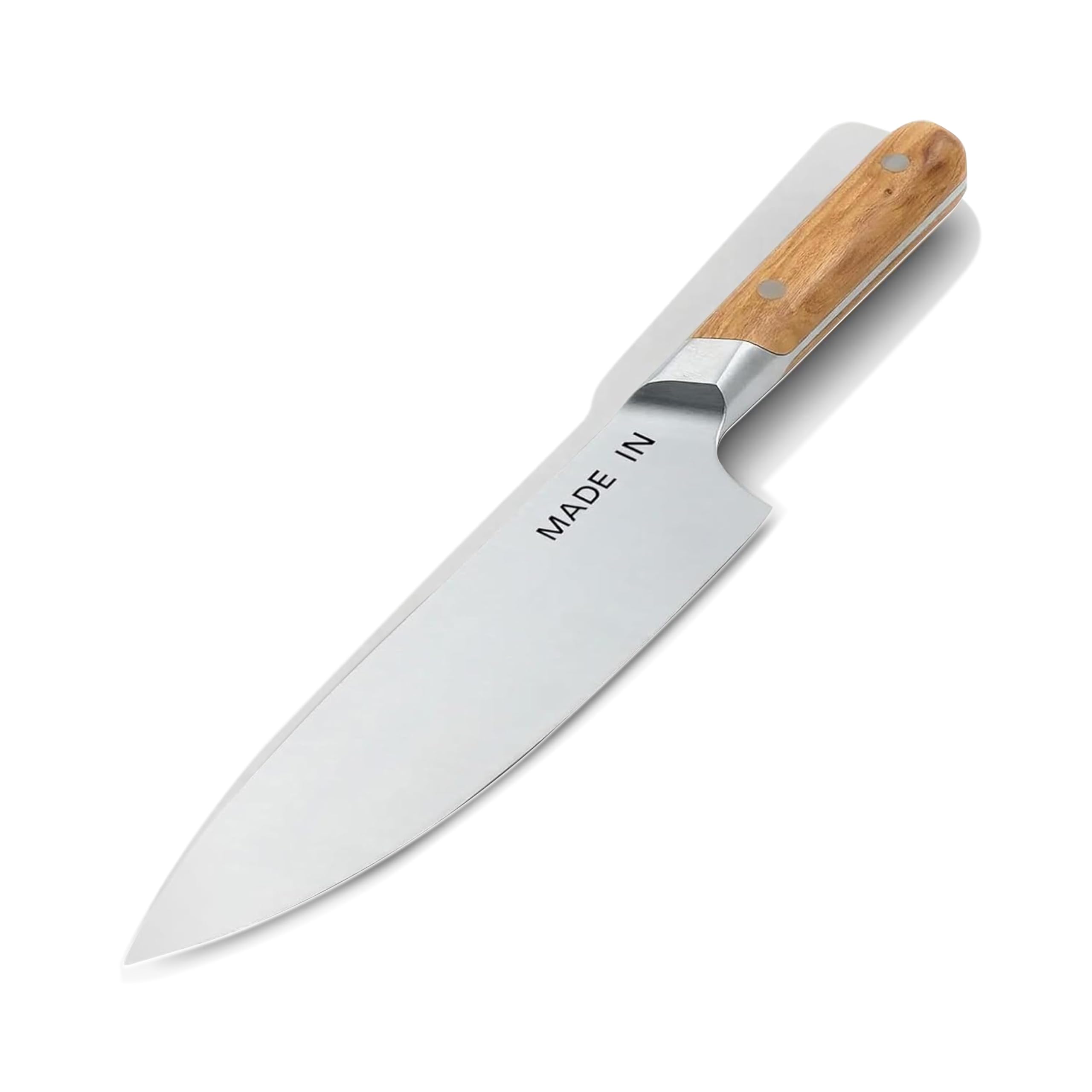
Made In has built a reputation on direct-to-consumer professional cookware, and their 8-inch chef knife follows that same philosophy — high-end materials without the distributor markup. The blade is nitrogen-treated X50CrMoV15 stainless steel, forged in Thiers, France by a fifth-generation bladesmith. The nitrogen treatment increases stain resistance and hardness compared to standard X50CrMoV15, bringing the Rockwell rating to approximately 58-60 HRC. The 8.5-inch blade length provides a useful extra half inch of cutting surface compared to standard eight-inch chef knives.
The full-tang design is paired with an olive wood handle that is both comfortable and durable. Olive wood has natural oils that resist moisture absorption, but it requires occasional oiling to keep it from drying out over years of use. The blade height of 1.96 inches offers ample knuckle clearance, and the 2 mm thickness strikes a good balance between nimble slicing and sturdy chopping through dense ingredients like butternut squash. The knife arrives with a beautifully balanced feel right out of the box.
This knife excels in versatility — it handles dicing onions, slicing bell peppers, and mincing herbs with equal precision. The slightly softer steel means it responds well to honing on a standard steel rod, making it more forgiving for cooks who prefer quick touch-ups between sharpening sessions. The olive wood handle has a warm, natural feel that develops a patina over time. It is a knife that fits comfortably in a home kitchen or on a professional line.
Why it’s great
- Nitrogen-treated X50CrMoV15 steel offers improved stain resistance and edge retention over standard German steel.
- Forged in Thiers, France — genuine heritage craftsmanship with a modern heat treatment process.
- Full-tang construction with olive wood handle provides excellent balance and a warm, secure grip.
Good to know
- Olive wood handle requires occasional mineral oil treatment to prevent drying and cracking.
- Factory edge is very good but not as aggressively sharp as some Japanese competition at the same price.
3. KAWAHIRO Japanese Chef Knife 8″ Gyuto
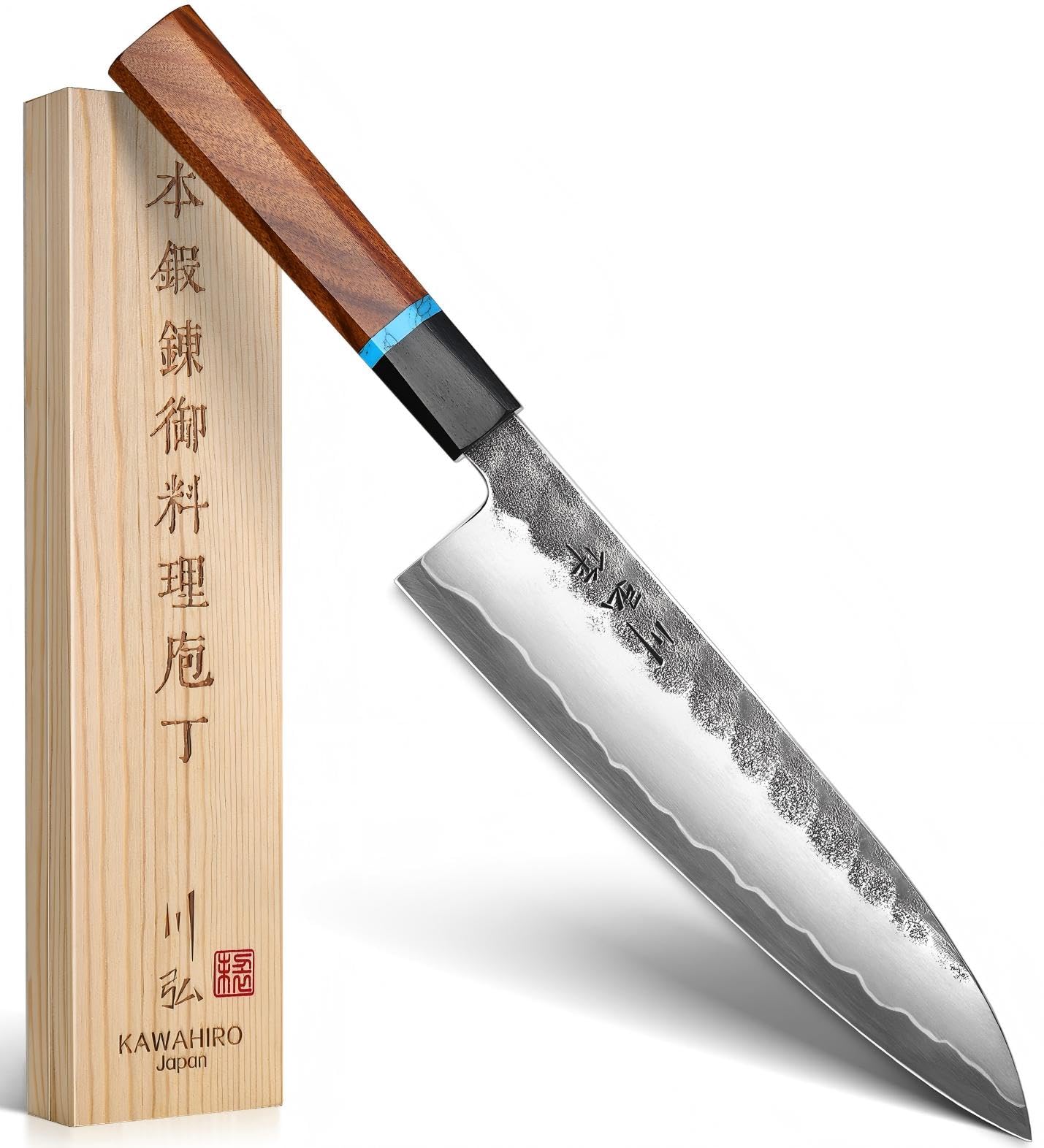
The KAWAHIRO 8-inch Gyuto is a striking example of Japanese knife-making artistry at a mid-premium price. The blade is forged from three-layer composite steel with a VG10 stainless steel core, providing a Rockwell hardness in the 60-62 HRC range — ideal for razor-sharp, long-lasting edges. The black forged finish gives the blade a distinctive, textured look that also reduces food sticking. The blade has a classic gyuto profile with a slight curve that accommodates both push-cutting and rock-chopping techniques.
The handle is the most unique feature of this knife. It is constructed from premium ruby wood, turquoise, and ebony — an eye-catching combination that is also functional. The mixed materials create a dense, stable handle with natural grip texture. The octagonal shape fits comfortably in a pinch grip and prevents the knife from rolling on a cutting board. The included premium gift box and certificate of authenticity make this a strong candidate for gifting, but the performance justifies the purchase for personal use.
Out of the box, the edge is extremely sharp — it easily cleanly slices through bell peppers, paper-thin garlic slices, and raw salmon without tearing. The VG10 core holds its edge significantly longer than softer German steels, though it requires a ceramic rod or water stone for sharpening. The blade is lightweight and nimble, making it excellent for precision work. The only trade-off is that the decorative handle materials require careful maintenance — avoid soaking and always dry immediately after washing.
Why it’s great
- VG10 core with three-layer composite construction delivers exceptional edge retention and sharpness.
- Octagonal handle made from ruby wood, turquoise, and ebony provides a secure, comfortable grip with unique aesthetics.
- Elegant gift box packaging with certificate of authenticity makes it a standout present for serious cooks.
Good to know
- Multi-material handle requires careful hand washing and immediate drying to preserve the natural components.
- Hard VG10 steel requires specialized sharpening tools — standard steel rods will not effectively maintain the edge.
4. Dalstrong Gladiator Elite Kiritsuke 8.5″

Dalstrong has carved out a reputation for delivering high-specification knives at competitive prices, and the Gladiator Series Elite Kiritsuke is a strong example. The 8.5-inch blade is forged from high-carbon German steel (X50CrMoV15), heat-treated to a Rockwell hardness of 56+ HRC. The edge is hand-polished to 14-16 degrees per side, resulting in a razor-sharp factory edge that handles everything from brunoise to large cuts. The blade features a satin finish with a subtle taper that reduces resistance during slicing.
The G10 handle is a standout feature for durability. G10 is a glass-fiber epoxy laminate that is incredibly tough, chemically resistant, and does not swell or shrink with humidity changes. It is the same material used in high-end firearm grips. The handle is triple-riveted and full-tang, providing excellent balance and confidence during heavy use. The kiritsuke profile offers a flat profile near the tip for precision cuts and a curved belly for rock-chopping — a versatile compromise between a gyuto and a traditional kiritsuke.
This knife is NSF certified, meaning it is designed to withstand the rigors of commercial kitchens. The high-carbon German steel is more forgiving than hard Japanese steels — it can be honed back to sharpness quickly on a steel rod and is less likely to chip if it contacts a cutting board edge or bone. The blade is relatively thick, giving it a satisfying heft that works well for breaking down large vegetables or semi-frozen ingredients. The included sheath protects the edge during storage.
Why it’s great
- NSF certified for commercial kitchen use — built to withstand high-volume daily wear and tear.
- G10 handle offers superior chemical resistance and durability compared to wood handles in wet environments.
- 56+ HRC hardness strikes a practical balance between edge retention and easy sharpening on standard steel rods.
Good to know
- Heavier than most Japanese-style knives — not ideal for cooks who prefer a very lightweight, nimble blade.
- Factory edge is very sharp but may require a quick honing out of the box to reach peak sharpness for precision work.
5. HOSHANHO 8″ Damascus Chef Knife

The HOSHANHO 8-inch Damascus Chef Knife offers an aggressive specification sheet at a mid-range price point. The blade is constructed from 67 layers of Damascus super steel, with a 10Cr15CoMoV steel core. This is a high-carbon steel formulation that, after proper heat treatment, reaches a Rockwell hardness of 62-64 HRC. That is a very hard blade that will hold a sharp edge through extended prep sessions without frequent touch-ups. The Damascus pattern is visually striking with clearly defined wave layers.
The handle is made from frosted glass fiber G10, which provides excellent grip even when hands are wet or oily. The wax-polished finishing process gives the G10 a slightly textured surface that is comfortable without being abrasive. The handle is molded to fit the hand naturally, with a subtle finger groove that aids in consistent blade orientation. The blade thickness is 2.2 mm, which is thin enough for clean slicing through dense produce but thick enough to feel sturdy during chopping.
The edge is hand-honed to a 12-degree angle on each side, delivering a very acute cutting angle that excels at push-cutting and slicing. The hardness means that this steel will chip if misused on bones, frozen food, or hard cutting surfaces — it requires a wooden or plastic cutting board. The included gift box presentation makes it a strong gifting option. At this price point, the combination of 62-64 HRC hardness and G10 handle is rare and represents genuine value for cooks who prioritize edge retention.
Why it’s great
- Very hard 62-64 HRC steel provides excellent edge retention — sharpening frequency is significantly reduced.
- 67-layer Damascus construction with 10Cr15CoMoV core delivers a sharp, durable blade with beautiful aesthetics.
- Frosted G10 handle offers a secure, non-slip grip with excellent chemical and moisture resistance.
Good to know
- Extremely hard steel is more brittle — avoid using on bones, frozen ingredients, or glass cutting boards.
- Requires diamond or ceramic sharpening equipment; standard steel honing rods will not effectively sharpen the edge.
6. KYOKU Shogun Series Chef Knife 8″

The KYOKU Shogun Series 8-inch Chef Knife brings a Japanese-inspired aesthetic with a VG10 steel core to a budget-friendly price point. The blade features a hammered Damascus finish, which is not only visually appealing but also reduces food sticking to the blade during slicing. The VG10 core provides a good balance of hardness (approximately 60-61 HRC) and corrosion resistance, making it suitable for cooks who want Japanese-style performance without moving into three-figure pricing.
The blade is paired with a synthetic handle that is shaped for comfort. While the handle material is not specified as a premium wood or G10, it is ergonomically designed with a slight curve that fits the palm. The knife includes a matching sheath for safe storage and a gift box for presentation. The blade length is a true 8 inches, making it suitable for most standard cutting tasks from dicing to slicing.
Performance-wise, the KYOKU Shogun delivers good out-of-the-box sharpness that will handle daily meal prep without issue. The VG10 core holds its edge noticeably longer than budget stainless steel knives but does not require the specialized sharpening equipment that harder Japanese blades demand — a standard ceramic rod will maintain the edge well. The hammered finish helps with food release, particularly for starchy vegetables like potatoes and for raw protein. The knife is best suited for home cooks looking to upgrade from a block set with an eye-catching design.
Why it’s great
- VG10 steel core provides genuine Japanese edge retention at a budget-friendly price point.
- Hammered Damascus finish reduces food sticking and adds visual interest to the blade.
- Includes a matching sheath for safe drawer storage.
Good to know
- Handle material is not as premium as wood or G10 — may feel less substantial in hand than higher-priced options.
- Factory edge may benefit from a quick touch-up with a ceramic rod before first use for peak sharpness.
7. Victorinox Wood 8″ Chef’s Knife

The Victorinox Wood 8-inch Chef’s Knife is the budget anchor of this list, but it carries a reputation that punches above its weight. Victorinox has been making professional kitchen tools since 1884, and their Fibrox line is legendary in culinary schools and commercial kitchens. This wood-handled version upgrades the standard Fibrox handle to a maple wood handle while keeping the same reliable stainless steel blade. The blade is stamped, not forged, which keeps the cost low while still delivering a sharp, functional cutting edge.
The maple handle is ergonomically shaped with a subtle curve that fits comfortably in the hand. The wood is sealed and polished, providing a warm, natural feel that is a significant step up from the standard black synthetic handle. The blade is 8 inches long with a plain edge, making it suitable for all standard chef knife tasks. The knife is lightweight at 0.1 kg, which reduces fatigue during long prep sessions but also means it lacks the heft of heavier forged knives. The steel is relatively soft, which makes it easy to sharpen on a standard steel rod.
This knife is not designed to compete with the VG10 or high-carbon German steel options above it in edge retention or hardness. Instead, it excels as a reliable, lightweight, and easily maintained workhorse. The blade is stamped, so it is thinner and more flexible than forged options, which can be an advantage for tasks like filleting or slicing thin cuts. The maple handle is not dishwasher safe, and the wood requires occasional oiling to maintain its appearance. For a cook on a tight budget who prioritizes easy maintenance and Swiss quality, this is a solid choice.
Why it’s great
- Swiss-made quality from a heritage brand trusted by professional kitchens worldwide.
- Lightweight design reduces hand fatigue during extended prep sessions.
- Soft stainless steel edge is easy to maintain and sharpen with a standard steel rod.
Good to know
- Stamped blade lacks the heft and balance of forged knives — may feel less substantial for heavy chopping.
- Softer steel requires more frequent honing to maintain peak sharpness compared to harder Japanese blades.
FAQ
What is the ideal Rockwell hardness for an 8-inch chef knife under $200?
Can I use a VG10 chef knife on a glass cutting board?
What is the difference between a stamped and a forged chef knife?
Final Thoughts: The Verdict
For most users, the chef knife under $200 winner is the Shun Classic 8″ Kiritsuke because it delivers a razor-sharp VG-MAX steel core, 68-layer Damascus cladding, and an ergonomic D-shaped handle that suits both left and right hands, backed by a lifetime warranty and free sharpening service. If you want a versatile workhorse with a warm olive wood handle made in France, grab the Made In 8″ Chef Knife. And for a budget-friendly entry point with Swiss heritage and easy maintenance, nothing beats the Victorinox Wood 8″ Chef’s Knife.