That factory-stamped blade from the big-box store loses its edge after a dozen dinners, forcing you to fight with onions and tomatoes. A true handmade chef knife changes that — each blade is forged, layered, and ground by artisans who treat steel like a medium, not a material. The difference is measurable: better edge retention, a balanced feel in hand, and a cutting experience that turns prep work into a deliberate act.
I’m Mohammad Maruf — the founder and writer behind AirfryerBite. I spend my time analyzing blade metallurgy, handle ergonomics, and forging techniques across the mid-range to premium spectrum so you can buy with genuine confidence.
This guide cuts through the marketing noise to focus on the real specs that matter — steel hardness measured in HRC, layer counts that define Damascus patterns, and handle materials that survive years of daily use — to help you find the absolute best handmade chef knives for your kitchen and your budget.
How To Choose The Best Handmade Chef Knives
A handmade chef knife is a long-term investment in your cooking workflow, so choosing the wrong one means years of frustration rather than years of precise cuts. Focus on four specific attributes that separate artisan blades from stamped alternatives.
Steel Core and HRC Hardness
The core steel determines how long the edge stays sharp and how easily it can be honed. VG10 high-carbon stainless steel is the most common premium core, delivering a Rockwell hardness between 60 and 62 HRC. That range sits well above entry-level knives (typically 52 to 56 HRC), which means you go weeks between sharpenings rather than days. For even higher performance, Sg2 micro-carbide powder steel hits 63 HRC and holds a finer edge, but it costs more and requires careful handling to avoid chipping.
Folding, Layering, and Real Damascus
Real Damascus steel is created by forge-welding multiple layers of carbon steel and stainless steel, then folding and hammering them until a visible pattern emerges. A genuine Damascus blade typically has 16 to 67 layers. Laser-etched patterns, by contrast, are chemically applied to a single slab of steel and offer no structural benefit. If you see a “Damascus pattern” on a thirty-dollar knife, it is almost certainly etched. Real Damascus improves toughness and creates micro-serrations along the edge that aid slicing.
Handle Material and Ergonomics
The handle is where your hand meets the blade every single time you cook. G10 glass-fiber handles offer superior grip when wet and will not crack or swell over time. Pakkawood is a resin-impregnated hardwood that combines the feel of natural wood with water resistance. Octagonal Japanese-style handles — made from ebony, rosewood, or cinnamon wood — provide better rotational control during precision cuts. Avoid hollow plastic handles, which create an unbalanced knife and trap moisture after washing.
Edge Angle and Sharpening Method
The edge geometry directly affects cutting effort. Most Western knives are ground to a 20-degree angle per side. Handmade Japanese knives often use a 15-degree or even 9.5- to 12-degree angle, achieved through the Honbazuke three-step sharpening process. A narrower angle slices through vegetables with less downward force, but it requires a whetstone for maintenance — never a pull-through sharpener, which can ruin the edge profile.
Quick Comparison
On smaller screens, swipe sideways to see the full table.
| Model | Category | Best For | Key Spec | Amazon |
|---|---|---|---|---|
| Miyabi Artisan 8-Inch | Premium | Hardcore edge retention | Sg2 powder steel / 63 HRC | Amazon |
| Miyabi Kaizen 8-Inch | Premium | Traditional Japanese profile | VG10 Cryodur / 60 HRC | Amazon |
| Yoshihiro VG10 Santoku 7-Inch | Mid-Range | Versatile all-purpose cutting | 16-layer hammered Damascus | Amazon |
| KAWAHIRO VG10 Chef 8-Inch | Mid-Range | Traditional black-forged finish | VG10 core / 60-62 HRC | Amazon |
| HexClad Chef’s Knife 8-Inch | Mid-Range | Modern ergonomic balance | 67-layer Damascus / 12° edge | Amazon |
| HOSHANHO 3-Piece Damascus Set | Mid-Range | Full knife set value | 10Cr15CoMoV core / 62 HRC | Amazon |
| MITSUMOTO SAKARI Kiritsuke 8-Inch | Mid-Range | Artistic handle design | 7-layer 440C Damascus | Amazon |
| HOSHANHO 3-Piece High Carbon Set | Mid-Range | Comfort grip for long sessions | 10Cr15CoMoV / 60 HRC | Amazon |
| SHAN ZU Damascus 3-Piece Set | Budget-Friendly | Entry-level Damascus set | 67-layer / 10Cr15Mov core | Amazon |
In‑Depth Reviews
1. MIYABI Artisan 8-inch Chef’s Knife
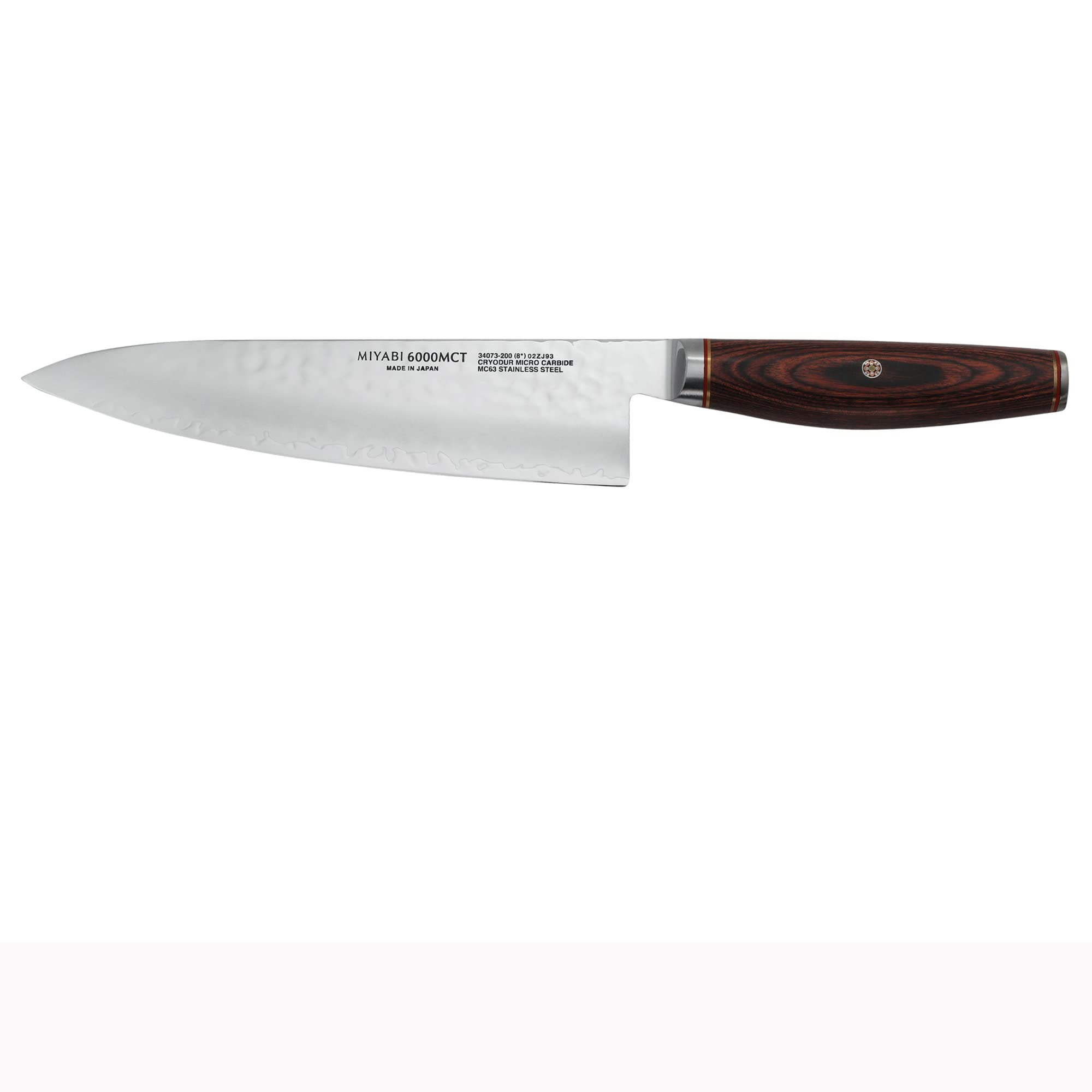
The MIYABI Artisan sits at the top of this list for a reason — it uses Sg2 micro-carbide powder steel, a material that holds a finer edge longer than standard VG10. The blade reaches a 63 HRC hardness rating, which is noticeably harder than most handmade kitchen knives and allows for a thinner edge geometry without deformation. Each blade is hand-honed using the three-step Honbazuke process, resulting in a 9.5- to 12-degree edge angle that glides through bell peppers and raw salmon with almost no resistance.
The Pakkawood handle is resin-stabilized, so it resists moisture absorption and maintains its fit over years of use. The traditional Japanese thin profile gives you precise control for detailed work like chiffonade or brunoise, while the full-tang construction keeps the knife balanced right at the pinch grip. At roughly 0.6 pounds, it feels light but not flimsy — exactly what you want for extended prep sessions.
This is not a knife for beginners who want to throw it in a dishwasher or use a pull-through sharpener. It demands whetstone maintenance and careful storage, but the payoff is a blade that outperforms nearly every production chef knife in its class. For serious home cooks and professionals who value edge geometry above all else, the Artisan is the benchmark.
Why it’s great
- Sg2 powder steel delivers exceptional edge retention at 63 HRC
- Honbazuke hand-honing produces a razor-sharp 9.5-12° edge
- Pakkawood handle is moisture-resistant and ergonomically shaped
Good to know
- Requires whetstone sharpening — pull-through sharpeners will damage the edge
- Premium pricing reflects the material and hand-finishing process
2. Miyabi Kaizen 8-Inch Chef’s Knife

The Miyabi Kaizen series uses a VG10 super steel core that undergoes a cryogenic treatment (Cryodur) to reach a Rockwell hardness of 60. That extra cold-tempering step refines the grain structure, giving the blade better wear resistance than standard VG10. The 65-layer flower Damascus cladding is functional — those layers create micro-serrations that help the knife grab and slice through tomato skins without crushing the flesh.
What sets the Kaizen apart from cheaper alternatives is the D-shaped Micarta handle. It forces your hand into a consistent pinch grip, which translates to more repeatable cuts over a long prep session. The three-step Honbazuke edge (9.5 to 12 degrees) is hand-honed in Seki, Japan, and arrives shaving-sharp out of the box. The red accent spacers and steel end cap add a visual cue that this is a serious tool, not a decorative piece.
The Kaizen does not come with a saya cover, so you will need to budget for a blade guard or magnetic strip. It is also not dishwasher safe — hand-wash and dry immediately after cutting acidic ingredients. For cooks who want Japanese blade geometry with a slightly more accessible price than the Artisan series, the Kaizen delivers professional-level performance without the top-tier powder steel cost.
Why it’s great
- Cryodur-treated VG10 core provides consistent 60 HRC hardness
- 65-layer Damascus cladding creates functional micro-serrations
- D-shaped Micarta handle encourages proper pinch grip technique
Good to know
- Does not include a protective saya cover
- Requires careful hand-washing and immediate drying after use
3. Yoshihiro VG10 16 Layer Hammered Damascus Santoku 7-Inch

The Yoshihiro VG10 Hammered Damascus Santoku is a perennial seller for good reason — it combines a genuine VG10 core with a 16-layer Damascus cladding and a hand-hammered (Tsuchime) finish that prevents food from sticking to the blade. At 7 inches, the Santoku profile is slightly shorter than a standard chef knife, which gives you more control for precision cuts like slicing garlic paper-thin or dicing shallots into uniform pieces.
The mahogany Western-style handle extends to a full tang and is ergonomically shaped to fill the palm without slipping. The hammered texture is not decorative — it creates air pockets between the blade surface and the ingredient, so sliced potatoes and carrots fall away rather than clinging to the steel. Each knife is handcrafted by master artisans in Japan, and the 60 HRC hardness means you can go weeks between sharpening sessions if you use a honing rod regularly.
One limitation of the Santoku shape is the flatter belly — it does not rock as easily for mincing herbs compared to a traditional 8-inch chef knife. The mahogany handle also requires periodic oiling to prevent drying over years of use. For cooks who prioritize versatility and want a genuine Japanese handmade blade at a mid-range price, this is the most balanced option on the list.
Why it’s great
- Genuine VG10 core with 16-layer Damascus cladding for toughness
- Hammered Tsuchime finish reduces food sticking during slicing
- Full-tang mahogany handle provides excellent balance and grip
Good to know
- Santoku profile has a flatter edge — less effective for rocking mince
- Mahogany handle needs periodic mineral oil treatment
4. KAWAHIRO Japanese Hand Forging Chef Knife 8-Inch
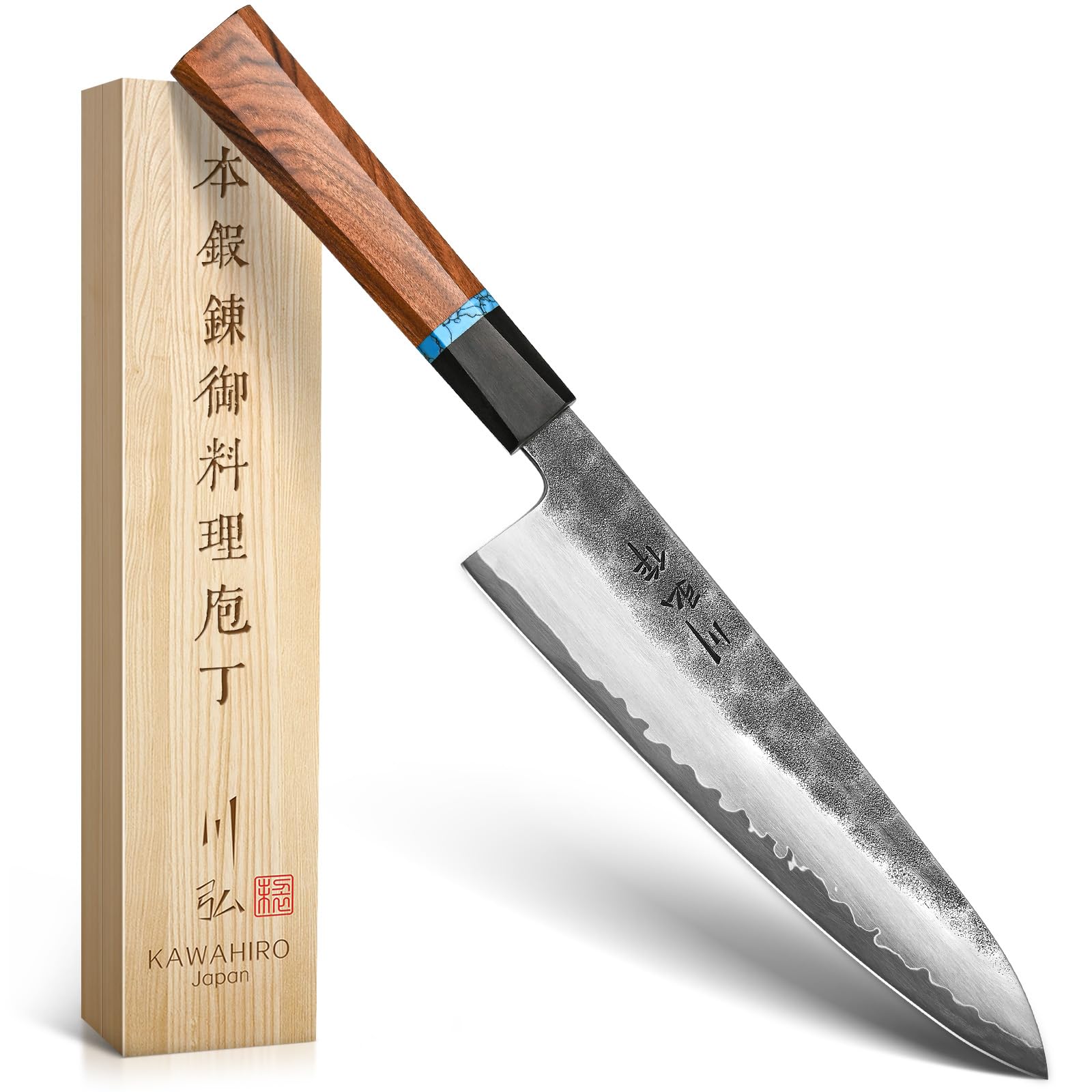
The KAWAHIRO 8-inch chef knife uses the San Mai construction method — a VG10 high-carbon steel core sandwiched between two softer layers of stainless steel. This three-layer forging creates a blade that is hard enough to hold a 15-degree edge (60-62 HRC) while remaining tough enough to resist chipping during heavy chopping. The black-forged (Kuro-uchi) finish on the spine gives it a traditional Japanese appearance and reduces food drag during slicing.
What makes this knife stand out in the mid-range category is the octagonal handle made from ebony, turquoise, and red cinnamon wood. The octagonal shape provides eight distinct grip positions, which allows you to rotate the knife in your hand for different cutting angles without losing control. Unlike round handles, the faceted design keeps the blade orientation consistent even when your hand is wet or oily. The included lacquered wooden gift box adds a premium unboxing experience.
The 15-degree edge angle requires whetstone maintenance — a honing rod will not restore the edge once it dulls past a certain point. The black-forged finish also develops a natural patina over time, which some users dislike. If you want a knife that feels authentically Japanese in every detail and comes from a brand that includes a certificate of authenticity, the KAWAHIRO is a strong mid-range contender.
Why it’s great
- San Mai VG10 core delivers 60-62 HRC with added impact resistance
- Octagonal ebony handle offers eight ergonomic grip positions
- Traditional Kuro-uchi finish reduces drag and looks distinctive
Good to know
- Requires whetstone sharpening — a honing rod is insufficient
- Black-forged finish will patina with use and acidic ingredients
5. HexClad Chef’s Knife 8-Inch

HexClad brings its hybrid cookware reputation into the cutlery world with an 8-inch chef knife built from 67 layers of Damascus stainless steel. The blade undergoes a three-step Honbazuke heat treatment that yields a 12-degree cutting edge — noticeably sharper than the 20-degree standard found on Western knives. The result is a blade that cuts through butternut squash and raw sweet potatoes with minimal downward force.
The Pakkawood handle is the standout feature here. It is ergonomically contoured with a slight palm swell that fills your hand naturally, reducing fatigue during long prep sessions. At 0.62 pounds, the knife has a slightly heavier feel than pure Japanese profiles, which some cooks prefer for tasks that require momentum, like chopping through herbs or cutting chicken into pieces. The 7.5-inch blade length (actually measured from heel to tip) is a half-inch shorter than standard, but the overall balance point sits exactly at the pinch grip.
HexClad claims dishwasher safety, but the Pakkawood handle will degrade over time with repeated dishwasher cycles — hand-washing is strongly recommended. The lifetime warranty covers manufacturing defects but not damage from improper use, including cutting on hard surfaces or using a pull-through sharpener. For cooks who want a Western-handle feel with Japanese blade geometry, the HexClad is a solid mid-range hybrid.
Why it’s great
- 67-layer Damascus construction with a sharp 12-degree Honbazuke edge
- Ergonomic Pakkawood handle reduces fatigue during extended use
- Lifetime warranty against manufacturing defects
Good to know
- Dishwasher-safe claim contradicts Pakkawood care best practices
- Warranty excludes damage from hard-surface cutting or misuse
6. HOSHANHO Damascus Kitchen Knife Set 3-Piece

HOSHANHO’s Damascus 3-piece set covers the three most-used kitchen blade profiles: an 8-inch chef knife, a 7-inch Santoku, and a 3.75-inch paring knife. Each blade is forged from 67-layer Damascus steel with a 10Cr15CoMoV cutting core hardened to 62 HRC. The combination of high carbon and cobalt-molybdenum additives gives the steel improved corrosion resistance compared to standard VG10, which matters if you often cut acidic fruits like lemons or tomatoes.
The olive wood handles are a tactile upgrade over basic Pakkawood. Olive wood has natural oils that resist moisture absorption, and the ergonomic contour fits both left- and right-handed users equally well. Each blade is ground to a 15-degree angle per side using a proprietary polishing technique, and the Damascus pattern is genuine — the result of repeated forge-welding and acid-etching to reveal the layered structure. The set arrives in a gift-ready box, making it a practical option for outfitting a kitchen in one purchase.
The paring knife in this set is shorter than some competing sets (3.75 inches versus 4 inches), which may feel limiting for larger-handed users. The olive wood handles also require occasional conditioning with food-safe mineral oil to prevent cracking in dry climates. For cooks who want a complete Damascus set with a higher HRC rating than most entry-level options, this HOSHANHO set delivers genuine craftsmanship at a mid-range price.
Why it’s great
- Three-knife set covers chef, Santoku, and paring tasks completely
- 67-layer Damascus with 62 HRC core for hard-use durability
- Olive wood handles resist moisture and fit both hand orientations
Good to know
- Paring knife at 3.75 inches is slightly shorter than standard
- Olive wood handles need periodic mineral oil conditioning
7. MITSUMOTO SAKARI 8-Inch Kiritsuke Knife

The MITSUMOTO SAKARI Kiritsuke knife uses 7 layers of 440C Damascus steel forged using traditional Japanese hand-hammering techniques. The 440C alloy contains a higher chromium content than standard high-carbon steel, which gives it enhanced stain resistance — a practical advantage for cooks who work with acidic ingredients frequently. The blade undergoes vacuum deep cooling treatment to refine the grain structure, resulting in a 13-degree edge angle that balances sharpness with chip resistance.
The visual highlight is the Shadowwood Pomegranate handle, developed in collaboration with a Japanese manga artist. The handle incorporates flowing color patterns that shift depending on the light, making each knife visually distinct. Despite the artistic focus, the handle is fully functional — it is contoured to fit the palm and provides adequate grip even when wet. The knife comes in a sandalwood gift box, which adds to the presentation value for gifting.
At 7 layers, the Damascus cladding is thinner than the 16- or 67-layer options on this list, which means the pattern is less pronounced and the structural benefits are more modest. The Kiritsuke profile has a flat edge with a slight curve at the tip, making it excellent for slicing but less effective for rock-chopping. For cooks who want a conversation-piece knife with genuine hand-forging and a striking handle, the MITSUMOTO SAKARI is a unique mid-range choice.
Why it’s great
- 440C stainless Damascus offers better stain resistance than standard carbon
- Shadowwood handle features unique hand-painted color patterns
- Includes a sandalwood presentation box for gifting
Good to know
- 7-layer Damascus is thinner — pattern and benefits are less pronounced
- Kiritsuke profile is less versatile for rock-chopping motions
8. HOSHANHO 3-Piece High Carbon Stainless Steel Knife Set
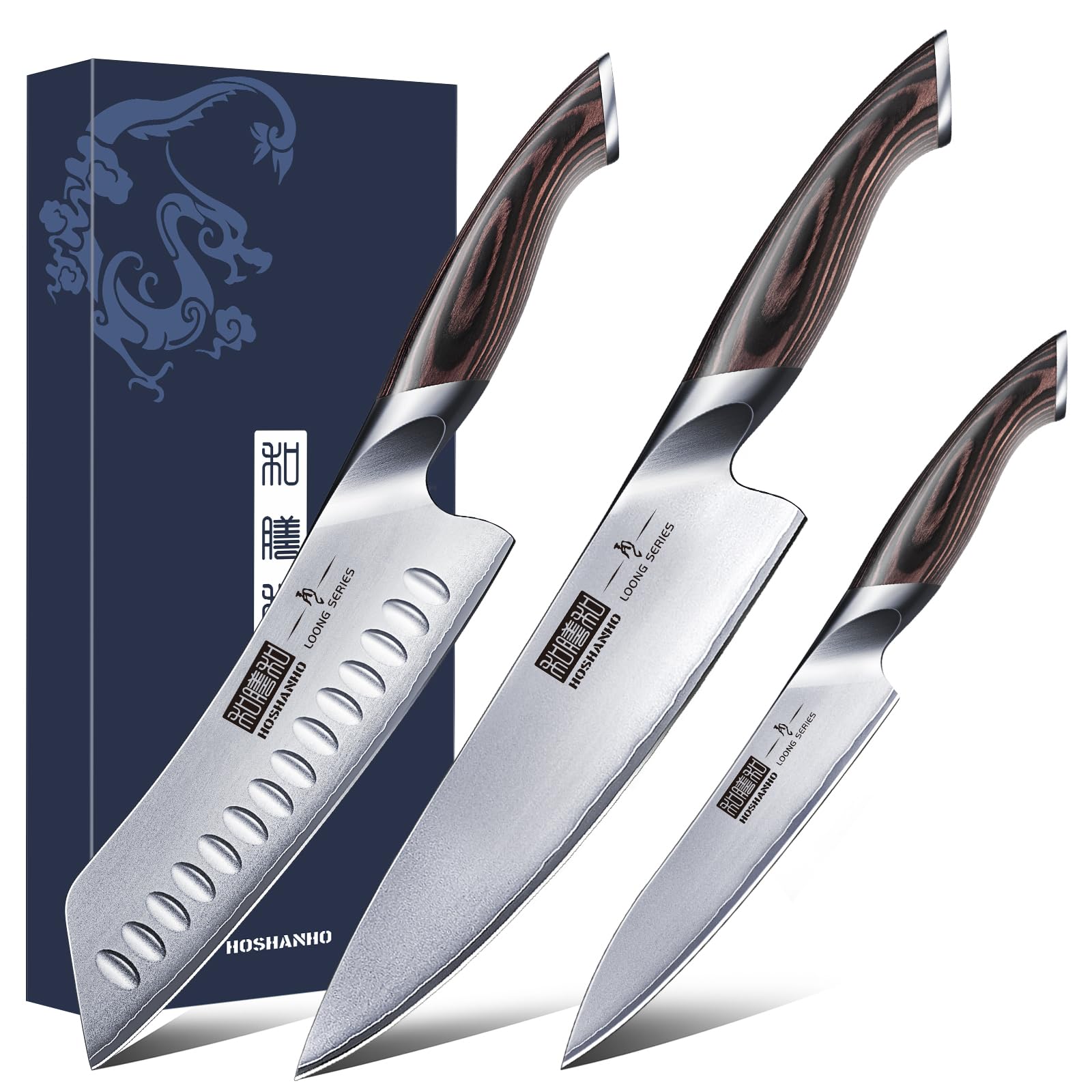
This HOSHANHO 3-piece set focuses on ergonomic comfort without sacrificing steel quality. The blades use Japanese 10Cr15CoMoV high-carbon stainless steel, which includes cobalt and molybdenum for improved wear resistance and edge stability at 60 HRC. Each blade is hand-polished to a 15-degree angle per side using high-temperature vacuum treatment and low-temperature cold nitrogen processing — a dual-cycle method that reduces micro-fractures in the edge.
The Pakkawood handles are ergonomically shaped with a subtle contour that fits the palm’s natural curve, reducing grip fatigue during extended prep sessions. The set includes an 8-inch chef knife, a 7-inch Santoku, and a 6-inch utility knife — the utility blade is a full inch longer than the paring knife in the Damascus set, making it more useful for tasks like slicing medium-sized tomatoes or butterflying chicken breasts. The knives arrive in a simple gift box, suitable for gifting without being overly flashy.
The 6-inch utility knife is slightly heavy for precise peeling work compared to a dedicated 3.5-inch paring knife. The set also lacks a paring knife entirely, so you will need a separate blade for small detail work. For home cooks who want a comfortable, high-carbon steel set with a focus on reducing hand strain, this HOSHANHO set delivers solid mid-range performance at a reasonable investment.
Why it’s great
- 10Cr15CoMoV core with cobalt and molybdenum for edge longevity
- Ergonomic Pakkawood handles reduce fatigue during long sessions
- 6-inch utility knife is more versatile than standard 3.5-inch paring blades
Good to know
- Utility knife is less precise for delicate peeling tasks
- No dedicated paring knife included in the set
9. SHAN ZU Damascus Knife Set 3-Piece
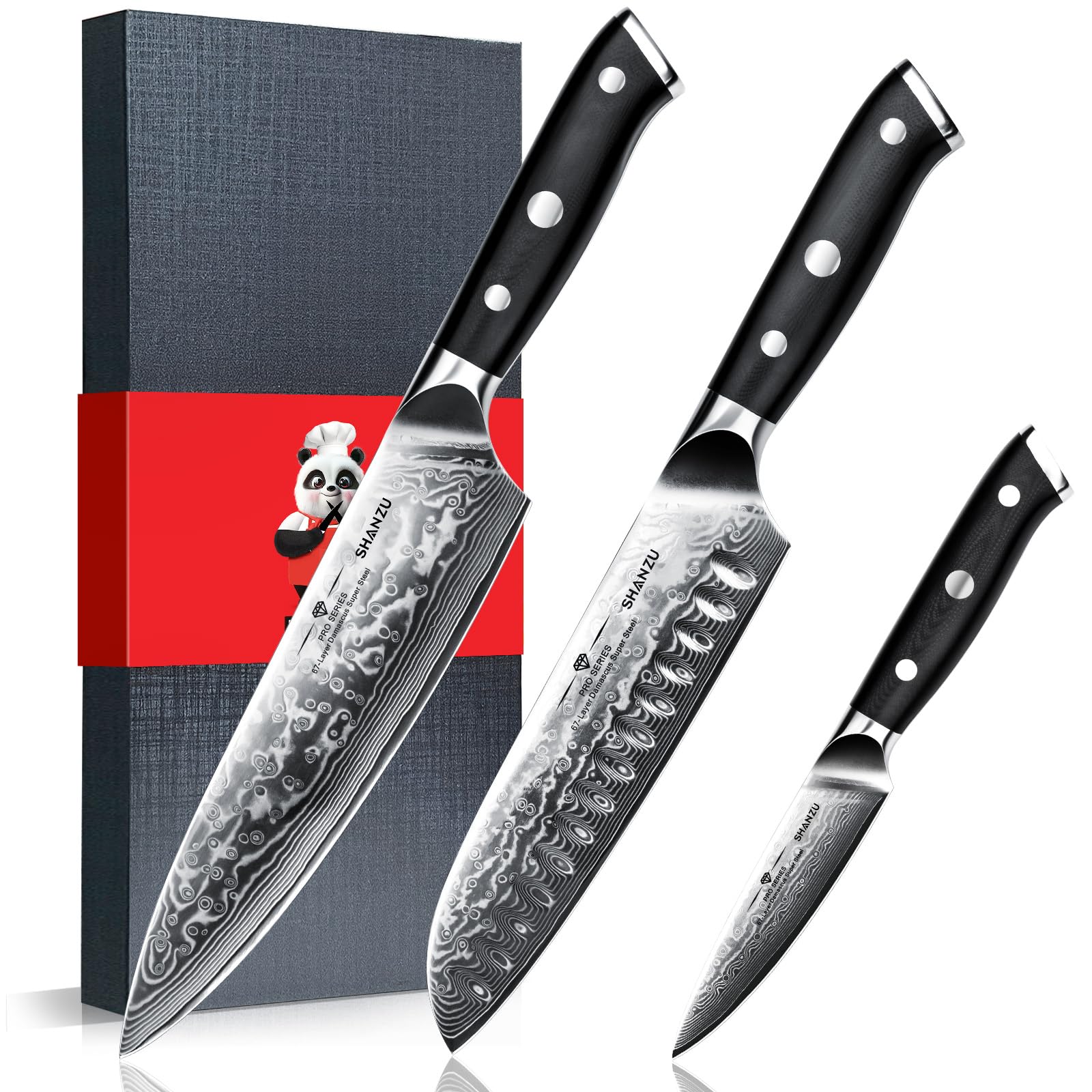
SHAN ZU’s 3-piece Damascus set is the most accessible entry point into genuine handmade chef knives on this list. The blades are forged from 67 layers of Damascus steel with a 10Cr15Mov Japanese steel core hardened to 62 HRC. The forging process involves repeated folding and hammering until the pattern is formed and then polished to make the layering visible. Unlike etched blades, this pattern runs through the entire thickness of the steel, contributing to the blade’s toughness.
The G10 glass-fiber handle is a practical choice for a lower price point — it is more durable than wood in humid conditions, does not swell or crack, and provides a secure grip even when your hands are wet. The set includes an 8-inch chef knife, a 7-inch Santoku, and a 4-inch paring knife, covering the three essential kitchen blade profiles. The G10 material is also non-porous, so it will not harbor bacteria or absorb food odors over time.
The included 4-inch paring knife is shorter than some competitors, and the G10 handle, while durable, lacks the tactile warmth of natural wood or Pakkawood. The blades also require immediate drying after use to prevent water spots on the Damascus pattern. For budget-conscious cooks who want a genuine 67-layer Damascus set with a practical, low-maintenance handle, the SHAN ZU set offers the highest layer count at the lowest investment point in this guide.
Why it’s great
- Genuine 67-layer Damascus with a 62 HRC Japanese steel core
- G10 glass-fiber handle is waterproof, non-porous, and durable
- Covers three essential profiles — chef, Santoku, and paring
Good to know
- G10 handle feels less warm and organic than wood alternatives
- Damascus pattern requires careful drying to avoid water spots
FAQ
Why can’t I put a handmade chef knife in the dishwasher?
What is the difference between VG10 and 10Cr15MoV steel?
How often should I sharpen a handmade chef knife?
Does a higher HRC rating mean a better knife?
Final Thoughts: The Verdict
For most users, the best handmade chef knives winner is the MIYABI Artisan 8-Inch because it combines Sg2 powder steel at 63 HRC with hand-honed Honbazuke edge geometry in a balanced Pakkawood handle — a combination that outperforms nearly every other blade in this guide. If you want the best balance of performance and price, grab the Yoshihiro VG10 Santoku 7-Inch for its genuine 16-layer Damascus cladding and ergonomic mahogany handle. And for a complete kitchen setup without breaking into the premium tier, nothing beats the HOSHANHO Damascus 3-Piece Set with its 62 HRC core and olive wood handles.