The difference between a coffee shop that thrives and one that struggles often comes down to a single piece of equipment: the espresso machine. For a small coffee shop, the right machine must balance speed, consistency, durability, and footprint — all while handling the relentless rhythm of back-to-back orders during morning rush.
I’m Mohammad Maruf — the founder and writer behind AirfryerBite. I’ve spent years analyzing commercial kitchen hardware specifications, comparing boiler systems, pump types, and build quality across the major brands to understand what actually survives daily commercial use.
After evaluating seven serious contenders spanning heat exchanger, dual boiler, and fully automatic platforms, I’ve built this guide to help you navigate the critical specs. This is everything you need to find the commercial espresso machine for small coffee shop that matches your volume, skill level, and space.
How To Choose The Best Commercial Espresso Machine For Small Coffee Shop
Selecting the right machine for a small coffee shop is a high-stakes decision. You need consistent output that can withstand daily use, without over-investing in a footprint or capacity you won’t fill. Here are the three biggest factors to evaluate.
Boiler System: Heat Exchanger vs. Dual Boiler
A heat exchanger uses a single boiler that keeps water at steam temperature, then passes brew water through a heat exchange tube to cool it down before extraction. This design is simpler and more affordable, but it requires careful temperature management. A dual boiler system separates brew and steam circuits entirely, giving you independent PID control over each. For a small shop serving both straight espresso and milk drinks, a dual boiler offers the most consistent results without compromise.
Pump Type: Rotary vs. Vibration
Vibration pumps are common in home machines — they are smaller, cheaper, and louder. Rotary pumps are standard in commercial machines for a reason. They run quieter, last significantly longer under continuous use, and allow you to plumb the machine directly into a water line. If your shop has space to run a water line, a rotary pump machine eliminates the need to refill a reservoir every few shots.
Group Head Design and Temperature Stability
The E61 group head is the gold standard in commercial espresso for a reason. Its large thermal mass and thermosiphon circulation keep the group head at stable temperatures throughout a busy shift. Machines without proper group head heating — or with a simple thermoblock — will deliver inconsistent shots as the machine heats up and cools down during back-to-back pulls.
Quick Comparison
On smaller screens, swipe sideways to see the full table.
| Model | Category | Best For | Key Spec | Amazon |
|---|---|---|---|---|
| Rocket Espresso R58 | Premium | Plumb-in capable dual boiler with rotary pump | Rotary Pump, Plumbable | Amazon |
| Breville Oracle Touch | Premium | Automated grinding, dosing, and tamping | Auto Dose & Tamp | Amazon |
| Bosch VeroCafe 800 | Premium | Fully automatic convenience with 36 drinks | 36 Beverage Programs | Amazon |
| Breville Oracle BES980XL | Mid-Range | Automated grinding and dual boiler performance | Auto Dose & Dual Boiler | Amazon |
| Rancilio Silvia Pro X | Mid-Range | Traditional manual dual boiler with PID | Dual Boiler, PID | Amazon |
| Diletta Bello+ | Mid-Range | E61 heat exchanger with PID and shot timer | E61, PID, Shot Timer | Amazon |
| Rocket Appartamento Nera | Mid-Range | Compact heat exchanger with E61 group | Heat Exchanger, E61 | Amazon |
In‑Depth Reviews
1. Rocket Espresso R58 Cinquantotto

The Rocket R58 Cinquantotto is the machine you spec when your small coffee shop is ready to grow. Its dual boiler system with independent PID control gives you separate brew and steam circuits, so you can pull shot after shot while steaming milk simultaneously without any temperature drift. The commercial-caliber rotary pump runs quieter than any vibration pump and supports optional plumbing directly into your water line — that means no refilling a reservoir mid-shift.
Ease of service is built into every detail. The detachable touchscreen PID gives you full access to brew and steam temperature settings without removing the machine from its counter position. Auto-on scheduling lets you program the machine to heat up before you unlock the door. The mirrored shot timer is a subtle but practical addition that helps baristas track extraction times without breaking their workflow.
Hand-built in Milan, Italy, every R58 is assembled with stainless steel construction and a 58mm group head that delivers the temperature stability small shops need for consistent shots. At 17 inches deep and 22.75 inches wide, it demands more counter space than compact options, but the plumb-in capability and rotary pump make it the long-term investment that pays for itself in reduced maintenance and higher throughput.
Why it’s great
- Commercial rotary pump enables plumb-in installation and quiet operation
- True dual boiler with independent PID for simultaneous brew and steam
- Auto-on scheduling saves energy and morning setup time
Good to know
- Significant counter footprint — measure carefully before purchasing
- Premium price point requires higher daily shot volume to justify
2. Breville Oracle Touch BES990BSS

The Breville Oracle Touch is the machine for the small coffee shop owner who values speed and consistency over manual barista craft. The integrated precision conical burr grinder automatically doses and tamps 22 grams of coffee, bypassing the biggest inconsistency in manual espresso — the tamp. The touchscreen interface lets baristas select espresso, long black, latte, flat white, or cappuccino with a single swipe, and up to eight custom drink profiles can be saved and named.
The dual boiler construction is genuine: a dedicated steam boiler works alongside the brew boiler, enabling simultaneous extraction and texturing. The Over Pressure Valve limits maximum pump pressure during extraction to prevent channeling and bitter flavors, while low-pressure preinfusion gradually saturates the puck. This automatic pressure management is a significant advantage if your staff is not yet experienced with manual profiling.
Automatic microfoam milk texturing is the standout feature for shops that serve milk-heavy menus. The self-cleaning steam wand textures milk to programmed temperature and texture settings, producing consistent microfoam shot after shot. The main trade-off is that the Oracle Touch lacks a rotary pump and plumb-in capability — it relies on a vibration pump and a 67-ounce reservoir, so refilling during peak hours may be necessary.
Why it’s great
- Automatic grinding, dosing, and tamping eliminates a major variable in shot consistency
- Touchscreen interface with programmable drink profiles reduces training time
- Dual boilers allow simultaneous brewing and milk texturing
Good to know
- Vibration pump cannot be plumbed in — requires reservoir refilling
- Automation may feel limiting for a dedicated professional barista
3. Bosch VeroCafe 800 TQU60703
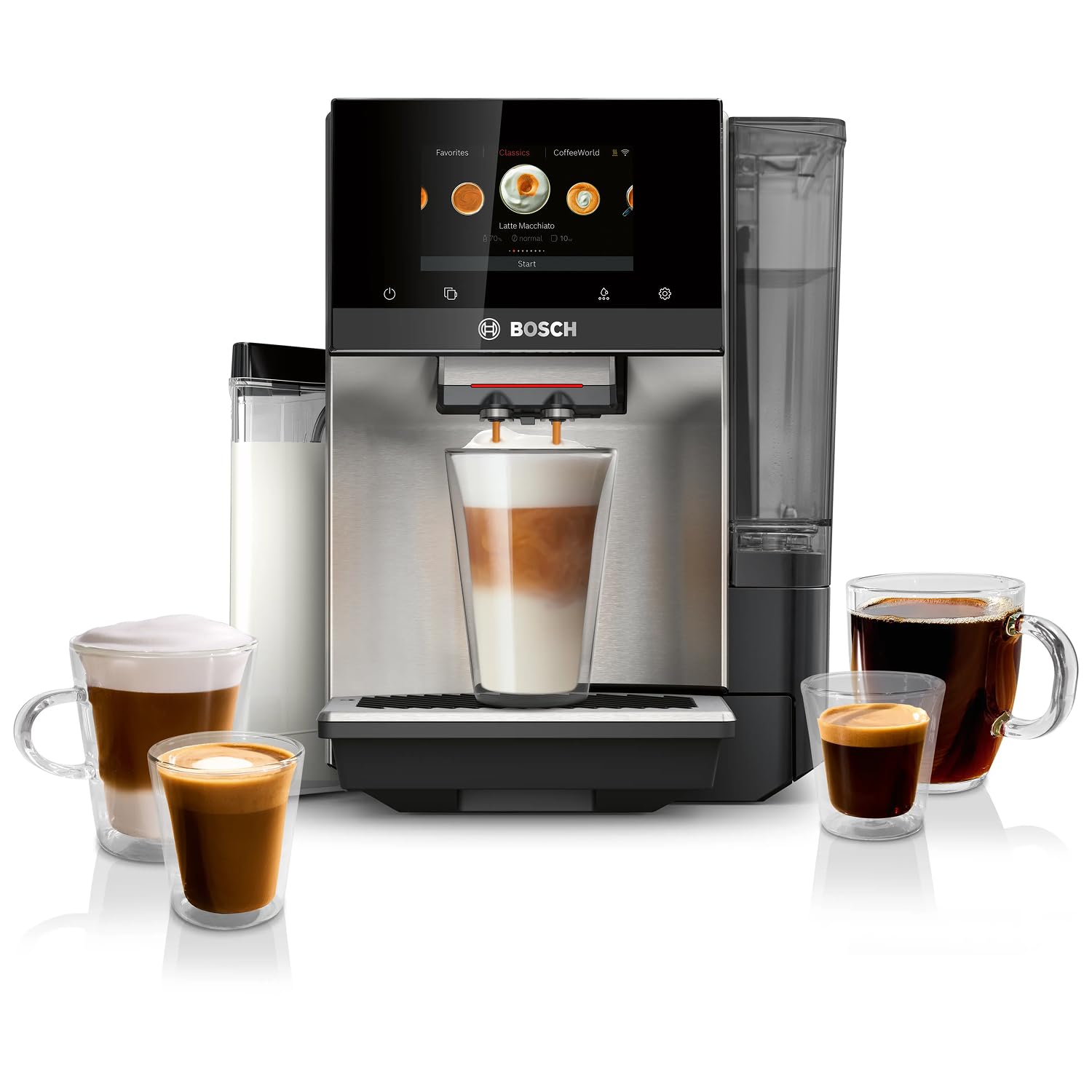
The Bosch VeroCafe 800 series brings a different philosophy — total automation from bean to cup. This fully automatic machine stores whole beans in a 5.1-pound hopper and grinds them fresh for every drink. The large touchscreen interface lets you browse 36 beverage programs, including various sizes of espresso, cappuccino, latte macchiato, and even long black. Each drink can be customized for strength, size, milk ratio, and aroma intensity.
Remote brewing through the Home Connect app adds a layer of convenience that traditional espresso machines cannot match. You can start a drink from your phone as you walk into the shop, saving time during off-peak moments. The integrated milk container and automatic milk frothing system mean minimal hands-on involvement, which reduces labor for shops that do not employ a dedicated barista.
Maintenance is streamlined through a combined cleaning and descaling program with step-by-step guidance. The machine also includes a Mavea water filter to reduce scaling. However, this is not a machine built for high-volume commercial rushes — its grinder and brew unit are designed for sequential single drinks, not simultaneous shot pulling. If your shop averages less than 50 drinks per day, it is a compelling option that sacrifices commercial durability for convenience.
Why it’s great
- 36 preset beverage programs with full customization
- Remote brewing via Home Connect app for convenience
- Combined cleaning and descaling simplifies maintenance
Good to know
- Not designed for simultaneous high-volume shot pulling
- Fully automatic systems are more complex to repair than manual machines
4. Breville Oracle BES980XL

The Breville Oracle BES980XL is the predecessor to the Oracle Touch and shares the core automated workflow that made the Oracle line popular. It grinds, doses, and tamps 22 grams automatically using an integrated conical burr grinder, then extracts through dual stainless steel boilers with PID temperature control. The heated group head delivers water at precisely the right temperature for optimal extraction.
Where this machine shines for a small shop is the automatic microfoam milk texturing. The self-cleaning steam wand, powered by its own dedicated boiler, textures milk to your programmed settings and produces barista-quality microfoam essential for latte art. The Over Pressure Valve limits extraction pressure to prevent bitter flavors, and low-pressure preinfusion gently expands the grounds before full pressure hits.
The LCD display gives you one-shot, two-shot, or manual control, plus a one-touch Americano function that dispenses hot water through a separate spout. The main drawbacks are the same as the Touch: a vibration pump without plumb-in capability and the need to keep the 84-ounce water tank filled. If you are choosing between the two Oracles, the Touch adds a touchscreen and more programmable profiles but does not change the fundamental hardware or performance.
Why it’s great
- Automatic dose and tamp system speeds up the workflow significantly
- Dual boilers with PID provide excellent temperature control
- Self-cleaning steam wand with automatic milk texturing
Good to know
- Vibration pump limits plumb-in potential
- Reservoir may need refilling during high-volume periods
5. Rancilio Silvia Pro X

The Rancilio Silvia Pro X is a serious dual boiler machine that fits into a small footprint without sacrificing the essentials. It uses a 1-liter steam boiler and a 300ml brew boiler, both controlled by dedicated PID circuits. This gives you independent temperature management for each circuit, adjustable to the degree, which is crucial for dialing in different coffee roasts.
Rancilio has added adjustable low-pressure preinfusion on the Pro X, which improves shot quality by gradually wetting the puck before full extraction pressure hits. The front-facing PID screen doubles as a shot timer when you start brewing, helping baristas track extraction times. A programmable auto-on feature means the machine can heat up on a schedule, saving energy when the shop is closed.
The upgraded stainless steel portafilter from the Rancilio Specialty line feels robust in hand and improves heat retention. At 10 inches wide and 16.5 inches deep, this is one of the narrower dual boiler machines available, making it an excellent choice for small counters. The key trade-off is that the steam boiler is only 1 liter — shops that serve a high volume of milk drinks may find themselves waiting for steam recovery during back-to-back lattes.
Why it’s great
- Compact dual boiler design — only 10 inches wide
- Dedicated PID control for brew and steam circuits
- Programmable auto-on and shot timer included
Good to know
- 1-liter steam boiler may limit high-volume milk drink production
- No rotary pump option for plumb-in installation
6. Diletta Bello+

The Diletta Bello+ brings Italian craftsmanship to the heat exchanger category with modern control upgrades that set it apart from older E61 designs. It uses a heat exchanger boiler with a front-mounted PID screen that lets you view and adjust steam boiler temperature. The PID screen also doubles as a shot timer, making it easier to track extractions without adding a separate device.
A standout feature is the programmable preinfusion — up to 10 seconds of passive pre-wetting before the pump engages. This reduces channeling and improves shot consistency, especially with lighter roasts. The eco-mode lowers boiler temperature when idle to save energy while still offering faster recovery to brew temperature compared to a full cool-down. All controls are manual, so the barista retains full authority over brew and steam.
Handmade in Milan, Italy with a stainless steel frame and boiler, the Bello+ offers a three-liter capacity in a form factor that is 11 inches wide. The E61 group head provides excellent thermal stability. The limitation is the heat exchanger design — temperature surfing between shots is often necessary for precise brew temperature, and the steam boiler temperature can fluctuate when pulling multiple shots in quick succession.
Why it’s great
- E61 group head with PID temperature monitoring and shot timer
- Programmable preinfusion for better shot quality
- Eco-mode saves energy between busy periods
Good to know
- Heat exchanger design requires temperature surfing for brew precision
- Steam temperature may fluctuate during consecutive shot pulls
7. Rocket Espresso Appartamento Nera

The Rocket Appartamento Nera is the entry point into professional-grade E61 espresso machines and a strong option for a shop with limited counter space. Its footprint is just 10.5 inches wide and 17 inches deep, making it the most space-efficient machine among the heat exchanger options here. Despite the compact size, it uses a 1.8-liter heat exchanger boiler that can steam milk and brew espresso simultaneously — a requirement for any shop that serves both shots and milk drinks.
The E61 group head is heated by a small flow of water from the boiler, keeping the group temperature stable for consistent shot pulls. All controls are manual — steam lever, brew lever, and mechanical buttons — giving the barista full tactile control over the extraction. Rocket includes a stainless steel tamper, cleaning cloth, single and double portafilters with baskets, a blind basket, and a cup rail in the box.
Where the Appartamento Nera falls short for a commercial setting is the heat exchanger temperature management. Unlike a dual boiler or PID-equipped system, you cannot precisely control brew temperature without learning the machine’s temperature surfing routine. The three-year warranty on parts and labor is excellent, but at roughly 58 pounds, it is not a machine you will move around frequently. For a very low-volume shop or a dedicated espresso bar within a larger establishment, it works well.
Why it’s great
- Compact footprint — only 10.5 inches wide
- E61 group head with thermosiphon heating for thermal stability
- Includes comprehensive accessories: tamper, cloth, portafilters, baskets
Good to know
- Heat exchanger design requires temperature surfing for consistent brew temps
- No PID temperature control — relies on mechanical thermostat
FAQ
Is a heat exchanger or dual boiler better for a small coffee shop?
Do I need a rotary pump for a commercial espresso machine?
What does the E61 group head do for espresso quality?
How much counter space should I plan for a commercial espresso machine?
Final Thoughts: The Verdict
For most small coffee shop owners, the commercial espresso machine for small coffee shop winner is the Rocket Espresso R58 Cinquantotto because its dual boiler, rotary pump, and plumb-in capability offer the best balance of commercial-grade durability and consistent shot quality. If you want automated grinding and milk texturing to speed up your workflow, grab the Breville Oracle Touch. And for a compact dual boiler that fits tight counters, nothing beats the Rancilio Silvia Pro X.