The knife handle slips after an hour of prep, the edge dulls halfway through a case of onions, and the blade chatters against the cutting board instead of gliding. For a chef — whether behind a pass or at a home island — a knife that fights back drains the joy out of cooking. The right blade should disappear in your hand, leaving only the ingredient and the cut.
I’m Mohammad Maruf — the founder and writer behind AirfryerBite. I’ve spent years studying blade geometry, steel chemistries, and handle ergonomics across hundreds of chef knives, analyzing how each spec translates into real prep-table performance.
This buying guide breaks down the steel types, handle materials, and construction methods that define professional-grade cutlery. My goal is to help you identify the best knives for chefs by focusing on the specs that actually matter for daily, high-volume use.
How To Choose The Best Knives For Chefs
A chef’s knife is a direct extension of the hand, and the wrong choice shows immediately in uneven cuts, hand fatigue, and constant trips to the steel. The selection process boils down to four non-negotiable areas.
Steel Type and Edge Retention
The steel determines how long the blade stays sharp and how it responds to sharpening. German high-carbon steel (often rated around 56-58 HRC) is tougher and resists chipping, making it a safe choice for heavy chopping and bone contact. Japanese VG-10 steel, typically hardened to 60-62 HRC, holds a finer edge longer but is more brittle and demands gentler use. For a chef working through continuous prep, edge retention matters more than brute toughness — fewer honing breaks keep the line moving.
Handle Ergonomics and Full Tang Construction
A full-tang blade — where the steel runs the entire length of the handle — provides the balanced heft that prevents wrist fatigue during extended cutting sessions. Handle material should offer a secure grip when wet: G10 (a glass-fiber laminate) and treated wood offer excellent traction without slipping. Avoid slick polymer or untreated wood that becomes greasy after a few hours of use.
Blade Geometry and Knuckle Clearance
Tall blade height, usually 1.8 to 2.0 inches on an 8-inch knife, gives your knuckles room to clear the board. A flat or slightly curved profile (the belly) determines the rock of the blade — a flatter edge is better for push-cutting vegetables, while more belly aids the rock chop for herbs. Chefs who do high-volume vegetable prep tend to favor a flatter edge profile.
Edge Angle and Sharpness Out of the Box
Factory edge angles range from 14 to 20 degrees per side. A 15-degree angle delivers a sharp, precise cut that glides through produce and boneless protein, but it requires a careful honing routine. Wider angles (18-20 degrees) are more forgiving for heavy tasks but sacrifice some initial slicing performance. A knife that arrives with a 15-degree hand-polished edge saves you the first sharpening session.
Quick Comparison
On smaller screens, swipe sideways to see the full table.
| Model | Category | Best For | Key Spec | Amazon |
|---|---|---|---|---|
| Dalstrong Kiritsuke 8.5″ | Premium | Professional prep, knuckle clearance | 56+ HRC German Steel | Amazon |
| KAWAHIRO Gyuto 8″ | Premium | Effortless slicing, gift-worthy build | VG10 Core, 60-62 HRC | Amazon |
| Shun Classic Kiritsuke 8″ | Premium | Traditional Japanese edge geometry | VG10 Damascus, 61 HRC | Amazon |
| ASETY Damascus Set (3pc) | Mid-Range | Multi-knife kit, NSF cert | VG10 Core, 60 HRC | Amazon |
| KYOKU Shogun 8″ | Mid-Range | Budget entry into VG10 Damascus | VG10 Hammered Damascus | Amazon |
| Victorinox Wood 8″ | Budget | Lightweight daily workhorse | High-carbon steel, wood handle | Amazon |
| Cutluxe Artisan Set (3pc) | Budget | Value-oriented full-tang set | German Steel, full tang | Amazon |
In‑Depth Reviews
1. Dalstrong Kiritsuke Chef Knife – 8.5 inch – Gladiator Series Elite

The Dalstrong Gladiator Series Elite Kiritsuke combines a hybrid profile — the flat edge of a gyuto with the angled tip of a kiritsuke — with forged high-carbon German steel hardened to 56+ HRC. The 8.5-inch blade offers tall knuckle clearance, making it suitable for both rocking herb chops and precise push cuts on vegetables. Out of the box, the hand-polished 14-16 degree edge glides through tomato skin without crushing the flesh.
The full-tang construction uses a black G10 handle that provides a secure grip even when wet, and the triple-riveted design feels solid in the hand. At just over a pound, the weight distribution leans slightly blade-forward, aiding momentum during continuous slicing. The satin finish is stain-resistant, which reduces maintenance in a busy kitchen environment.
NSF certification adds a layer of confidence for professional use, and the included sheath protects the edge during storage. The knuckle clearance is noticeably better than standard 8-inch chef knives, and the flat profile near the heel improves precision for horizontal cuts on proteins. The only concession is the price, which sits at a premium tier — but the build quality justifies the investment for a primary line knife.
Why it’s great
- Tall blade height provides excellent knuckle clearance for heavy prep
- NSF certified and stain-resistant German steel reduces kitchen maintenance
- Hybrid kiritsuke profile works well for both rocking and push cuts
Good to know
- Premium price point may exceed casual home cook budgets
- 56+ HRC steel requires regular honing to maintain peak edge
2. KAWAHIRO Japanese Chef Knife – 8 Inch Hand Forged VG10 Gyuto
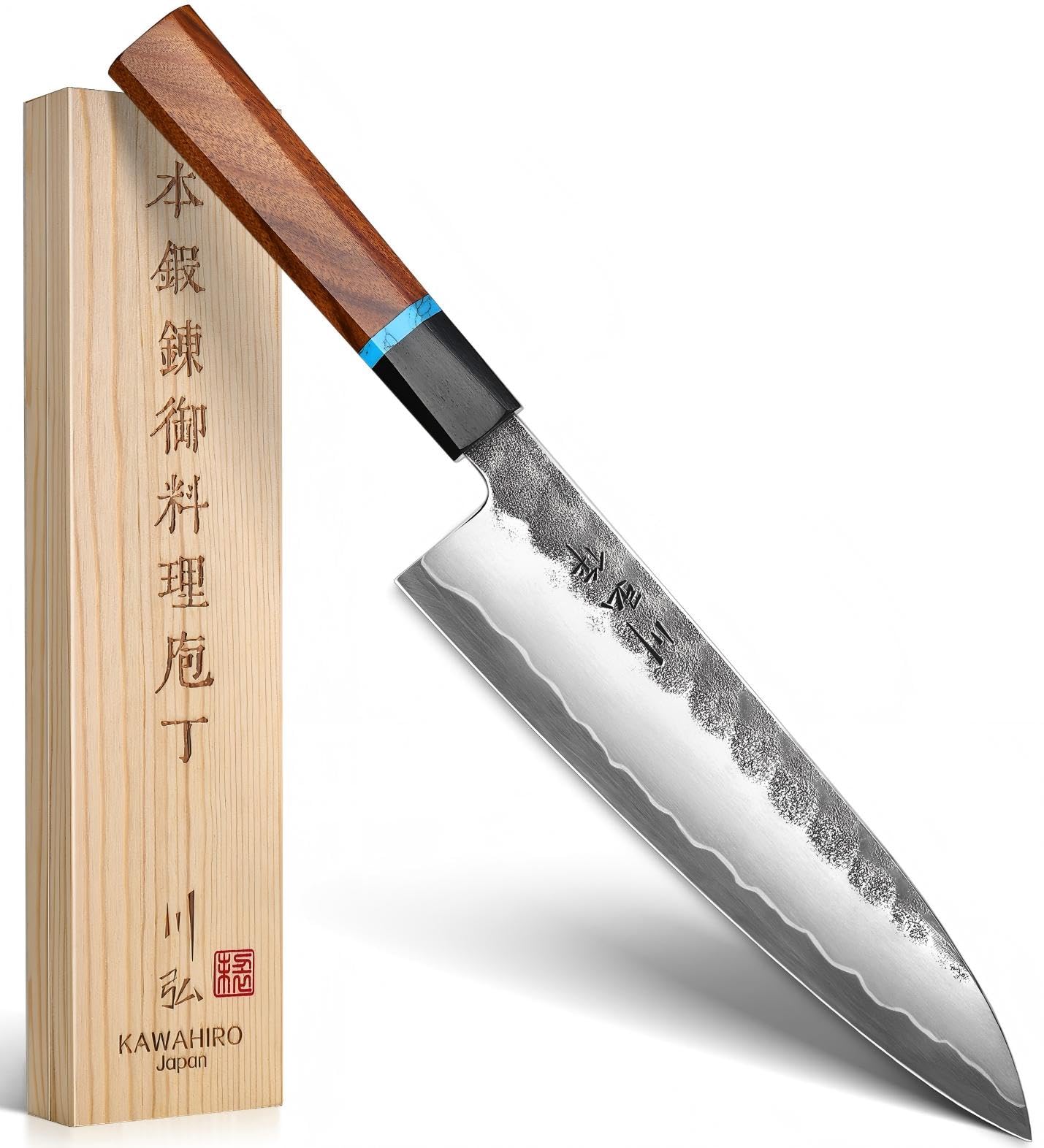
The KAWAHIRO Gyuto is forged with a VG10 stainless steel core sandwiched between three layers of softer steel, a construction that balances edge hardness (60-62 HRC) with overall blade toughness. The 8.27-inch blade receives a hand-polished edge that arrives shaving-sharp, and the black forged finish reduces drag when slicing through dense vegetables like sweet potatoes or raw beets. The layered steel pattern is unique to each knife due to the hand-forging process.
The octagonal handle is crafted from a composite of premium ruby wood, turquoise, and ebony, offering a comfortable grip that suits both pinch and handle grips. The shape prevents rolling in the hand during extended prep, and the seamless transition from handle to blade creates a balanced feel at the pinch point. A certificate of authenticity and a wipe cloth are included in the premium wooden gift box.
This knife excels in push-cut and pull-slice techniques common in Japanese cuisine, but the fine 60-62 HRC edge is less forgiving on hard items like bones or frozen product. The aesthetic craftsmanship makes it a strong candidate for a chef who values presentation as much as performance. The included wooden case adds storage convenience, but the handle materials require gentle handling to avoid moisture damage over time.
Why it’s great
- VG10 core at 60-62 HRC holds a razor edge through long prep sessions
- Octagonal handle provides secure grip and reduces hand fatigue
- Unique hand-forged finish and premium gift packaging elevate presentation
Good to know
- Brittle edge can chip if used on hard surfaces or bones
- Wood and composite handle requires careful drying after each use
3. Shun Classic 8″ Kiritsuke Knife

The Shun Classic Kiritsuke blends traditional Japanese knife geometry with a VG-10 Damascus steel core hardened to 61 HRC. The 8-inch blade features 68 layers of Damascus cladding that not only reduce sticking during slicing but also create a distinctive aesthetic that holds up well in a professional kitchen. The edge is hand-sharpened to a 16-degree angle, producing a fine cutting surface that requires minimal pressure to initiate a cut.
The handle is constructed from molded PakkaWood, a resin-impregnated hardwood that resists moisture better than natural wood while maintaining a warm, comfortable feel. The D-shaped handle is designed for right-handed users and provides a secure pinch grip at the bolster. The full-tang blade contributes to a balanced heft that feels nimble for detail work but sufficient for heavy vegetable prep.
Shun’s reputation for consistent quality control means the edge geometry is reliably symmetrical, reducing the need for immediate correction out of the box. The kiritsuke tip allows for precise detailing work like trimming silverskin or slicing chives. The hardness rating of 61 HRC demands a quality ceramic or diamond sharpening system when the edge eventually requires resetting, as standard steels struggle to restore the original angle.
Why it’s great
- 61 HRC VG-10 core delivers exceptional edge retention for high-volume prep
- 68-layer Damascus cladding reduces food sticking during slicing
- PakkaWood handle resists moisture better than natural wood handles
Good to know
- D-shaped handle molded for right-handed users only
- High hardness requires diamond or ceramic sharpening stones
4. ASETY Damascus Knife Set – 3 PCS (Chef, Santoku, Utility)

The ASETY Damascus set includes an 8-inch chef knife, a 7-inch santoku, and a 5.5-inch utility knife, all forged with a VG-10 equivalent steel core (10Cr15CoMoV) at 60 HRC with 67 layers of Damascus cladding. The chef knife’s 15-degree edge per side slices cleanly through dense produce, and the santoku’s scalloped Granton edge reduces friction on sliced items like cheese or cured meat. The utility knife covers smaller tasks like trimming herbs or slicing fruit.
Each knife features a full-tang G10 handle with a triple-riveted design. G10 is a military-grade glass-fiber laminate that provides a positive grip even when the handle is wet, and it resists thermal expansion better than wood or synthetic materials. The bolster slopes at a 60-degree angle to accommodate a natural pinch grip, and the front-to-back cutting design supports a rocking motion without fatiguing the wrist. The set is NSF certified, confirming it meets sanitary standards for commercial kitchens.
At a mid-range price, the set provides three knives that cover most daily prep tasks without forcing a single-blade compromise. The included elegant box offers organized storage, though the knives themselves lack individual blade guards. The 60 HRC hardness paired with the Damascus layering offers a noticeable upgrade over entry-level German steel sets, but expect to hone the chef knife weekly to maintain the factory edge.
Why it’s great
- Three-knife set covers chef, santoku, and utility tasks out of the box
- G10 handles offer superior wet-grip durability compared to wood
- NSF certified for professional kitchen sanitary standards
Good to know
- No individual blade guards included in the storage box
- Regular weekly honing needed to maintain the 15-degree edge
5. KYOKU Chef Knife – 8″ Shogun Series VG10 Damascus

The KYOKU Shogun series brings a VG10 steel core with hammered Damascus cladding to the mid-range market. The 8-inch chef knife features a hand-polished 15-degree edge per side, and the hammered tsuchime finish creates micro-air pockets between the blade and food, reducing friction during slicing. The 67-layer Damascus pattern is visually striking and consistent across the blade face, offering a premium aesthetic at a more accessible price.
The handle is constructed from black pakkawood with a triple-riveted full-tang design. Pakkawood provides a balance of moisture resistance and classic wood warmth, though it may require periodic conditioning in high-humidity kitchens. The blade profile has a moderate belly that suits both rocking and chopping motions, making it versatile for general prep work. The included sheath protects the edge during storage, and the gift box adds value for gifting scenarios.
At its price point, the KYOKU delivers a VG10 core that typically belongs in higher tiers, but the fit-and-finish details — such as the handle-to-blade transition — are slightly less refined than premium options. The edge arrives sharp but may benefit from a quick pass on a fine stone to reach peak sharpness. It is best suited for chefs who want VG10 performance without crossing into three-figure territory.
Why it’s great
- VG10 Damascus core delivers genuine Japanese steel at a mid-range price
- Hammered tsuchime finish reduces sticking during vegetable slicing
- Includes sheath and gift box for safe storage and presentation
Good to know
- Handle-to-blade transition less refined than premium Japanese brands
- Factory edge may need a fine stone tune-up out of the box
6. Victorinox Wood 8 Inch Chef’s Knife, Straight Edge

The Victorinox Wood 8-inch chef knife replaces the brand’s classic Fibrox handle with a contoured wood option, retaining the same high-carbon stainless steel blade that has made the Fibrox a staple in culinary schools. The blade is stamped rather than forged, which keeps the weight low and the price accessible, but the straight edge still delivers reliable cutting performance for a wide range of tasks. At under half a pound, this knife is ideal for chefs who prioritize speed and agility over blade heft.
The wood handle is ergonomically shaped and sealed to resist moisture, though it requires more careful drying than synthetic handles to prevent cracking over years of use. The full ratchet tang is visible through the handle and provides adequate structural integrity for daily prep. The blade’s 8-inch length and moderate belly make it suitable for rocking, slicing, and chopping without specialized technique demands.
This is a budget-tier knife that punches above its weight for straight performance, but the stamped steel will require more frequent sharpening than forged VG10 or German steel options. Professional chefs may find the edge softens noticeably after a week of heavy use, but for the price, it is a solid spare or learning knife. The wood handle adds a traditional feel that distinguishes it from the standard Fibrox line.
Why it’s great
- Lightweight stamped blade reduces fatigue during high-volume prep
- Contoured wood handle offers a traditional, comfortable grip
- Entry-level price makes it ideal for students or back-up knives
Good to know
- Stamped steel requires more frequent sharpening than forged alternatives
- Wood handle needs thorough drying to prevent long-term cracking
7. Cutluxe Chef Knife Set – 3 PCS Professional German Steel Set
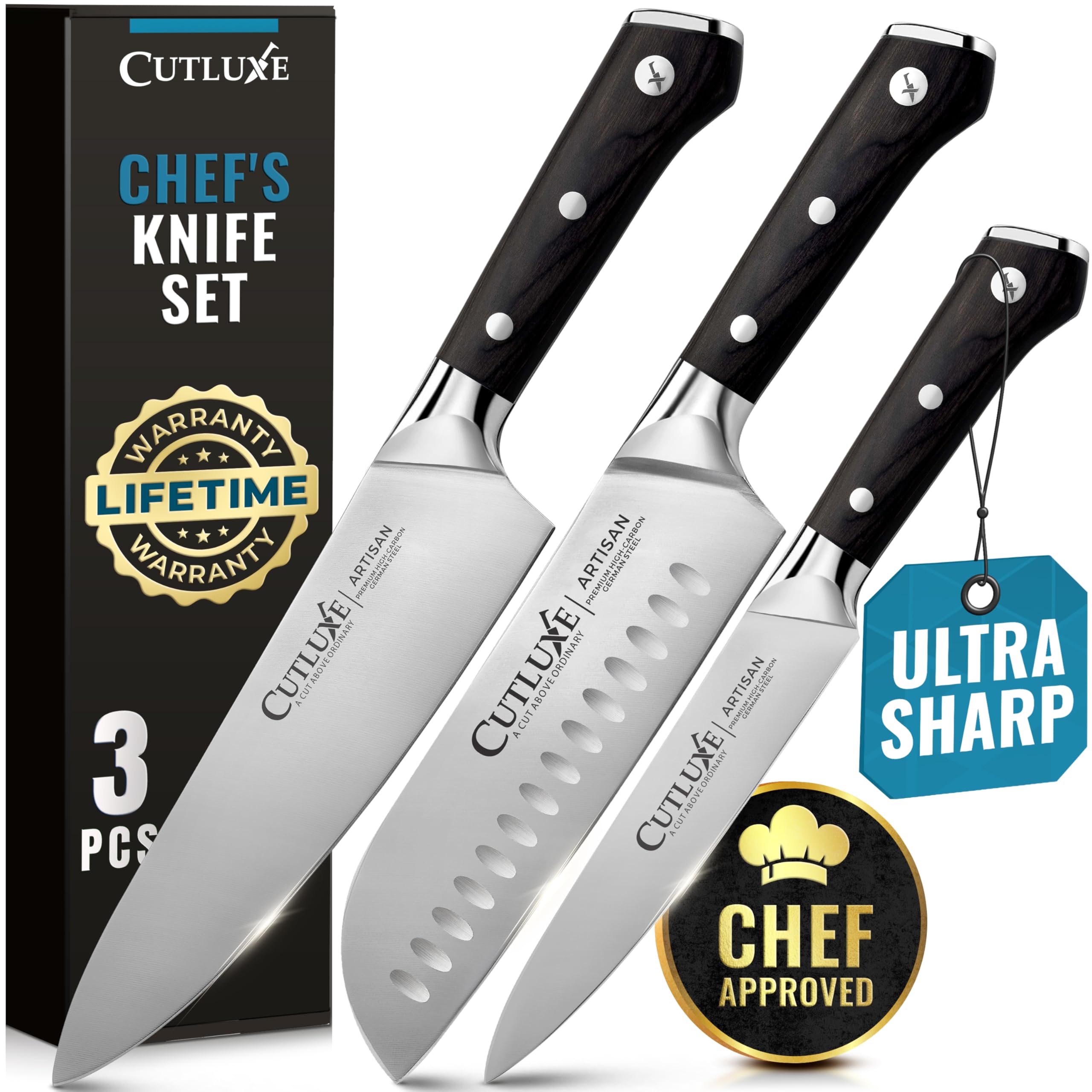
The Cutluxe Artisan Series set includes three German steel knives — an 8-inch chef knife, a 7-inch santoku, and a 5.5-inch utility knife — all forged with a full-tang construction and triple-riveted handles. The blades are hardened to approximately 56-58 HRC, offering a balance of edge retention and toughness that withstands occasional contact with hard ingredients. The chef knife features a moderate belly that supports both rock chopping and push cutting.
The handles are made from premium Pakkawood with a brass rivet detail, giving the set a classic aesthetic that resembles far more expensive cutlery. Each knife is hand-polished to a 15-degree edge per side, and the satin finish helps food slide off during slicing. The set includes an elegant wooden storage block that keeps the knives organized and accessible on the counter. The full-tang design provides balanced weight distribution that helps with control during detailed cuts.
At a budget-friendly price, this set delivers the feel and look of a premium set without the premium steel performance. The 56-58 HRC steel will lose its edge faster than a VG10 core, and the Pakkawood handles require occasional oiling to maintain their color and moisture resistance. For a home cook or a chef building a secondary kit, the Cutluxe set offers strong value in a cohesive three-knife package.
Why it’s great
- Full-tang forged German steel with a classic handle aesthetic
- Includes chef, santoku, and utility knives in a wooden storage block
- 15-degree hand-polished edge delivers good sharpness out of the box
Good to know
- 56-58 HRC steel requires more frequent honing than higher-hardness blades
- Pakkawood handles benefit from occasional mineral oil treatment
FAQ
Why do Japanese chef knives use a higher Rockwell hardness than German knives?
How does a Damascus steel pattern affect the knife’s performance?
What is the ideal blade length for a professional chef knife?
Can a chef knife with a wooden handle be safely used in a commercial kitchen?
How often should a chef’s knife be sharpened compared to honed?
Final Thoughts: The Verdict
For most users, the knives for chefs winner is the Dalstrong Kiritsuke 8.5 inch because its hybrid profile, NSF-certified German steel, and G10 handle deliver professional-grade performance without the fragility of higher-hardness Japanese blades. If you want a razor-sharp VG10 core with artisan craftsmanship, grab the KAWAHIRO Gyuto 8 inch. And for a budget-friendly entry into VG10 Damascus, nothing beats the KYOKU Shogun 8 inch.