Chopping an onion well is the single most common task in any kitchen, yet most cooks grab the wrong blade for the job. A standard chef knife’s curved belly rocks unevenly over a halved onion, often leaving a ragged strip of uncut layers that you have to go back and chase. The right blade geometry—whether a straight-edged nakiri or a granton-edged santoku—makes every slice feel like the knife is doing the work for you.
I’m Mohammad Maruf — the founder and writer behind AirfryerBite. I’ve spent years studying steel composition, edge geometry, and blade profiles to understand exactly how each design interacts with dense allium layers and high-moisture cell structure.
Whether you suffer from teary eyes, sloppy dice, or repetitive stress in your knuckles, the knife for chopping onions you choose determines the entire experience from first cut to final piece.
How To Choose The Best Knife For Chopping Onions
Not every kitchen knife cuts an onion well. The curved blade of a typical chef knife rocks through the first pass but tends to lift off the board at the tail end, leaving a half-millimeter strip of un-sliced onion skin. To avoid that, you need a blade with a flat profile—something that lands the entire cutting edge on the board in one stroke.
Flat Edge Profile vs. Curved Belly
A nakiri knife has a completely straight cutting edge from heel to tip. When you push down, every part of the blade contacts the cutting board simultaneously. This eliminates the “accordion effect” where the last few layers stay attached to the root end. Santoku knives with a granton edge—the dimpled hollows along the blade face—create tiny air pockets that stop wet onion slices from suction-sticking to the steel, giving you cleaner separation per cut.
Steel Hardness and Edge Retention
Onions are abrasive. The cell walls contain microscopic silica-like compounds that dull a soft stainless blade after just a few pounds of product. Look for a blade rated at 58 HRC or higher. VG-10 core steel at 60 HRC holds its edge roughly four times longer than a basic 55 HRC German stainless. That means you re-sharpen less often and get consistent thin slices every time you pull the knife out.
Knuckle Clearance and Handle Comfort
When you grip the handle, your knuckles should sit at least 1.5 inches below the spine of the blade. A tall nakiri blade—typically 2 inches or more from spine to edge—gives your knuckles room to clear the cutting board. If the blade is too short, you’ll bash your knuckles against the board on every downward stroke. Slippery onion juices also demand a handle with textured grip; Santoprene or G10 handles stay secure even when your hands are wet.
Quick Comparison
On smaller screens, swipe sideways to see the full table.
| Model | Category | Best For | Key Spec | Amazon |
|---|---|---|---|---|
| Mercer Culinary M20907 Nakiri | Mid-Range | Budget-conscious cooks wanting a true flat edge | 7″ high-carbon German steel, Santoprene handle | Amazon |
| Mercer Culinary M23590 Santoku | Mid-Range | All-purpose onion dicing with granton edge | 7″ forged high-carbon steel, granton edge | Amazon |
| KYOKU Shogun 8″ Chef Knife | Mid-Range | Precision cuts with Damascus VG-10 core | 8″ VG-10 Damascus blade, 58-60 HRC | Amazon |
| Dalstrong Nakiri 7″ | Premium | Serious home chefs wanting NSF-certified durability | 7″ German high-carbon steel, G10 handle, NSF | Amazon |
| Yoshihiro VG10 Nakiri 6.5″ | Premium | Traditional Japanese vegetable prep | 6.5″ VG-10 Damascus, hammered finish | Amazon |
| WÜSTHOF Classic Santoku 7″ | Premium | High-volume commercial onion prep | 7″ forged high-carbon stainless, 58 HRC | Amazon |
| Shun Premier Blonde Nakiri 5.5″ | Premium | Specialty vegetable slicing with heirloom finish | 5.5″ VG-MAX Damascus, 16° edge angle | Amazon |
In-Depth Reviews
1. Mercer Culinary M20907 Genesis 7-Inch Nakiri Vegetable Knife

The Mercer Genesis Nakiri is the most practical entry point into flat-edge onion chopping. Its high-carbon German steel blade is precision-forged and taper-ground, meaning the edge transitions from thicker at the spine to razor-thin at the cutting surface. When you push down on a halved yellow onion, the full 7-inch straight edge lands flush on the cutting board, leaving zero uncut membrane at the tail end. The Santoprene handle is soft-touch and non-slip even when coated in onion juice—a real advantage when you’re working through five pounds of prep.
The balance point sits directly over the pinch grip area, so the blade feels weightless in your hand. At 4 ounces total weight, this knife encourages rapid chopping without wrist fatigue. The edge arrives sharp enough to slice through an onion skin in a single draw, and the high-carbon steel holds that edge through about three weeks of daily use before needing a quick pass on a honing rod. It is not dishwasher safe—hand washing is required to prevent the Santoprene handle from degrading.
For home cooks who want a dedicated onion knife without stepping into premium pricing, this is the benchmark. The flat profile eliminates the rocking motion you’d use with a chef knife, so you’ll likely find cleaner dice and fewer ragged onion strips from day one. It also handles celery, carrots, and peppers with the same even cut.
Why it’s great
- True flat edge eliminates onion tail hang-ups
- Light 4-ounce weight prevents hand fatigue
- Non-slip Santoprene handle stays secure when wet
Good to know
- Hand wash only; dishwasher damages handle
- Edge needs honing every 2-3 weeks with heavy use
2. Mercer Culinary M23590 Renaissance 7-Inch Santoku Knife

The Mercer Renaissance Santoku introduces a granton edge—those oval dimples along the blade face that create microscopic air pockets. When you slice through a sweet onion, the juices and thin layers try to cling to the steel via suction. The granton dimples break that suction, so each slice falls cleanly away instead of stacking up and tearing. This is the single biggest time-saver for high-volume onion dicing because you rarely have to stop and peel stuck slices off the blade.
The blade is forged from high-carbon German cutlery steel and triple-riveted into a Delrin handle that resists moisture absorption. The rounded spine feels comfortable against the index finger during pinch-grip work. At 0.4 pounds, it carries slightly more heft than the nakiri above, which some cooks prefer for the momentum that helps drive through dense root vegetables like turnips. The edge angle is factory-sharpened to a 20-degree bevel, which balances edge retention with ease of sharpening at home.
If you only want one knife that does everything—onions, herbs, garlic, boneless meat—this santoku is a smarter choice than a nakiri because the slight curve near the tip still allows a limited rocking motion for mincing parsley. The granton edge also makes it excellent for slicing tomatoes without crushing the flesh. Hand washing is required to protect the riveted handle.
Why it’s great
- Granton edge prevents onion slices from sticking
- Triple-riveted Delrin handle resists moisture
- Slight tip curve allows rocking mince motion
Good to know
- Not dishwasher safe; hand wash only
- Heavier than a dedicated nakiri at 0.4 lb
3. KYOKU Chef Knife – 8″ Shogun Series Damascus VG-10

At 8 inches, the KYOKU Shogun is the longest blade in this roundup, and the extra length gives you a longer cutting stroke for halving multiple onions at once. The VG-10 steel core is clad in 67 layers of Damascus stainless, hardened to 58-60 HRC. That hardness level means the edge resists rolling when you slice through paper-thin onion membranes, and the 8-to-12-degree Honbazuke edge angle is sharper than the typical 20-degree Western bevel. The result is a blade that parts onion cells rather than crushing them, which reduces the release of the tear-inducing gas syn-propanethial-S-oxide.
The G10 handle is a glass-fiber laminate that is impervious to moisture, heat, and cold—you can run this handle under hot water without it expanding or cracking. The full-tang construction and mosaic pin give the knife a substantial 1.4-pound feel, which some cooks prefer for the authority it brings to large dice. The included sheath and storage case keep the edge protected when not in use, which matters for VG-10 steel because it is harder to re-sharpen if it chips.
This is the best option if you want a single, dramatic knife that handles onion prep plus meat and fish work. The Damascus pattern also makes it a visual centerpiece on a magnetic strip. Be aware that the 1.4-pound weight may feel heavy for extended onion-dicing sessions; cooks with smaller hands may prefer the lighter Mercer nakiri.
Why it’s great
- VG-10 core at 58-60 HRC for exceptional edge retention
- 8-inch length handles multiple onions per stroke
- Includes sheath and storage case
Good to know
- Heavier than dedicated vegetable knives at 1.4 lb
- Hard steel is more prone to chipping on bones
4. Dalstrong Nakiri Asian Vegetable Knife 7″ – Gladiator Series

The Dalstrong Gladiator Nakiri is NSF-certified, meaning it is built to commercial kitchen sanitation standards. The full-tang German high-carbon steel blade is hand-polished to a 16-to-18-degree edge per side and tempered to 56+ HRC. While 56 HRC is softer than the VG-10 options above, it offers two practical advantages for onion prep: the edge is tougher and less likely to chip if you accidentally hit a cutting board corner, and it is easier to re-sharpen with a standard whetstone or pull-through sharpener.
The blade height is 2 inches from spine to edge, giving you generous knuckle clearance. When you grip the handle, your fingers sit well above the board surface, so you can stack onion halves and cut through with confidence. The black G10 handle is triple-riveted and polished to a sanitary finish that won’t trap bacteria. At 318 grams (roughly 11.2 ounces), it feels substantial without being overly heavy—a good middle ground between the featherlight Mercer and the hefty KYOKU.
The tall blade profile also makes it excellent for scooping chopped onions off the board. You can slide the flat side under the pile and transfer directly to a pan without using a bench scraper. The included sheath protects the edge during drawer storage. Note that the hollow edge—small scalloped divots along the blade—functions similarly to a granton edge to reduce food sticking.
Why it’s great
- NSF-certified for commercial kitchen sanitation
- Tall 2-inch blade gives excellent knuckle clearance
- Hollow edge reduces onion slice sticking
Good to know
- 56 HRC is softer than VG-10; edge dulls faster
- Hand wash only to protect G10 handle
5. Yoshihiro VG10 16 Layer Hammered Damascus Nakiri 6.5″

The Yoshihiro Nakiri is a handmade Japanese vegetable knife that embodies the traditional approach to onion prep. The 6.5-inch blade is shorter than the others here, but the flat cutting edge contacts the entire board surface on every stroke—like a tiny cleaver dedicated to vegetables. The VG-10 core is clad in 16 layers of Damascus stainless with a hammered tsuchime finish. That hammered texture serves a functional purpose: it creates microscopic irregularities that break the surface tension of onion juice, preventing slices from sticking to the blade face.
The western-style handle is carved from mahogany and extends to the full tang for balanced weight distribution. At 6.56 ounces, it is lighter than it looks. The 60 HRC hardness means you can thin the edge down to a very acute angle for maximum sharpness. When you slice through a red onion with this knife, the blade parts the cell walls so cleanly that the onion holds its shape longer before weeping juice. This is a major advantage if you are prepping onions for a raw salad or garnish where appearance matters.
Because it is handcrafted, each knife has slight variations in the Damascus pattern. The edge requires care—use only water whetstones for sharpening, and never cut through bones, nutshells, or frozen foods. The mahogany handle also needs occasional oiling to prevent drying. This is a purpose-built tool that rewards deliberate technique.
Why it’s great
- Hammered finish prevents onion slice adhesion
- 60 HRC VG-10 core holds razor edge
- Handcrafted in Japan with unique Damascus pattern
Good to know
- 6.5-inch blade is shorter than typical nakiri
- Mahogany handle requires periodic oiling
6. WÜSTHOF Classic 7″ Santoku Knife

WÜSTHOF’s Classic Santoku is the workhorse of professional kitchens. It is forged from a single block of high-carbon stainless steel and tempered to 58 HRC, then sharpened using Precision Edge Technology (PEtec) which yields a blade 20 percent sharper than previous WÜSTHOF models. The 7-inch blade features a hollow edge—seven oval divots on each side—that serves the same anti-stick function as a granton edge. When you dice a Vidalia onion, the divots create air cushions that prevent the wet slices from clinging to the blade.
The full bolster and finger guard add safety for cooks who choke up on the blade, and the triple-riveted synthetic handle is virtually indestructible under commercial dishwashing—though WÜSTHOF still recommends hand washing. The balance point sits exactly at the bolster, giving you precise control for fine brunoise cuts. At 85 grams (3 ounces), this is one of the lightest knives in the premium tier, which translates to less fatigue during long prep sessions.
The PEtec edge holds its factory sharpness for months with regular honing. If you are a serious cook who goes through 10 pounds of onions per week, this knife will maintain consistent performance longer than any mid-range option. The downside is the premium cost, but the edge retention and German build quality make it a long-term investment. It also serves as an excellent all-purpose knife for herbs, boneless proteins, and cheese.
Why it’s great
- PEtec edge is 20% sharper with doubled retention
Good to know
- Premium pricing requires serious commitment
7. Shun Premier Blonde 5.5″ Nakiri Knife
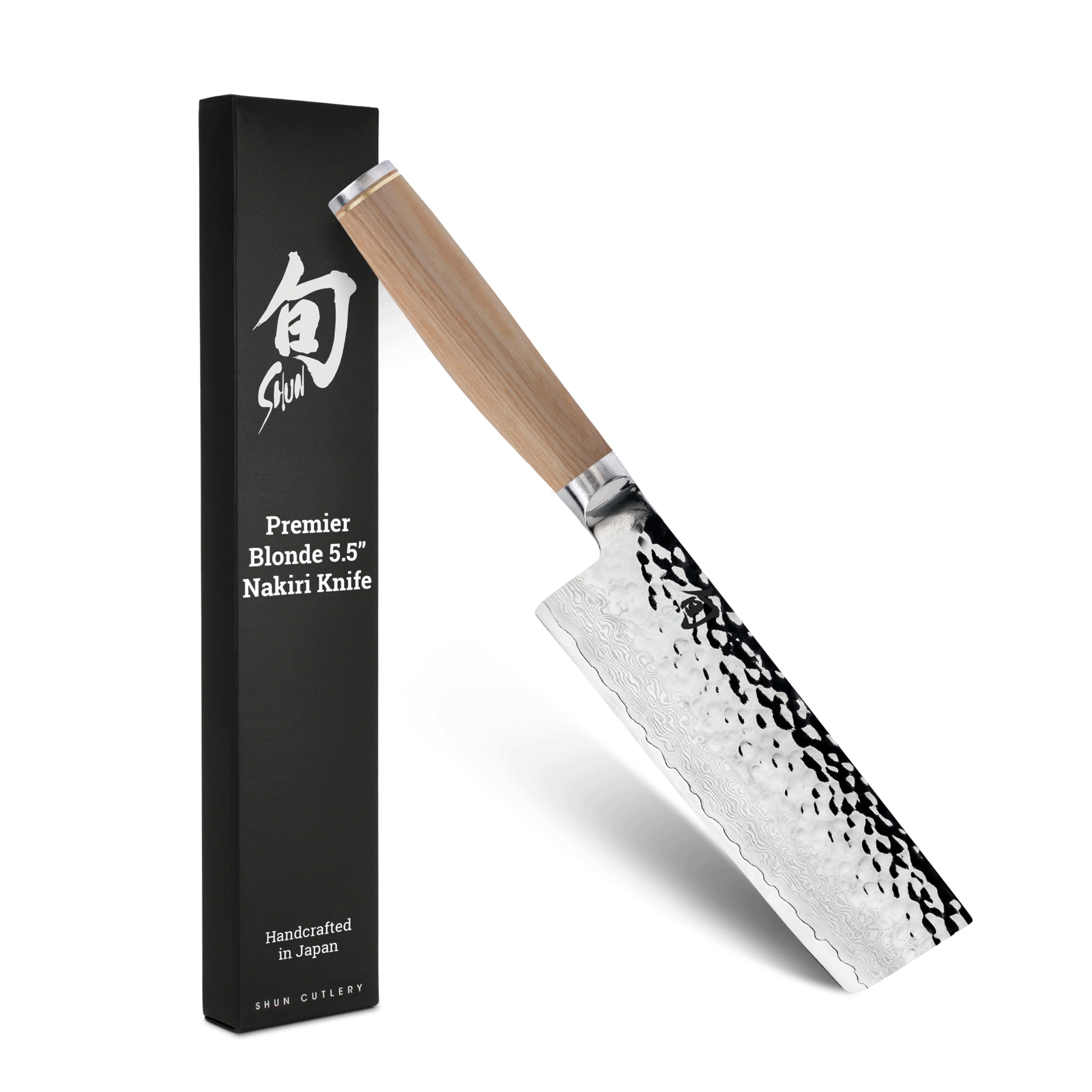
The Shun Premier Blonde Nakiri is the most specialized vegetable knife in this lineup. At 5.5 inches, it is intentionally compact—designed for precise vegetable work rather than general-purpose cutting. The blade uses a VG-MAX core, which is Shun’s proprietary evolution of VG-10 with added vanadium and molybdenum for higher wear resistance. Clad in 68 layers of Damascus stainless steel with a hammered tsuchime finish, the blade is sharpened to a 16-degree edge angle. That acute angle, combined with the hard core, produces the cleanest onion cut in this entire roundup.
The blonde Pakkawood handle is contoured to fit both left and right hands and provides a secure grip even when wet. The hammered finish reduces drag and prevents food from sticking—onion slices fall away from the blade without any clinging. The compact blade length gives you maximum control for fine dice; you can work close to the bolster without the tip wandering. At 9.13 ounces, it is heavier than it looks due to the full-tang construction, but the weight is distributed evenly so it feels balanced in a pinch grip.
Shun offers free sharpening and honing services for the life of the knife, which offsets the premium cost over time. The blade is strictly for vegetables and boneless proteins—never use it on bones, frozen food, or hard squash. The Pakkawood handle should never be submerged in water; wipe it clean with a damp cloth. This is the knife for the cook who views onion prep as a craft rather than a chore.
Why it’s great
- VG-MAX core with 68-layer Damascus cladding
- 16-degree edge for exceptionally clean cuts
- Free sharpening service included
Good to know
- 5.5-inch blade is short for large onions
- Pakkawood handle must not be submerged
FAQ
Is a nakiri knife actually better than a chef knife for onions?
Does a granton edge really stop onion slices from sticking?
What blade hardness is ideal for heavy onion prep?
How do I prevent my onion knife from rusting between uses?
Final Thoughts: The Verdict
For most users, the knife for chopping onions winner is the Mercer Culinary Genesis Nakiri because it delivers a true flat cutting edge, non-slip handle, and sharp high-carbon steel at a price that makes it a no-regret purchase for any home cook. If you want anti-stick granton dimples and a more versatile blade shape for herbs and meat, grab the Mercer Renaissance Santoku. And for the traditionalist who values handcrafted Japanese steel and a hammered finish that repels onion juice, nothing beats the Yoshihiro VG10 Nakiri.