Choose the wrong grain, the wrong wood species, or a board that lacks a proper juice groove, and you’ll accelerate blade dulling, harbor bacteria in deep knife scars, or deal with warping within weeks. The right board, on the other hand, becomes a functional kitchen tool that stays flat, stays clean, and actually extends the life of your chef’s knife.
I’m Mohammad Maruf — the founder and writer behind AirfryerBite. I’ve spent years analyzing wood density ratings, moisture-resistance tests, end-grain vs. edge-grain construction trade-offs, and real-world durability data across the most popular kitchen cutting board brands to separate the kitchen workhorses from the disposable slabs.
This guide breaks down seven of the most thoroughly vetted options on the market, comparing board construction, wood species, thickness, and maintenance needs so you can confidently choose the best wood cutting board for your daily prep routine.
How To Choose The Best Wood Cutting Board
Choosing a wood cutting board comes down to matching the board’s physical construction to your prep volume, knife quality, and maintenance tolerance. The three decisions that carry the most weight are grain orientation, wood species density, and board thickness.
Grain Orientation: End Grain vs. Edge Grain
End-grain boards are built by gluing together blocks of wood so that the cut ends of the wood fibers face upward. This vertical fiber structure absorbs knife impact by letting the blade slide between the fibers rather than shearing through them — meaning your edges stay sharper longer. Edge-grain boards, where the wood fibers run parallel to the surface, are easier to manufacture and more affordable but produce deeper knife marks over time. If you own high-carbon steel knives or Japanese blades, end-grain construction should be your priority.
Wood Species and Hardness
Teak offers excellent moisture resistance and a moderate Janka hardness rating (around 1,000 lbf), making it gentle on blades while resisting warping in humid environments. Acacia clocks in higher (2,300 lbf), providing extreme durability but requiring more frequent oiling to prevent drying. Walnut sits in a sweet spot (~1,010 lbf) with good dent resistance and a naturally warm aesthetic that also hides scratch marks well. Bamboo — technically a grass — is very hard (1,400–1,800 lbf) and eco-friendly but can be harsh on knife edges due to its silica content.
Thickness and Stability
A board thinner than 1.25 inches is vulnerable to bowing, cracking, and shifting on the counter. Look for a thickness of at least 1.5 inches for a stable, heavy slab that stays planted during heavy chopping. Boards 1.7 inches or thicker offer the most mass, the best warp resistance, and a substantial feel that signals long-term quality.
Quick Comparison
On smaller screens, swipe sideways to see the full table.
| Model | Category | Best For | Key Spec | Amazon |
|---|---|---|---|---|
| BABILONIA Black Walnut | End Grain / Premium | Knife‑friendly heavy prep & serving | 1.7 in thick, 19.7×12.2 in | Amazon |
| HOMESTEAD Acacia End Grain | End Grain / Large | Big‑batch meal prep & butchery | 1.5 in thick, 23×18 in | Amazon |
| BEEFURNI Teak 22×16 | Edge Grain / Premium | Versatile reversible prep with carrying ease | 1.25 in thick, teak hardwood | Amazon |
| Yes4All Teak End Grain | End Grain / Mid‑Range | Compact end‑grain performance with juice groove | 1.5 in thick, 17×13 in | Amazon |
| Socisen Teak 3‑Pack | Multi‑Size / Teak | Multi‑tasking with dedicated size for each task | 3 boards, 10/13/17 in lengths | Amazon |
| Socisen Bamboo 3‑Pack | Bamboo / Value | Budget‑friendly set for everyday chopping | 1.0 in thick, 5‑layer bamboo | Amazon |
| GAOMON Giant Bamboo | Oversized / Bamboo | Stove‑top cover & oversize serving | 0.8 in thick, 30×20 in | Amazon |
In‑Depth Reviews
1. BABILONIA Black Walnut Cutting Board
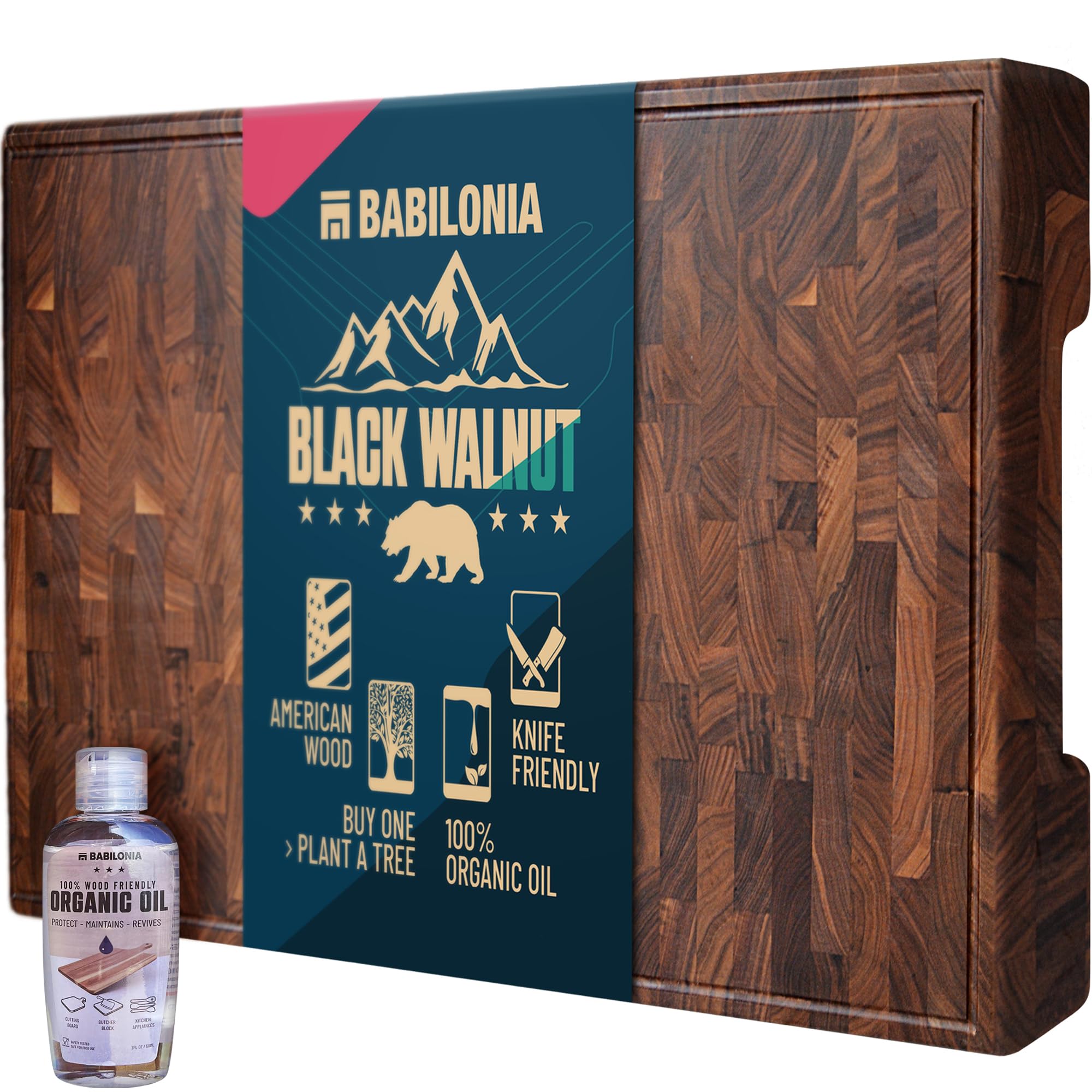
The BABILONIA Black Walnut board uses end-grain construction with a full 1.7-inch thickness, giving it the mass to stay planted under heavy knife work while protecting blade edges through the vertical fiber structure. American black walnut sits at a Janka hardness of around 1,010 lbf — hard enough to resist deep scarring, yet soft enough to avoid excessive blade wear. The 19.7 by 12.2-inch surface includes a juice groove on one side and a hidden handle on the reverse, making it a reversible board that works equally well as a butcher block and a serving tray.
A clever slide-notch detail on one side lets you sweep chopped ingredients directly into a bowl or pan without lifting the board, which is a genuinely useful ergonomic upgrade over standard flat slabs. The board ships pre-oiled and comes with a bottle of organic oil and a stainless steel plate, so you can start prepping immediately without a separate conditioning purchase. The walnut grain pattern is rich and varied, giving each board a distinct look that makes it gift-worthy right out of the box.
Hand wash only — no dishwasher — and BABILONIA recommends oiling every few weeks during the first months of use, then monthly thereafter. The 2-year warranty and Italian brand backing add confidence, though the premium positioning means this board is an investment rather than a budget grab. For cooks who value knife preservation, stability, and a board that transitions from prep to table, this is the strongest all-around choice.
Why it’s great
- End-grain fiber structure notably reduces knife edge wear during daily use
- 1.7-inch thickness delivers exceptional warp resistance and solid counter feel
- Slide-notch design eliminates the need to lift the board for ingredient transfer
Good to know
- Requires regular mineral oil conditioning to maintain moisture balance
- Premium price point reflects the black walnut material and Italian craftsmanship
2. HOMESTEAD End Grain Acacia Cutting Board
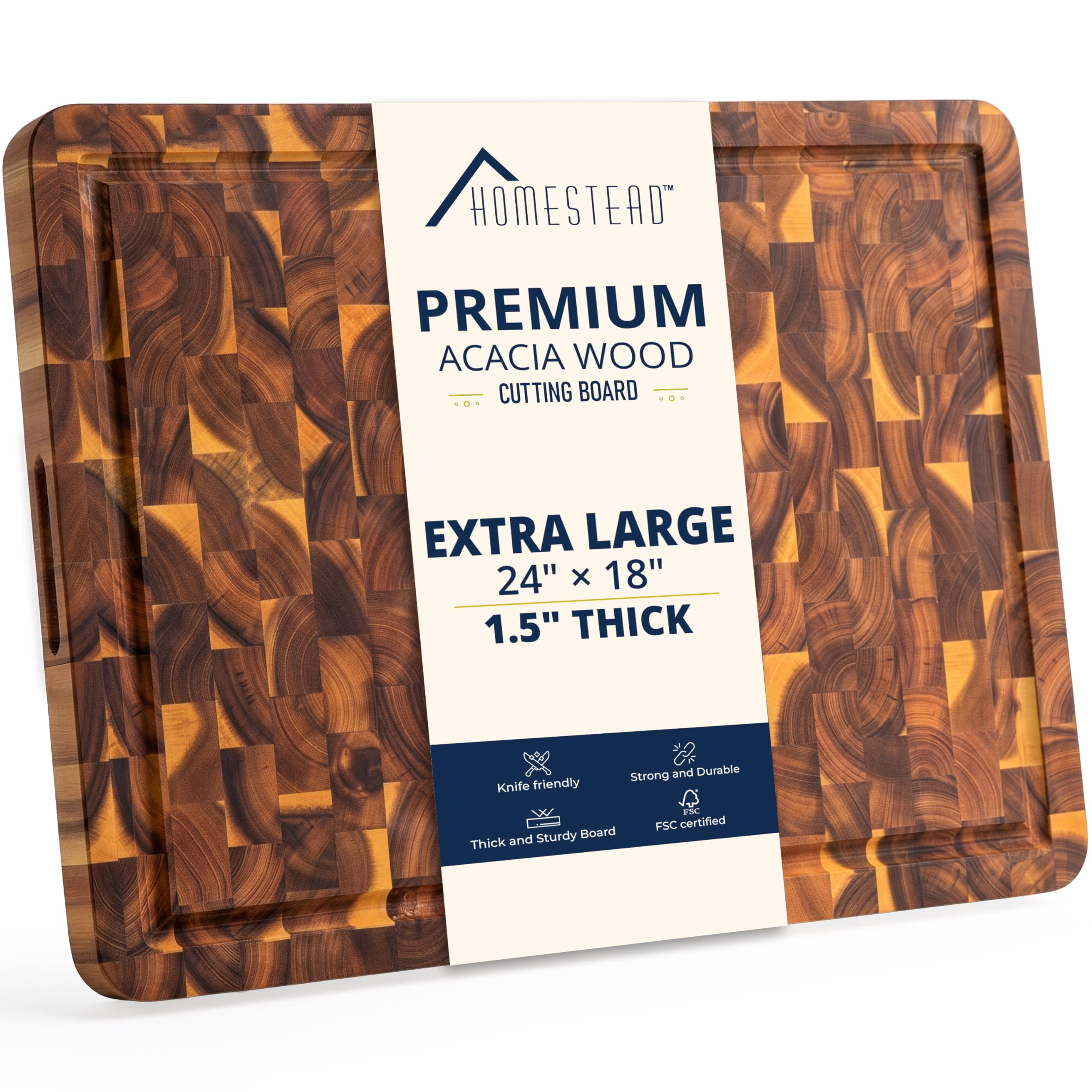
The HOMESTEAD board delivers end-grain construction on a genuinely large footprint — 23 inches long by 18 inches wide at a 1.5-inch thickness. Acacia wood has a Janka rating near 2,300 lbf, making it one of the harder domestic hardwoods used in cutting boards. The end-grain layout compensates somewhat for the wood’s natural hardness, allowing the knife blade to settle between the vertical fibers rather than skidding across the surface. The result is a surface that stands up to heavy butchery and weekly whole-roast prep without warping or showing deep cut lines.
The surrounding juice groove is cut deep enough to handle liquid from a large roast or a watermelon without spilling over the edges. Integrated side handholds make lifting the 23-inch board from counter to sink manageable despite its weight. The acacia grain varies from medium brown to darker striations, giving the board an attractive appearance that works well for serving charcuterie directly at the table. No maintenance kit is included, so you will need to source food-grade mineral oil separately.
At 1.5 inches, the board is heavy enough to stay still during vigorous chopping, but not so heavy that moving it becomes a two-person job. Hand washing and monthly oiling are required — acacia’s density means it can dry out and crack if neglected. This board is best suited for cooks who frequently prep large quantities and want a single, oversized end-grain slab that can handle both raw meat breakdown and final presentation.
Why it’s great
- Very large 23×18 inch surface accommodates whole roasts and large meal prep batches
- End-grain structure reduces blade dulling compared to standard edge-grain acacia boards
- Deep juice groove effectively captures drippings from meat and high-moisture produce
Good to know
- Acacia wood requires consistent monthly oiling to prevent cracking from moisture loss
- No maintenance oil or care kit is provided with the purchase
3. BEEFURNI Teak Cutting Board 22×16

The BEEFURNI Teak board is an edge-grain slab made from 100% Southeast Asian teak — a species prized for its natural oil content that repels moisture and resists bacterial absorption better than most other hardwoods. At 22 by 16 inches with a 1.25-inch thickness, it provides generous prep real estate without the extreme weight of a full end-grain butcher block. The board is reversible: one side is flat for general chopping, and the other side includes a slim juice groove for carving meats. Carved hand grips on both long edges make it easy to carry from kitchen counter to tabletop for serving.
BEEFURNI includes a free maintenance kit with 1 ounce of food-grade oil and 320-grit sandpaper, which is a welcome inclusion that removes the guesswork from initial board conditioning. The teak’s natural golden-brown color and straight grain patterns give it a clean, premium look that ages well as the oil darkens the wood over time. Because teak contains its own natural oils, it requires less frequent conditioning than acacia or bamboo — a light oiling every few months is usually enough to keep the board hydrated.
The edge-grain surface will show knife marks faster than an end-grain board, but the teak’s moderate hardness (around 1,000 Janka) means those marks stay shallow and can be sanded out during routine maintenance. Hand wash only, and avoid leaving the board submerged. This is the right choice for cooks who want a large teak board with built-in carrying convenience, a reversible design, and a free care package to get started.
Why it’s great
- Teak’s natural oil content provides superior moisture resistance with less frequent oiling needed
- Carved side handles make moving the 22-inch board between kitchen and table effortless
- Free mineral oil and sandpaper kit included, ready for immediate use
Good to know
- Edge-grain construction shows visible knife marks sooner than end-grain alternatives
- 1.25-inch thickness is adequate but less warp-resistant than 1.5-inch-plus boards
4. Yes4All End Grain Teak Cutting Board
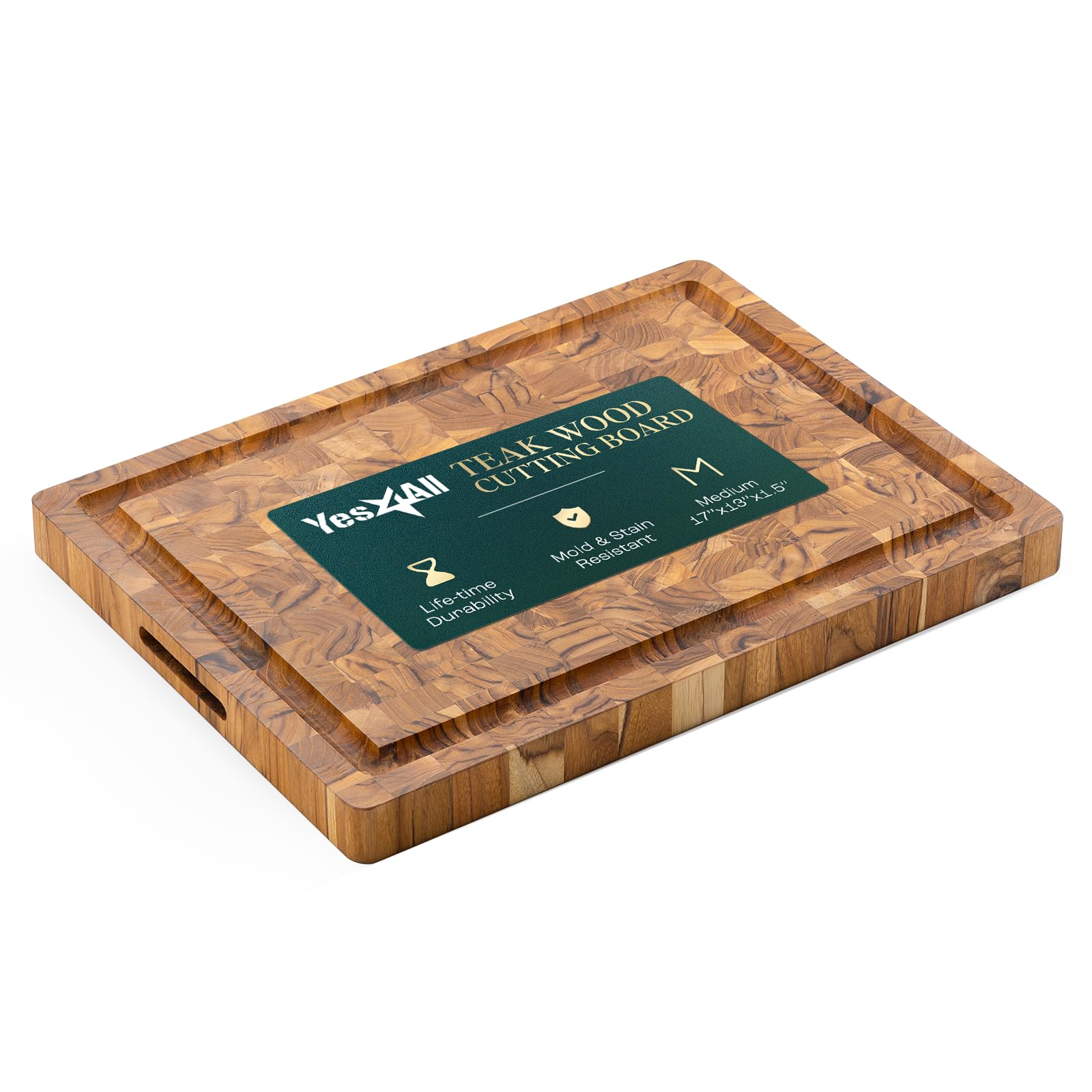
Yes4All brings genuine end-grain construction to a more manageable footprint — 17 by 13 inches at a full 1.5-inch thickness — using teak wood as the base material. The end-grain blocks are assembled into a checkerboard-like pattern that gives the board a premium butchers-block look while keeping the weight reasonable for daily handling. The board is pre-oiled with food-grade oil, so it arrives ready to use without an initial conditioning treatment. A perimeter juice groove channels liquid away from the cutting area, and built-in handhold cutouts on two sides simplify lifting.
At 8.3 pounds, this board is heavy enough to stay stationary during active chopping but light enough to move between counter and sink without strain. The teak’s natural grain varies from light golden to deeper amber tones, and the end-grain pattern creates a distinctive, high-end appearance that stands out compared to uniform edge-grain slabs. The 1.5-inch thickness provides good thermal and impact insulation, which reduces the risk of warping over time even in kitchens with fluctuating humidity.
The board is not reversible — the juice groove is cut into the top face, and the bottom is flat with no groove. That is a minor limitation for cooks who like to flip the board for raw and cooked prep separation. Hand washing and periodic oiling are required. For cooks who want end-grain performance without dedicating a full 22-inch slab of counter space, this Yes4All teak board is a well-proportioned mid-range option.
Why it’s great
- True end-grain teak construction at a 1.5-inch thickness protects knife edges effectively
- Compact 17×13 inch footprint fits smaller kitchens while still offering generous work area
- Pre-oiled and ready to use immediately with included juice groove for liquid capture
Good to know
- Not reversible — juice groove is only on one side, limiting dual-purpose use
- Teak end-grain boards require regular oiling to maintain the block structure
5. Socisen Teak Wood Cutting Board 3-Pack
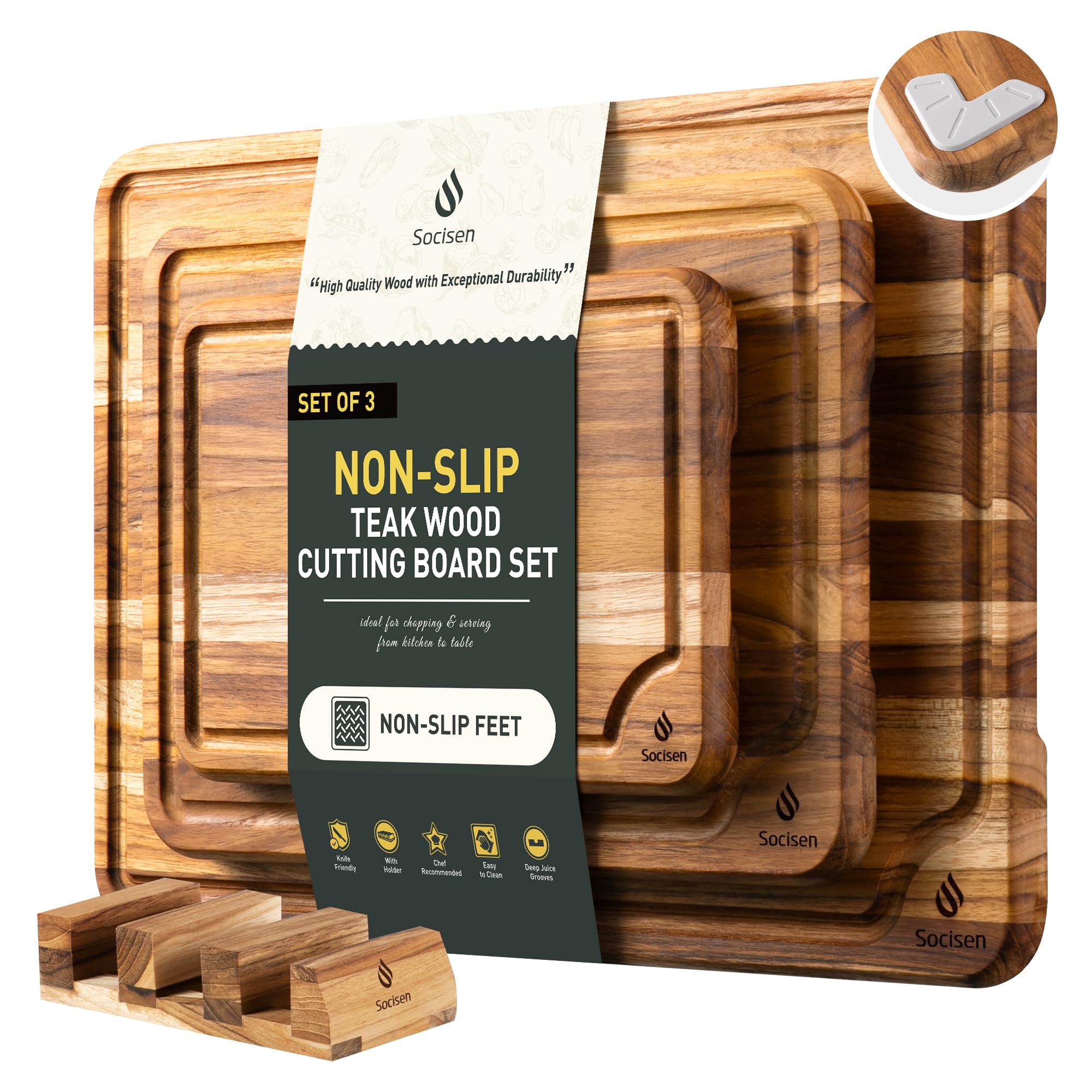
The Socisen Teak set provides three boards — 10, 13, and 17 inches long — all made from FSC-certified teak wood with a non-slip rubber base on each board. The teak construction offers the same moisture resistance as single-board teak options, and the multiple sizes allow you to dedicate one board to raw meat, one to vegetables, and one to fruit or bread without cross-contamination. The 17-inch board is 12 inches wide, giving it a usable surface similar to a standard mid-range cutting board for larger prep tasks.
The boards are edge-grain, not end-grain, which means they will show knife marks over time, but the teak’s natural hardness provides decent resistance to deep scarring. Each board includes rounded edges for comfortable handling, and the set comes with a wooden stand for vertical storage that keeps air circulating around the boards and prevents moisture buildup. A juice groove runs along the perimeter of the larger two boards, though the smallest board is flat — acceptable given its intended use for quick tasks like slicing lemons or cheese.
Hand washing is required, and the teak benefits from occasional oiling to maintain its color and moisture barrier. The set is a practical solution for cooks who want designated boards for different food groups without buying separate premium slabs. The included stand keeps the counter organized and the boards dry. For the price of a single large end-grain board, you get three dedicated teak surfaces plus storage.
Why it’s great
- Three teak boards allow dedicated surfaces for meat, vegetables, and fruit to prevent cross-contamination
- FSC-certified teak sourced from responsibly managed forests
- Includes wooden stand for vertical storage that promotes airflow and drying
Good to know
- Edge-grain construction shows knife marks faster than end-grain boards
- Smallest board (10 inches) lacks a juice groove, limiting its use for juicy produce
6. Socisen Bamboo Cutting Board 3-Pack

The Socisen Bamboo set uses a 5-layer laminated bamboo construction at a total thickness of 2.8 inches (the combined layering, not a single slab). Each board is FSC-certified and fitted with non-slip rubber feet that keep the board stable on smooth countertops. The set includes three rectangular boards at graduated sizes — the largest being 17 by 12 inches — which covers the same multi-use, zone-dedicated workflow as the teak version at a lower entry point. Bamboo’s Janka hardness sits around 1,400–1,800 lbf, making it significantly harder than teak or walnut.
The boards are hand-sanded and pre-finished with food-grade mineral oil, ready for immediate use. The surface is smooth with no burrs or splinters, and the rounded edges provide a comfortable grip during transfer. Bamboo’s hardness means these boards will resist deep cut marks well, but the silica content in bamboo can accelerate blade dulling compared to teak or walnut surfaces. If you use high-end knives, this is a trade-off worth noting.
Hand wash only, and regular oiling helps prevent the bamboo from drying and splitting over time. The non-slip rubber feet are a genuine safety upgrade — the boards stay put even during aggressive chopping. For budget-conscious shoppers who need multiple boards for different prep zones, this set delivers good utility per board. Knife edge wear is the only real compromise here.
Why it’s great
- Affordable 3-board set provides dedicated prep surfaces for different food types
- Non-slip rubber feet keep each board stable during use on any counter surface
- FSC-certified bamboo with 5-layer laminated construction resists warping effectively
Good to know
- Bamboo’s silica content can dull knife edges more quickly than teak or walnut
- Regular mineral oil conditioning is required to prevent bamboo from drying and cracking
7. GAOMON Extra Large Bamboo Cutting Board

The GAOMON board is a 30 by 20-inch bamboo slab at 0.8-inch thickness — an intentionally thin profile that serves multiple roles beyond chopping. It functions as a cutting board, a stove-top cover for small kitchens without enough counter space, a sink cover, a noodle rolling board, and a large charcuterie serving platter. The four-sided juice groove captures liquid from meats and fruit, and the board is fully reversible, with the second side offering a flat surface for dough rolling or pastry work.
Bamboo at this thin profile (0.8 inches) is not built for heavy butchery or forceful cleaver work — the board will flex under extreme impact and is more prone to warping than thicker slabs. The surface ships pre-sanded and smooth, with no visible glue lines in the bamboo strips. The large surface area is genuinely useful for rolling pasta, assembling large charcuterie spreads, or creating temporary counter space in a cramped RV or apartment. The board weighs 5.65 kilograms (about 12.5 pounds), which is manageable given its size.
Hand wash only and store vertically or flat in a dry area. The thin construction means moisture causes warping faster than thicker boards, so drying both sides after washing is essential. This is a specialty tool for kitchens that lack counter space and need a multi-surface solution, not a primary chopping board for heavy daily knife work.
Why it’s great
- Oversized 30×20 inch surface doubles as a stove-top or sink cover for small kitchens
- Reversible design with juice groove on one side and flat surface on the other
- Versatile enough for chopping, serving charcuterie, rolling dough, and table presentation
Good to know
- 0.8-inch thickness lacks the mass and warp resistance needed for heavy daily chopping
- Bamboo material at this thin profile is not suitable for heavy butchery or cleaver work
FAQ
How often should I oil my wood cutting board?
Can I put a wood cutting board in the dishwasher?
What is the difference between end-grain and edge-grain cutting boards?
Which wood species is best for a cutting board — teak, walnut, acacia, or bamboo?
Final Thoughts: The Verdict
For most users, the wood cutting board winner is the BABILONIA Black Walnut Cutting Board because its end-grain construction, 1.7-inch thickness, and thoughtful slide-notch design deliver the best balance of knife protection, stability, and serving versatility. If you want a massive surface that doubles as a stove-top cover for small kitchens, grab the HOMESTEAD Acacia End Grain Board. And for a budget-friendly multi-board set that keeps raw and cooked prep separate, nothing beats the Socisen Teak 3-Pack.