A commercial toaster is the backbone of any breakfast service, but choosing between a pop-up and a conveyor model means understanding real throughput numbers, not just marketing claims. The wrong pick leaves you with burnt bagels at peak rush or a machine that can’t keep pace with your morning crowd.
I’m Mohammad Maruf — the founder and writer behind AirfryerBite. I analyze commercial-grade kitchen hardware by breaking down specs like slices-per-hour, heating element configurations, and build materials to find the real workhorses for high-demand environments.
After comparing throughput rates, slot widths, and heating patterns across nine units, we have identified the models that genuinely earn the title of best commercial toaster for busy kitchens.
How To Choose The Best Commercial Toaster
Selecting a commercial toaster comes down to two major factors: the volume of toast you need per hour and the type of bread products you serve. A high-volume diner needs a conveyor toaster pushing 300 slices per hour, while a cafe with counter space constraints may prefer a four-slot pop-up that fits on a tight shelf.
Throughput Rate and Slot Width
Throughput rates range from 150 to 450 slices per hour. Pop-up toasters with four slots typically deliver around 220 slices per hour, while conveyor models start at 150 and go up past 450. Slot width matters more than you think — a 1.375-inch slot handles thick bagels and artisan bread without forcing them in, while 1.25-inch slots work best for standard sandwich bread. Self-centering racks ensure even browning on both sides of irregularly shaped items.
Heating Element Configuration
Conveyor toasters use either radiant or quartz heating elements. Radiant elements are more durable and better for high-volume toasting of standard bread. Quartz elements heat up faster and produce more even browning but are more fragile. The best units have independently controlled top and bottom elements so you can toast bagels (top heat only) or buns (bottom heat only) without burning one side.
Build Quality and Certifications
Commercial kitchens require NSF and UL certifications for safety and sanitation. Brushed stainless steel resists fingerprints and corrosion better than standard stainless. Look for removable crumb trays that slide out without tools — daily cleaning is non-negotiable in a health-inspected kitchen. Heavy-duty power cords and cool-touch side panels are additional signs of pro-grade construction.
Quick Comparison
On smaller screens, swipe sideways to see the full table.
| Model | Category | Best For | Key Spec | Amazon |
|---|---|---|---|---|
| Waring CTS1000 | Conveyor | High-volume kitchens | 450 slices/hour | Amazon |
| Winco ECT-300 | Conveyor | Mid-volume restaurants | 300 slices/hour | Amazon |
| Hatco TPT-120 | Pop-Up | Compact countertops | 4 self-centering slots | Amazon |
| PYY 300pcs/h | Conveyor | Bagel-heavy bakeries | 300 slices/hour | Amazon |
| SUCISENI TT-300 | Conveyor | Versatile baking patterns | 3 heating modes | Amazon |
| APW Wyott AT Express | Conveyor | Tight counter spaces | 300 slices/hour | Amazon |
| PYY 150pcs/h | Conveyor | Small cafes | 150 slices/hour | Amazon |
| Waring WCT708 | Pop-Up | Budget-conscious diners | 225 slices/hour | Amazon |
| KETIAN KT-01U | Smart Pop-Up | Tech-forward kitchens | LCD touchscreen | Amazon |
In‑Depth Reviews
1. Waring Commercial CTS1000
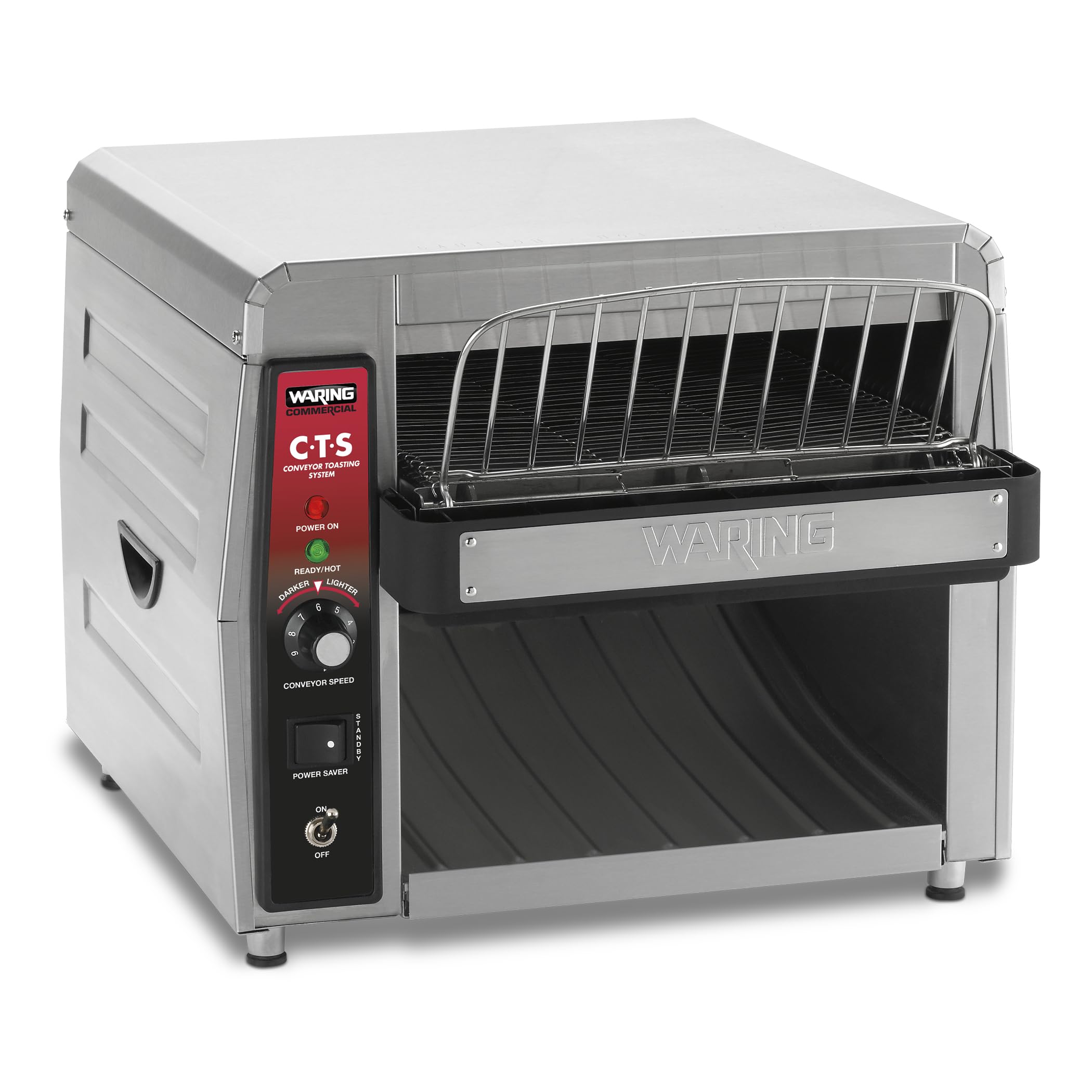
The Waring CTS1000 is the benchmark for high-output conveyor toasters in serious commercial kitchens. With a throughput of 450 slices per hour and a brushed stainless steel body, this unit is built to handle the breakfast rush at hotels, large cafeterias, and fast-casual chains. The 1800W heating system and 9 speed settings give you fine control over the conveyor belt speed and toasting level.
POWER ON and READY indicator lights eliminate guesswork, while cool-touch side panels improve safety in tight workspaces. The compact footprint (19 by 16 by 16.5 inches) fits on standard countertops without dominating the surface. UL and NSF certifications mean it meets the highest safety and sanitation standards required by health inspectors.
The included front and rear catch trays make cleanup straightforward, and the heavy-duty construction handles daily commercial use without degrading performance. For any operation that needs to crank out hundreds of perfectly browned slices every morning, this is the machine to beat.
Why it’s great
- Industry-leading 450 slices per hour throughput
- NSF and UL certified for commercial compliance
- Cool-touch side panels enhance counter safety
Good to know
- Premium investment suitable for high-volume operations only
- Heavier than some conveyor competitors at 27.9 pounds
2. Winco ECT-300 Commercial Conveyor Toaster
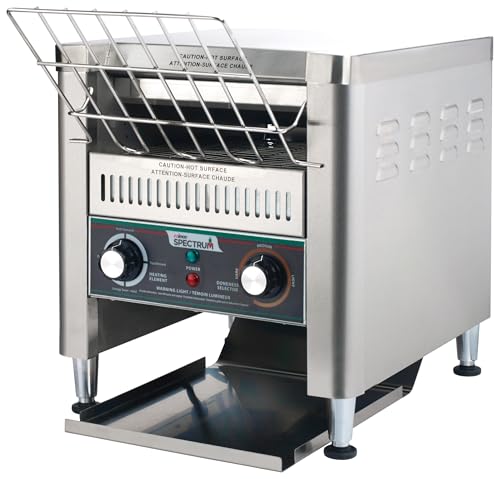
The Winco ECT-300 delivers a solid 300 slices per hour in a conveyor design that suits mid-volume restaurants, bakeries, and coffee shops. Its variable speed dial lets you fine-tune belt speed for precise doneness, while the independent top and bottom heating elements — controlled by a three-position dial — allow you to toast bagels with only top heat or buns with only bottom heat.
The all-stainless steel body and heavy-duty heating elements are built for daily commercial use. The 15-slot conveyor accepts a wide variety of bread shapes and sizes, from standard sandwich bread to thick bagels and croissants. The dimensions (17.52 by 21.65 by 18.7 inches) require a moderate amount of counter space but are still within reason for most commercial setups.
This model sits at a reasonable price point for the 300-slice-per-hour capacity, making it a strong contender for operations that need conveyor reliability without the highest-end price tag. The three-position heating dial adds flexibility that pop-up toasters simply cannot match.
Why it’s great
- Independent top and bottom heating for bagel mode
- Variable speed dial for precise browning control
- Stainless steel construction withstands daily use
Good to know
- No cooling rack or keep-warm zone built in
- Conveyor belt may require periodic tension adjustment
3. Hatco TPT-120 4-Slot Pop-Up Toaster
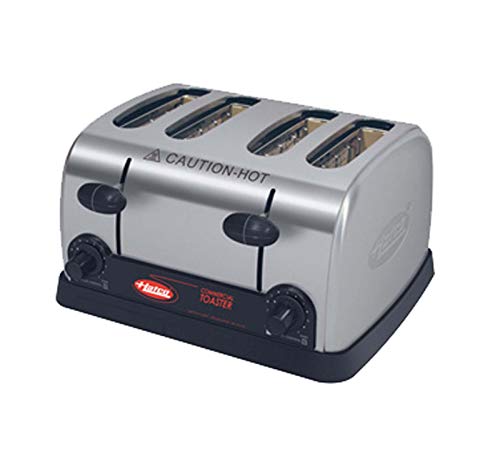
The Hatco TPT-120 is a compact four-slot pop-up toaster that fits easily into tight countertop spaces while still delivering 220 slices per hour. Each of the 1.25-inch wide slots has self-centering racks that grip bread evenly, ensuring consistent browning on both sides even when toasting irregularly shaped bagels or artisan breads.
Individual manual controls for each slot pair give you flexibility to run different doneness levels simultaneously. The removable crumb tray slides out for quick cleaning without moving the toaster. At just 8.12 inches tall and 13.43 inches wide, this unit is ideal for cafes or deli counters where every inch of workspace matters.
cULus and UL EPH certifications confirm the Hatco meets commercial safety standards. The 1440W heating system is adequate for steady morning output, though it cannot match conveyor speeds during peak rushes. For operations that prioritize a small footprint over maximum throughput, this pop-up is a reliable choice.
Why it’s great
- Self-centering slots ensure even browning on bagels
- Compact dimensions save valuable counter space
- cULus certified for commercial safety compliance
Good to know
- 220 slices per hour is fine for low-to-mid volume
- Plastic housing components feel less robust than full steel
4. PYY Commercial Conveyor Toaster 300pcs/h
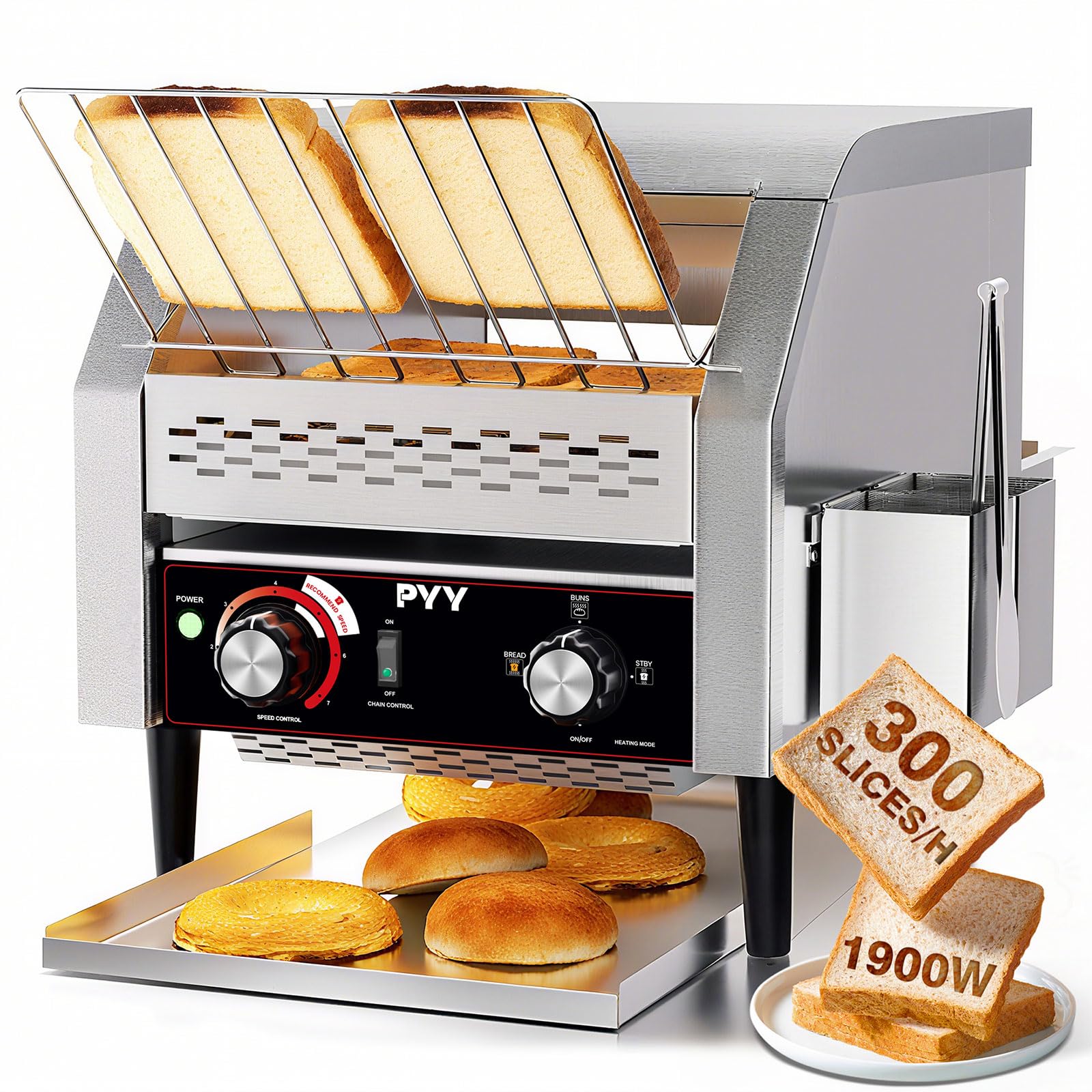
The PYY 300-pieces-per-hour conveyor toaster offers a solid balance of throughput and affordability for bakeries, buffets, and larger cafes. The heavy-duty stainless steel body resists corrosion, while the food-grade chain net conveyor delivers bread smoothly through the heating chamber. Seven speed options give you fine control over browning levels, from lightly golden to deeply crisped.
A standout feature is the front/rear output chute, letting you dispense toast from either side depending on your kitchen layout. The 21.45 by 18.7 by 17.12-inch footprint is reasonable for a conveyor model, and the four non-slip feet keep the unit stable during operation. The removable crumb tray makes daily cleaning manageable.
This toaster handles bagels, bread, donuts, and buns with equal ease. The compact design fits on most standard countertops without dominating the space. For operations that need 300 slices per hour without jumping to premium-tier pricing, the PYY delivers dependable performance.
Why it’s great
- Front and rear output chutes for flexible kitchen layouts
- Food-grade chain net ensures smooth bread delivery
- Seven speed settings for precise browning control
Good to know
- Heavier unit at 41.6 pounds for its size
- Heating elements may require more time to reach full temp
5. SUCISENI TT-300 Commercial Toaster

The SUCISENI TT-300 brings versatility with three distinct heating patterns: STBY for low-temperature toasting with both upper and lower tubes, BUNS mode using only the upper tube for gentle top browning, and BREAD mode for high-temperature baking with both tubes active. This flexibility makes it ideal for kitchens that serve bagels, buns, croissants, and waffles from the same machine.
The 1900W power output delivers fast recovery times during heavy use, and the seven speed adjustments on the conveyor belt let you dial in the exact color you want. Polished stainless steel surfaces resist oil and dust buildup, while rear vents keep internal temperatures under control. Four adjustable-height non-slip feet accommodate uneven countertops.
This unit processes up to 300 slices per hour, matching the throughput of higher-priced competitors. The one-year warranty and 24-hour customer support add peace of mind for first-time commercial toaster buyers. For kitchens that need both volume and versatility in one machine, the TT-300 is a strong mid-range option.
Why it’s great
- Three distinct heating patterns for different foods
- 1900W power for fast heat recovery
- Adjustable feet for uneven counter surfaces
Good to know
- No built-in keep-warm function
- Polished finish shows fingerprints more than brushed steel
6. APW Wyott AT Express Radiant Conveyor Toaster

The APW Wyott AT Express is designed for tight counter spaces without sacrificing output, producing over 300 slices per hour from a compact frame. Its radiant heating system delivers consistent browning across the full width of the conveyor, while the variable speed control lets you adjust belt speed to match your desired doneness.
A unique advantage is the keep-warm zone that holds toast at serving temperature until it reaches the end of the conveyor, so you can batch-toast during a rush without items getting cold. The stainless steel construction and cool-touch exterior improve both durability and safety in busy kitchens. At only 14 pounds, this is one of the lightest conveyor models available.
The compact dimensions — designed specifically to fit into tight counter areas — make it a favorite for food trucks, small cafes, and buffet lines where space is at a premium. Variable speed control ensures you can switch between bagel and bread settings without a learning curve.
Why it’s great
- Keep-warm zone maintains serving temperature
- Lightweight at 14 pounds for easy placement
- Variable speed for precise browning control
Good to know
- Radiant elements heat up slower than quartz
- No separate top/bottom heating controls
7. PYY Commercial Conveyor Toaster 150pcs/h
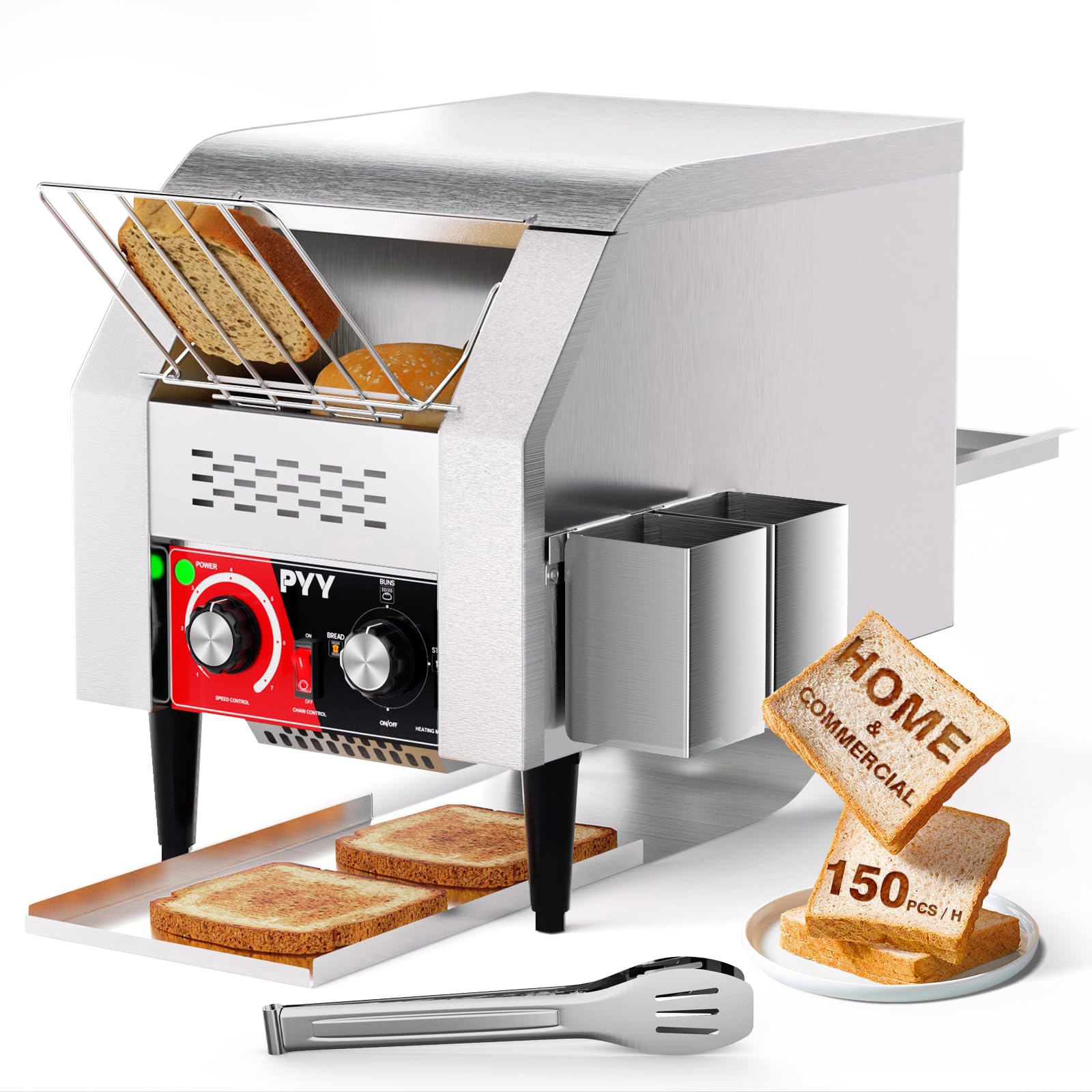
The PYY 150-pieces-per-hour conveyor toaster is an entry-level commercial unit that brings conveyor reliability to smaller operations. With seven speed options and a front/rear output chute, it offers the same layout flexibility as larger PYY models but at a lower throughput that matches the pace of a small cafe or office cafeteria.
The heavy-duty stainless steel body provides corrosion resistance, while the food-grade chain net prevents sticking during continuous operation. Four non-slip feet keep the 37-pound unit stable on any countertop. The removable crumb tray simplifies daily cleaning, and the air vents are positioned for effective heat dissipation during extended use.
This toaster handles bagels, bread, donuts, and buns, making it versatile enough for limited menus. The 150 slices per hour rating is sufficient for breakfast service at a small diner or hotel breakfast bar without overwhelming the counter space or the electrical circuit.
Why it’s great
- Front and rear output chutes for flexible kitchen layout
- Seven speed options for adjustable browning
- Heavy-duty stainless steel resists corrosion
Good to know
- 150 slices per hour may not keep up with peak rushes
- Chain net may require occasional lubrication
8. Waring WCT708 Four-Compartment Pop-Up Toaster

The Waring WCT708 is a four-compartment pop-up toaster that delivers 225 slices per hour at a budget-friendly entry point. Each of the four extra-wide 1.375-inch slots accommodates thick bagels, artisan bread, and English muffins without squeezing. Self-centering bread racks hold items upright for even browning on both sides.
The brushed stainless steel body is durable enough for light commercial use in diners, bed-and-breakfasts, or office break rooms. Electronic browning control with six settings provides enough range to handle different bread types and preferences. The removable crumb tray makes cleanup quick, though the toaster lacks some of the premium build features of higher-end competitors.
At 7.5 pounds and with a compact footprint, the WCT708 is easy to move and store. It is best suited for low-to-mid volume settings where an entry-level price point is the priority. For operations that cannot justify the cost of a conveyor system, this pop-up provides reliable morning output without the complexity.
Why it’s great
- Extra-wide 1.375-inch slots for thick bagels
- Self-centering racks ensure even browning
- Affordable entry point for commercial toasting
Good to know
- Brushed steel body feels less heavy-duty than other models
- 225 slices per hour is the low end of commercial throughput
9. KETIAN Touch Screen 2 Slice Smart Toaster

The KETIAN KT-01U is a two-slice smart toaster with a 5-inch full-vision LCD touchscreen that sets it apart from traditional commercial pop-ups. The fully automatic smart system features leverless automatic lifting, and each of the four heating panels can be individually controlled to work independently for custom toasting patterns.
The 1400W power output shortens toasting time by roughly 50 percent compared to standard residential toasters, making it suitable for a boutique cafe or hotel kitchen that values precision over mass throughput. Seven custom time settings let you program your preferred doneness and save it for repeatable results. The stainless steel construction gives it a modern, clean look that matches contemporary kitchen designs.
While this unit is not designed for high-volume commercial use like a conveyor toaster, it offers exceptional control for operations that serve a limited number of specialty toast items. The KETIAN is ideal for tech-forward kitchens that want consistent, customizable results with a modern interface.
Why it’s great
- Individual heating panel control for custom browning
- 5-inch LCD touchscreen with automatic lifting
- 1400W for faster toasting than standard home models
Good to know
- Two-slot design limits throughput for busy commercial kitchens
- Touchscreen requires careful cleaning to avoid damage
FAQ
What is the difference between a pop-up and a conveyor commercial toaster?
How many slices per hour does my restaurant need?
Do I need NSF certification for a commercial toaster?
Can I use a residential toaster in my commercial kitchen?
Final Thoughts: The Verdict
For most users, the best commercial toaster winner is the Waring Commercial CTS1000 because it delivers the highest throughput at 450 slices per hour with NSF certification and cool-touch safety features. If you want precise bagel and bun control in a mid-volume setting, grab the Winco ECT-300. And for compact spaces that still need 300 slices per hour, nothing beats the APW Wyott AT Express with its keep-warm zone and lightweight design.